Genes Before Gods: Reconstructing Ancient India Through Genetics Part 4
How Three Ancient Populations Wrote the First Chapter of Indian Civilization
Genes Before Gods: Reconstructing Ancient India Through Genetics Part 4
How Three Ancient Populations Wrote the First Chapter of Indian Civilization
“India was not born in a single moment. It was assembled, one migration at a time.”
Every Civilization Begins With a Question
For more than a century, historians argued about the origins of Indian civilization.
- Some imagined a single indigenous civilization that simply evolved in place.
- Others proposed dramatic invasions sweeping across the subcontinent.
- Still others suggested waves of migrations extending over thousands of years.
Each theory drew support from language, archaeology or ancient texts. Each contained strengths. Each contained weaknesses.
Then, almost unexpectedly, genetics entered the conversation. Not to replace archaeology. Not to replace history. But to ask a different kind of question.
Instead of asking,
“What stories did people tell about themselves?”
genetics asked,
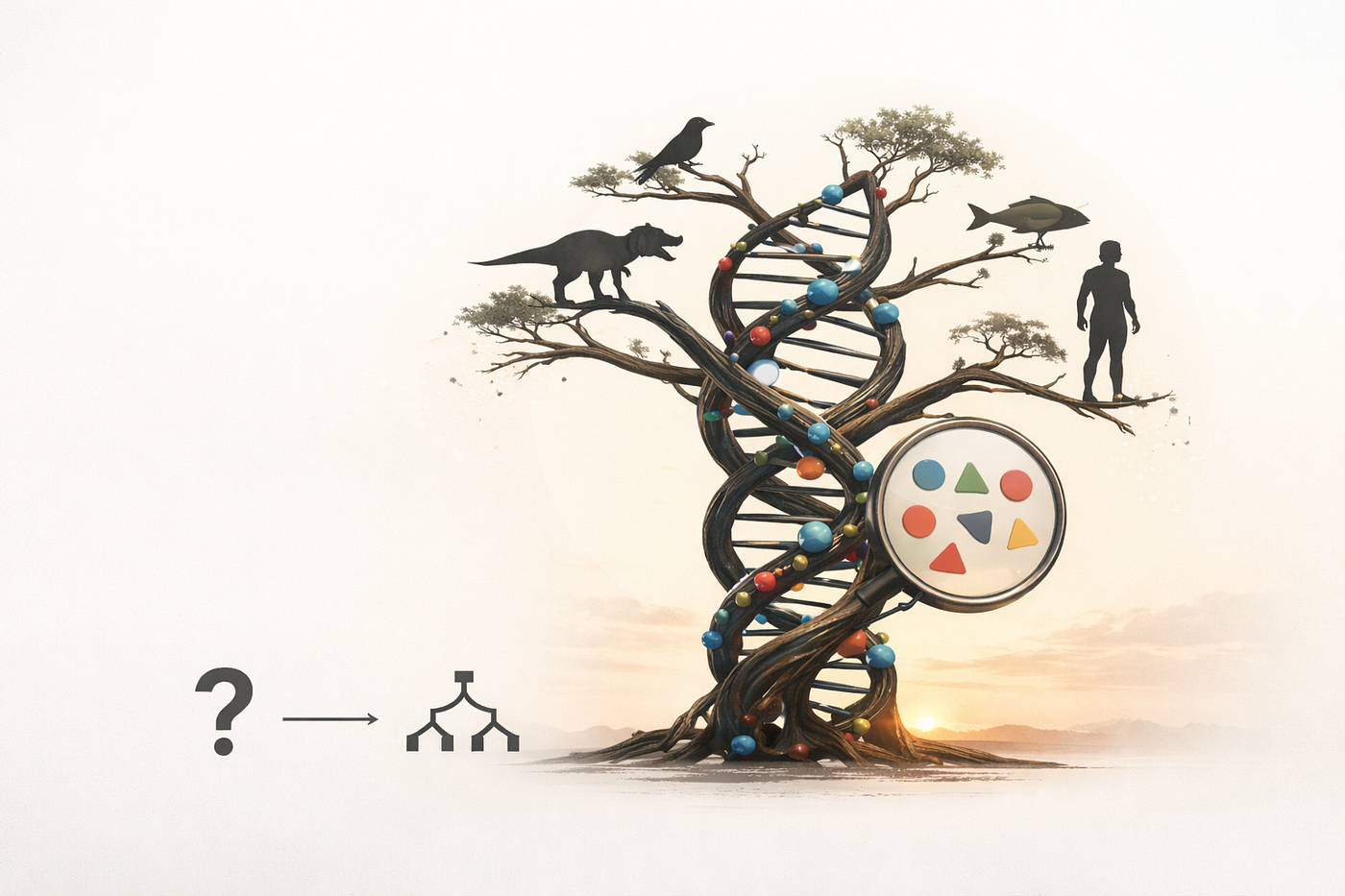
“What stories do their chromosomes tell?”
For the first time, we possessed a witness that had travelled continuously from parent to child for thousands of years.
That witness had no ideology. It had no political affiliation. It had no religious commitment. It simply carried the record of inheritance. What it revealed surprised almost everyone.
There Was No First Indian
One of the most striking discoveries of modern population genetics is also one of the simplest.
There was never a moment when “the first Indian” suddenly appeared. India was not created by a single people. Nor by a single migration. Nor by a single civilization.
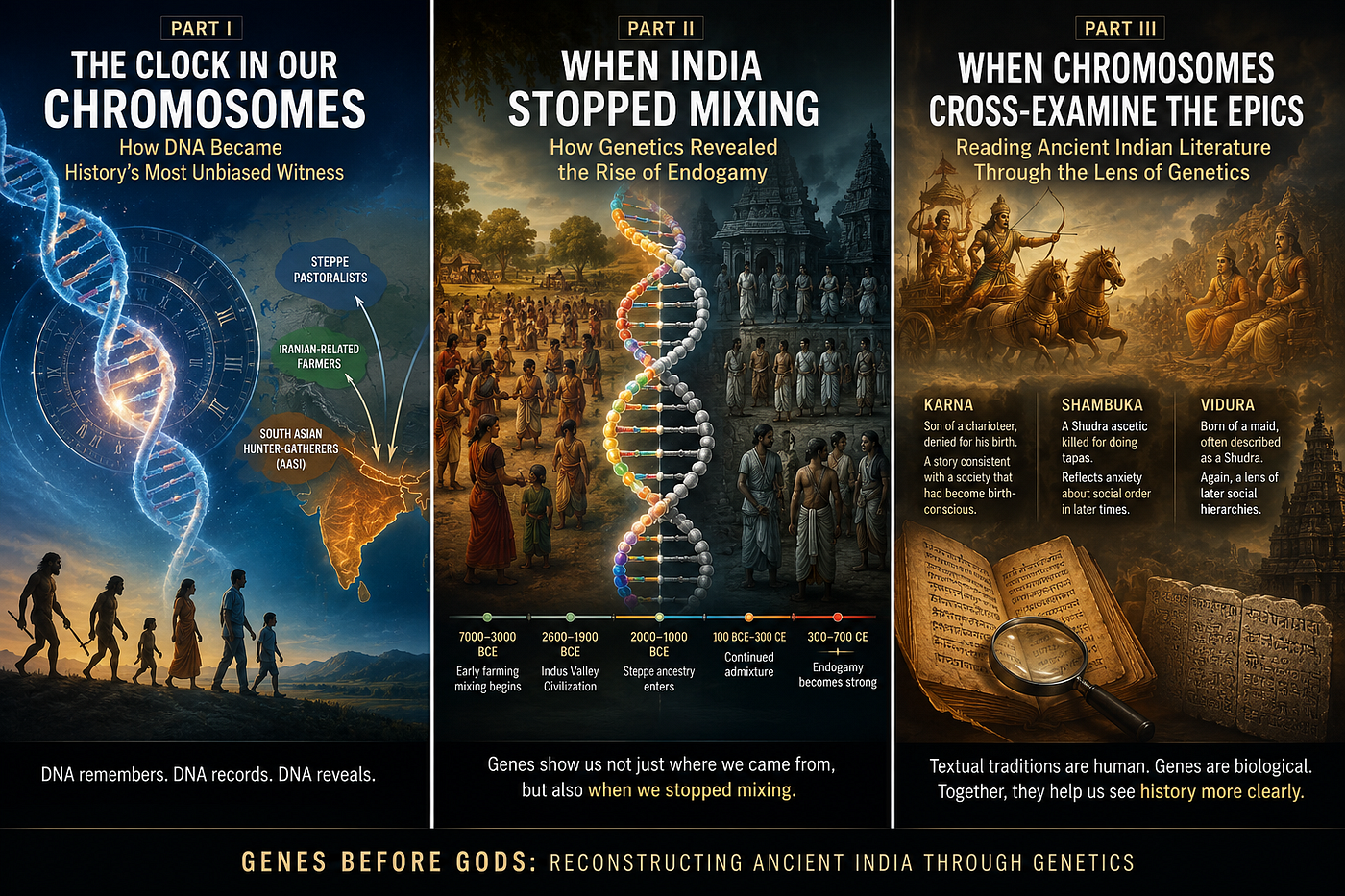
Instead, the genetic evidence suggests that the overwhelming majority of people living in South Asia today descend from the gradual mixture of three broad ancestral populations that met, interacted and blended over several millennia.
This is not merely an opinion.
It is the conclusion reached independently by multiple studies employing ancient DNA, linkage disequilibrium, admixture modelling, f-statistics, chromosome painting and demographic simulations.
The names given to these populations differ slightly between papers.
For clarity, we shall use the simplest terminology.
- Ancient Ancestral South Indians (AASI)
- Iranian-related agricultural populations
- Eurasian Steppe pastoralists
Every modern Indian population carries ancestry from these groups in different proportions. Some populations carry more from one source. Others carry more from another. But almost no population represents any one source in isolation.
India, from its very beginning, was a civilization of mixtures.
The First Indians
Long before cities. Long before agriculture. Long before kingdoms. There were hunter-gatherers. Modern geneticists call this deeply ancient ancestry AASI — Ancient Ancestral South Indians. The name sounds deceptively modern. It does not refer to a tribe that called itself AASI.
Rather, it represents a reconstructed ancestral population inferred from modern genomes and supported indirectly by ancient DNA from neighbouring regions.
These people probably descended from some of the earliest modern humans to settle South Asia after leaving Africa roughly sixty-five thousand years ago.
For tens of thousands of years they hunted, gathered, fished and adapted to remarkably diverse environments ranging from tropical forests to river valleys and coastal plains.
They witnessed volcanic eruptions. Ice ages. Changing coastlines. Extinct animals. They survived them all. In many ways, they are the deepest biological roots of the Indian subcontinent.
Yet they are not the whole story. If they were, Indian genomes would look very different today. Something changed.
A New Way of Living Arrives
Around the seventh millennium BCE, another transformation began unfolding across western Asia. Human beings discovered something extraordinary. Seeds could be planted. Animals could be domesticated. Food could be produced rather than merely collected. Agriculture changed everything. Villages appeared. Permanent settlements expanded. Population sizes increased dramatically. These agricultural communities gradually spread across large parts of western Asia. Some eventually reached regions bordering the northwestern Indian subcontinent.
Here we must be careful with terminology. Geneticists often speak of Iranian-related ancestry. This phrase has generated enormous misunderstanding. It does not mean these people were citizens of the modern nation of Iran. Modern nation-states did not exist.
The term refers instead to ancient populations genetically related to early agricultural communities living on the Iranian plateau thousands of years before recorded history.
Their DNA resembles that recovered from ancient skeletons excavated in regions of present-day Iran. It is a genetic description. Not a political one.
Two Worlds Meet
Imagine the scene. On one side stand communities whose ancestors had lived in South Asia for tens of thousands of years. On the other stand early agricultural groups bringing farming technologies, domesticated animals and new ways of organizing society.
Did one replace the other? That would certainly produce a simple story. The chromosomes disagree. Instead of replacement, the evidence overwhelmingly indicates mixture. Repeated mixture. Long-lasting mixture. Communities met. Married. Raised children. Shared technologies. Shared food. Shared genes. The descendants of these unions gradually formed the population that would later build one of humanity’s earliest urban civilizations.
The Birth of the Indus Civilization
By roughly 3300 BCE, these mixed populations had begun creating something unprecedented in South Asia. Cities. Planned streets. Granaries. Craft specialization. Long-distance trade. Standardized weights. Sophisticated drainage systems. What we now call the Indus Valley Civilization — or more accurately, the Indus Civilization — did not emerge from a biological vacuum. Its people were themselves products of earlier mixtures.
Ancient DNA recovered from individuals associated with the civilization, together with sophisticated admixture modelling, strongly suggests that they derived most of their ancestry from combinations of AASI-related peoples and Iranian-related agricultural populations, with little or no Steppe ancestry at this stage.
This conclusion is remarkably important.
The Indus Civilization was already genetically mixed before the arrival of later Steppe pastoralist ancestry. The great urban civilization of Bronze Age South Asia was not genetically homogeneous. It was already cosmopolitan.
Then Came Another Journey
History, however, rarely stops moving. While cities flourished across the Indus region, another remarkable society occupied the vast grasslands stretching across the Eurasian Steppe. These were pastoralists. Masters of horses. Cattle. Mobile herding. Long-distance movement. Their lives differed profoundly from those of settled agricultural communities. Yet their chromosomes would eventually become part of the Indian story as well.
Beginning roughly during the second millennium BCE, populations carrying Steppe-related ancestry gradually entered northwestern South Asia.
Notice the wording carefully. The evidence strongly supports migration. It does not support the old nineteenth-century image of a single overwhelming military invasion replacing existing populations overnight. Genetics reveals something considerably more subtle. People arrived over extended periods. They mixed with local populations. Their ancestry gradually spread through subsequent generations.
Exactly how these migrations intersected with language, culture and social organization remains an active area of research. The chromosomes answer some questions. They leave others open.
Three Streams Become One River
By now, the broad outline begins to emerge. First came the ancient hunter-gatherers who established humanity’s deepest roots in South Asia. Later came Iranian-related agricultural populations whose arrival coincided with profound economic and demographic transformations. Still later came Steppe pastoralists whose ancestry became incorporated into many northern populations through sustained admixture.
None of these peoples vanished completely. None remained genetically isolated. Instead, generation after generation, they blended. Every marriage produced children carrying chromosomes from more than one ancestral tradition.
Every subsequent generation shuffled those chromosomes through recombination. Eventually, the original ancestral segments became so thoroughly interwoven that modern Indians inherited them as inseparable mosaics. This is why geneticists often say that every chromosome is a historical document.
Every chromosome literally contains pieces of multiple ancient populations stitched together by thousands of years of human relationships.
A River Does Not Flow Forever
If the story ended here, India might have continued mixing indefinitely. But the chromosomes tell us something unexpected. For thousands of years, admixture appears to have been widespread. Then, gradually, something changed.
Across much of the subcontinent, genetic mixing slowed dramatically. Eventually, many communities became strongly endogamous, marrying largely within their own groups. The chromosomes remember this transformation with astonishing clarity.
They preserve not only the evidence that people mixed. They preserve evidence that, at some point, many of them largely stopped mixing.
Why?
That question carries us into one of the most fascinating intersections of genetics, archaeology, sociology and history. And it is there that our next part begins.
When India Stopped Mixing.
But Stories Are Easy. Evidence Is Hard.
By this point, the broad outline of India’s genetic history appears almost deceptively simple. Ancient hunter-gatherers formed the earliest layer of ancestry. Early agricultural communities related to those of the Iranian plateau contributed another. Later, Steppe pastoralists added a third.
Generation after generation, these ancestries blended until they became the genetic foundation of the Indian subcontinent.
It is an elegant story. Perhaps too elegant.
Whenever history appears this neat, every scientifically minded reader should become slightly suspicious.
- How do we know these were the populations involved?
- Why do geneticists call one ancestry Iranian-related?
- Why not Mesopotamian? Or Central Asian? Or Bactrian?
- How do we know the earliest inhabitants arrived around sixty-five thousand years ago?
- How can scientists identify a population such as the Ancient Ancestral South Indians when no perfectly unmixed individual from that population has yet been discovered?
- How do we distinguish a migration from an invasion using nothing more than chromosomes?
- And perhaps most importantly, how do we separate conclusions supported by genetics from historical interpretations built upon those conclusions?
These are not merely technical questions. They are the very questions that determine whether genetics deserves a place alongside archaeology and history as evidence for reconstructing the past.
The remarkable answer is that geneticists do not begin with names such as AASI, Iranian-related or Steppe.
They begin with genomes. The names come later. Only after thousands of genomes have been compared, modeled and tested against competing demographic scenarios do those labels emerge as convenient descriptions of statistical patterns.
The story you have just read was therefore not the starting point of the scientific investigation. It was the destination.
To appreciate why geneticists have such confidence in this reconstruction, we must now retrace the investigation itself and examine how each of these ancestral populations was identified from the chromosomes they left behind.
Ancient DNA Changed Everything
For most of the twentieth century, archaeologists worked almost entirely from objects.
- Pottery
- Stone tools
- Burial practices
- Jewellery
- Architecture
These artefacts reveal culture. They do not necessarily reveal ancestry. Two neighbouring populations may use similar pottery while remaining genetically quite distinct. Conversely, genetically related populations may adopt completely different material cultures. Archaeologists have long understood this limitation.
Objects travel. Ideas travel. People sometimes do. Sometimes they do not.
Ancient DNA fundamentally changed the conversation. Instead of inferring populations from pottery, scientists could sequence DNA directly from skeletons excavated in archaeological sites. For the first time, the people themselves entered the analysis. The pottery no longer spoke on their behalf. Their chromosomes did.
Why “Iranian-Related” Does Not Mean Iranian
This terminology often confuses readers. Geneticists frequently refer to Iranian-related ancestry. The phrase sounds geographical. It is actually statistical.
Researchers sequenced ancient skeletons excavated from Neolithic sites in the Zagros Mountains of present-day Iran. These early agricultural communities possessed a distinctive genetic profile.
These individuals possess a characteristic genome-wide allele-frequency profile. When geneticists compare them with genomes from South Asia and Indus regions, one component consistently matches remarkably these ancient Zagros farmers.
Notice what scientists are saying. They are not claiming that Iranians migrated into India. Nor are they claiming these ancient farmers considered themselves Iranian or from Zagros. Modern Iran did not exist. The term simply means
“the closest ancient genomes presently available resemble those excavated from the Zagros region.”
Tomorrow another excavation may discover an even better ancestral population elsewhere. Science would happily update the terminology. The label follows the evidence. Not the other way around.
Mehrgarh: Where Genetics Meets Archaeology
One of the earliest agricultural settlements associated with South Asia is Mehrgarh, located in present-day Balochistan.
Long before the great cities of Harappa and Mohenjo-daro appeared, communities at Mehrgarh cultivated crops, domesticated animals and developed increasingly complex village life.
Archaeologists had long suspected that Mehrgarh represented an important transition between western Asian farming traditions and the later Indus Civilization.
Genetics strongly reinforced that picture. Although ancient DNA from the region remains limited, demographic modelling consistently indicates that populations associated with the Indus Civilization possessed ancestry related both to ancient South Asian hunter-gatherers and to early agricultural populations resembling those from the Zagros region.
Archaeology suggested cultural continuity. Genetics independently suggested biological continuity. Two different disciplines reached remarkably similar conclusions.
The Deep Roots of AASI
If Iranian-related ancestry represents one side of the story, Ancient Ancestral South Indians represent the other. Unlike the Zagros farmers, however, no perfectly preserved genome belonging to an unmixed AASI individual has yet been recovered. Instead, AASI is reconstructed computationally.
This often surprises readers. How can scientists reconstruct a population whose DNA has never been observed directly? If no completely unmixed Ancient Ancestral South Indian individual has yet been sequenced, how can geneticists confidently describe them?
The answer lies in one of the most elegant applications of statistical inference in population genetics. Modern Indian genomes contain ancestry from several ancient populations. Ancient genomes from the Eurasian Steppe are now available. Ancient genomes from Neolithic populations of the Zagros region are also available.
When these known ancestral components are mathematically modeled and subtracted from present-day South Asian genomes using methods such as qpAdm, qpGraph, ADMIXTURE and f-statistics, a substantial residual ancestry consistently remains.
Independent algorithms repeatedly converge upon essentially the same deeply divergent ancestral component. That reconstructed ancestry (inferred lineage) is called Ancient Ancestral South Indian (AASI).
Its closest known relatives outside South Asia are the ancient hunter-gatherer populations represented by groups such as the Andamanese Onge, although the Onge are not direct ancestors of AASI. Rather, they serve as the closest available modern proxy because both descend from an ancient eastern Eurasian lineage that separated very early from other non-African populations.
By combining mutation rates, coalescent models and whole-genome comparisons, geneticists estimate that the ancestors of AASI ultimately derive from the first successful wave of modern humans leaving Africa roughly 60,000–70,000 years ago. Their descendants settled South Asia and remained there for tens of thousands of years before later migrations added new ancestry.
No single mutation announces, “I am AASI.” Instead, it is the collective statistical signature across hundreds of thousands of genetic markers that reveals this deep ancestry.
It is therefore a statistical reconstruction supported by multiple independent lines of evidence rather than by one perfectly preserved skeleton. Ironically, some of the oldest ancestors are reconstructed not because they survived intact, but because their descendants still carry fragments of their genomes.
The Arrival of the Steppe
Perhaps no aspect of South Asian genetics has generated more discussion than Steppe ancestry. Again, the terminology deserves careful explanation. Scientists did not begin by searching for Aryans. They began by sequencing ancient skeletons recovered across the Eurasian Steppe. Several related archaeological cultures emerged.
Readers often hear the words Yamnaya and Steppe ancestry used almost interchangeably. The reality is slightly more nuanced. The Yamnaya horizon represents one of the earliest major Bronze Age pastoralist expansions across the Pontic–Caspian Steppe.
Several centuries later, populations associated with the Sintashta and Andronovo archaeological horizons inherited much of this Steppe ancestry while developing new cultural and technological traits, including sophisticated chariot technology.
Although these cultures differed from one another, they shared substantial genetic continuity.
When South Asian genomes were analysed, a striking observation appeared. When South Asian genomes are modeled against ancient DNA, they generally show the closest affinity to Middle–Late Bronze Age Steppe populations, especially those related to Sintashta and Andronovo, rather than directly to the earlier Yamnaya.
This does not imply that Yamnaya contributed nothing. This does not imply that every migrant belonged exclusively to one archaeological culture. Rather, the migrants entering South Asia appear to have descended from Steppe populations that had themselves already evolved from earlier Yamnaya-related ancestors.
The migration therefore represents a genetic lineage, not a single tribe Once again, the names follow the genomes. Not ideology.
R1a: The Famous Y Chromosome
Perhaps no genetic marker has attracted more public attention than the Y-chromosome haplogroup R1a. It has unfortunately attracted considerable misunderstanding as well. A Y chromosome traces only one narrow line of ancestry. Your father’s father’s father and so on. It represents one lineage among thousands contributing to your overall genome.
Nevertheless, R1a tells an interesting story. Certain branches of R1a, particularly those associated with Bronze Age Steppe populations, expanded dramatically during later prehistoric migrations. Several branches of the R1a-Z93 lineage expanded dramatically during the Bronze Age and today occur at relatively high frequencies across many Indo-Iranian-speaking populations.
These paternal lineages appear today at relatively high frequencies among many Indo-European-speaking populations across Eurasia, including numerous North Indian groups.
At the same time, maternal lineages remain overwhelmingly derived from older South Asian ancestry. Crucially, mitochondrial DNA tells a somewhat different story. Maternal lineages remain overwhelmingly local. This asymmetry suggests that Steppe ancestry entered South Asia through migration that was disproportionately male-mediated.
That conclusion emerges not from mythology. It emerges because paternal and maternal inheritance preserve different historical signals.
Why ANI and ASI Are Not Races
Readers frequently encounter the terms ANI and ASI and imagine two ancient peoples who once lived side by side. The reality is considerably subtler. ANI and ASI are not archaeological cultures. They are not ethnic groups. They are not races. They are statistical populations.
Imagine attempting to explain the colours produced by mixing red, blue and yellow paint. A computer analysing the final colours may infer three hidden source colours. Those inferred colours need not correspond perfectly to any actual paint bucket. They are mathematical constructs explaining observed variation.
ANI and ASI play exactly this role. ANI represents ancestry more closely related to West Eurasian populations. ASI represents ancestry produced primarily by mixtures of AASI-related ancestry with Iranian-related ancestry but without substantial Steppe contribution.
As ancient DNA accumulated, scientists gradually replaced these statistical abstractions with real ancient populations whenever possible. The field matured from mathematical inference to archaeological confirmation.
Why Genetics Rejects the Classical Aryan Invasion Theory but Supports Migration
The Aryan Invasion Theory proposed during the nineteenth century imagined a rapid, large-scale invasion that replaced much of the existing population.
Modern genomes do not display the signature expected from such an event. Instead of abrupt replacement, they show widespread admixture. Ancient South Asian ancestry continues throughout later populations. Iranian-related ancestry remains. Steppe ancestry is added rather than replacing earlier components. The chromosomes therefore describe mixture rather than wholesale replacement.
This is why many population geneticists today prefer the expression Steppe Migration or Aryan Migration, rather than Aryan Invasion.
Migration leaves chromosomes from both populations. Replacement largely erases one. The genomes overwhelmingly support the first picture.
Does Genetics Support Out of India?
Perhaps the most debated question concerns the Out of India hypothesis.
Can genetics determine whether Indo-European populations primarily expanded outward from India during the Bronze Age?
Current genetic evidence provides little support for such a scenario. If large Bronze Age migrations had radiated from India into the Eurasian Steppe and onward into Europe, one would expect several genetic signatures.
The oldest Steppe ancestry should appear first within South Asia. Bronze Age populations outside India should carry substantial ancestry traceable to contemporary Indian populations. Y-chromosome lineages associated with the expansion should show their earliest diversification within South Asia.
Ancient DNA has not revealed these patterns.
Instead, the oldest genomes carrying characteristic Steppe ancestry occur outside South Asia, while Steppe-related ancestry appears in South Asia only after those populations were already established on the Eurasian Steppe.
Likewise, the earliest known diversification of the relevant R1a-Z93 lineages currently aligns more closely with Steppe-associated populations than with ancient South Asian genomes.
This does not prove that every version of Out of India is impossible. Science rarely proves universal negatives. However, based on presently available ancient DNA, population genetics provides strong support for migration into South Asia during the Bronze Age and does not presently provide corresponding genetic evidence for a large Bronze Age expansion out of South Asia into the Steppe.
Future discoveries may refine the picture. For now, that is where the evidence points.
Putting India Together
By this stage, the remarkable coherence of the evidence begins to emerge.
- Archaeology reveals villages becoming cities.
- Ancient DNA reveals populations mixing.
- Linguistics traces language families.
- Radiocarbon dating establishes chronology.
- Population genetics reconstructs ancestry.
Each discipline sees only part of the elephant. Together they reveal the animal.
The earliest inhabitants of South Asia contributed one deep ancestral layer. Iranian-related agricultural populations contributed another. Steppe pastoralists contributed a third. Generation after generation, recombination stitched these ancestries together into the chromosomes carried by modern Indians.
No chromosome today belongs entirely to one ancient people. Every chromosome is a mosaic. Every Indian carries fragments of an astonishingly long human journey.
But Did Everyone Stop Mixing At The Same Time?
One might imagine that after these great admixture events ended, every community in India suddenly became endogamous.
The chromosomes tell a more interesting story.
Different populations appear to have reduced genetic mixing at different times. Some became highly endogamous relatively early. Others continued exchanging genes for centuries longer.
When geneticists estimate the cessation of large-scale admixture, they therefore do not obtain one magical year. They obtain a distribution. Some estimates cluster earlier. Some later. Many centre roughly around the first millennium of the Common Era. This is why scientists speak of confidence intervals rather than precise historical dates.
The famous “300 CE” estimate should therefore be understood as a convenient summary of a much richer statistical distribution rather than a universal biological event experienced simultaneously across the entire subcontinent.
The chromosomes preserve history with astonishing fidelity. But history itself was never perfectly synchronized. Human societies rarely change everywhere at once. India was no exception.
The Stage Is Finally Set
We now understand who the major ancestral populations were. We understand why geneticists call them by these names. We understand why ANI and ASI are statistical models rather than biological races.
We understand why archaeology, ancient DNA and computational genetics independently converge upon the same broad reconstruction.
The genetic landscape of ancient India has finally come into focus. Only one great mystery remains. If populations mixed freely for thousands of years… why did so many eventually stop? The chromosomes remember that transition with extraordinary clarity. Our next part begins there.
Epilogue — A Civilization That Mixed… Until It Didn’t
If we step back from all the names, dates and genetic terminology, one extraordinary pattern emerges.
For nearly three thousand years, the story of the Indian subcontinent appears to have been a story of continual encounters. Ancient hunter-gatherers met incoming farming communities. Those mixed populations later interacted with pastoralists arriving from the Eurasian Steppe.
Communities expanded, merged, separated and merged again.
Every generation produced children whose chromosomes carried pieces of multiple ancestral histories. Recombination quietly stitched those histories together into the genetic mosaics carried by people today.
This is not speculation. It is written across the chromosomes of millions of living Indians. The remarkable fact is not that India mixed. The remarkable fact is how long India continued mixing.
For many centuries after the rise of the Indus Civilization, and even after Steppe-related ancestry entered the subcontinent, populations continued exchanging genes. The boundaries between communities were permeable. Marriages crossed ancestral lines often enough that recombination steadily blended the three major ancestral components into increasingly intricate genomic mosaics.
Then something changed. Not everywhere. Not all at once. Not by a single royal decree. The chromosomes tell a subtler story. Some communities reduced genetic exchange earlier than others. Some continued mixing for centuries longer. Different regions followed different trajectories.
Yet across much of the subcontinent, the independent signals all point in the same general direction. The long era of widespread admixture gradually came to an end. To a geneticist, this transformation is unmistakable.
- The long ancestry segments produced by recent mixing stop appearing.
- Linkage disequilibrium begins decaying in a different way.
- Identity-by-Descent patterns change.
- Runs of homozygosity become more common in many populations.
- Founder effects become increasingly visible.
The molecular clock records not merely that people once mixed. It records that many populations eventually stopped. The question is no longer whether this happened. The genetic evidence leaves little doubt that it did.
The real questions are different.
- When did different communities become endogamous?
- How do geneticists estimate those dates from chromosomes alone?
- Why do the estimates form a broad statistical distribution rather than one magical year such as 300 CE?
Most importantly…
What changed in Indian society that caused a civilization built upon millennia of admixture to become a civilization increasingly organized around endogamy?
Genetics can answer part of that question. History must answer the rest.
It is at this fascinating intersection — where chromosomes meet culture, where biology meets sociology, and where statistical inference meets historical interpretation — that our journey now turns.
In the next part, we shall discover how geneticists used recombination itself as a clock to reconstruct one of the most profound social transformations in Indian history.
When India Stopped Mixing.
메타데이터
- post_id
- 13b7a47eb7ea
- slug
- genes-before-gods-reconstructing-ancient-india-through-genetics-part-4-13b7a47eb7ea
- url
- https://medium.com/@datavector/genes-before-gods-reconstructing-ancient-india-through-genetics-part-4-13b7a47eb7ea
- canonical_url
- https://medium.com/@datavector/genes-before-gods-reconstructing-ancient-india-through-genetics-part-4-13b7a47eb7ea
- author_url
- https://medium.com/@datavector
- status
- ok
- fetched_at
- 2026-06-21 12:17:11