Capturing Institutional Reimbursement Knowledge Through Adaptive Workflow Intelligence
Abstract
Capturing Institutional Reimbursement Knowledge Through Adaptive Workflow Intelligence
Abstract
Healthcare organizations frequently depend on institutional knowledge that exists only in the experience of senior coding and billing personnel. As workforce turnover occurs, undocumented reimbursement practices may be lost, resulting in inconsistent coding decisions and repeated administrative work. One of our core design principles is that no healthcare organization should ever have to say, “When Barbara takes a vacation, we have to pause progress because no one else knows how to do what she does.” Critical reimbursement knowledge should live in systems and workflows - not exclusively in individual employees.
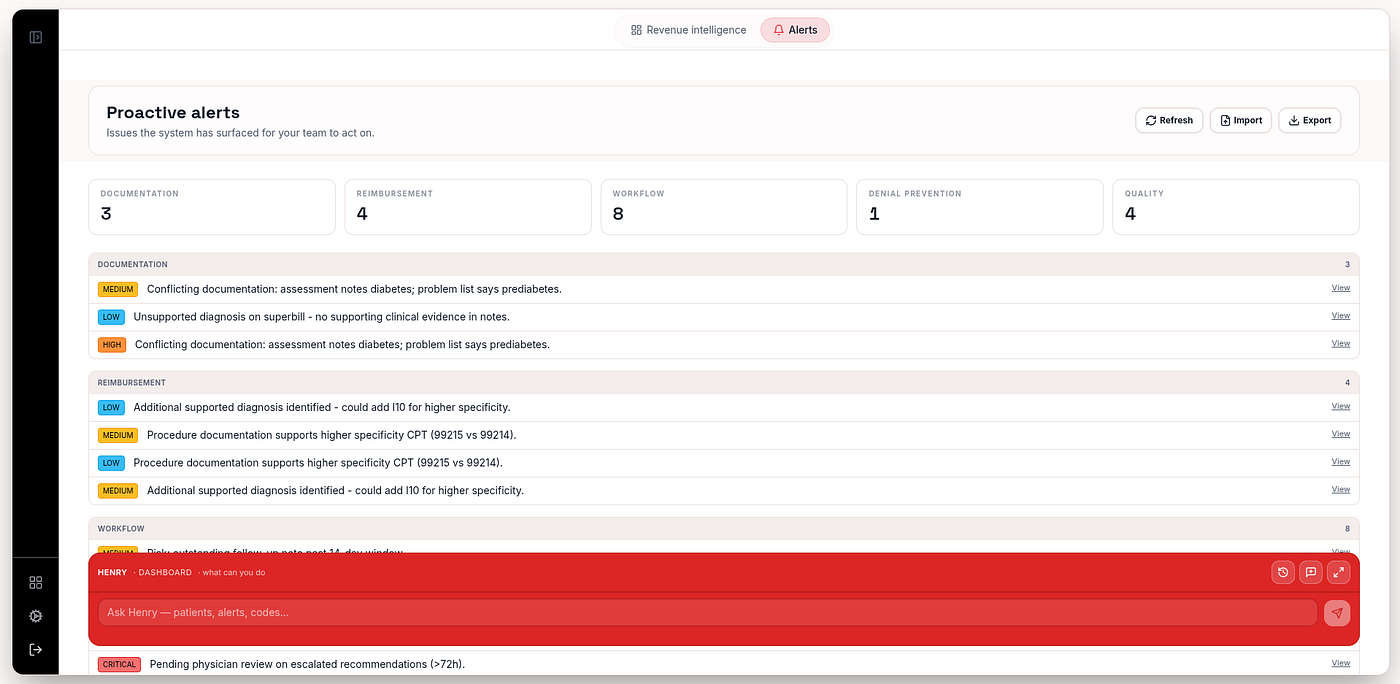
Proactive Alert System, AICD-10
Knowledge Acquisition
Every interaction between the reviewer and the system represents an opportunity to capture organizational preferences, across both specialties and practices. Each iteration of AICD-10 is built around the users interacting with it day-to-day - meaning accepted recommendations, rejected suggestions, documentation edits, payer-specific observations, and coding rationale can be recorded as structured workflow events rather than transient user actions.
Over time, these events form a longitudinal institutional memory that complements published coding guidance without replacing expert review.
Payer-Aware Reasoning
Different payers may exhibit distinct documentation expectations or historical reimbursement patterns. Rather than hardcoding these behaviors, AICD-10 employs a three-layer intelligence architecture. The foundational layer consists of highly structured clinical and reimbursement data that remains stable and deterministic. Above that sits a flexible learning layer that continuously captures emerging patterns, reviewer feedback, payer-specific observations, and institutional knowledge as they evolve. The top layer is fully adaptable, allowing healthcare organizations to define and refine custom business rules, preferred coding strategies, and payer-specific guidance without modifying the underlying data model. This separation enables the system to preserve core clinical facts while continuously adapting to changing reimbursement requirements and organizational practices.
Examples include preferred supporting documentation, recurring denial scenarios, or organization-approved coding practices. Human review remains mandatory before institutional guidance is modified or operationalized.
Adaptive Feedback Loop
When reviewers consistently override a recommendation or supplement documentation before submission, those interactions can be analyzed to identify systematic opportunities for improvement. Conversely, recommendations that repeatedly survive human review may be promoted as higher-confidence suggestions.
This architecture enables a continuously evolving decision-support system while preserving accountability through human oversight and evidence-based scoring. Rather than treating every input equally, AICD-10 assigns confidence scores to knowledge based on its source, recency, consistency, and historical reliability. For example, an officially published update from the World Health Organization or CMS would carry substantially greater weight than a recommendation originating from a newly onboarded coder. Conversely, if multiple experienced reviewers within an organization consistently make the same payer-specific adjustment and those decisions lead to successful reimbursement outcomes, the confidence assigned to that institutional knowledge can increase over time. This weighted approach allows the platform to adapt continuously while minimizing the risk of low-quality or anecdotal guidance overriding authoritative clinical and regulatory sources.
Organizational Continuity
The principal objective is preservation of expertise. Rather than relying exclusively on informal mentorship or individual memory, reimbursement knowledge becomes embedded within structured workflows that persist across personnel changes and organizational growth.
Future Evaluation
Planned production evaluations include measuring reviewer agreement, override frequency, consistency across coding teams, documentation completeness, and administrative rework over time. These studies are intended to assess whether structured institutional memory improves operational continuity and reimbursement quality while maintaining human oversight.
메타데이터
- post_id
- 1428df8be01b
- slug
- capturing-institutional-reimbursement-knowledge-through-adaptive-workflow-intelligence-1428df8be01b
- url
- https://medium.com/@edan-ais/capturing-institutional-reimbursement-knowledge-through-adaptive-workflow-intelligence-1428df8be01b
- canonical_url
- https://medium.com/@edan-ais/capturing-institutional-reimbursement-knowledge-through-adaptive-workflow-intelligence-1428df8be01b
- author_url
- https://medium.com/@edan-ais
- status
- ok
- fetched_at
- 2026-06-12 18:14:10