ORBITAL ECONOMICS | post #32: July 28, 2026
This Week’s Signal: Intel’s entry into space-grade silicon chips has triggered a three-way architecture race for the future of orbital and…
ORBITAL ECONOMICS | post #32: July 28, 2026
This Week’s Signal: Intel’s entry into space-grade silicon chips has triggered a three-way architecture race for the future of orbital and cisLunar compute — and the winner will determine who controls onboard intelligence for every satellite, spacecraft, and lunar installation launched in the next decade.
Support my research on Ko-fi
Thanks for reading! Subscribe for free to receive new posts and support my work.
THE SPACE CHIP RACE HAS STARTED — AND THREE DIFFERENT TEAMS ARE EYEING THE PODIUM
For decades, the question of what processor goes into a critical space mission had one answer: whatever BAE Systems had qualified. The RAD750–150nm lithography, under 200 MHz — has flown on Curiosity, Perseverance, the James Webb Space Telescope, and more than 150 other spacecraft. It works. It survives. And by every metric that matters for modern AI inference, it is hopelessly outclassed. In July 2026, three companies announced they intend to close that gap — and, it turns out, there’s more than one way to do it.
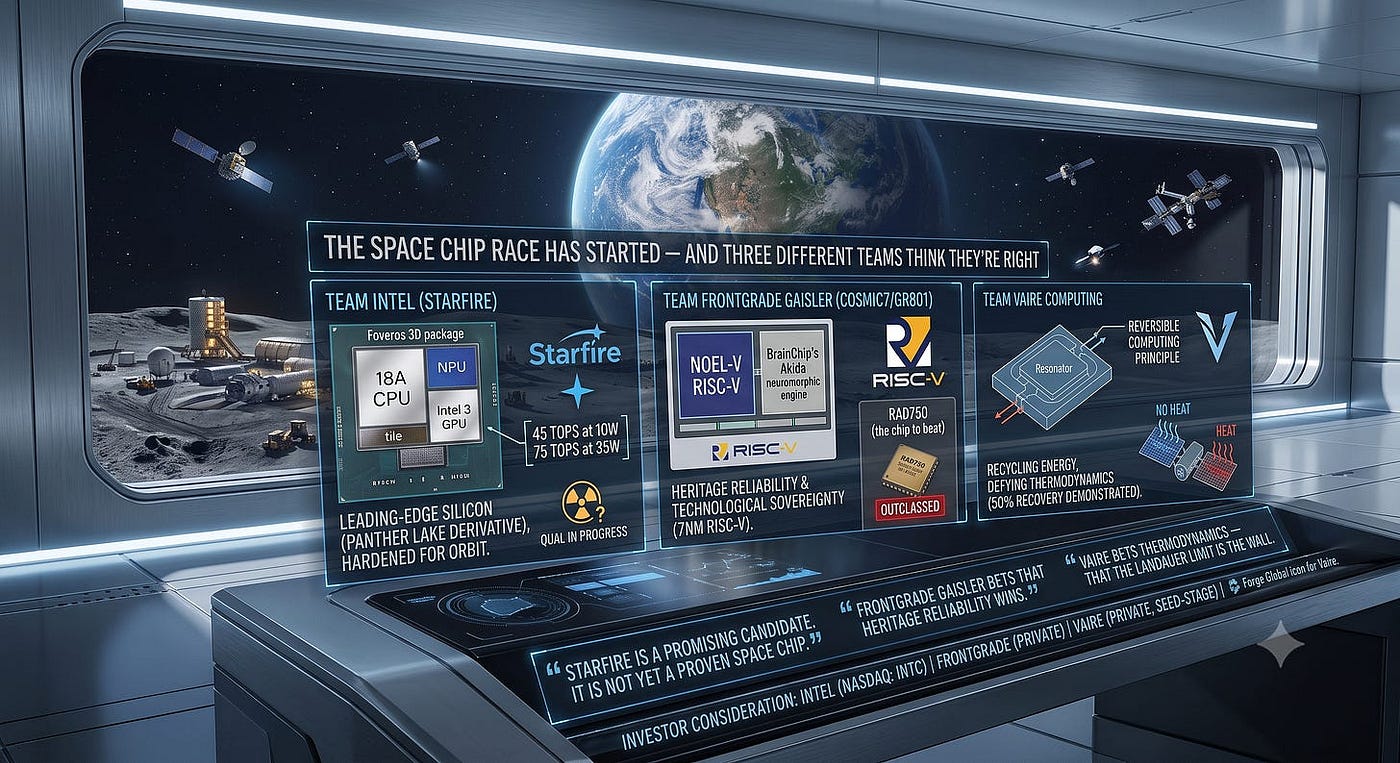
On July 9, Intel unveiled Starfire: a space-grade SoC pairing an 18A CPU and NPU — the same process node headed to next-generation laptops — with an Intel 3 GPU tile in a Foveros 3D package. Two configurations: 45 TOPS at 10 watts and 75 TOPS at 35 watts. Intel Government Technologies is running the program, samples ship Q3 2026. The pitch to Washington is simple: Intel took Panther Lake, hardened it for orbit, and priced it competitively. Space customers get leading-edge silicon without a bespoke program. Intel gets a new revenue line without building a new architecture.
If it works. The critical asterisk is the one Intel itself placed there: radiation qualification — testing for total ionizing dose, single-event latch-up, and single-event effects — is still in progress. Smaller, denser transistors carry less charge per bit and are inherently more vulnerable to cosmic ray bit flips. “Designed to address” and “radiation-qualified” are different claims. Starfire is a promising candidate. It is not yet a proven space chip.
Meanwhile, Frontgrade Gaisler — the incumbent whose qualified GR740 runs the systems Intel is trying to replace — was not standing still. On May 28, the European Commission awarded Horizon Europe funding for COSMIC7: a 7nm RISC-V test chip toward a future space microprocessor designated the GR7xV. The EU’s motivation is explicit: technological sovereignty, reducing European mission dependence on US-controlled supply chains. Frontgrade Gaisler’s GR801 — NOEL-V RISC-V paired with BrainChip’s Akida, a Laguna Hill, CA company, neuromorphic engine, in commercialization phase. Where Intel bets that commercial silicon can be hardened after the fact, Frontgrade Gaisler bets that heritage reliability wins against newcomers who haven’t yet survived a solar particle event.
The third position belongs to Vaire Computing, a startup that has taped out its first chip and demonstrated 50% energy recovery in the resonator component — a validated first step in reversible computing, with the company noting the figure excludes additional system overheads. Vaire is what makes orbital AI, and any vacuum operation, hard: Every watt generated in a power-constrained environment must be stored and thermally managed (no convection in a vacuum). An architecture that recycles energy rather than converting it to heat changes every downstream constraint.
Three architectures. Three bets on where the ceiling is. Intel bets qualification. Frontgrade Gaisler bets trust. Vaire bets thermodynamics — that the Landauer limit, not Moore’s Law, is the wall the industry hasn’t seen coming. All three could be right in different segments. What isn’t in doubt: the AI performance gap between space-grade and commercial silicon is closing fast.
Investor Consideration: Intel (NASDAQ: INTC) offers direct public exposure to Starfire — investors are buying an option on the space program embedded in a broader semiconductor turnaround thesis. Frontgrade Gaisler is a privately held division of Frontgrade Technologies; no direct vehicle exists. Vaire Computing is private and seed-stage ($10M raised total); no public vehicle exists. Accredited investors can explore secondary market exposure via Forge Global.
━━━━━━━━━━━━━━━━━━
QUICK HITS
THE EU BETS ON SOVEREIGN SILICON — AND IT’S NOT THEORETICAL
The COSMIC7 award to Frontgrade Gaisler in May 2026 is not a research grant in the conventional sense. It is a funded commercialization mandate from the European Commission for a 7nm radiation-hardened space microprocessor built on RISC-V open architecture — specifically structured to reduce European mission dependence on US-controlled supply chains. The GR7xV processor this program targets will integrate many-core general purpose compute, AI acceleration, security, and high-speed Ethernet switching in a single device. What makes this commercially significant is that the ESA missions, European defense satellites, and the growing constellation of European commercial operators who face the same US export (ITAR) control constraints now have an option.
Investor Consideration: While Frontgrade Technologies is privately held, he nearest public proxy for European sovereign space compute is OHB SE (Xetra: OHBG; OTC ADR: OHBGY), a German space systems integrator with direct supply chain exposure to Frontgrade Gaisler’s processor ecosystem. Thales Group (Euronext Paris: HO; OTC ADR: THLLY) is a larger, more liquid indirect proxy. Airbus Defence and Space is part of Airbus Group (Xetra: AIR; OTC ADR: EADSY).
NVIDIA IN ORBIT: THE INCUMBENT THAT ARRIVED FIRST
While Intel’s Starfire announcement dominated July headlines, the more mature commercial position in space computing hardware belongs to NVIDIA. In March 2026, NVIDIA announced the Space-1 Vera Rubin Module — designed to deliver up to 25x the AI compute of an H100 GPU for space-based inferencing — alongside confirmation that Cowboy Space (formally Aetherflux), Axiom Space, Kepler Communications, Planet Labs, Sophia Space, and Starcloud are already using NVIDIA’s existing accelerated computing platforms, including IGX Thor and Jetson Orin, for active missions and near-term deployments. The Vera Rubin Module itself has no confirmed ship date yet; NVIDIA says it will be available “at a later date.” For investors comparing the space chip landscape, the architecture distinction matters: NVIDIA has paying customers deploying hardware in orbit now; Intel has engineering samples with radiation data still pending; Frontgrade Gaisler has mission-proven parts but is racing to close the AI performance gap.
Investor Consideration: NVIDIA (NASDAQ: NVDA) offers the broadest and most liquid exposure to space AI compute, though space remains a small fraction of total revenue. For direct exposure to the orbital compute customer side: *Cowboy Space* — one of NVIDIA’s six named partners, targeting its first orbital data center node in Q1 2027 — is reportedly raising a Series B at a $2 billion valuation ($250–300M target, led by Index Ventures, with a16z and Breakthrough Energy among existing backers). The company is private; accredited investors can explore secondary access via Forge Global. Planet Labs PBC (NASDAQ: PL) offers public exposure to the satellite AI data processing use case as a named NVIDIA partner with active on-orbit deployments.
━━━━━━━━━━━━━━━━━━
CITATIONS
- Intel Corporation, “Intel Starfire Built for Extremes, Powered by Intel” — product brief published July 9, 2026: https://www.intel.com/content/www/us/en/content-details/923451/intel-starfire-built-for-extremes-powered-by-intel.html
- Tom’s Hardware, “Intel’s new space-grade Starfire chip is a Panther Lake SoC that puts an 18A CPU into orbit,” July 13, 2026: https://www.tomshardware.com/tech-industry/semiconductors/intel-shows-off-starfire-space-grade-chip
- Frontgrade Gaisler, “The European Commission awards Frontgrade Gaisler funding under Horizon Europe — COSMIC7,” May 28, 2026: https://www.gaisler.com/news-events/the-european-commission-awards-frontgrade-gaisler-funding-under-the-horizon-europe-space-r-i-work-programme-cosmic7
- Frontgrade / BrainChip, “Frontgrade Gaisler Launches GRAIN Line and Wins SNSA Contract to Commercialize First Neuromorphic AI for Space,” April 2, 2025: https://www.frontgrade.com/news/frontgrade-gaisler-launches-new-grain-line-and-wins-snsa-contract-commercialize-first-energy
- NVIDIA Newsroom, “NVIDIA Launches Space Computing, Rocketing AI Into Orbit,” March 16, 2026: https://nvidianews.nvidia.com/news/space-computing
- SpaceNews, “Nvidia unveils AI computing module for space-based data centers,” March 17, 2026: https://spacenews.com/nvidia-unveils-ai-computing-module-for-space-based-data-centers/
- EE Times, “Vaire Demos Energy Recovery With Reversible Computing Test Chip,” September 4, 2025: https://www.eetimes.com/vaire-demos-energy-recovery-with-reversible-computing-test-chip/
- Data Center Dynamics, “Vaire Computing tapes out demo chip capable of recycling 50% of its energy-intensity,” May 2025: https://www.datacenterdynamics.com/en/news/vaire-computing-tapes-out-demo-chip-capable-of-recycling-50-of-its-energy-intensity/
- igor’sLAB, “Intel Starfire: 18A SoC for Space with 75 TOPS,” July 2026: https://www.igorslab.de/en/intel-starfire-18a-soc-75-tops-ai-space/
━━━━━━━━━━━━━━━━━━
Vlad Algin | Author, Orbital Economics | Support my research on Ko-fi | For informational purposes only. Not investment advice.
메타데이터
- post_id
- 142cc177906b
- slug
- orbital-economics-post-32-july-28-2026-142cc177906b
- url
- https://medium.com/@valgin2150/orbital-economics-post-32-july-28-2026-142cc177906b
- canonical_url
- https://medium.com/@valgin2150/orbital-economics-post-32-july-28-2026-142cc177906b
- author_url
- https://medium.com/@valgin2150
- status
- ok
- fetched_at
- 2026-08-05 01:12:45