System Design Journey — Chapter 6: CAP Theorem (Introduction)
Today’s lesson completely changed how I think about distributed systems.
System Design Journey — Chapter 6: CAP Theorem (Introduction)
Today’s lesson completely changed how I think about distributed systems.
Like many developers, I had always heard:
“In distributed systems, you can only choose two: Consistency, Availability, and Partition Tolerance.”
It turns out that’s one of the biggest misconceptions in System Design.
What is the CAP Theorem?
The CAP Theorem states that when a network partition occurs, a distributed system must choose between:
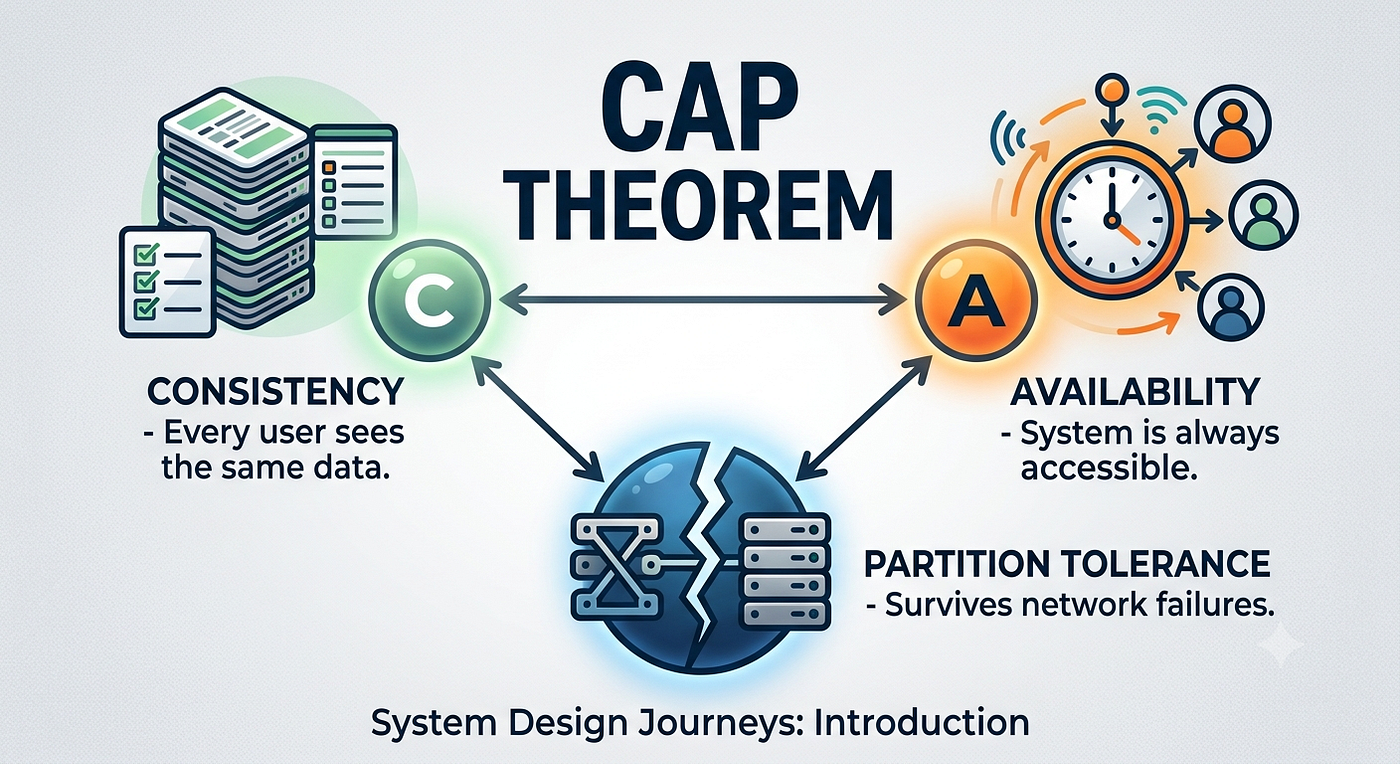
- Consistency ( C ) — Every user sees the latest, correct data.
- Availability (A) — Every request receives a response, even if the data might be slightly outdated.
- Partition Tolerance (P) — The system continues operating even when communication between servers is interrupted.
The important part is “when a network partition occurs.”
Modern distributed systems communicate over networks, and networks are never 100% reliable. Servers can lose connectivity due to router failures, cloud outages, firewall issues, or network congestion.
This means Partition Tolerance isn’t really optional — it’s a reality.
The Biggest Misconception
The famous statement:
“Choose any two out of three.”
isn’t entirely accurate.
A better way to think about CAP is:
When a partition happens, you must decide between Consistency and Availability.
That small wording change completely changed my understanding of the theorem.
A Simple Example
Imagine your shipping address is stored in two database replicas.
You update your address, but before the second replica receives the update, a network partition occurs.
Now another user request reaches the second database.
The system has two choices:
Option 1 — Prioritize Consistency
Return an error (or ask the client to retry) until all replicas agree on the latest address.
✅ Correct data ❌ Lower availability
Option 2 — Prioritize Availability
Respond immediately using the data available on that replica.
✅ Application remains responsive ❌ User may receive stale data
Neither choice is universally correct — it depends entirely on the business requirements.
Real-World Examples
Some systems cannot afford stale data:
- 💳 Online Banking
- 💰 Payment Processing
- 🚚 Food Delivery Order Placement
These typically prioritize Consistency because incorrect data can have serious consequences.
Other systems care more about staying responsive:
- 💬 WhatsApp Messaging
- ❤️ Instagram Likes
- ▶️ YouTube View Counters
For these, slight delays in synchronization are usually acceptable, so Availability is often prioritized.
One Key Learning
One insight I found particularly interesting is that an entire application doesn’t have to make a single CAP decision.
Take Uber as an example:
- Payments → Consistency
- Driver Locations → Availability
- Promotions → Availability
- Ratings → Availability
Different services solve different business problems, so they make different trade-offs.
💡 Interview Tip
If an interviewer asks about the CAP Theorem, don’t simply say:
“You can only choose two.”
Instead, explain that:
Network partitions are inevitable in distributed systems. During a partition, architects must decide whether it’s more important to serve users immediately (Availability) or guarantee that every user sees the latest data (Consistency).
That explanation demonstrates a much deeper understanding than simply memorizing the theorem.
메타데이터
- post_id
- 142d93b7c36f
- slug
- system-design-journey-chapter-6-cap-theorem-introduction-142d93b7c36f
- url
- https://medium.com/@jutt41697/system-design-journey-chapter-6-cap-theorem-introduction-142d93b7c36f
- canonical_url
- https://medium.com/@jutt41697/system-design-journey-chapter-6-cap-theorem-introduction-142d93b7c36f
- author_url
- https://medium.com/@jutt41697
- status
- ok
- fetched_at
- 2026-08-19 18:15:50