C-DIAM Multi-Omics Studio: A Comprehensive Platform for Multi Omics Data
Multi-omics research is changing the game in biomedical science. By pulling together data from different biological layers — like genomics…
C-DIAM Multi-Omics Studio: A Comprehensive Platform for Multi Omics Data
Multi-omics research is changing the game in biomedical science. By pulling together data from different biological layers — like genomics, proteomics, and metabolomics — it gives us a fuller picture of how the body works and opens the door to real progress in precision medicine.
But as exciting as it is, working with multi-omics data isn’t all smooth sailing. Researchers still face some major roadblocks: data can be hard to access, analyzing it is tricky because it’s super complex and varied, combining results across studies and omics types is tough, and working across different disciplines isn’t always easy.
Building on that, we created C-DIAM Multi-omics Studio— a powerful, all-in-one web platform designed to make multi-omics research a whole lot easier. In this blog, we’ll highlight the key challenges C-DIAM solves — and some of the major features.
What is C-DIAM?
CDIAM, or **CDIAM Multi-Omics Studio**, is a SAAS platform for multi-omics analysis with speed of development, adaptability and customization.
CDIAM stands for “Carpe DIAM” meaning to seize the Data, Interactome, Algorithms and Machine Learning. The platform takes in data and analysis results from various types of omics such as Genomics, Transcriptomics, Proteomics, Epigenetics, Metabolomics, Microbiome, Interactome, Single Cell, and Spatial data (e.g. Visium, VisiumHD, Xenium, CosMx SMI).
Inputs can be as simple as a gene/protein table, a DE result, or an expression matrix.
What challenges does C-DIAM address?
1. Accessible Omics Data Analysis & Team Collaboration
C-DIAM features a point-and-click graphical interface that supports a wide range of omics data types. That means even scientists without a coding background can perform advanced analysis — while still giving bioinformaticians the power and flexibility they need.
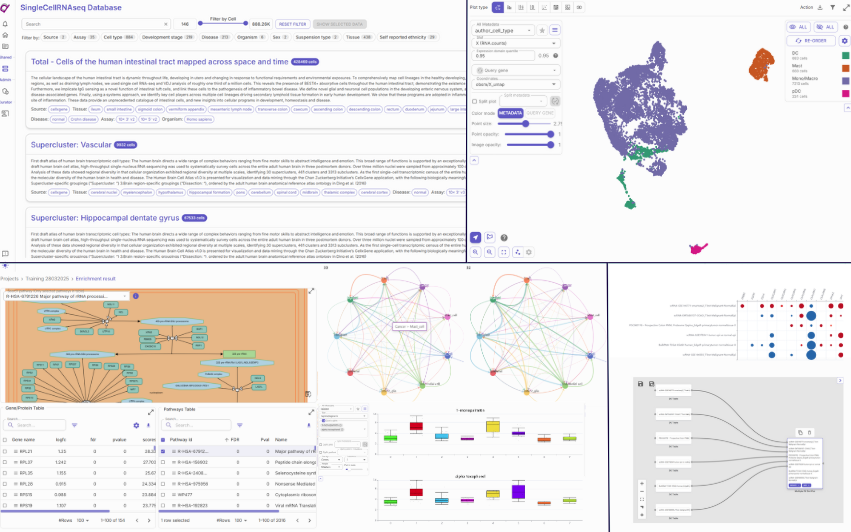
C-DIAM GUI for multi-omics data analysis (from top to bottom, left to right: curated data portal browser, single-cell analysis dashboard, pathway enrichment, cell-cell communication, multi-data summary)
Collaborative workflows
The platform also supports collaborative analysis workflows, while enabling seamless data and result sharing across collaborators. Bioinformaticians and computational biologists can load Seurat or Scanpy objects, and let bench scientists explore results interactively — no need to go back and forth over screenshots or static reports. Analyses and results can be easily shared through direct links.
No installation
And since C-DIAM is cloud-based, there’s no installation required. Just open it up in Chrome, Firefox, Safari, or any modern browser — on any device. It can be hosted behind an organization’s firewall or in a private cloud.
2. Public data access
Public omics data are incredibly valuable resources — they offer insights from thousands of studies and can help validate findings or uncover new patterns. However, they’re often fragmented across multiple repositories, and come in different raw formats, units, and metadata standards. This makes it tough to access, harmonize, and standardize the data, which in turn slows down discovery and makes cross-study analysis a major challenge.
To tackle these challenges head-on, we have built within C-DIAM the **Pythiomics **database, a curated database of over 10,000 multi-omics datasets, all rigorously QCed, harmonized, and mapped to standard vocabularies.
With C-DIAM, you can:
- Easily browse datasets of interest
- Interactively access and analyze public studies using built-in tools
- Compare public and private data to uncover shared signals and trends
- Perform meta-analysis and summarize cross-study insights — all in one place

Examples of visualizations and analytics in C-DIAM Multi-omics Studio — supporting instant and interactive access to Pythiomics
By turning messy, inconsistent public data into an organized, analysis-ready resource, C-DIAM helps you tap into the full potential of what’s already out there.
3. Meta-Analysis & Cross-Omics Insights
Different omics layers — like transcriptomics, proteomics, and metabolomics — each provide a unique view of biology. But when combined, they can tell a much bigger, more powerful story. The problem? There are very few platforms out there that make it easy to cross-analyze datasets across these layers.
C-DIAM allows you to organize datasets into “projects” where you can run meta-analyses and pull out shared patterns and insights — across studies, data types, and conditions.
Some of the powerful cross-omics insights you can extract include:
- Shared ligand-receptor interactions across conditions
- Consistently enriched pathways across datasets
- Top molecular targets found across multiple experiments

Summarizing key targets across 3 datasets
Check out this meta-analysis example, where we validated potential ADC (antibody-drug conjugate) targets for colorectal cancer using C-DIAM: A Cross-omis Validation of 25 Emerging Tumor Markers for Colorectal Cancer | Application Report
4. Customization and new method integration
Built with a microservice architecture, C-DIAM is highly customizable. Whether you want to integrate internal pipelines, add your own R Shiny apps, or run C-DIAM alongside in-house infrastructure — it’s all possible.
Let’s “Carpe DIAM”
CDIAM is currently available for free trial. Feel free to request access to the platform via: Request a trial for CDIAM | Pythia Biosciences
Source: CDIAM: A multi-omics analysis software platform with adaptability and ease of use
메타데이터
- post_id
- 143d969752b0
- slug
- c-diam-multi-omics-studio-a-comprehensive-platform-for-multi-omics-data-143d969752b0
- url
- https://medium.com/@pythia_biosciences/c-diam-multi-omics-studio-a-comprehensive-platform-for-multi-omics-data-143d969752b0
- canonical_url
- https://medium.com/@pythia_biosciences/c-diam-multi-omics-studio-a-comprehensive-platform-for-multi-omics-data-143d969752b0
- author_url
- https://medium.com/@pythia_biosciences
- status
- ok
- fetched_at
- 2026-06-09 15:37:30