What CISOs Need to Know Before Deploying AI in Their Security Stack
I am an Information Security SpecialistIncident Response / AI Business Strategist | ISO 27001,22301 & 42001 Practitioner
What CISOs Need to Know Before Deploying AI in Their Security Stack
I am an Information Security SpecialistIncident Response / AI Business Strategist | ISO 27001,22301 & 42001 Practitioner
Here’s something worth sitting with for a moment: AI is most likely already deployed in your security stack — and you may not fully know where.
Your EDR vendor added behavioral AI to detect fileless attacks. Your SIEM uses machine learning to baseline anomalies. Your email security platform runs large language models to catch sophisticated phishing. Your identity provider uses AI-driven risk scoring to trigger step-up authentication.
None of that required a board presentation, a new budget line, or a formal AI deployment decision. It shipped in a software update. You clicked accept on a terms-of-service change. And now AI is making consequential decisions inside your security infrastructure — decisions about what gets flagged, what gets blocked, and what gets ignored.
The question isn’t whether to deploy AI in your security stack. It’s whether you know where it already lives — and what risk it’s already carrying.
This is the reality CISOs are navigating in 2025. AI adoption in security isn’t a future decision — it’s a current audit finding waiting to happen. The organizations that get ahead of this will define their posture. The ones that wait will be reacting to incidents.
Before you deploy another AI-powered tool — and before you sign off on the ones already running — here’s what you need to have answered.
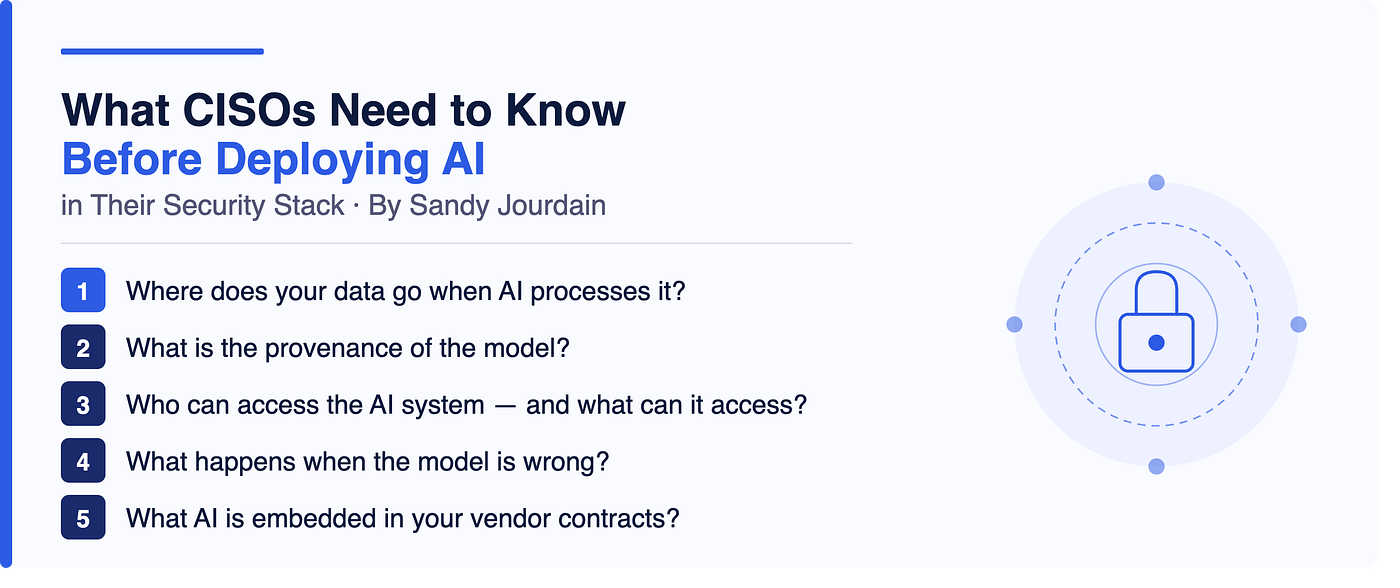
The Five Questions Every CISO Must Answer First
These aren’t philosophical — they’re operational. If you can’t answer them for an AI system in your stack, you have an uncharacterized risk in your environment.
1. Where does your data go when AI processes it?
Every AI system ingests data to function. The question is what happens to that data after it’s processed. Does it stay in your environment? Does it traverse to a vendor’s cloud? Is it used to train future model versions? Most enterprise AI contracts are vague on this — and most security teams haven’t read the data processing addendum closely enough to know. Data residency and sovereignty are not afterthoughts; they’re pre-procurement requirements.
2. What is the provenance of the model?
Where was this model trained, on what data, and by whom? Open-source models embedded in vendor products carry supply chain risk just like any other third-party component. A model trained on data that includes synthetic adversarial examples, or sourced from jurisdictions with different data governance standards, introduces risk you can’t see from the UI. Model provenance should be in your vendor security questionnaire.
3. Who can access the AI system — and what can it access?
AI systems that integrate deeply into your security stack often require elevated permissions to function. An AI-powered SOAR platform that can take automated remediation actions is, effectively, a privileged actor in your environment. Access controls, audit logging, and human-in-the-loop requirements for high-impact actions need to be defined before deployment, not after the first false-positive containment event.
4. What happens when the model is wrong?
Every AI model produces errors. In a security context, those errors have asymmetric consequences. A false negative on a critical alert means a missed intrusion. A false positive driving automated response means a contained endpoint that shouldn’t have been. You need to know the failure modes of every AI system in your stack, the mechanisms for human review, and the escalation path when the model’s confidence is low. If the vendor can’t answer this question with specifics, that’s your answer.
5. What AI is embedded in your vendor contracts?
This is the one most teams haven’t done. Pull your top 20 vendor contracts and read the AI and automated processing clauses. You will find language that permits vendors to use your data for model improvement, to deploy AI in ways that affect your environment, and to make that determination unilaterally. This is a legal and security risk. Your next vendor review cycle needs an AI addendum review as a standard step.
The Governance Gap: Why Your Existing Policies Don’t Cover AI
ISO 27001 is a strong foundation. NIST CSF gives you a credible risk framework. SOC 2 demonstrates operational controls. None of them were designed for AI systems — and the gaps are significant.
Information security frameworks assume deterministic systems. A firewall rule either allows or blocks traffic — the logic is defined, auditable, and consistent. An AI model operating on probabilistic inference doesn’t work that way. Its outputs vary based on training data, model drift, prompt construction, and input distribution shifts. The controls you’ve built for deterministic systems don’t map cleanly onto AI behavior.
Two frameworks address this directly and deserve your attention now:
● ISO 42001 (AI Management Systems) establishes requirements for responsible AI development and deployment. If you hold ISO 27001, the structure will feel familiar — it’s designed to integrate. The key additions are AI risk assessment methodology, transparency requirements, and human oversight controls. This is where forward-looking CISOs are investing their governance energy right now.
● NIST AI RMF (AI Risk Management Framework) provides a practical four-function structure: Govern, Map, Measure, Manage. It’s not prescriptive, which makes it adaptable across different AI deployment contexts. For security teams, the ‘Measure’ function — operationalizing AI risk metrics — is where the most immediate value sits.
Most security programs have a governance gap between what their frameworks require and what their AI systems actually do. Closing that gap is a CISO-level priority — not a future roadmap item.
The EU AI Act adds a regulatory dimension, particularly for organizations with European operations or EU-based data subjects. High-risk AI applications — which include AI used in critical infrastructure and certain security contexts — carry mandatory requirements for human oversight, transparency, and conformity assessment. If your organization operates across jurisdictions, AI Act compliance needs to be in your 2025 planning horizon.
Three AI Deployment Failure Modes in Security
These aren’t theoretical. These are patterns playing out in enterprise security environments right now.
Failure Mode 1: Over-automation without human review gates
The promise of AI in security is speed — faster detection, faster response, faster containment. The risk is that speed without human judgment amplifies errors at machine scale. When an AI-driven SOAR platform is configured to automatically isolate endpoints, block user accounts, or revoke access tokens based on model confidence scores, you’ve created a system where a model error becomes an operational incident. The right architecture always includes human review gates at high-impact decision points. Automation should accelerate the analyst, not replace their judgment on consequential actions.
Failure Mode 2: Shadow AI from analysts using unapproved tools
Your SOC analysts are already using AI. If your organization hasn’t provided approved, governed tools, they’re using personal accounts on public LLM platforms — and they’re pasting alert data, log excerpts, and incident details into those interfaces. That data is leaving your environment with no controls, no audit trail, and no data processing agreement. Shadow AI in security teams is a data exfiltration risk hiding in plain sight. The answer isn’t restriction — it’s providing governed tools with appropriate controls so analysts don’t need to go outside the perimeter to get the help they need.
Failure Mode 3: Adversarial inputs targeting AI decision logic
Sophisticated threat actors are studying the AI systems defenders use. Prompt injection attacks against AI-powered security tools, adversarial inputs designed to evade ML-based detection, and data poisoning attempts targeting models that learn from your environment are not future threats — they’re documented techniques. Your threat model needs to include the AI systems themselves as attack surfaces. Red team exercises should explicitly test AI components, and vendor security assessments should include questions about adversarial robustness testing.
AI Readiness Checklist: Eight Actions Before You Deploy
This is designed to be actionable within your current security program — no new budget required for the first five items.
1. Conduct an AI inventory audit.
Map every AI component currently in your security stack, including vendor-embedded AI. Document data flows, permissions, and decision authority for each system.
2. Review vendor contracts for AI clauses.
Pull your top vendor agreements and identify AI-related data processing terms. Flag any clauses permitting training data use or unilateral AI deployment.
3. Define human-in-the-loop requirements.
Establish which AI-driven actions require human approval before execution. Document this as a formal policy, not an informal norm.
4. Assess your AI governance gap.
Map your current frameworks (ISO 27001, NIST CSF, SOC 2) against ISO 42001 and NIST AI RMF. Identify the delta — these are your uncharacterized AI risks.
5. Address shadow AI proactively.
Survey your security team on what AI tools they’re currently using. Provide sanctioned alternatives with appropriate controls before restricting access.
6. Add AI to your threat model.
Update your threat model to include AI systems as attack surfaces. Include adversarial input testing in your next red team scope.
7. Build AI into your vendor security questionnaire.
Add model provenance, data residency, adversarial robustness, and AI governance questions to your standard vendor assessment process.
8. Develop an AI incident response playbook.
Define how your team responds when an AI system produces a consequential error, is compromised, or behaves anomalously. This playbook doesn’t exist in most organizations.
The Window Is Now
Regulatory pressure on AI is accelerating faster than most security programs are moving. The EU AI Act is in force. US state-level AI legislation is proliferating. Sector-specific guidance from financial regulators, healthcare oversight bodies, and critical infrastructure frameworks is putting AI governance on the examination list.
The CISOs who map their AI risk now — who conduct the inventory, close the governance gaps, and build the oversight structures — will be positioned to lead their organizations through what’s coming. They’ll be the ones briefing the board with data, not apologizing for gaps.
The ones who wait will be reacting. And in security, reactive is never where you want to be.
AI governance isn’t a future CISO priority. It’s a current audit finding waiting to be discovered.
The good news: the foundation you’ve already built — your information security management system, your risk frameworks, your vendor governance processes — is the right starting point. AI governance is not a rebuild. It’s an extension. And the CISOs who recognize that will move faster than those waiting for a perfect framework to emerge.
Start with the inventory. Everything else follows from knowing what you’re actually running.
Thank you for reading.
메타데이터
- post_id
- 14475e2e1e40
- slug
- what-cisos-need-to-know-before-deploying-ai-in-their-security-stack-14475e2e1e40
- url
- https://medium.com/@sandy.jourdain/what-cisos-need-to-know-before-deploying-ai-in-their-security-stack-14475e2e1e40
- canonical_url
- https://medium.com/@sandy.jourdain/what-cisos-need-to-know-before-deploying-ai-in-their-security-stack-14475e2e1e40
- author_url
- https://medium.com/@sandy.jourdain
- status
- ok
- fetched_at
- 2026-08-08 06:39:37


