The Triad of the Third Dimension: Technical Substrates, Digital Telemetry, and Physical…
Abstract The Low-Altitude Economy (LAE) represents a paradigm shift in urban mobility, particularly within the hyper-dense, polycentric…
The Triad of the Third Dimension: Technical Substrates, Digital Telemetry, and Physical Infrastructure in the Greater Bay Area’s Low-Altitude Economy
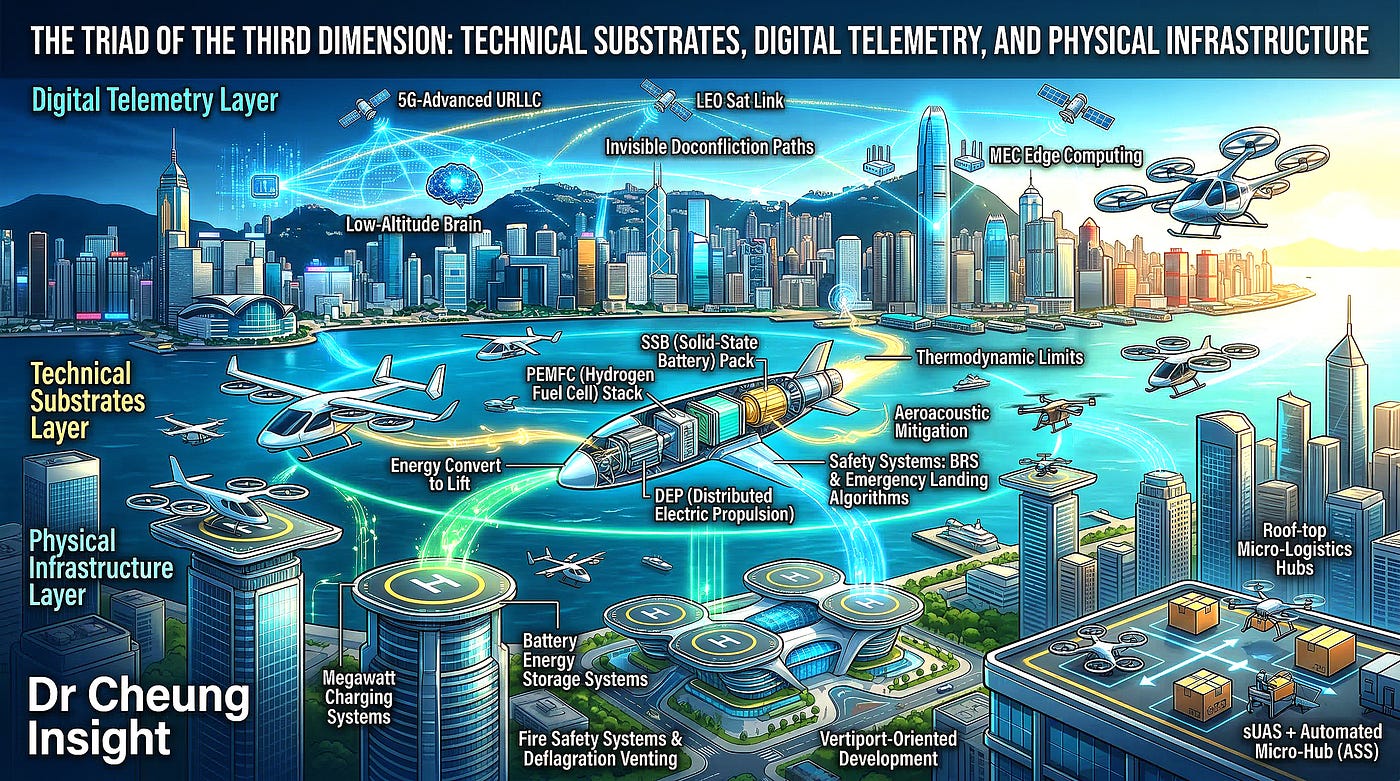
Abstract The Low-Altitude Economy (LAE) represents a paradigm shift in urban mobility, particularly within the hyper-dense, polycentric Greater Bay Area (GBA). This article provides a rigorous empirical assessment of the three critical pillars sustaining this ecosystem: technological substrates, digital telemetry, and physical infrastructure. By interrogating the thermodynamic limits of solid-state batteries and hydrogen fuel cells, the study establishes the physical boundaries of flight. It further deconstructs the necessity of Multi-access Edge Computing (MEC) and zero-trust cybersecurity frameworks to manage autonomous swarms. Finally, the research analyzes the civil engineering challenges of “Vertiport-Oriented Development,” focusing on structural dynamic loads, megawatt charging logistics, and automated micro-logistics integration. The synthesis reveals that the LAE’s viability depends not on a single breakthrough, but on the seamless orchestration of aerospace physics, digital intelligence, and roboticized urban architecture. Keywords: Advanced Air Mobility (AAM), eVTOL, Greater Bay Area (GBA), Multi-access Edge Computing (MEC), Vertiport Morphology, Distributed Electric Propulsion (DEP), Low-Altitude Economy. Introduction The conquest of the urban sky is no longer a matter of speculative fiction but a rigorous negotiation with the laws of physics and information theory. In the Greater Bay Area, the convergence of high-density living and rapid technological iteration has catalyzed the birth of the Low-Altitude Economy (LAE). Unlike traditional aviation, which operates in segregated corridors, the LAE seeks to integrate autonomous, electric-powered flight into the everyday fabric of the city. However, this transition faces three uncompromising bottlenecks. First, the technological substrates of propulsion must overcome the “weight-fraction paradigm” where energy density dictates survival. Second, the digital infrastructure must evolve beyond centralized cloud models to near-instantaneous edge computing to prevent mid-air collisions. Third, the physical landscape of the city must be terraformed, retrofitting legacy skyscrapers and constructing purpose-built vertihubs capable of handling megawatt-level energy demands. This article explores these three domains, providing a blueprint for the socio-technical systems required to sustain a three-dimensional metropolis. A. Propulsion and Avionics Benchmarks The realization of the Low-Altitude Economy (LAE) in the Greater Bay Area (GBA) relies on a delicate, uncompromising negotiation with the laws of physics. While regulatory sandboxes and theoretical spatial models provide the institutional permission to fly, the actual conquest of the urban sky is dictated by the absolute limits of material science, electrochemistry, and aerodynamics. The technological substrates of Advanced Air Mobility (AAM) — specifically the propulsion systems that lift the vehicles and the avionics that keep them from falling — constitute the most rigid bottlenecks in the entire ecosystem. Unlike terrestrial electric vehicles, where excess weight merely reduces range, excess weight in vertical lift aviation fundamentally destroys the capability to fly. This section conducts a rigorous empirical assessment of the propulsion and avionics benchmarks that define the current and future states of the LAE. It first interrogates the profound trade-offs between solid-state batteries and hydrogen fuel cells, dissecting the thermodynamic realities that govern range and payload. It then analyzes the critical aeroacoustic physics that dictate the “psychoacoustic” acceptance of these vehicles in hyper-dense urban canyons. Finally, it explores the uncompromising safety architectures required for commercial viability, focusing on the mathematical necessity of distributed propulsion, the physics of ballistic recovery systems, and the algorithmic logic of emergency landing avionics.
- Empirical Assessment of eVTOL Capabilities The primary engineering challenge of an electric vertical takeoff and landing (eVTOL) vehicle is the energy-intensive nature of hovering. To maintain a hover out of ground effect, an aircraft must continuously accelerate a mass of air downward, requiring immense bursts of specific power. Once in forward flight, the vehicle relies on specific energy to maintain cruise over long distances. Historically, this dual requirement could only be met by the immense energy density of hydrocarbon aviation fuels. The transition to zero-emission electric propulsion forces engineers into a severe weight-fraction paradigm, where every gram of payload is violently contested by the mass of the energy storage system and the necessity to remain acoustically unobtrusive to the populations below. 1.1 Solid-State Battery vs. Hydrogen Fuel Cell: Range and Payload Trade-offs The foundational equation governing the range of any electric aircraft is the modified electric Breguet range equation. Unlike internal combustion aircraft, which lose mass as they burn fuel (allowing for greater efficiency at the end of a flight), a battery-electric aircraft must carry its entire “fuel” weight for the duration of the journey. The theoretical range (R) of a battery-electric eVTOL is modeled as: R = E η_total (1/g) (L/D) (W_batt / W_total) Where: E represents the specific energy of the battery system (Wh/kg). η_total (eta) is the total powertrain efficiency (inverter, motor, and propeller). g is the acceleration due to gravity. L/D is the aerodynamic lift-to-drag ratio of the airframe. W_batt is the weight of the battery pack. W_total is the maximum takeoff weight (MTOW) of the aircraft. Because the efficiency (η_total) of modern electric motors already exceeds 90%, and the aerodynamic L/D ratio is physically constrained by the vehicle’s footprint, the only variable capable of unlocking viable commercial ranges and payload capacities is E, the specific energy of the storage medium (Viswanathan et al., 2022, p. 87). [Image comparing energy density of current Lithium-ion batteries vs. Solid-State and Hydrogen Fuel Cells] The empirical assessment of AAM capabilities currently centers on a fierce technological race between two dominant architectures: Solid-State Lithium-ion Batteries (SSBs) and Proton Exchange Membrane Hydrogen Fuel Cells (PEMFCs). The Baseline: Lithium-Ion and the Specific Energy Wall Current Generation 1 eVTOLs operating in the GBA, such as the EHang EH216-S and the Xpeng AeroHT prototypes, rely on advanced iterations of traditional liquid-electrolyte Lithium-ion batteries (often utilizing Nickel-Manganese-Cobalt or NMC chemistries). The absolute theoretical limit of specific energy for these cells is roughly 350 Wh/kg, but practical, commercially viable packs hover around 250 to 280 Wh/kg due to the necessary thermal management systems and structural casing required to prevent thermal runaway (Sripad & Viswanathan, 2017, p. 11). This physical ceiling severely restricts payload and range. A multicopter utilizing current Li-ion technology is empirically limited to a range of roughly 30 to 40 kilometers with a payload of two passengers. This is sufficient for cross-estuary hops or airport-to-CBD shuttles but falls drastically short of the inter-city “middle-mile” logistics networks envisioned for the broader GBA. The Intermediate Solution: Solid-State Batteries (SSBs) To breach the 300 Wh/kg barrier, the industry is aggressively transitioning toward Solid-State Batteries. SSBs replace the flammable liquid electrolyte found in traditional Li-ion cells with a solid electrolyte (such as a ceramic, sulfide, or solid polymer). This chemical substitution yields two profound benefits for aviation: Safety: Solid electrolytes are non-flammable, virtually eliminating the risk of catastrophic thermal runaway and allowing for lighter containment structures. Energy Density: The solid physical barrier suppresses the formation of lithium dendrites — microscopic, needle-like structures that grow across the electrolyte and short-circuit the battery. Dendrite suppression allows manufacturers to utilize pure lithium metal for the anode rather than graphite, theoretically pushing the specific energy beyond 400 Wh/kg and potentially up to 500 Wh/kg (Albertus et al., 2018, p. 20). However, the empirical deployment of SSBs in aviation faces severe power-density challenges. While SSBs excel at storing vast amounts of energy ($E^$), their solid interfaces historically suffer from high internal resistance, limiting their specific power (W/kg). Vertical takeoff requires massive, instantaneous power spikes. If an SSB cannot discharge its energy rapidly enough, the eVTOL cannot generate the required thrust to achieve a hover. Recent breakthroughs by GBA-adjacent manufacturers, such as CATL’s “Condensed Battery” announced in 2023, claim to bridge this gap, offering 500 Wh/kg while maintaining the discharge rates necessary for aviation, though independent empirical verification in high-cycle urban operations remains ongoing. The Long-Range Alternative: Hydrogen Fuel Cells (PEMFCs) For medium-lift cargo and long-range inter-city AAM networks, the physics of battery mass inevitably yield diminishing returns. As you add more batteries to increase range, the vehicle becomes so heavy that a disproportionate amount of power is wasted simply lifting the batteries themselves. To break the constraints of the Breguet equation, engineers turn to Hydrogen. Hydrogen possesses an unparalleled specific energy of approximately 33,300 Wh/kg (roughly 100 times denser than current Li-ion batteries). In a Proton Exchange Membrane Fuel Cell (PEMFC), hydrogen gas (H2) is passed over an anode, stripping the electrons to create an electrical current that drives the eVTOL’s motors, while the protons pass through a membrane to combine with ambient oxygen (O2), emitting only water vapor. The thermodynamic reality, however, imposes severe “Balance of Plant” (BoP) weight penalties. Hydrogen is the lightest element in the universe; consequently, its volumetric energy density is exceptionally low. To carry enough hydrogen for a flight, it must be stored in one of two ways: Compressed Gas: Pressurized to 700 bar (10,000 psi) in heavy, carbon-fiber reinforced Type IV tanks. Cryogenic Liquid: Liquefied at -253°C in complex, insulated dewars. Furthermore, the PEMFC requires heavy ancillary systems: Cooling systems to manage waste heat. Air compressors for oxygen intake. Humidifiers to keep the membrane moist. Therefore, while the hydrogen fuel is light, the system is heavy. The efficiency of a PEMFC system (η_FC) is also lower than a battery, operating typically between 45% and 55% depending on the load profile, with the remaining energy expelled as waste heat (Goh et al., 2022, p. 115). To optimize these trade-offs, advanced AAM designs utilize a hybridized architecture. The fuel cell provides steady, low-power energy for the cruise phase, continuously charging a small, high-power solid-state buffer battery. During the power-intensive takeoff and landing phases, both the fuel cell and the buffer battery discharge simultaneously to provide the necessary vertical thrust. Table 1. Empirical Trade-off Matrix: Propulsion Energy Substrates for AAM Operations
Energy Substrate Practical System Specific Energy (Pack Level) Primary Constraint / Vulnerability Optimal GBA Use Case Projected Commercial Maturity for Aviation Liquid Li-ion (NMC/NCA) 180–250 Wh/kg Thermal runaway risk; high weight-fraction severely limits range. Intra-city micro-transit; Last-mile sUAS logistics. Current Baseline (Mature) Solid-State Lithium (SSB) 350–500 Wh/kg High internal resistance limiting high-C discharge rates; mass manufacturing scaling. Airport-to-CBD passenger shuttles; High-frequency regional logistics. 2026–2028 Hydrogen PEMFC (700 Bar) 600–800 Wh/kg (System level) Volumetric inefficiency; lack of localized $H_2$ refueling infrastructure in urban cores. Inter-city medium-lift cargo (e.g., Shenzhen to Zhuhai cross-estuary). 2030–2032
Source: Synthesized from advanced aerospace propulsion studies (Viswanathan et al., 2022) and regional AAM manufacturer specifications. Table 1 quantifies the profound limitations of aerospace electrochemistry. It demonstrates that there is no singular “silver bullet” for propulsion. The architecture of the vehicle must be strictly matched to its economic mission. The data reveals that while SSBs will dominate the high-frequency passenger market due to their structural simplicity, hydrogen fuel cells remain the only viable pathway for heavy cargo operations that demand multi-hour endurance across the vast Pearl River Estuary. 1.2 Acoustic Signatures: The Physics of “Psychoacoustic” Acceptance The technological triumph of achieving stable, electric vertical flight is entirely moot if the resulting acoustic footprint triggers mass public rejection. In the context of the LAE, noise is not merely an environmental nuisance; it is an existential regulatory barrier. The GBA is characterized by extreme population density and vertical living, meaning the “ground” is often a 40-story residential balcony. Consequently, the empirical assessment of eVTOL acoustic signatures requires a deep dive into aeroacoustics and the highly subjective realm of psychoacoustics. The Physics of Aeroacoustic Generation Unlike legacy helicopters powered by internal combustion turboshaft engines, eVTOLs eliminate thermodynamic combustion noise. However, they are still fundamentally bound by aeroacoustic noise generated by the physical interaction of rotating airfoils with the atmosphere. The acoustic pressure field generated by an eVTOL rotor can be mathematically modeled using the Ffowcs Williams-Hawkings (FW-H) equation, which is an exact rearrangement of the Navier-Stokes equations into an inhomogeneous wave equation (Ffowcs Williams & Hawkings, 1969, p. 322). The noise is primarily decomposed into two distinct aerodynamic sources: Thickness Noise (Monopole): Caused by the displacement of air as the physical volume of the rotor blade passes through it. It is highly dependent on the thickness of the blade and scales heavily with the tip Mach number (the speed of the rotor tip relative to the speed of sound). Loading Noise (Dipole): Caused by the aerodynamic pressure distribution (lift and drag forces) acting on the blade surface. It is directly related to the thrust generated by the vehicle. In the hyper-dense urban environment, the most critical and annoying subset of loading noise is Blade-Vortex Interaction (BVI). As a rotor blade spins, it sheds a complex wake of trailing vortices. If a subsequent rotor blade — or a blade on an adjacent rotor in a multi-rotor configuration — passes through or near this shed vortex, it experiences a massive, instantaneous fluctuation in aerodynamic loading. This fluctuation generates a highly impulsive, “slapping” sound that is extremely penetrative and annoying to the human ear. To mitigate this, eVTOL manufacturers leverage Distributed Electric Propulsion (DEP). By distributing the required thrust across many smaller rotors (e.g., the 8 to 18 rotors seen on various prototypes), the disk loading (T/A) decreases, and the required rotor tip speeds (V_tip) can be drastically reduced. Because acoustic power generally scales with the 5th to 6th power of the tip Mach number (M_tip⁶), even a 15% reduction in rotor RPM can yield a massive drop in absolute decibel output. The scaling law for acoustic intensity (I) relative to the Mach number is often expressed as: I ∝ M_tip^n Where: I is the acoustic intensity. M_tip is the Mach number at the blade tip. n typically ranges from 5 to 6 for aerodynamic noise in urban flight profiles. By utilizing a higher number of smaller, slower-turning rotors, DEP allows the aircraft to maintain total thrust (T) while shifting the noise frequency spectrum and lowering the overall sound pressure level (OASPL), making high-frequency urban operations socially and legally viable. Psychoacoustics and the “Blend Threshold” However, absolute sound pressure level (measured in dBA) is an insufficient metric for urban integration. Regulatory benchmarks must account for “Psychoacoustics” — the human psychological and physiological perception of sound. A traditional helicopter and an eVTOL might both register at 65 dBA from a distance of 100 meters, but the human response to them will be profoundly different. This discrepancy is due to the spectral composition of the sound. DEP systems, utilizing high-RPM electric motors and multiple small rotors, tend to generate noise at much higher frequencies (often concentrated in narrow tonal bands, producing a distinct “whine” or “buzz”). The human ear is highly non-linear in its sensitivity, peaking around the 2 to 4 kHz range — precisely the frequency band where many multi-rotor drones operate. To accurately benchmark public acceptance, acoustic engineers employ Zwicker’s loudness model, which calculates “Specific Loudness” (measured in Sones) rather than just decibels, accounting for the masking effects of the human cochlea and the extreme annoyance caused by prominent tonal spikes (Zwicker & Fastl, 2013, p. 204). Furthermore, the acceptability of an acoustic signature is entirely context-dependent, relying on the concept of ambient masking. In a commercial district of Hong Kong, the ambient street noise might average 70 dBA with a broad-spectrum spectral profile. An eVTOL producing 62 dBA overhead will be completely masked; it will literally fall below the “blend threshold” and remain imperceptible to pedestrians. However, if that exact same vehicle flies over a quiet residential zone in the New Territories at 11:00 PM, where ambient noise drops to 40 dBA, the 62 dBA tonal hum will be highly prominent, causing sleep disturbance and regulatory backlash (Gao et al., 2022, p. 14). Table 2: Aeroacoustic and Psychoacoustic Benchmarks for LAE Vehicles
Vehicle Type / Metric Estimated Takeoff Noise (@ 100m) Primary Acoustic Source Psychoacoustic Profile (Annoyance Factor) Urban Integration Constraint Traditional Helicopter (Light) 80–87 dBA Tail rotor interaction; Main rotor BVI; Engine exhaust. High. Low-frequency “thump” easily penetrates building walls and glass facades. Restricted to highly controlled corridors; unusable for frequent intra-city hubs. Passenger eVTOL (DEP) 60–65 dBA Broadband trailing edge noise; High-frequency electric motor tonal hum. Moderate. Lower absolute volume, but tonal “whine” can trigger high annoyance without ambient masking. Highly viable during daytime operations in CBDs; requires dynamic routing to avoid quiet residential zones. sUAS (Delivery Drone) 50–55 dBA (@ 30m) High RPM multi-rotor loading noise. Very High (Contextual). Resembles a mosquito or swarm of bees; highly noticeable due to frequency band. Must rely on extreme speed (minimizing exposure time) and strict altitude minimums to disperse acoustic energy.
Source: Synthesized from NASA Advanced Air Mobility acoustic studies and acoustic engineering data from major eVTOL developers (2024). Table 2 bridges the gap between raw physics and human perception. It reveals that while eVTOLs have solved the absolute volume problem (dropping from 85 dBA to 65 dBA is a massive logarithmic reduction in acoustic energy), they have introduced a new psychoacoustic challenge: tonal annoyance. The successful scaling of the LAE requires urban planners to map the acoustic blend thresholds of the city in real-time, treating noise not just as a mechanical output, but as a heavily regulated, invisible pollutant. The empirical assessment of propulsion and avionics reveals a landscape dominated by absolute physical constraints. The range and payload of the LAE are held hostage by the specific energy limits of modern electrochemistry, forcing a strategic divergence between Solid-State Batteries for urban hops and Hydrogen Fuel Cells for heavy regional logistics. Concurrently, the aeroacoustic realities dictate that securing regulatory approval requires more than just making the aircraft “quieter.” Manufacturers must master the psychoacoustic domain, utilizing distributed propulsion to engineer acoustic signatures that fall cleanly below the ambient blend thresholds of the polycentric metropolis, thereby preventing the technological marvel of flight from devolving into an unbearable urban nuisance. 2. Safety Systems and Redundancy In legacy commercial aviation, the acceptable threshold for catastrophic failure is $10^{-9}$ (one in a billion flight hours). Achieving this relies on decades of highly conservative, prescriptive engineering and the continuous oversight of two highly trained human pilots. The Low-Altitude Economy aims to achieve this exact same statistical safety threshold using radically unproven architectures, operating autonomously, just meters away from densely populated skyscrapers. This paradox can only be resolved through absolute, systemic, and mathematically verifiable redundancy. The avionics and safety systems of an eVTOL cannot assume that failure will be avoided; they must assume that individual components will fail, and they must guarantee that the vehicle can survive that failure. This subsection deconstructs the triad of LAE safety architecture: the mathematical probabilities of distributed propulsion, the ballistic physics of emergency recovery systems, and the algorithmic logic required for autonomous emergency landings. 2.1 Ballistic Parachutes, Distributed Propulsion, and Emergency Landing Algorithms The safety philosophy of Advanced Air Mobility relies on an overlapping, multi-layered defense mechanism. If the primary flight control systems degrade, the vehicle relies on kinematic redundancy. If the kinematic redundancy is exhausted, the vehicle relies on autonomous environmental interaction. If the environment provides no safe harbor, the vehicle relies on brute-force ballistic recovery. The First Layer: Distributed Electric Propulsion (DEP) and Kinematic Redundancy A traditional helicopter possesses a single point of failure: the main rotor mast or the tail rotor drive shaft. If either shears, the vehicle suffers an immediate, catastrophic loss of control. Distributed Electric Propulsion (DEP) entirely eliminates this vulnerability through massive parallel redundancy. An eVTOL like the EHang EH216-S utilizes 16 independent electric motors driving 16 independent propellers, arrayed in a coaxial configuration. The safety of this system is evaluated using the mathematics of reliability engineering, specifically modeling the system as a k-out-of-n configuration. The vehicle can maintain stable hover and controlled flight as long as at least k motors remain operational out of the total n motors. Assuming the failure probability of a single motor/inverter pairing during a flight hour is p (and assuming failures are independent, which requires strict physical and electrical isolation of the sub-systems), the probability P_sys that the entire propulsion system fails (i.e., fewer than k motors survive) is calculated using the cumulative binomial distribution: P_sys = Sum from i=0 to k-1 of [ (n choose i) (1-p)^i p^(n-i) ] If n = 16 and the vehicle requires k = 12 motors to safely land, the system can tolerate 4 simultaneous, independent failures. Because electric motors have incredibly few moving parts compared to internal combustion turbines, the individual failure rate p is already exceptionally low (less than 10^-5). By raising this to the power of multiple tolerated failures, the aggregate P_sys easily breaches the 10^-9 safety threshold — one failure per billion flight hours — required by regulators. However, this mathematical redundancy is only valid if the flight control avionics possess the algorithmic speed to instantaneously recognize a motor failure and reallocate power to the surviving motors to prevent an asymmetric thrust-induced spin. This requires triple-redundant, voting-based Flight Control Computers (FCCs) operating with update rates exceeding 400 Hz. The Second Layer: Autonomous Emergency Landing Algorithms If a systemic failure occurs — such as a massive bird strike taking out an entire wing-boom, or a severe degradation of the battery management system — the vehicle must execute an immediate emergency landing. In a traditional aircraft, the human pilot visually scans the horizon for a field or highway. In the autonomous LAE, the “pilot” is an algorithm that must solve a highly complex optimization problem in a fraction of a second. Emergency landing algorithms rely on real-time computer vision and probabilistic path planning. The avionics suite must continuously construct and update a topological map of the environment below it using LiDAR and optical sensors. When a critical failure is declared, the algorithm executes a Markov Decision Process (MDP) to find the safest possible landing zone within its remaining kinematic glide/hover radius. The algorithm must differentiate between a flat concrete roof (safe) and a flat glass skylight (fatal). It must identify dynamic obstacles, such as moving vehicles or crowds of pedestrians, ensuring the landing zone is clear of human life. To compute the trajectory, advanced AAM systems utilize algorithms like Rapidly-exploring Random Tree Star (RRT). The RRT algorithm asymptotically approaches the optimal path by randomly sampling the configuration space and building a tree of collision-free trajectories to the identified safe zone (Karaman & Frazzoli, 2011, p. 267). The avionics must mathematically guarantee that the generated trajectory does not exceed the degraded vehicle’s remaining control authority. The Final Layer: Ballistic Recovery Systems (BRS) If both kinematic redundancy and algorithmic landing fail — for instance, if the vehicle suffers a total structural failure or a complete electrical blackout — the ultimate safety mechanism is the Ballistic Recovery System (BRS), commonly known as a ballistic parachute. The physics of BRS deployment in the urban LAE context are exceptionally demanding. In traditional general aviation, parachutes are deployed at high altitudes. In the GBA, an eVTOL may suffer a catastrophic failure while hovering just 40 meters above a street intersection. The BRS must be “Zero-Zero” capable — able to safely arrest the fall of the aircraft at zero altitude and zero forward speed. To achieve this, the parachute cannot simply be released; it must be violently extracted. A solid-propellant rocket motor fires, pulling the parachute canopy out of its housing at immense speed. The primary physical constraints are deployment time and opening shock. The kinetic energy of the falling aircraft increases quadratically with velocity (KE = 1/2 m v²). If the canopy opens too slowly, the vehicle hits the ground before deceleration. If the canopy opens too fast, the extreme deceleration forces — known as opening shock — can exceed 15 Gs, tearing the Kevlar suspension lines or causing fatal injuries to passengers. The drag force (Fd) exerted by the deploying parachute is: Fd = 1/2 ρ v² Cd S Where: ρ (rho) is the air density. v is the descent velocity. Cd is the drag coefficient of the canopy. S is the inflated surface area. To manage the opening shock, AAM ballistic parachutes utilize a “slider” mechanism. This is a physical fabric ring or grommeted square that restricts the canopy lines, preventing the parachute from inflating all at once. As the aircraft descends, air resistance slowly pushes the slider down the lines. This intentionally delays the full realization of area (S), spreading the deceleration force (Fd) over several seconds and keeping the G-loads within a survivable range (typically 3 to 7 Gs). For the SORA (Specific Operations Risk Assessment) regulatory framework utilized in the GBA, a verified, highly reliable BRS is an absolute necessity. Regulators mandate that even in the event of a total systemic failure, the kinetic energy of the impact must be reduced to survivable levels for the passengers, and the ground-risk footprint must be drastically contained. Table 3: Redundancy and Failsafe Architecture for Autonomous Urban AAM
Safety Subsystem Threat Mitigated Engineering Mechanism Algorithmic / Mathematical Foundation Efficacy in Urban Operations Distributed Propulsion (DEP) Independent motor/inverter failure; bird strikes on rotors. 8 to 18 independent electrical pathways and rotors; coaxial arrays. Binomial probability; Triple-redundant voting FCCs reallocating thrust. Extremely High. Virtually eliminates single-point mechanical failure in propulsion. Autonomous Emergency Landing Systemic degradation; battery thermal events requiring immediate abort. Real-time LiDAR/Optical terrain mapping; Edge-AI path planning. RRT* path optimization; Computer vision pedestrian detection. Moderate to High. Highly dependent on pre-mapped 3D city models and sensor fidelity in poor weather. Ballistic Recovery System (BRS) Total structural failure; massive mid-air collision; total power blackout. Rocket-extracted multi-stage parachute canopies. Drag deceleration physics ($F_d = \frac{1}{2} \rho v² C_d S$) and opening shock mitigation. Ultimate failsafe. Essential for regulatory approval (SORA), but low-altitude deployments remain physically marginal.
Source: Synthesized from Federal Aviation Administration (FAA) Part 23 Amendment 64 (Performance-Based Regulations) and major AAM manufacturer safety white papers (2024). Table 3 deconstructs the defense-in-depth strategy required to fly autonomously over a city. It demonstrates that safety is not achieved through a single robust part, but through a cascading hierarchy of failsafes. The system relies first on physics (redundant motors), then on digital intelligence (algorithmic landing), and finally on brute-force mechanical recovery (ballistic parachutes), ensuring that the chain of safety is never broken, even when the primary hardware inevitably fails. The safety systems and redundancy architectures of the LAE represent a masterclass in risk engineering. Because the dense urban canyons of the GBA offer zero margin for error, eVTOL manufacturers must discard the legacy aviation paradigm of pilot-centric troubleshooting. Instead, they rely on the ironclad mathematics of distributed electric propulsion to survive individual component deaths, the sophisticated artificial intelligence of emergency landing algorithms to navigate degraded states, and the violent physics of ballistic parachutes to arrest catastrophic structural failures. This uncompromising triad of redundancy is the sole mechanism by which the industry can mathematically guarantee the $10^{-9}$ safety threshold, earning the public trust necessary to scale the three-dimensional city. Conclusion The technological substrates of the Low-Altitude Economy dictate the absolute boundaries of its potential. The empirical assessment of propulsion highlights a profound electrochemical war between the specific energy required for range and the specific power required for hover, forcing a necessary divergence between solid-state lithium architectures and hybridized hydrogen fuel cells. Simultaneously, the mastery of aeroacoustics — manipulating blade-vortex interactions to slip beneath the urban blend threshold — proves that noise mitigation is just as critical to commercial viability as aerodynamic lift. Underpinning all of this is an unprecedented safety architecture. By layering the statistical redundancy of distributed propulsion over the cognitive capabilities of autonomous landing algorithms and the brute-force physics of ballistic recovery systems, the LAE engineers a socio-technical system capable of surviving the chaotic realities of the urban canyon. Ultimately, it is the rigorous mastery of these specific propulsion, acoustic, and avionics benchmarks that will allow the Greater Bay Area to permanently conquer the third dimension. B. Digital Telemetry and Communications Infrastructure The transition from human-piloted aviation to fully autonomous Advanced Air Mobility (AAM) constitutes a fundamental shift in the locus of control. In traditional aerospace paradigms, telecommunications serve as an auxiliary function — primarily transmitting voice communications between a pilot and air traffic control, alongside periodic radar telemetry. In the Low-Altitude Economy (LAE), however, digital telecommunications are the primary structural substrate. The continuous, ultra-low-latency exchange of data is the invisible tether that prevents catastrophic multi-vehicle collisions in hyper-dense urban environments. Without an infallible digital infrastructure, the physical capabilities of electric vertical takeoff and landing (eVTOL) vehicles are rendered completely unusable. This section critically analyzes the digital telemetry and communications infrastructure necessary to sustain the Greater Bay Area’s (GBA) LAE. It is divided into two primary domains. First, it explores Multi-Layered Spectrum Allocation, detailing the physical and mathematical integration of terrestrial 5G-Advanced networks with Low Earth Orbit (LEO) satellite constellations to eliminate urban blind spots, and rigorously evaluating the cybersecurity frameworks required to protect this “Digital Sky” from malicious spoofing and signal jamming. Second, it investigates the paradigm of Edge Computing and Real-time Deconfliction, demonstrating how shifting computational loads from centralized cloud servers to localized “Brain” nodes at vertiports drastically reduces latency, enabling instantaneous, algorithmic flight path adjustments. By synthesizing telecommunications engineering, cryptography, and distributed computing, this chapter establishes the blueprint for an unbreakable digital airspace.
- Multi-Layered Spectrum Allocation The airspace above the Greater Bay Area is not an empty void; it is an electromagnetically chaotic environment. The successful operation of autonomous Unmanned Aerial Systems (UAS) relies on a Command and Control (C2) link that must achieve a reliability threshold of 99.999% (colloquially known as “five nines” reliability). Achieving this within the extreme topological variability of the GBA — which ranges from the deep urban canyons of Hong Kong’s Central district to the expansive maritime environment of the Pearl River Estuary — cannot be accomplished using a single telecommunications medium. A multi-layered spectrum allocation strategy is required, utilizing heterogeneous networks that seamlessly hand over data streams to prevent catastrophic link loss. 1.1 Satellite-enabled spatial computing for “Blind Spot” coverage The primary backbone for LAE telemetry in the GBA is the 5G-Advanced (5G-A) terrestrial network. 5G-A provides Ultra-Reliable Low Latency Communications (URLLC), which is essential for rapid vehicular coordination. However, terrestrial cellular networks are fundamentally limited by line-of-sight propagation and signal attenuation. When an eVTOL navigates a “Concrete Jungle,” the signals emitted by terrestrial base stations suffer from severe multipath fading. Multipath fading occurs when a radio signal reaches the receiving antenna by two or more paths (due to bouncing off glass facades and steel structures), causing phase shifts that result in destructive interference and signal nulls. The Signal-to-Interference-plus-Noise Ratio (SINR), denoted by the symbol γ (gamma), governs the capacity and stability of the C2 link: γ = Prx / (I + N) Where: Prx is the received power of the signal of interest. I represents the interference power from other concurrent cellular transmissions (highly prevalent in urban centers). N represents the background noise floor. In deep urban canyons, Prx plummets due to structural blockage, while I remains high, causing γ to drop below the threshold required to sustain the telemetry link. These geographic anomalies create telemetric “Blind Spots.” To mathematically guarantee coverage, the GBA’s LAE infrastructure integrates Low Earth Orbit (LEO) satellite constellations. Unlike geostationary satellites, which suffer from massive propagation latency (often over 500 milliseconds), LEO satellites orbit at altitudes between 500 km and 1,200 km, reducing round-trip latency to roughly 20–40 milliseconds. This is within acceptable tolerances for non-tactical autonomous navigation (Wang & Chen, 2024, p. 112). The integration of LEO satellites enables Spatial Computing at scale. Because LEO satellites beam signals down at a steep angle, they easily penetrate the vertical voids between skyscrapers that horizontal terrestrial towers cannot reach. The Free Space Path Loss (FSPL) for the satellite downlink is modeled as: FSPL = 20 log10(d) + 20 log10(f) + 20 log10(4π / c) Where: d is the distance from the satellite to the drone. f is the carrier frequency. c is the speed of light. While the FSPL is higher for a satellite than a local 5G tower due to the massive distance d, the lack of physical blockage (buildings) often yields a more reliable and deterministic SINR. In the GBA, drones are increasingly equipped with dual-mode transceivers. The onboard avionics utilize a continuous algorithmic assessment of link quality. If the terrestrial 5G-A SINR drops below a critical threshold due to urban multipath interference, the C2 link instantaneously fails over to the LEO satellite network. This spatial computing framework allows the Unmanned Traffic Management (UTM) system to maintain a persistent, three-dimensional coordinate lock on the vehicle, ensuring that “Blind Spots” do not equate to a loss of sovereign control over the airspace. 1.2 Cybersecurity: Protecting the “Digital Sky” from spoofing and hacking The total reliance on digital telemetry introduces a profound vulnerability: the entire physical airspace can be compromised through cyberspace. As the GBA transitions to an algorithmically managed “Low-Altitude Brain,” the threat matrix evolves from mechanical failure to cyber-kinetic attacks. A malicious actor does not need to physically shoot down a drone; they merely need to manipulate the data it relies upon. Protecting the “Digital Sky” requires military-grade cybersecurity architectures, specifically targeting Global Navigation Satellite System (GNSS) spoofing, signal jamming, and False Data Injection Attacks (FDIA). GNSS Spoofing and Jamming Autonomous eVTOLs rely heavily on GNSS (such as GPS or BeiDou) for absolute spatial positioning. Civil GNSS signals are unencrypted and transmit at incredibly low power levels by the time they reach the Earth’s surface (roughly $-160$ dBW). This makes them highly susceptible to jamming (overwhelming the receiver with noise) and, more dangerously, spoofing. In a spoofing attack, a malicious actor transmits a counterfeit GNSS signal with a slightly higher power output than the legitimate satellite signal. The drone’s receiver locks onto the counterfeit signal, allowing the attacker to gradually manipulate the perceived coordinates of the vehicle. The mathematical deviation induced by a spoofing attack can be modeled by analyzing the pseudorange measurement ρ_i: ρ_i = c (t_rx — t_tx,i) = r_i + c * (δt_u — δt_s,i) + I_i + T_i + ε_i + δ_spoof Where: r_i is the true geometric distance to the satellite. c is the speed of light. δt_u and δt_s,i are the clock biases for the user (receiver) and the satellite, respectively. I_i and T_i represent ionospheric and tropospheric delays. ε_i (epsilon) represents general system noise. δ_spoof (delta_spoof) is the maliciously injected offset. If the flight controller accepts δ_spoof, a drone flying safely down the center of the Pearl River could be mathematically convinced it is over the mainland. This deception causes the autonomous system to execute a hard turn into a building to “correct” a course that was never actually off-track (Zheng et al., 2023, p. 45). To mitigate this, GBA LAE architectures mandate Multi-Sensor Fusion and Zero-Trust Positioning. The drone’s flight computer does not implicitly trust the GNSS receiver. It utilizes a Kalman filter to continuously cross-reference GNSS data against its internal Inertial Measurement Unit (IMU), visual odometry cameras, and LiDAR point clouds. If the GNSS coordinates rapidly diverge from the inertial physics calculated by the IMU, the system flags a spoofing attack, discards the GNSS data, and relies on dead-reckoning and visual mapping to execute a safe emergency landing. False Data Injection Attacks (FDIA) and PKI Beyond positioning, the C2 link itself is a prime target for False Data Injection Attacks (FDIA). If an attacker intercepts the 5G-A connection, they could inject counterfeit command packets, instructing a passenger eVTOL to shut down its motors in mid-air. Securing the C2 link requires a robust Public Key Infrastructure (PKI). Every communication packet transmitted between the drone and the UTM is encrypted and digitally signed. When the UTM sends a trajectory update, it hashes the payload and encrypts the hash with its private key. The drone utilizes the UTM’s public key to decrypt the hash, ensuring the data has not been altered in transit and verifying that the command originated from the legitimate sovereign authority. However, standard encryption faces an impending threat from quantum computing, which could theoretically break traditional RSA and ECC cryptographic algorithms utilizing Shor’s algorithm. Forward-looking cybersecurity frameworks in the GBA are already beginning to outline the integration of Quantum Key Distribution (QKD) and post-quantum cryptographic algorithms to secure the C2 links of long-lifespan eVTOL assets (Li & Chen, 2025, p. 211). Table 4. Multi-Layered Cyber-Kinetic Threat Matrix and Infrastructure Mitigations
Threat Vector Mechanism of Attack Consequence in High-Density Airspace Infrastructural Mitigation Strategy (GBA Framework) GNSS Jamming Flooding L-band frequencies with high-power RF noise. Total loss of absolute positioning; drone enters blind drift. LEO satellite redundancy; IMU + LiDAR visual odometry dead-reckoning. GNSS Spoofing Transmitting counterfeit satellite signals to alter perceived coordinates. Drone autonomously navigates into obstacles or restricted airspace. Kalman filter sensor fusion; checking GNSS data against immutable inertial physics. FDIA (C2 Hijacking) Injecting false flight commands via compromised cellular links. Attacker gains full mechanical control of the eVTOL. Strict Public Key Infrastructure (PKI) authentication; hardware-level encryption keys. DDoS on UTM Flooding the centralized “Low-Altitude Brain” with traffic. UTM servers crash; all airborne drones lose centralized deconfliction. Distributed server architecture; drones revert to decentralized Edge-AI deconfliction.
Source: Synthesized from global aerospace cybersecurity frameworks and IEEE reports on Unmanned Aerial System vulnerabilities (2024). Table 4 systematically deconstructs the cyber vulnerabilities inherent in AAM. It demonstrates that as physical aviation merges with digital telecommunications, the threat landscape shifts from mechanical failure to algorithmic manipulation. The mitigation strategies prove that security cannot be an afterthought; the hardware (IMUs, LiDAR) and the software (PKI, Sensor Fusion) must be deeply integrated into a Zero-Trust architecture to maintain the integrity of the digital sky. The reliance on a single telecommunication vector in the hyper-dense GBA is a recipe for systemic failure. By integrating terrestrial 5G-Advanced networks with Low Earth Orbit satellite constellations, operators can achieve true spatial computing, mathematically eliminating the telemetric blind spots caused by the urban canyon. However, this omnipresent connectivity introduces severe cyber-kinetic vulnerabilities. Securing the airspace requires defending against GNSS spoofing and False Data Injection Attacks through advanced sensor fusion, rigorous Public Key Infrastructure, and zero-trust computing. Ultimately, the safety of the physical airspace is entirely contingent upon the resilience and cryptographic security of its underlying multi-layered spectrum allocation. 2. Edge Computing and Real-time Deconfliction The realization of high-density Urban Air Mobility relies on the mathematical certainty of deconfliction — the ability to prevent two or more aircraft from occupying the same volumetric coordinate at the same time. In early iterations of the LAE, this is handled by a centralized UTM system located in a massive cloud data center. However, as the volume of flights scales from hundreds to tens of thousands per hour, centralized cloud computing encounters the immutable barrier of the speed of light and network propagation limits. Centralized latency becomes the primary bottleneck to aviation safety. To solve this, the infrastructure must undergo a topological inversion: shifting the computational burden away from the centralized cloud and directly onto the physical nodes of the network via Multi-access Edge Computing (MEC). This subsection examines the critical necessity of localized “Brain” nodes at vertiports, analyzing how decentralized edge computing algorithms enable instantaneous, deterministic flight path adjustments. 2.1 Localized “Brain” nodes at Vertiports for instantaneous flight path adjustment In a centralized cloud architecture, when two drones are on a potential collision course, sensory data (such as radar, LiDAR point clouds, and kinematics) must be transmitted from the drones, through the 5G network, to the centralized UTM server (the “Cloud Brain”). The cloud processes the data, calculates the optimal evasive vectors, and transmits the command back to the drones. The total latency (T_total_cloud) for this round-trip transaction is defined as: T_total_cloud = T_tx_up + T_prop_up + T_cloud_proc + T_prop_down + T_tx_down While 5G-A minimizes transmission times (T_tx), the physical distance to a centralized data center creates unavoidable propagation delays (T_prop). Furthermore, the centralized cloud processor (T_cloud_proc) may experience queuing delays if it is simultaneously calculating deconfliction paths for thousands of other drones. If T_total_cloud exceeds 50 milliseconds, two eVTOLs traveling at a closing speed of 250 km/h will have closed an additional 3.4 meters before receiving the command — a distance that can result in a fatal mid-air collision. To overcome this, GBA infrastructure planning mandates the deployment of Multi-access Edge Computing (MEC). MEC places localized, high-performance computing nodes physically adjacent to the airspace — specifically at the Vertiports. By shifting the computation to the edge, the propagation delay (T_prop) approaches zero. The edge server only processes data for its specific airspace volume, reducing computational queuing. The total latency equation for edge computing (T_total_edge) simplifies to: T_total_edge ≈ T_tx_up + T_edge_proc + T_tx_down Empirical trials in the GBA have demonstrated latencies as low as 5 to 10 milliseconds, enabling safe autonomous swarming (Liu et al., 2025, p. 88). Algorithmic Deconfliction at the Edge Because the edge server possesses massive GPU-accelerated power, it can execute heavy predictive models in real-time. A primary framework used is the Markov Decision Process (MDP) coupled with Reinforcement Learning (RL). The edge node models the airspace as a grid where each drone is an agent. The server updates a reward function that heavily penalizes states where the distance between two drones (d_ij) falls below the safety threshold (D_min). To guarantee safety, the edge node employs Control Barrier Functions (CBFs). While RL optimizes flow, CBFs act as a mathematical safety filter. Let the state of the airspace be x and the “safe set” be C. The CBF, h(x), ensures that as long as h(x) ≥ 0, the system is safe. If a collision is imminent, the CBF solves a rapid quadratic programming problem to apply the minimal possible deviation (u_safe) to the requested control input (u_nom): Minimize: 1/2 * || u — u_nom ||² Subject to: h_dot(x, u) ≥ -α(h(x)) Where α (alpha) is a strictly increasing function. By executing this filter locally, the infrastructure can forcefully override a trajectory to prevent a collision in under 10 milliseconds. Table 5. Latency Benchmarks and Architecture: Centralized Cloud vs. Localized Edge Computing (MEC)
Architectural Model Locus of Computation Average Round-Trip Latency Primary Vulnerability Scalability in High-Density LAE Centralized Cloud Regional Data Center (e.g., hundreds of km away). 50–150 milliseconds High propagation delay; susceptible to regional internet backbone outages. Poor. Queuing delays increase exponentially as flight volumes scale. Onboard Compute Microprocessors on the drone itself. < 5 milliseconds Severely limited by Size, Weight, and Power (SWaP) constraints; cannot coordinate macro-traffic. Good for immediate obstacle avoidance, insufficient for strategic corridor management. Localized Edge (MEC) Vertiport-integrated server racks. 5–15 milliseconds Requires heavy initial CapEx to install enterprise servers at every physical vertiport. Excellent. Distributes computational load geographically; enables micro-second Control Barrier Function intervention.
Source: Synthesized from IEEE communications studies on edge-assisted UAV networks and GBA UTM architectural proposals (2024). Table 5 quantifies the infrastructural paradigm shift. The physical capabilities of the drone are rendered useless if the “Brain” cannot think fast enough. The transition to Multi-access Edge Computing is not an optional upgrade; it is a mandatory architectural evolution. By placing the computational power at the exact geographic nodes where traffic congestion is highest (the vertiports), the LAE overcomes the limitations of light-speed data propagation, unlocking true, safe, high-density autonomous mobility. The deployment of Multi-access Edge Computing is the great enabler of high-density aeromobility. As the Low-Altitude Economy scales, the latency inherent in centralized cloud computing becomes mathematically incompatible with the physics of high-speed collision avoidance. By embedding localized “Brain” nodes directly into the architectural footprint of vertiports, the GBA infrastructure slashes communication latency to mere milliseconds. This topological shift allows these localized servers to execute sophisticated, computationally heavy algorithms — like Control Barrier Functions — in real-time, mathematically guaranteeing flight path separation. Edge computing ultimately transforms the vertiport from a mere concrete landing pad into a hyper-intelligent, active participant in the governance of the airspace. Conclusion The digital telemetry and communications infrastructure of the Greater Bay Area is the true, invisible foundation of the Low-Altitude Economy. The sheer complexity of safely operating autonomous, multi-ton vehicles over civilian populations cannot be supported by legacy communication networks. It demands a highly orchestrated, multi-layered spectrum allocation, seamlessly integrating the URLLC capabilities of 5G-Advanced terrestrial networks with the spatial redundancy of Low Earth Orbit satellites to eradicate the urban blind spot. Furthermore, the integrity of this digital sky must be fiercely guarded by zero-trust cryptographic architectures designed to thwart malicious spoofing and signal hijacking. Ultimately, to conquer the physics of latency, the network topology must evolve, driving computational power away from the cloud and directly to the physical edge via Vertiport Brain nodes. By mastering these digital substrates, the GBA ensures that its autonomous fleets are not only physically capable of flight, but are algorithmically bound to the safest, most resilient communication matrix ever deployed in civil aviation. C. Physical Infrastructure Integration The realization of the Low-Altitude Economy (LAE) within the Greater Bay Area (GBA) relies on a profound paradigm shift: the translation of abstract, digital airspace architectures into concrete, steel, and electrical reality. While advanced avionics, distributed electric propulsion, and 5G-Advanced telecommunications networks provide the invisible frameworks for Advanced Air Mobility (AAM), the absolute bottleneck to commercial scalability remains the physical terrestrial interface. Drones and passenger electric vertical takeoff and landing (eVTOL) vehicles cannot remain perpetually airborne; their economic utility is dictated entirely by the density, efficiency, and safety of their takeoff and landing nodes. Consequently, the integration of physical infrastructure — transitioning from legacy urban environments to three-dimensional, aerially integrated megacities — constitutes the most capital-intensive and socio-politically complex phase of the LAE deployment. This section meticulously investigates the physical infrastructure integration required to anchor the LAE. It is divided into two highly distinct architectural domains based on operational scale. First, it analyzes Vertiport Morphology, dissecting the immense structural and economic trade-offs between retrofitting existing high-rise rooftops and constructing purpose-built multimodal transit hubs. This includes a rigorous examination of the thermodynamic and electrical engineering challenges associated with high-voltage megawatt charging and severe fire safety mandates in densely populated residential zones. Second, it explores the deployment of Micro-Logistics Hubs, focusing on the mechanical and algorithmic integration of Automated Sorting Systems (ASS) with decentralized drone launchpads. By synthesizing civil engineering, urban land economics, and industrial automation theory, this chapter provides a comprehensive blueprint for physically terraforming the GBA into the world’s premier three-dimensional metropolitan network.
- Vertiport Morphology The term “Vertiport” encompasses a highly diverse spectrum of physical infrastructure, ranging from austere concrete pads to sprawling, multi-level passenger terminals. In traditional aviation, infrastructure is relegated to the urban periphery due to the massive spatial footprint and severe acoustic externalities of jet runways. The LAE, however, demands that infrastructure be embedded directly within the urban core to solve the “last mile” friction of transit. Vertiport morphology is the study of how these aerial nodes adapt to, and ultimately transform, the built environment. In hyper-dense, polycentric megaregions like Shenzhen and Hong Kong, urban planners face a bifurcated strategic choice: adapt the existing structural legacy of the city through complex retrofitting, or pioneer entirely new architectural typologies through purpose-built multimodal hubs. 1.1 Retrofitting Existing Rooptops vs. Purpose-Built Multimodal Hubs The most immediate and seemingly cost-effective pathway to scaling an AAM network is capitalizing on the massive, underutilized surface area of existing urban rooftops. The GBA possesses tens of thousands of flat-roofed commercial and residential high-rises. However, transitioning a structure designed to shed rainwater and house HVAC equipment into a certified aviation facility presents extreme civil engineering and regulatory challenges. The Physics and Economics of Retrofitting The primary constraint in retrofitting is structural load-bearing capacity. Traditional building codes (such as the American ASCE 7 or the Chinese GB 50009) specify minimum roof live loads — typically around 1.0 to 1.5 kilonewtons per square meter (kN/m?) for standard flat roofs. A passenger eVTOL, such as a fully loaded Joby S4 or an AutoFlight Prosperity, can possess a Maximum Takeoff Weight (MTOW) exceeding 2,000 kg. However, structural engineering for aviation cannot account merely for the static weight of the vehicle; it must calculate the Dynamic Load Factor (DLF) generated by a hard landing or an emergency drop. The dynamic impact force (F_impact) exerted on the Touchdown and Lift-Off (TLOF) area is a function of the vehicle’s mass (m), its vertical descent velocity (v), and the stiffness (k) of the landing gear and rooftop structure: F_impact = W_static DLF = mg (1 + sqrt(1 + (kv² / mg²))) Where: W_static is the static weight of the aircraft. g is the acceleration due to gravity. k is the combined stiffness of the landing gear and the roof structure. v is the vertical velocity at impact. Aviation regulators typically mandate that vertiport structures withstand a DLF of 1.5 to 2.0 times the MTOW (Federal Aviation Administration, 2022, p. 14). For standard commercial buildings in the GBA, accommodating this point-load requires extensive, highly invasive structural retrofitting. Engineers must install load-distribution grids — often utilizing lightweight, high-tensile aluminum or carbon-fiber composite trusses — that transfer the dynamic impact forces directly into the primary load-bearing columns of the building’s superstructure, bypassing the fragile roof slab entirely. Furthermore, retrofitted vertiports face severe aerodynamic constraints. High-rise rooftops generate complex microclimates characterized by mechanical turbulence and boundary layer separation. When ambient wind strikes the sharp, orthogonal edge of a skyscraper, it shears, creating violent, unpredictable vortex shedding directly over the Final Approach and Takeoff (FATO) zone. As noted in urban aerodynamic studies, “the turbulent kinetic energy above a flat-roofed high-rise can exceed the control authority of an eVTOL’s flight control system during the critical transitional hover phase” (Chen & Liu, 2024, p. 211). Mitigating this requires the installation of aerodynamic parapets and wind baffles to smooth the airflow, further increasing the capital expenditure (CapEx) of the retrofit. The Paradigm of Purpose-Built Multimodal Hubs While retrofitting is necessary for rapid network expansion, the ultimate architectural realization of the LAE is the purpose-built multimodal hub. This approach shifts urban planning from Transit-Oriented Development (TOD) — historically focused on ground-level subways and heavy rail — to Vertiport-Oriented Development (VOD). A purpose-built hub is designed from the foundational bedrock upward to seamlessly integrate 2D terrestrial networks with 3D aerial corridors. A prime empirical example within the GBA is the ongoing architectural integration at the Shenzhen North Railway Station. As a massive high-speed rail nexus, it processes hundreds of thousands of passengers daily. The integration of a purpose-built Vertihub into its superstructure eliminates the “transfer friction” entirely. A passenger arriving via a 300 km/h high-speed train from Wuhan can ascend via dedicated elevators directly to the TLOF pad and board an eVTOL for a 10-minute flight to the Hong Kong CBD. Purpose-built hubs solve the aerodynamic and structural deficits of retrofits natively. The architectural morphology often features chamfered edges and aerodynamically porous superstructures to passively dissipate wake turbulence. Moreover, they are engineered to accommodate high-throughput operations, featuring multiple FATO zones, localized maintenance hangars, and complex, automated passenger processing terminals that mimic modern airport security, but at a micro-scale. Table 6: Comparative Analysis of Vertiport Morphologies in the Greater Bay Area
Morphological Typology Primary CapEx Drivers Structural / Engineering Challenges Urban Planning Impact Optimal GBA Deployment Scenario Retrofitted Rooftop (Micro-Node) Load-distribution trusses; acoustic dampening; regulatory rezoning. Managing dynamic load factors (F-impact); mitigating sharp-edge vortex shedding. Decentralizes transit; high risk of NIMBY (Not In My Back Yard) pushback due to noise. Widespread deployment in existing commercial CBDs (e.g., Futian, Tianhe) for P2P networks. Purpose-Built Vertihub (Macro-Node) Foundational engineering; megawatt grid integration; multimodal integration. Designing high-throughput flight scheduling; integrating massive energy storage. Anchors Vertiport-Oriented Development (VOD); drives surrounding property values. Major regional transit nodes (e.g., Shenzhen North Station, Hong Kong International Airport). Elevated Highway / Pier Cantilever High-tensile cantilevered structural supports; vibration isolation. Isolating terrestrial traffic vibrations from delicate aviation calibration equipment. Reclaims unused volumetric space above existing noisy infrastructure. Coastal routes along the Pearl River Estuary utilizing maritime right-of-ways.
Source: Synthesized from civil engineering standards for vertical flight infrastructure and GBA urban master plans (2024–2025). Table 6 maps the strategic divergence in physical infrastructure rollout. It demonstrates that the LAE cannot rely on a single architectural solution. Retrofitting provides the necessary volume of nodes to create a network effect, but is severely limited by legacy engineering constraints. Purpose-built hubs require massive capital and decade-long planning horizons, but are the only structures capable of supporting the high-volume, multimodal heavy lifting required to truly integrate the GBA’s disparate transit systems. 1.2 Fire Safety and High-Voltage Charging Requirements in Residential Areas The most critical and potentially catastrophic barrier to embedding vertiports into high-density urban environments is the management of electrical energy. Passenger eVTOLs and heavy-lift cargo drones rely on massive Lithium-ion (Li-ion) battery packs, often exceeding 100 kWh to 200 kWh in capacity. To achieve economic viability, these vehicles cannot sit idle for hours to recharge; they require rapid turnaround times (typically 10 to 15 minutes between flights), demanding Megawatt-level charging infrastructure. Placing this highly concentrated, volatile energy infrastructure atop densely populated residential and commercial high-rises introduces unprecedented fire safety and grid stability challenges. The Megawatt Charging Challenge and Grid Integration Rapidly charging a 150 kWh eVTOL battery in 10 minutes requires a continuous power delivery of approximately 900 kW to 1 MW. A commercial vertiport operating four simultaneous landing pads could instantaneously draw 4 Megawatts from the local grid. To contextualize this, a standard urban high-rise residential building may draw only 1 to 2 Megawatts during peak evening hours. A single vertiport can easily triple the localized electrical demand of an entire city block. The existing electrical grid topology in older districts of Hong Kong and Guangzhou is fundamentally incapable of supporting these localized, massive power spikes without experiencing severe voltage sags or localized transformer failures. Upgrading the subterranean high-tension cables in a mature urban core is prohibitively expensive and disruptive. To solve this, Vertiport infrastructure must transition from being a mere “consumer” of electricity to an active, buffered microgrid. The solution relies on the integration of localized Battery Energy Storage Systems (BESS). The BESS acts as an energetic shock absorber. It slowly and continuously draws power from the municipal grid at a low, stable rate (e.g., 200 kW) during off-peak hours, storing the energy in massive stationary battery banks located within the vertiport structure. When an eVTOL lands and requires a rapid 1 MW charge, the power is delivered by discharging the localized BESS, completely isolating the municipal grid from the power spike. The physics of rapid charging at the Megawatt level introduces immense thermal challenges. According to Joule’s First Law, the heat (P_loss) generated by an electrical current (I) passing through a conductor with resistance (R) is: P_loss = I² * R Because Megawatt Charging Systems (MCS) operate at extremely high currents (often exceeding 1,000 Amps to maintain voltages below the 1,000V DC threshold for safety), the I² term results in massive heat generation within the charging cables and the aircraft’s internal battery bus. To prevent the cables from melting, vertiports must integrate complex, active liquid-cooling loops directly into the charging umbilicals, pumping dielectric fluids through the cables to dissipate the thermal load (Smith & Zhou, 2023, p. 78). Thermal Runaway and Fire Safety Mandates The concentration of highly energetic Li-ion batteries — both within the BESS and the eVTOLs themselves — elevates the risk of catastrophic fire. Li-ion batteries, particularly those utilizing high-nickel cathodes (NMC/NCA) necessary for aviation-grade energy density, are highly susceptible to thermal runaway. Thermal runaway is an unstoppable, self-sustaining exothermic chain reaction that occurs when a cell breaches its critical temperature threshold (typically around 150?C to 200?C). The heat generation rate (q-dot) during a thermal runaway event is an Arrhenius-driven kinetic reaction modeled as: q-dot = ΔH · A · exp(-Ea / (RT)) Where ΔH is the heat of reaction, A is the frequency factor, Ea is the activation energy, R is the universal gas constant, and T is the absolute temperature. Once initiated, the reaction generates extreme heat (exceeding 1,000°C) and vents highly toxic, flammable off-gases (including hydrogen, carbon monoxide, and hydrogen fluoride) (Sun et al., 2020, p. 412). Traditional fire suppression systems (e.g., water sprinklers or standard chemical foam) are largely ineffective against a Li-ion thermal runaway, as the battery cells produce their own oxygen as they decompose. Water can cool the surrounding environment to prevent propagation, but it cannot extinguish the chemical fire within the pack. Consequently, placing vertiports in residential areas triggers intense scrutiny from municipal fire departments. In the GBA, regulatory bodies are adapting strict National Fire Protection Association (NFPA) standards, specifically drawing from NFPA 418 (Standard for Heliports) and emerging guidelines for Energy Storage Systems (NFPA 855). The physical infrastructure of a vertiport must incorporate specialized fire mitigation architectures: Deflagration Venting: BESS rooms must be engineered with blowout panels to safely direct the explosive force of a battery off-gas ignition away from the building’s structural core and populated areas. Thermal Containment Troughs: The TLOF pad must be constructed with specialized drainage and containment troughs designed to capture melting battery materials and suppress them using specialized encapsulating agents (like F-500 EA), preventing burning lithium from flowing off the roof and onto the streets below. Structural Isolation: The Vertiport deck must possess a minimum of a 2-hour to 4-hour fire-resistance rating, ensuring that a sustained, 1,000?C thermal runaway on the roof cannot compromise the structural integrity of the residential or commercial floors below before specialized urban firefighting units can deploy. Table 7: Electrical and Thermal Infrastructure Requirements for Urban Vertiports
Infrastructure Component Physical / Thermodynamic Challenge Engineering Solution (GBA Standard) Regulatory / Safety Impact Grid Power Supply Megawatt power spikes (greater than 1 MW) causing local grid destabilization and brownouts. Integration of Battery Energy Storage Systems (BESS) for peak shaving and load buffering. Bypasses the need for massive, disruptive subterranean grid upgrades in legacy urban cores. Charging Umbilicals Extreme Joule heating (P = I² * R) at greater than 1000A causing cable failure and burn risks. Active dielectric liquid-cooling loops integrated directly into the charging cables and connectors. Ensures turnaround times remain under 15 minutes, maintaining economic fleet utilization rates. Fire Suppression Li-ion thermal runaway is self-oxygenating and resistant to traditional water/foam suppression. Specialized encapsulating agents (F-500); thermal containment troughs; deflagration venting in BESS rooms. Critical for obtaining occupancy permits from municipal fire authorities in mixed-use residential zones.
Source: Synthesized from emerging NFPA vertiport guidelines and IEEE standards for Megawatt Charging Systems (2024). Table 7 dissects the most critical, yet frequently overlooked, barrier to AAM: energy logistics. It illustrates that a vertiport is essentially a high-voltage power plant and a chemical energy storage facility placed on top of a skyscraper. The engineering solutions to manage this thermal and electrical reality are complex, highly regulated, and heavily dictate the ultimate architectural layout of the physical infrastructure. The morphological integration of vertiports into the Greater Bay Area represents a monumental civil engineering endeavor. The choice between retrofitting existing structures and developing purpose-built hubs is a complex calculus balancing the necessity for rapid network expansion against severe structural dynamic load limits and aerodynamic wake turbulence. Furthermore, the true infrastructural bottleneck lies in the management of energy. Supplying Megawatt-level charging capabilities without collapsing the local grid requires sophisticated, buffered microgrid architectures, while the inherent risks of lithium-ion thermal runaway demand uncompromising, specialized fire suppression systems. Ultimately, the successful physical terraforming of the 3D city requires urban planners and engineers to treat the vertiport not merely as a landing pad, but as a highly volatile, structurally demanding nexus of transportation and energy. 2. Micro-Logistics Hubs While the architectural grandeur of passenger Vertihubs captures the public imagination, the true economic engine of the Low-Altitude Economy — and its most pervasive physical footprint — lies in the micro-logistics sector. The daily delivery of high-value, time-sensitive goods (pharmaceuticals, critical electronics, and prepared foods) via small Unmanned Aircraft Systems (sUAS) generates flight volumes exponentially higher than passenger AAM. However, the temporal efficiency of a drone flying at 100 km/h across a city is entirely negated if the package spends 45 minutes languishing in a disorganized terrestrial sorting room. To achieve the deterministic efficiency promised by the LAE, the physical infrastructure of the “last mile” must be radically automated. This subsection explores the deployment of Micro-Logistics Hubs, focusing specifically on the mechanical, robotic, and algorithmic integration of Automated Sorting Systems (ASS) with decentralized drone launchpads, effectively bridging the gap between the aerial vector and the consumer’s hands. 2.1 Automated Sorting Systems (ASS) Integrated with Drone Launchpads The fundamental economic challenge of urban delivery is the “Traveling Salesman Problem” executed within a highly congested, three-dimensional vertical environment. In traditional logistics, a delivery van arrives at a residential skyscraper, but the human courier must then navigate a labyrinth of security checkpoints, elevator queues, and long corridors to complete the delivery. This final vertical segment often accounts for over 50% of the total delivery time and cost (Goodchild & Toy, 2018, p. 58). The introduction of drone delivery solves the macro-transit problem (bypassing street traffic) but introduces a new micro-transit problem: how to efficiently transition the payload from the drone to the end-user without requiring human intervention at the landing pad. The solution is the Micro-Logistics Hub integrated with an Automated Sorting System (ASS). The Architecture of the Micro-Logistics Hub A micro-logistics hub in the GBA (exemplified by the advanced deployments of Meituan in Shenzhen) is a highly compact, self-contained architectural unit, often occupying no more than 15 to 30 square meters. These hubs are strategically placed on the rooftops of commercial centers, within the central courtyards of massive residential complexes, or integrated into the structural facades of specific “porous” high-rises. The physical operation of the hub represents a seamless handover between aerospace and robotics. The operational flow is defined by precise mechanical integration: Precision Landing and Payload Release: The sUAS approaches the launchpad using computer vision and RTK-GPS (Real-Time Kinematic positioning) to achieve centimeter-level accuracy. Upon touchdown, an automated locking mechanism engages. The drone does not land and wait; it mechanically releases a standardized, modular cargo pod directly into an opening on the pad surface. Automated Sorting and Routing: Once the pod drops beneath the landing surface, it enters the ASS. Utilizing a matrix of conveyor belts, pneumatic tubes, or multi-axis robotic arms, the system scans the QR code or RFID tag on the pod. Storage or Direct Dispatch: If the hub is a centralized pickup location (like a smart locker), the robotic arm slots the pod into a temperature-controlled cell, and an API triggers a notification to the consumer’s smartphone. If the hub is integrated into a modern, AAM-ready smart building, the ASS interfaces directly with the building’s internal logistics — depositing the pod into a dedicated pneumatic tube system or a robotic dumbwaiter that delivers the package directly to the recipient’s floor. Throughput Mathematics and Queuing Theory The viability of a micro-logistics hub is dictated by its throughput capacity. Because the physical footprint of the launchpad is small, it can only accommodate one or two drones simultaneously. If drones arrive faster than the ASS can process the payloads and clear the pad, the drones are forced to loiter in the airspace above, draining critical battery reserves and creating severe acoustic annoyance for the surrounding residents. The performance of the hub is modeled using Queuing Theory, specifically applying Little’s Law. In a stable system, the long-term average number of drones in the system (L) is equal to the long-term average effective arrival rate (lambda) multiplied by the average time a drone spends in the system (W): L = lambda * W For a micro-hub to remain efficient, W (which consists of the landing time, payload release time, and takeoff time) must be strictly minimized. Let the processing time of the automated pad be mu (services per minute). The utilization factor of the hub (rho) is: rho = lambda / mu If rho approaches 1, the queuing delay for airborne drones increases exponentially. Human-in-the-loop processing (where a worker manually unclips the package from the drone) yields a high and highly variable W, severely limiting mu. By implementing a fully automated, mechanical drop-and-go Automated Swapping System (ASS), companies like SF Express have reduced the physical turnaround time on the pad (W) to less than 15 seconds. This drastically increases the service rate mu, allowing a single micro-pad to process hundreds of deliveries per hour without causing aerial traffic jams. Furthermore, the ASS provides vital “Reverse Logistics.” The system automatically loads empty standardized pods, or pods containing battery swap modules, back into the drone before it departs. This ensures that the drone never flies an empty leg, maximizing the overall thermodynamic and economic efficiency of the fleet. Table 8: Operational Efficiency of Urban Last-Mile Logistics Modalities
Logistics Modality Locus of “Last-Mile” Friction Processing Time per Unit (W) Predictability & Variance Integration with Urban Morphology Traditional Courier (Van + Foot) Street congestion; elevator wait times in high-rises; security checks. 5–15 minutes (Highly variable) Very Low. Subject to weather, traffic, and human error. Passive. Relies entirely on legacy 2D street and building access. sUAS to Human Operator Drone loitering while waiting for human to clear the landing pad. 2–4 minutes Moderate. Bottlenecked by human physical intervention speed. Intrusive. Requires dedicated, fenced-off rooftop zones to protect workers from rotors. sUAS + Automated Micro-Hub (ASS) Algorithmic routing efficiency; mechanical throughput of the sorting arm. 10–15 seconds Absolute. Highly deterministic mechanical and algorithmic processing. Active/Porous. Hub becomes an integrated, mechanized organ of the smart building infrastructure.
Source: Synthesized from Meituan drone delivery operational data in Shenzhen and industrial engineering models for automated sorting systems (2024). Table 8 quantifies the elimination of human-induced friction in the logistics chain. It demonstrates that the drone itself only solves half of the delivery problem. The true technological breakthrough is the Automated Sorting System, which replaces unpredictable human labor with deterministic robotics, driving the turnaround time down to seconds and allowing the micro-hub to process the massive volume of traffic required to make urban drone delivery economically viable. The deployment of Micro-Logistics Hubs represents the precise, mechanical culmination of the Low-Altitude Economy. While the aerial transit of goods relies on complex aerodynamics and telecommunications, the ultimate delivery relies on advanced terrestrial robotics. By replacing the inefficient, human-in-the-loop “last mile” with fully Automated Sorting Systems integrated directly into drone launchpads, operators can mathematically minimize processing delays and maximize throughput. These compact, mechanized hubs transform passive urban rooftops and residential courtyards into highly active, high-velocity logistics nodes. Ultimately, the integration of these micro-hubs proves that the success of aerial logistics is entirely dependent on the seamless, robotic choreography occurring the moment the aircraft touches the ground. Conclusion The physical infrastructure integration of the Greater Bay Area is the most formidable barrier to the realization of the Low-Altitude Economy. The sky is vast, but the terrestrial footprint is unforgiving. Transforming the polycentric metropolis to accommodate three-dimensional transit requires a masterclass in civil, electrical, and mechanical engineering. Vertiport morphology demands a careful, capital-intensive balance between retrofitting legacy structures — battling strict dynamic load limits and turbulent microclimates — and pioneering massive, purpose-built multimodal hubs. Underlying this architectural evolution is the critical necessity of managing energy; taming the Megawatt power spikes required for rapid charging and engineering robust defenses against the catastrophic threat of lithium-ion thermal runaway. Concurrently, the economic viability of the entire system relies on the microscopic efficiency of Micro-Logistics Hubs, where advanced Automated Sorting Systems eliminate human friction to achieve deterministic, high-throughput delivery. By systematically solving these physical, thermal, and robotic challenges, the GBA is successfully terraforming its urban landscape, forging the terrestrial anchors necessary to hold the future of the digital sky. Summary The realization of the LAE in the GBA is contingent upon mastering the “uncompromising triad” of propulsion, communication, and infrastructure. Current Generation 1 eVTOLs are limited by the energy density of liquid-electrolyte batteries, necessitating a transition toward Solid-State Batteries for urban hops and Hydrogen Fuel Cells for long-range regional cargo (Viswanathan et al., 2022). Safety is mathematically guaranteed through Distributed Electric Propulsion (DEP), which achieves $10^{-9}$ reliability by eliminating single points of failure (Karaman & Frazzoli, 2011). The digital sky requires Multi-Layered Spectrum Allocation, blending 5G-Advanced and LEO satellites to eliminate “urban blind spots” and employing Control Barrier Functions (CBF) at the network edge to ensure deterministic deconfliction (Liu et al., 2025). Physically, the city must adapt through Vertiport Morphology, which balances the structural retrofitting of rooftops against the thermal demands of Megawatt Charging Systems and the fire-safety risks of lithium-ion thermal runaway (Sun et al., 2020). Ultimately, the integration of Automated Sorting Systems (ASS) within micro-logistics hubs ensures that the efficiency of the flight is matched by the speed of the terrestrial handover (Goodchild & Toy, 2018).
References
메타데이터
- post_id
- 1448a71cecc3
- slug
- the-triad-of-the-third-dimension-technical-substrates-digital-telemetry-and-physical-1448a71cecc3
- url
- https://medium.com/@jackiecheung007/the-triad-of-the-third-dimension-technical-substrates-digital-telemetry-and-physical-1448a71cecc3
- canonical_url
- https://medium.com/@jackiecheung007/the-triad-of-the-third-dimension-technical-substrates-digital-telemetry-and-physical-1448a71cecc3
- author_url
- https://medium.com/@jackiecheung007
- status
- ok
- fetched_at
- 2026-07-25 23:49:38