Beyond the Indian Textbooks: Part 1
The Ottoman Empire..
Beyond the Indian Textbooks..
The Ottoman Empire..
It was around this time of the year.. 5 years ago..
I looked outside the window.. The cold, mizzly calm settled in after the rain..
All I wanted to do was just lose myself in that weather..
But suddenly I heard a voice.. as if I was the only one not concentrating..
Shekhar Sir said..
Repeat after me.. “Ottoman Turks captured the city of Constantinople..”
We all repeated in chorus..
“They levied heavy taxes on the goods that were being transported through the land route.” We repeated the same..
That was the first class of Social Science subject in my 10th Boards and the chapter was THE ADVENT OF EUROPEANS TO INDIA.
[Click the chapter name to find the textbook..]
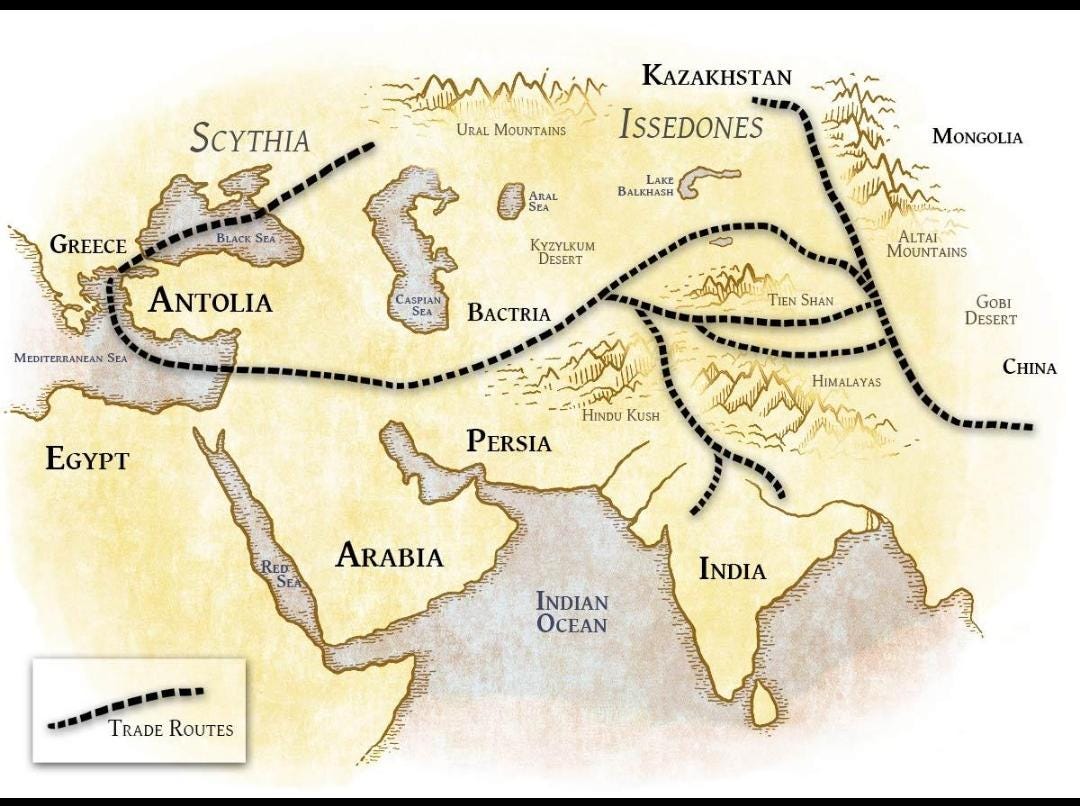
Image generated from Chatgpt by the author..
I can still remember these sentences because we were asked to repeat them again and again until it became a lasting memory.. and honestly when I was reading this chapter, the only thing that came to my mind was that, “These Turks are very cruel.. What can they even achieve after blocking thousands of people from trade and business..? They must be the villians in this story..”
And I never really went on to search the reality..
Ever..
Until one day..
During lockdown.., I was studying for final exams and Dad called me..
“Achu, search Ertuğrul Ghazi on youtube. It’s a Turkish series and it is based on real events. Watch the 1st episode and tell me how it is..” It was evident that he was in hurry.. and he called me in the middle of his work.. just to let me know this.. [Later on he told me that, he read about it in a newspaper]
That was the phase when I was following each and every word of his as an order.. I searched. Found the series in urdu. Started watching the first episode..
Trust me when I say this.. it felt as if I entered a new world.. That first episode where Ertugrul Bey was forging the sword saying, “Haq hai Allah.. Sach hai Wallah.. [in Turkish it was “Haydır Allah, Haqq Allah” which translates to “Allah is the Ever-Living, Allah is the Truth.”] is still fresh in my memories..

Picture by Wallpapers.com
After watching the first episode, I couldn’t believe that it is actually based on the true events.. Just to satisfy my curious little brain, I went on to search about it. Watched various Youtube videos about the history of Ottoman empires, and the modern Turkey. As days passed by, and the more episodes I watched, I became more curious about the country that I never knew existed.. Even to the extent that, I just started learning Turkish just because I couldn’t find subtitles to the series and litrally fell in love with this language..
That was the time I realised the background to the story, that why Ottoman Turks levied heavy taxes on the goods. Not beacuse they were having fun doing that.. But actually beacuse they were being killed in their very own motherland by the byzantines and mongols..
It was the fight of thier survival.. For taking the lives of their people who were just in search of livelihood.. Long before they understood that, just being in survival mode is not enough, if we really want to make a way out of this day to day fear that who is going to attack us today, then the only way is, to build a State.. [Devlet] That is how we can strive through these struggles and provide a proper motherland for our future generations..
And they kept their promise.. They united all their tribes and built a single state.. One empire.. where they made sure that thier survival and hardships are not in risk.. They did not impose taxes simply to make life difficult for European traders. Since they controlled the major trade routes after capturing Constantinople, collecting taxes from merchants became an important source of income for the empire. However, these taxes made Asian goods more expensive in Europe. This encouraged European kingdoms to search for a direct sea route to India so that they could trade without depending on the routes controlled by the Ottomans.
Just think of modern day tollgates.. Exactly like that..
We were just told about how they controlled the routes and levied heavy taxes. Nothing about the history of Turks and what made them conquer the city of Constantinople.. We the young minds recited it, memorised it, wrote in the exam and kept the same mindset about them as villians and never really went on to question them.
If I ask my classmates of that time.. then none of them is aware of the reforms that they brought after their conquest.. like,
**The Millet System: **Instead of forcing Christians and Jews to convert, the Ottomans organized them into self-governing religious communities called millets. The Orthodox Christian community (Millet-i Rûm) was allowed to keep its churches, speak its language, and use its own religious courts for civil matters like marriage, divorce, and inheritance.
**Lower Initial Taxes:** The Ottomans abolished the complex, predatory Byzantine tax system. They replaced it with a predictable land tax and the Jizya (a protection tax for non-Muslims). In the early centuries, this total tax burden was significantly lighter than what the Byzantines had demanded.
Rule of Law: Early Ottoman sultans heavily enforced the Kanun (secular sultanic laws) alongside Sharia. Ottoman courts were remarkably efficient for the medieval era. Christian peasants frequently chose to bring property and business disputes to Islamic courts because Ottoman judges (qadis) were strictly ordered to rule fairly, regardless of religion, to prevent rebellions.
But no, even after having soo many stories, behind just a single sentence, NCERT be like, “Apna marzi chalega [we will do whatever we want to do..”], and will bury the truth. So that peoplw will believe that they were villians in the history, which will make them villains in modern times as well..
That is exactly how a common opinion is formed about a whole nation.. It was never a coincidence.. But it is shaping the opinions of the young minds without letting them have their own independent thinking.. and I don’t think that I need to explain the causes of not having an independent & questioning mindset in this particular time and age..
This is where the writing pauses, even if the thought doesn’t.. — ZΛ
메타데이터
- post_id
- 14656e8da994
- slug
- what-indian-textbooks-leave-out-part-1-14656e8da994
- url
- https://medium.com/zul-writes/what-indian-textbooks-leave-out-part-1-14656e8da994
- canonical_url
- https://medium.com/zul-writes/what-indian-textbooks-leave-out-part-1-14656e8da994
- author_url
- https://medium.com/@zafthaz04
- status
- ok
- fetched_at
- 2026-06-11 05:11:55