My Hands Were Shaking Behind My Back: What No One Tells You About Teacher Confidence
You’re standing in front of 30 students. You know the material. And yet — your voice catches, your mind blanks, and something inside you…
My Hands Were Shaking Behind My Back: What No One Tells You About Teacher Confidence
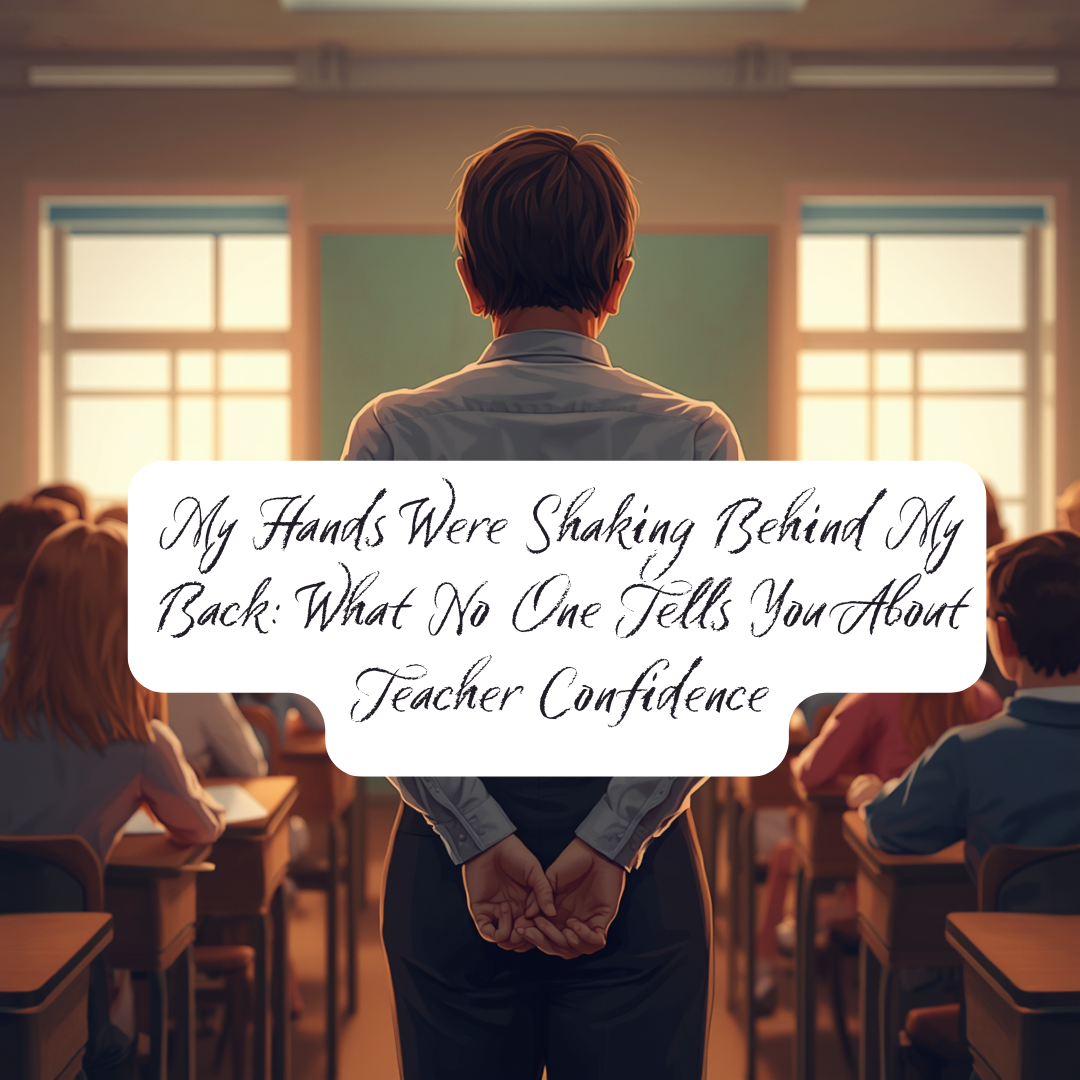
You’re standing in front of 30 students. You know the material. And yet — your voice catches, your mind blanks, and something inside you whispers: they can see right through you.
The classroom was quiet.
Too quiet.
I had just asked a question I was certain would spark discussion. Instead, twenty-something faces stared back at me with the particular blankness that teenagers have perfected — the expression that lives exactly between boredom and judgment.
I smiled. I waited. Inside, I was dissolving.
That moment — that specific, stomach-dropping silence, is one that thousands of teachers experience every day and seldom talk about. Because teachers are supposed to be the confident ones. The ones with the answers. The ones who hold the room.
But confidence is not a credential you receive with your degree. And for many teachers, especially early in their careers, standing at the front of a classroom feels less like authority and more like exposure.
This is that conversation. The one we don’t have in staffrooms.
The Confidence Paradox No One Prepares You For
Here is what teacher training gets wrong: it prepares you for the content of teaching, not the psychology of it.
You learn lesson planning. You learn assessment strategies. You learn classroom management theory.
Nobody teaches you what to do when your voice shakes during a parent meeting. Nobody teaches you how to recover when a student challenges you in front of the class, and your mind goes completely, terrifyingly blank. Nobody teaches you that imposter syndrome doesn’t end after your first year, that for many teachers, it simply gets quieter, never fully silent.
Teacher confidence isn’t about knowing more. It’s about your relationship with uncertainty.
The most experienced teachers I’ve observed are not the ones who never doubt themselves. They’re the ones who have learned to act despite the doubt, and more importantly, who have stopped mistaking self-doubt for incompetence.
Those are two very different things.
What’s Actually Happening When You Lose Confidence in the Classroom
From a psychological standpoint, classroom confidence collapses are rarely about knowledge. They are almost always about perceived evaluation threat.
Your brain, specifically the amygdala, is doing its job. It has detected an audience. It has flagged the possibility of judgment, failure, or social rejection. And it has responded the way it responds to any perceived threat: fight, flight, or freeze.
The problem is that this threat response was designed for predators, not parent-teacher conferences.
When you feel your face flush during a lesson, when your mind goes blank mid-explanation, when you stumble over a word you’ve said a thousand times, your nervous system is not betraying you. It is protecting you. Poorly, in this context. But protection nonetheless.
Understanding this doesn’t eliminate the anxiety. But it does something almost as useful: it removes the shame.
You are not weak. You are not wrong for the job. You are a human being whose brain is responding to a genuinely high-stakes social situation the way human brains have responded to high-stakes situations for millennia.
That’s the starting point.
The 5 Things That Actually Build Classroom Confidence
1. Shrink the Audience in Your Mind
Research on performance anxiety consistently shows that one of the most effective interventions is audience reframing — consciously reducing the perceived evaluative weight of the people in front of you.
In practice: before entering your classroom, remind yourself who is actually sitting in those chairs. Not critics. Not judges. Students who are mostly thinking about their own social anxieties, their lunch plans, and whether the person they like noticed them in the hallway.
They are not there to evaluate you. They are there because they have to be. The judgment you fear is almost entirely internal projection.
This isn’t toxic positivity. It’s accurate perception. Most teachers dramatically overestimate how critically their students are watching them.
2. Build Micro-Competencies, Not Global Confidence
“Be more confident” is useless advice. It’s like telling someone who is drowning to “be more buoyant.”
Confidence is not a general state. It is domain-specific and built through small, accumulated experiences of competence.
Instead of trying to feel confident in the entire classroom, identify one micro-skill to strengthen this week. Make eye contact with three students during your next explanation. Ask one open-ended question and wait — actually wait — for the answer. Use a student’s name naturally in a correction.
Each small moment of successful connection or delivery deposits into what psychologists call your self-efficacy account. Over time, those deposits compound.
You don’t build classroom confidence. You build it one interaction at a time.
3. Rewrite What Silence Means to You
For many teachers, student silence reads as failure. The empty pause after a question feels like evidence that you’ve lost them, bored them, or asked something foolish.
This is rarely true.
Silence after a thoughtful question means students are thinking. It means you have asked something that requires actual cognitive processing — not a recall question with an obvious answer, but something real.
Practise the 7-second rule. After asking a question, count silently to seven before doing anything. It will feel unbearable at first. Lean into that discomfort. What you’ll find, consistently, is that someone answers — and the answer is usually better than what you’d have gotten from a rushed, anxious follow-up prompt.
The silence was never the problem. Your interpretation of it was.
4. Create a Pre-Lesson Ritual That Grounds You
Athletes don’t walk onto a field without a warm-up. Performers don’t walk onto a stage without preparation rituals. Teachers routinely walk into classrooms running on coffee and corridor conversations and wonder why they feel scattered.
A pre-lesson grounding ritual doesn’t need to be elaborate. It needs to be consistent.
Three minutes before class: stand outside your classroom door. Take four slow breaths — in for four counts, hold for four, out for four. Review your opening question or activity, not your entire lesson plan. Remind yourself of one student you’re genuinely looking forward to teaching today.
This isn’t wellness theater. It is neurological preparation. Slow breathing activates the parasympathetic nervous system, reducing the cortisol spike that triggers performance anxiety. Specificity — thinking of one student — pulls your focus from abstract threat (the whole class, all their potential judgment) to concrete relationship (this person, today).
You walk in grounded. Not fearless. Grounded.
5. Debrief Yourself Honestly — Not Harshly
After a difficult lesson, most teachers do one of two things: replay every mistake on a loop, or avoid thinking about it entirely.
Neither is useful.
What works is structured self-debriefing — the same tool good therapists use after a challenging session. Ask yourself three questions:
- What did I do well today, specifically? (Force yourself to find something real. “I managed the transition between activities smoothly.” “I noticed when Aisha seemed confused and checked in.” Not vague. Specific.)
- What was one moment I’d handle differently?
- What does that moment tell me to practise, not avoid?
The goal is not self-congratulation or self-flagellation. It is professional learning in real time, treating your own classroom experience the way you’d treat a case study — with curiosity, not judgment.
The Thing About Confident Teachers That Took Me Years to Understand
The teachers whose students remember them are rarely the ones who never stumbled.
They are the ones who stumbled and kept going. The ones who said “I’m not sure — let me think about that” without collapsing. The ones who could hold the uncertainty of a student’s hard question without rushing to fill the silence with false certainty.
That is the real model of teacher confidence — not the absence of doubt, but the willingness to stay in the room with it.
Students are remarkably perceptive. They know when a teacher is performing certainty they don’t feel. What they respond to — what they actually trust — is a teacher who is genuinely present, genuinely trying, and genuinely human.
Your self-doubt, managed well, is not your liability.
It might be one of your greatest teaching assets.
A Word for the Teacher Reading This Alone
If you’re reading this in a staffroom, or late at night after a lesson that didn’t go the way you planned, or in the minutes before class trying to steel yourself, I want to say something directly.
What you are carrying is real. The pressure to appear confident when you feel anything but is exhausting in a way that people outside education rarely understand. You are asked to perform competence, warmth, authority, and patience simultaneously, for hours at a time, in front of an audience that didn’t choose to be there.
That is genuinely hard.
And the fact that you are thinking about how to do it better — reading, reflecting, looking for tools — means you are already further along than you think.
The shaking hands behind your back? Most of your students never saw them.
But even if they had — staying anyway is what teaching actually is.
메타데이터
- post_id
- 147b45a30a4e
- slug
- my-hands-were-shaking-behind-my-back-what-no-one-tells-you-about-teacher-confidence-147b45a30a4e
- url
- https://medium.com/@mu34568/my-hands-were-shaking-behind-my-back-what-no-one-tells-you-about-teacher-confidence-147b45a30a4e
- canonical_url
- https://medium.com/@mu34568/my-hands-were-shaking-behind-my-back-what-no-one-tells-you-about-teacher-confidence-147b45a30a4e
- author_url
- https://medium.com/@mu34568
- status
- ok
- fetched_at
- 2026-06-09 15:37:30