EHR and EMR Integration Services in 2026: What the Four Main Methods Actually Are — and How to…
If your product sells into U.S. healthcare, integration with an EHR is not optional. It’s the conversation that comes up in every…
EHR and EMR Integration Services in 2026: What the Four Main Methods Actually Are — and How to Choose the Right One
If your product sells into U.S. healthcare, integration with an EHR is not optional. It’s the conversation that comes up in every enterprise sales call, in every pilot kickoff, and — for teams that didn’t plan it early enough — in every post-launch incident review.
The global EHR market was valued at $35.89 billion in 2025 and is projected to reach $53.11 billion by 2033. Epic alone runs 41.3% to 43.7% of U.S. hospital installations and 56.9% of hospital beds, processing 10 billion FHIR API calls every month across its infrastructure. Whatever you’re building, there’s a meaningful probability your customers are on Epic — and a near certainty that your next customer is on some EHR that expects to connect with your product.
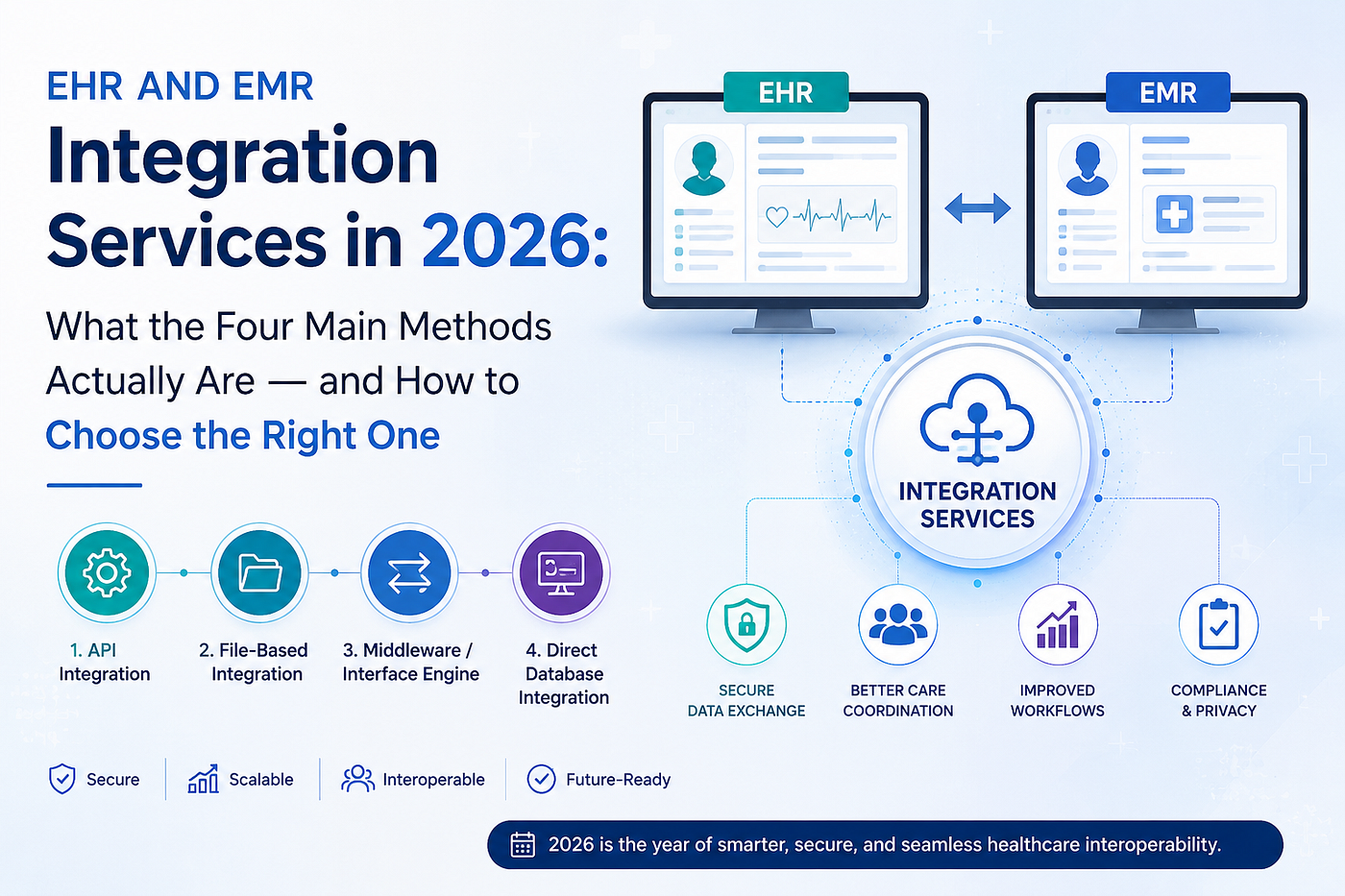
The problem is that **EHR and EMR integration services** get treated as a single category when they’re four distinct technical approaches, each with a different cost profile, maintenance burden, and appropriate use case. Organizations that choose the wrong method for their environment spend months discovering why — usually after the project is already underway.
Here’s what each method actually does and how to choose between them before you start.
The Four Integration Methods — and What Each One Actually Gets You
Direct FHIR R4 API integration
FHIR — Fast Healthcare Interoperability Resources — is the modern standard for healthcare data exchange, and it’s the ONC-mandated approach for any new integration built against a certified EHR. Version R4 is the current production standard across all major EHR vendors. What FHIR R4 gives you is a RESTful API over HTTPS, secured with OAuth 2.0 authorization, that returns structured health data as JSON resources — Patient, Observation, MedicationRequest, Condition, Encounter, and dozens more.
For the right use case, this is a significantly better developer experience than what came before it. You’re calling a standardized API against a standard data model, with standard authentication. A patient’s demographics query looks essentially the same whether the EHR on the other end is Epic or athenahealth.
The catch is “essential.” Each EHR exposes different FHIR resources, enforces different scope requirements, and handles token management differently. FHIR standardizes the architecture; it doesn’t fully standardize the behavior. Teams that discover this mid-project have typically already made design decisions they need to undo.
FHIR R4 integration is the right choice for new digital health builds, patient-facing applications, real-time clinical data access, and anything that needs to move data in both directions with a modern EHR. It’s the approach your compliance team wants, your product roadmap needs, and your long-term architecture should be built on.
HL7 v2 messaging
HL7 version 2 is the older, message-based standard that has been running inside hospital infrastructure since the late 1980s. Unlike FHIR’s REST architecture, HL7 v2 sends pipe-delimited messages — ADT (Admission, Discharge, Transfer) notifications, ORU (observation results) messages for lab data, ORM (order messages) for clinical orders — through a connection that’s closer to traditional TCP/IP socket communication than a modern API.
Despite its age, HL7 v2 is not optional to understand in 2026. Most production healthcare integration environments need to speak both FHIR and HL7 v2. Lab results, ADT feeds, and scheduling data frequently travel through HL7 v2 — not because organizations prefer it, but because the systems generating that data were built when HL7 v2 was the only available standard and haven’t been replaced.
HL7 v2 integration is the right choice when your integration target is a legacy clinical system that hasn’t been updated to expose FHIR APIs — and in a typical hospital environment, there are several of these. The key is recognizing that supporting HL7 v2 isn’t a workaround. It’s a requirement for any realistic production integration, right alongside FHIR.
Integration engine middleware
Integration engines — Mirth Connect, Cloverleaf, Corepoint, and similar platforms — sit between systems as a central hub, handling the translation, routing, and error management that direct point-to-point integrations push onto each individual interface.
The economics here matters. Organizations that have built mature integration engine environments report 40–60% reductions in per-interface build costs compared to point-to-point approaches. The first integration through an engine cost more than a direct connection. The tenth costs dramatically less, because the core infrastructure — format conversion logic, routing rules, monitoring, error alerting — is already built.
For any organization running more than three or four interfaces — or planning to — an integration engine is the architecture that makes the maintenance workload manageable. Each interface doesn’t become its own isolated system that breaks independently and gets debugged in isolation. It becomes one spoke in a hub that can be monitored, updated, and extended centrally.
The caveat worth knowing: the integration engine itself requires expertise to operate. The licensing cost is rarely the primary cost. Personnel — interface analysts, HL7 developers, or an outsourced managed service — are. Organizations that buy Mirth Connect without accounting for the operational cost of running it often find themselves with capable infrastructure they can’t adequately staff.
EHR Integration by Vendor: Why Epic, Oracle Health, and Athenahealth All Require Different Technical Approaches
The same FHIR standard applied to three different EHRs produces three meaningfully different integration projects. This is the fact that most integration vendor pitches don’t surface until you’re already past the requirements phase.
Epic
Epic’s FHIR infrastructure is the most capable and the most scrutinized in U.S. healthcare. The 750+ no-cost APIs on the open.epic developer portal give you access to a deep set of resources without initial licensing cost. USCDI v3 has been the federal interoperability floor since January 2026, and it’s the version you can count on being live across virtually all Epic installations.
The integration challenge with Epic isn’t the API — it’s the production approval process. App Orchard certification, required for any application that will connect to a live Epic customer environment, takes 2–4 months. Teams that haven’t done this before typically budget for it as a one-week technical step. It’s a 2–4-month organizational process involving documentation review, testing against Epic’s compliance requirements, and a review cycle that you have limited ability to accelerate.
The practical implication: App Orchard certification is a project milestone that belongs in your sprint plan before development begins, not a deployment step you add at the end.
Oracle Health (Cerner)
Oracle Health — the entity that now encompasses what was Cerner — deprecated DSTU2 entirely in December 2025. Any integration still running on DSTU2 needed to migrate to FHIR R4 by that deadline or risk of losing connectivity. For teams building new Oracle Health integrations in 2026, FHIR R4 is the only viable path.
API licensing costs $15,000 per year for standard services and $25,000 per year for advanced services — a cost structure different from Epic’s no-cost API access model that affects the total cost of ownership calculation for any Oracle Health integration project.
The technical detail that causes the most mid-project surprises on Oracle Health is token management. Oracle Health access tokens expire on a shorter cycle than Epic’s. Older Cerner instances have inconsistent refreshing token support. A team that builds token refresh logic assuming Epic-style behavior and then tests it against a Cerner environment discovers the discrepancy as silent data gaps — the integration appears to be running, but it’s dropping data because tokens are expiring before the refresh logic fires. This is a production failure that shows up in data audits, not in error logs.
Athenahealth
Athenahealth occupies a different position in the EHR landscape — stronger in ambulatory care and specialty practices than in hospital systems, with an API-first cloud-native architecture that makes it typically the least expensive EHR to integrate with in the $10,000 to $48,000 range per integration.
The tradeoff is coverage depth. Athenahealth’s FHIR R4 support has expanded meaningfully in recent years, but it remains less complete than Epic or Oracle Health for complex resource types. For scheduling data and ADT feeds specifically, HL7 v2 interfaces remain more reliable in athenahealth integrations than FHIR R4 — which means an integration scoped as “FHIR only” against athenahealth often needs to add HL7 v2 support when the first gap in resource coverage surfaces in testing.
How to Choose the Right Integration Method for Your Specific Use Case and EHR Environment
The decision matrix
The right integration method follows from four questions about your specific project:
Is the data flow read-only, or does your application need to write back to the EHR? Bidirectional write-back requires deeper API permissions, more complex authorization scopes, and — in Epic’s case — a different category of App Orchard certification.
Does your application need real-time data, or will batch exports suffice? An ambient documentation tool that needs to live in patient context during an encounter requires real-time streaming. A population health analytics tool can often work with nightly data exports. These are fundamentally different technical requirements.
Is this a single-site integration or a multi-EHR environment? Single site with one EHR version is straightforward. Multi-site environments where different facilities run different EHR platforms — common after health system acquisitions — multiply the integration complexity and require separate certification processes for each vendor.
What systems on the source side generate the data? If the answer includes legacy clinical systems built before 2010, you’re likely dealing with HL7 v2 whether your architecture preference is FHIR or not.
Why “FHIR for everything” is the wrong answer
The modernization argument for FHIR is correct: it’s more portable, more standardized, and better supported by ONC mandates and EHR vendor roadmaps than HL7 v2. But most real-world production healthcare environments in 2026 use both.
Lab systems, pharmacy systems, and ADT feeds from legacy clinical platforms generate HL7 v2. FHIR handles the modern clinical data layer. An integration architecture that accounts for only one of these produces gaps the other must fill. The realistic answer for most production environments isn’t “FHIR instead of HL7 v2” — it’s “FHIR for the modern workflow layer and HL7 v2 for the legacy feeds that aren’t going away.”
The teams that discover this after scoping a FHIR-only project spend several weeks adding HL7 v2 support they didn’t budget for. The teams that anticipated it scoped correctly from the start.
How we approach method selection
Our team scopes **EHR and EMR integration services** by starting with your environment, not with a preferred architecture. That means documenting your EHR vendor and version, the data flow direction and timing requirements, the systems on both sides of the integration, and the certification requirements you’ll need to satisfy before your application goes live in a production customer environment.
The method of recommendation that comes out of that assessment is tied to your specific situation — not a default preference for FHIR because it’s modern or middleware because it’s familiar. The right method for a read-only FHIR connection to one athenahealth instance is different from the right method for a bidirectional, multi-site integration spanning Epic and Oracle Health. Both are common projects. Both require a different starting point.
메타데이터
- post_id
- 147f3890c38c
- slug
- ehr-and-emr-integration-services-in-2026-what-the-four-main-methods-actually-are-and-how-to-147f3890c38c
- url
- https://medium.com/@Larisa10/ehr-and-emr-integration-services-in-2026-what-the-four-main-methods-actually-are-and-how-to-147f3890c38c
- canonical_url
- https://medium.com/@Larisa10/ehr-and-emr-integration-services-in-2026-what-the-four-main-methods-actually-are-and-how-to-147f3890c38c
- author_url
- https://medium.com/@Larisa10
- status
- ok
- fetched_at
- 2026-07-07 01:49:13