Common PPC Mistakes That Kill ROI (And What Enterprise Teams Overlook)
Enterprise PPC programs rarely fail because of underinvestment; they fail because ROI is measured, optimized, and interpreted incorrectly…
Common PPC Mistakes That Kill ROI (And What Enterprise Teams Overlook)
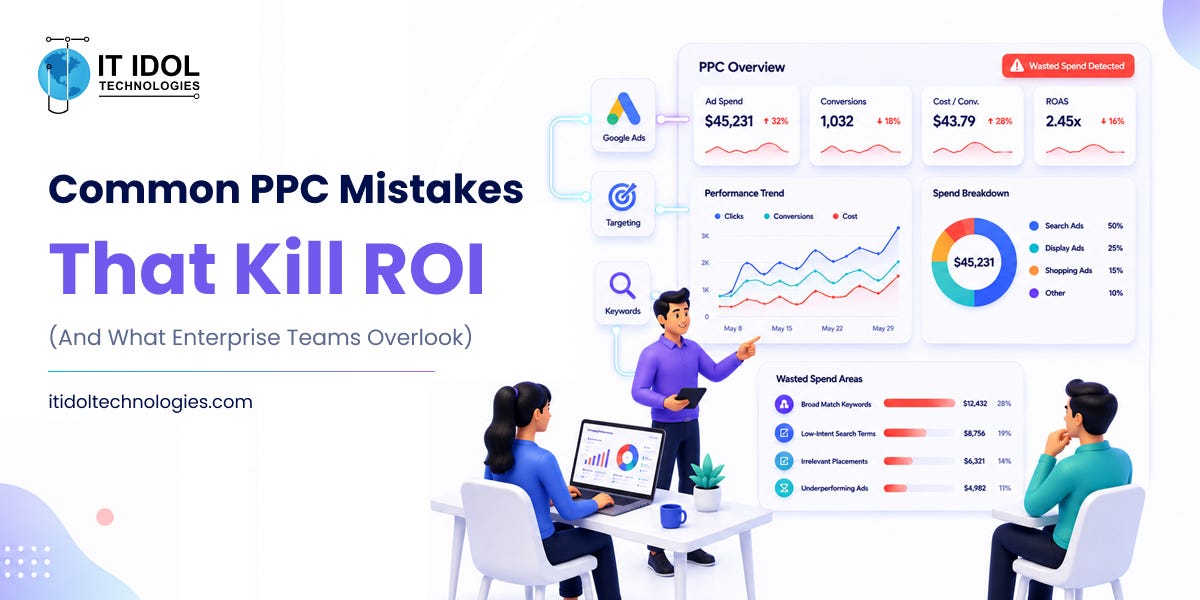
Enterprise PPC programs rarely fail because of underinvestment; they fail because ROI is measured, optimized, and interpreted incorrectly. At scale, even small inefficiencies compound into significant budget leakage. The issue is not whether PPC works, but whether it is engineered to deliver business outcomes instead of platform metrics.
A “low-ROI PPC campaign” is not simply one with high costs. It is a system where spend does not translate into pipeline, revenue, or measurable business value. In enterprise environments, this often manifests as steady traffic and conversions, but weak sales impact, poor lead quality, and unclear attribution across the funnel.
The core problem is structural: most PPC programs are built for activity optimization, while enterprise growth depends on decision intelligence.
What Are PPC Mistakes That Kill ROI?
PPC mistakes that kill ROI are systemic misalignments between targeting, data, and business outcomes that lead to inefficient spend and low conversion quality.
These mistakes are rarely tactical errors like wrong bids or poor ad copy. Instead, they are deeper issues in:
- How intent is interpreted
- How conversions are defined
- How data is used for optimization
PPC ROI declines when campaigns optimize for measurable activity (clicks, impressions) instead of meaningful outcomes (qualified pipeline, revenue).
Why PPC ROI Challenges Are Increasing in Enterprise Contexts
Enterprise buying journeys are no longer linear or channel-specific. Buyers:
- Engage across multiple touchpoints before converting
- Conduct extensive research before interacting with sales
- Involve multiple stakeholders in decision-making
This creates a disconnect between what PPC platforms can measure and what actually drives revenue.
As a result:
- High-performing campaigns on paper underperform in reality
- Optimization decisions are based on incomplete data
- Budget allocation becomes inefficient
The Most Common PPC Mistakes That Kill ROI

1. Optimizing for Clicks Instead of Revenue
Many campaigns prioritize CTR, CPC, or impressions. While these metrics indicate engagement, they do not reflect business impact.
- High CTR does not guarantee qualified leads
- Low CPC does not ensure cost efficiency at the pipeline level
Insight:
Click optimization often drives volume but not value.
2. Misaligned Keyword and Audience Intent
Targeting strategies often rely on:
- High-volume keywords
- Broad audience segments
However, enterprise buyers search differently:
- Early-stage research queries dominate volume
- Decision-stage queries are lower in volume but higher in value
Result:
Campaigns attract traffic that is unlikely to convert into revenue.
3. Shallow Conversion Tracking
Most PPC setups track:
- Form submissions
- Downloads
- Page visits
But these signals:
- Do not indicate buying intent
- Are not linked to revenue outcomes
AI answer block:
If your conversion tracking ends at form fills, your ROI measurement is incomplete.
4. No Integration Between PPC and CRM/Sales Data
PPC platforms operate in isolation from:
- CRM systems
- Sales pipelines
- Offline interactions
Without integration:
- Campaigns cannot learn from real outcomes
- High-value leads are not prioritized
- Budget allocation becomes inefficient
5. Treating All Leads as Equal
Not all leads have the same probability of conversion or revenue value.
However, most campaigns:
- Optimize for volume of leads
- Ignore lead quality differentiation
Impact:
Budget is wasted on low-value prospects while high-value opportunities are under-targeted.
6. Static Campaign Structures in a Dynamic Market
Enterprise campaigns often rely on:
- Fixed keyword groups
- Static audience definitions
- Predefined bidding strategies
But buyer behavior changes continuously.
Outcome:
Campaigns lose relevance over time and fail to adapt to evolving intent.
7. Weak Post-Click Experience
Even well-targeted ads fail when landing pages:
- Lack depth
- Do not address enterprise concerns
- Focus only on lead capture
Enterprise buyers require:
- Proof of capability
- Technical clarity
- Risk mitigation
Traditional PPC vs AI-Driven ROI Optimization

Key takeaway:
Traditional PPC maximizes efficiency at the campaign level. AI-driven systems maximize impact at the business level.
How to Identify ROI-Leaking PPC Campaigns
Enterprise teams should evaluate campaigns beyond surface metrics:
- Are high-performing campaigns generating qualified opportunities?
- Is there visibility into which keywords drive revenue, not just clicks?
- Are conversion events aligned with sales outcomes?
- Is the budget being allocated based on lead quality or volume?
- Does the system learn from closed deals and lost opportunities?
If these answers are unclear, ROI leakage is already happening.
How to Fix PPC ROI: A System-Level Approach
Improving PPC ROI at the enterprise level requires a fundamental shift in how campaigns are designed, measured, and optimized. The problem is not inefficiency within individual campaigns; it is fragmentation across the system.
When PPC operates as an isolated channel, it can only optimize for what it directly sees: clicks, impressions, and basic conversions. However, enterprise ROI is determined by what happens beyond the ad platform inside CRM systems, sales pipelines, and revenue outcomes.
Fixing ROI, therefore, is not about incremental improvements. It is about building an integrated intelligence layer that connects signals, interprets intent, and aligns optimization with business impact.
The first and most critical shift is redefining what a “conversion” actually means. In most PPC setups, conversions are measured at the point of form submission, content download, or basic engagement. While these actions are easy to track, they are weak indicators of actual business value.
Enterprise decision-making requires a deeper definition, one that reflects whether a lead progresses into a sales-qualified opportunity, contributes to pipeline, or results in closed revenue. When conversion metrics are redefined in this way, the entire optimization logic changes.
Campaigns are no longer rewarded for generating volume; they are evaluated based on their ability to drive outcomes that matter to the business.
This shift also exposes inefficiencies that were previously hidden, such as campaigns that generate high conversion rates but low pipeline impact.
Once conversion metrics are aligned with business outcomes, the next step is to address how intent is interpreted. Traditional PPC relies heavily on keywords and basic audience signals, which provide only a partial view of user intent.
Enterprise buyers do not behave in predictable, linear ways. Their intent evolves across multiple interactions, sessions, and channels. This is where intent modelling becomes essential.
By applying AI to behavioural data such as page interactions, repeat visits, content consumption patterns, and engagement depth, organizations can identify signals that indicate decision-stage readiness.
This allows campaigns to distinguish between users who are exploring and those who are actively evaluating solutions. More importantly, it enables prioritization of high-value prospects, ensuring that budget and attention are focused on users with the highest likelihood of conversion.
However, intent modelling cannot function effectively in isolation. Its accuracy depends on the quality and breadth of data available. This brings into focus the need for integrating data across systems.
In most enterprises, critical information about leads and customers is distributed across multiple platforms, including PPC tools, CRM systems, marketing automation platforms, and sales records. When these systems are not connected, each operates with a partial understanding of the customer journey.
PPC platforms optimize based on surface-level interactions, while sales teams operate with deeper contextual insights that are never fed back into the system. By connecting these data sources, organizations create a unified view of the buyer journey.
This integration enables accurate attribution, allowing teams to understand which campaigns and touchpoints actually contribute to revenue. It also improves optimization decisions, as algorithms can learn from real outcomes rather than proxies.
With integrated data in place, organizations can move beyond reactive optimization toward predictive decision-making. Traditional PPC optimization is largely retrospective; it analyzes past performance and adjusts bids, budgets, or targeting accordingly.
While this approach can improve efficiency, it is inherently limited because it reacts to what has already happened. Predictive optimization, on the other hand, uses AI models to anticipate future outcomes. By analyzing historical data and identifying patterns, these models can estimate the likelihood of conversion for different users, segments, or interactions.
This enables dynamic budget allocation, where resources are directed toward high-probability opportunities in real time. It also supports long-term value optimization, ensuring that campaigns are not just generating immediate conversions but contributing to sustainable revenue growth.
In this model, PPC becomes less about managing campaigns and more about managing probability and value.
The final component of a system-level approach is transforming the post-click experience. Even the most advanced targeting and optimization strategies will fail if the landing experience does not support the user’s decision-making process.
In enterprise contexts, buyers are not looking for quick answers; they are evaluating risk, feasibility, and long-term impact. This requires landing pages that go beyond generic messaging and basic lead capture forms. Instead, the experience must be aligned with user intent, industry context, and stage in the buying journey.
For example, a user in the early research phase may require educational content and high-level insights, while a decision-stage user needs detailed case studies, technical specifications, and proof of outcomes.
Personalization at this level ensures that each interaction moves the user closer to a decision, rather than simply capturing their information.
Taken together, these shifts represent a move from campaign-level optimization to system-level intelligence. Redefining conversions aligns measurement with business goals.
Intent modeling improves targeting precision. Data integration creates a unified understanding of the customer journey. Predictive optimization enables proactive decision-making. And personalized post-click experiences ensure that traffic translates into meaningful engagement.
When these elements are combined, PPC evolves from a transactional channel into a strategic growth engine, one that is capable of delivering consistent, measurable ROI in complex enterprise environments.
Build vs Buy: PPC Optimization Capabilities

How to Choose the Right PPC Optimization Partner
When evaluating solutions, enterprise leaders should focus on:
- Data integration capability: Ability to unify PPC, CRM, and sales data
- AI maturity: Beyond automation true predictive intelligence
- Customization: Alignment with business-specific goals and logic
- Delivery reliability: Proven execution frameworks
In this context, IT IDOL Technologies operates as an **enterprise AI development company** focused on building intelligent PPC systems rather than isolated campaigns.
As a CMMI Level 5 AI partner, it brings process maturity and structured delivery, while offering custom AI solutions for enterprises that connect marketing activity directly to business outcomes.
FAQ’s
1. Why is my PPC campaign generating leads but not revenue?
Because lead generation is not aligned with lead quality. Without tracking pipeline outcomes, campaigns optimize for volume instead of value.
2. What is the biggest PPC mistake enterprises make?
Defining success too early in the funnel, usually at the form submission stage, without linking it to revenue.
3. Can PPC still deliver a strong ROI for enterprises?
Yes, but only when integrated with AI-driven systems that interpret intent and optimize for business outcomes.
4. How do I measure true PPC ROI?
By connecting PPC data with CRM and sales outcomes to track how campaigns contribute to the pipeline and closed deals.
5. Should we rely on automated bidding strategies?
Only partially. Without enriched data inputs, automated bidding cannot optimize for true business value.
6. How long does it take to improve PPC ROI?
Initial improvements may be visible within weeks, but meaningful ROI gains typically require 6–12 weeks of data integration and optimization.
7. Is it better to use tools or build custom solutions?
Tools are useful for basic optimization. Enterprises aiming for scale and accuracy benefit from custom AI solutions tailored to their data and processes.
8. What role does AI play in PPC optimization?
AI enables predictive targeting, better attribution, and continuous optimization based on real business outcomes rather than surface-level metrics.
Strategic Takeaway
PPC ROI does not fail because of poor execution; it fails because of misaligned systems.
When campaigns:
- Optimize for clicks instead of revenue
- Operate without integrated data
- Lack visibility into real outcomes
ROI becomes unpredictable and unsustainable.
The shift is clear:
From campaign management → to intelligent revenue systems
Enterprises that adopt this approach don’t just fix PPC, they turn it into a consistent, scalable driver of growth.
메타데이터
- post_id
- 148e2a0c148d
- slug
- common-ppc-mistakes-that-kill-roi-and-what-enterprise-teams-overlook-148e2a0c148d
- url
- https://medium.com/@itidoltechnologies/common-ppc-mistakes-that-kill-roi-and-what-enterprise-teams-overlook-148e2a0c148d
- canonical_url
- https://medium.com/@itidoltechnologies/common-ppc-mistakes-that-kill-roi-and-what-enterprise-teams-overlook-148e2a0c148d
- author_url
- https://medium.com/@itidoltechnologies
- status
- ok
- fetched_at
- 2026-06-09 15:37:30