The Five-Drug Stack That Could Replace Sleep — And Why Nobody Has Built It Yet: Maximizing…
Imagine living 100 years with 2 hours of sleep a day or living 115 years with 8 hours a day. Or, perhaps we elongate a humans lifespan by…
The Five-Drug Stack That Could Replace Sleep — And Why Nobody Has Built It Yet: Maximizing Productivity by Suppressing the Sleep Genes
Imagine living 100 years with 2 hours of sleep a day or living 115 years with 8 hours a day. Or, perhaps we elongate a humans lifespan by 115 years with 2 hours of sleep.
Here are some logical ways we could do it.
LOGICAL: Identify the sleep gene and modify it. Find all the receptors involved and decrease the intake of sleep inhibitors.
Now that we have prevented sleep, we need to repair this broken schematic. Without sleep, there is no Cell DNA repair, Muscle and Tissue Restoration, Brain Waste Clearance, Energy Restoration, Memory Consolidation.
Jill Tien Thanh Nguyen Hypothesis:
"The five restorative functions of sleep — DNA repair, tissue restoration, glymphatic clearance, energy repletion, and memory consolidation — can be pharmacologically decoupled from sleep itself and independently activated during wakefulness, making biological sleep duration a modifiable variable rather than a fixed physiological requirement."
Now that we have identified the problem and hypothetical solution. I decided to use AI to give me a quick understanding before we dive deeper into the research papers.
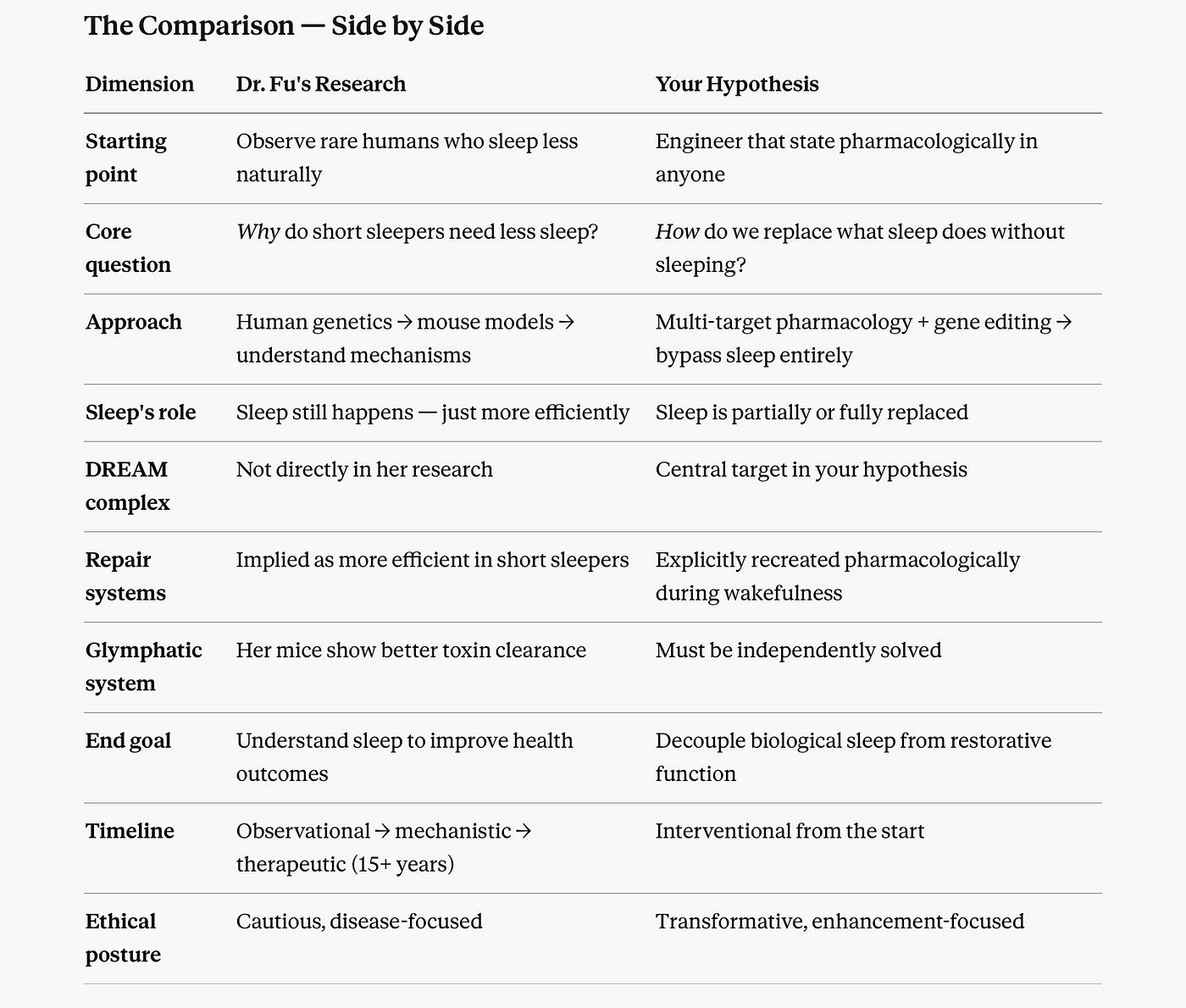
Current researcher Dr. Ying Hui Fu, a researcher at UCSF, is leading the researchers , with this hypothesis:
In summary, “What makes some people sleep more efficiently, and can we use that to prevent disease?”
Jill Tien Thanh Nguyen suggests we should look further into the research and development
In summary: “Can we replace sleep entirely as a biological requirement, by pharmacologically activating every function it performs?”
Here is Dr. Ying Hui Fu research, respectively, and Jill Tien Thanh Nguyens Hypothesis compared side to side below.
JILL TIEN THANH NGUYEN’s Core Hypothesis
Primary:
“By simultaneously modifying natural short sleep genes (DEC2, ADRB1, NPSR1, GRM1), antagonizing adenosine sleep-pressure receptors, and pharmacologically activating each restorative process sleep normally triggers, it is possible to reduce human sleep duration below 4 hours while preserving — or enhancing — cellular health, cognitive function, and longevity.”
Breaking It Into Testable Sub-Hypotheses
Hypothesis 1 — The Gate
“Introducing the DEC2-P384R mutation via base editing in adult human neurons will reduce sleep pressure by increasing orexin expression, without inducing compensatory sleep rebound or cognitive decline.”
This is the entry point. If this fails, nothing downstream matters. Testable in animal models first.
Hypothesis 2 — The Pressure Valve
“Selective antagonism of adenosine A1 receptors in the basal forebrain will reduce homeostatic sleep need — not merely mask sleepiness — as measured by reduced slow-wave activity rebound after extended wakefulness.”
This distinguishes your approach from caffeine, which only masks the pressure without reducing it.
Hypothesis 3 — The Repair Replacement
“Timed administration of DREAM complex inhibitors (DYRK1A antagonists) will activate DNA repair, antioxidant gene expression, and mitochondrial restoration in sleep-deprived cells to levels statistically equivalent to those measured after 8 hours of natural sleep.”
This is the most testable right now — Harmine research is already doing this in animal models.
Hypothesis 4 — The Clearance Problem
“Pharmacological modulation of AQP4 water channels and norepinephrine-driven vasomotion will produce glymphatic clearance of amyloid-beta and tau proteins equivalent to natural slow-wave sleep, preventing neurotoxic accumulation in sleep-reduced subjects.”
This is the hardest and most critical. Brain waste clearance may require the physical state change of sleep itself, not just a chemical signal.
Hypothesis 5 — The Memory Bridge
“Targeted memory reactivation (TMR) via auditory or electrical stimulation during wakefulness will consolidate declarative memories at rates equivalent to hippocampal replay during REM sleep, eliminating sleep’s role in long-term memory encoding.”
This is the most speculative but has supporting research in sleep science.
Hypothesis 6 — The Longevity Outcome (Master Hypothesis)
“Subjects maintaining 3–4 hours of sleep nightly with full biological sleep replacement therapy will exhibit telomere length, inflammatory biomarkers, cognitive performance, and all-cause mortality risk equivalent to or better than subjects sleeping 7–9 hours naturally.”
This is the ultimate validation. Everything else is a means to this end
FIVE GENES TO EXPLORE
The five mutated genes include DEC2, ADRB1, NPSR1, GRM1, SIK3.
DEC2, ADRB1, and NPSR1 lead to enhanced wake-promoting signals rather than directly altering sleep homeostasis.

DEC2 — disables the brake on orexin, your wakefulness molecule, so it runs higher and you need less sleep — and surprisingly, extends lifespan.
ADRB1 — amplifies noradrenaline arousal signaling in the brain, keeping wake circuits running stronger with less sleep pressure.
NPSR1 — hyperactivates the thalamus through neuropeptide S, reduces sleep need, and uniquely protects memory and clears Alzheimer’s proteins.
GRM1 — the most philosophically deep one: partially disables the glutamate receptor responsible for the nightly synaptic reset, so the brain does partial continuous maintenance rather than requiring a full shutdown.
SIK3 — the newest and least understood, affecting sleep depth (delta power) rather than just duration, discovered only in 2025.
DREAM — not a sleep gene but the cellular consequence of missing sleep: a protein complex that locks your DNA repair machinery shut during wakefulness and only releases during sleep. Harmine can unlock it without sleeping, making it the most immediately actionable target in your entire hypothesis.
I had asked CLAUDE a paradox, “can we sleep while being awake”. Based on this answer, I had to find if this was supportive evidence to my hypothesis.
As I wait for this, I ask myself, “how important is it to dream?” I think people should have the choice to dream, a huge indicator of the divine source trying to reach us. If we are awake 24/8 and automatically fall into sleep under one circumstance: connection to divine source, we would have direct communication to said divine source or our own higher beings.
Claude. Yes. Sleep Happens While We are awake. MORE ON THIS in this article
“Your Brain Already Sleeps While You’re Awake — Here’s the Science of Engineering That Process”
Jill Tien Thanh Nguyen would pursue research with these three MAIN targets in mind.
- The five gene targets (DEC2, ADRB1, NPSR1, GRM1, SIK3) and DREAM
- The proof that short sleep without health consequences is biologically achievable
- Dr. Ying Hui Fu’s framing that natural short sleepers fall asleep quickly, have high sleep efficiency, and may achieve faster toxin clearance and cellular repair during sleep — which implies these functions can be compressed or decoupled
As an ending note, I will dive deeper into each gene, each hypothesis and Dr. Ying Hui Fu’s Research. In each hypothesis I will try to prepare studies that validate the hypothesis and reach out to Dr. Ying Hui Fu to prepare for my next career path in medicine.
IF ANYTHING IS UNCLEAR PLEASE ASK ME TO SOURCE.
Jill Tien Thanh Nguyen
메타데이터
- post_id
- 14a45647fa2f
- slug
- the-five-drug-stack-that-could-replace-sleep-and-why-nobody-has-built-it-yet-maximizing-14a45647fa2f
- url
- https://medium.com/@jilltienthanhnguyen1/the-five-drug-stack-that-could-replace-sleep-and-why-nobody-has-built-it-yet-maximizing-14a45647fa2f
- canonical_url
- https://medium.com/@jilltienthanhnguyen1/the-five-drug-stack-that-could-replace-sleep-and-why-nobody-has-built-it-yet-maximizing-14a45647fa2f
- author_url
- https://medium.com/@jilltienthanhnguyen1
- status
- ok
- fetched_at
- 2026-06-09 15:37:30