Painting Like Monet In Kindergarten
A child’s first brushstrokes opened a window into perception, memory, and the quiet wisdom of color.
COLOR CREATIVITY
Painting Like Monet In Kindergarten
A child’s first brushstrokes opened a window into perception, memory, and the quiet wisdom of color.
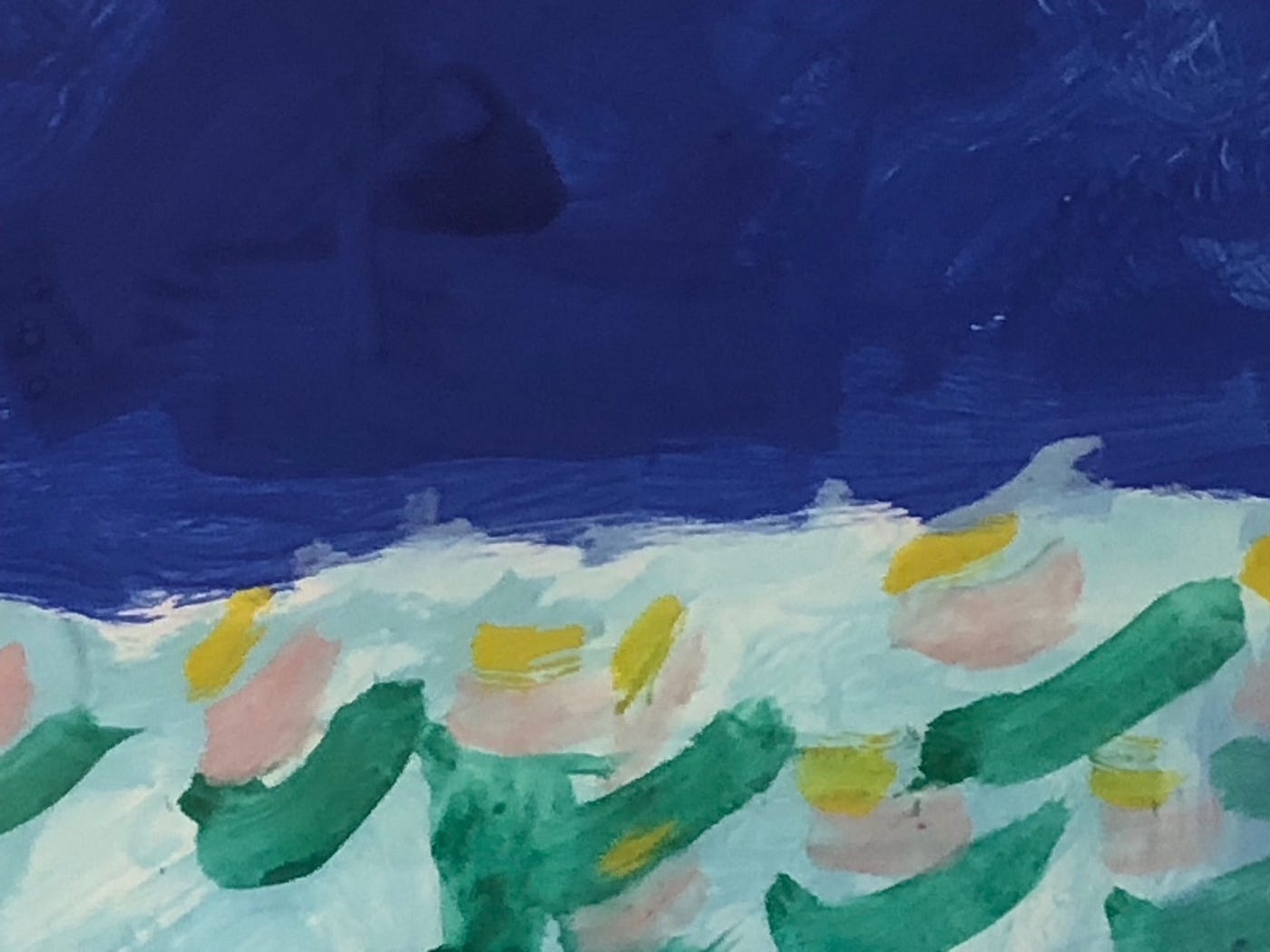
Water lilies by my son in kindergarten — photo provided by the author.
“Did Spider-Man never tangle his webs?” Lee, my six-year-old son, asked.
We were untangling wool we had been using to form a pattern with glue and paint on his project. Lee became interested in doing at-home art projects after he had an art activity in his kindergarten class.
He loved doing the first painting at school and wanted to try a new project at home. It involved more glue and wool before he set up the easel to paint.
“Probably, but they never put those shots in the show,” I replied.
“So Spider-Man had homework and art to make too. Do you think he practiced with his Mom’s wool like me?” He asked.
It was a joy to play and encourage my son’s creativity in art even before he could read and write. Creating pictures of his thoughts and impressions in pictographic form was a natural precursor to developing symbols for writing and storytelling.
One day, Lee painted a picture that still warms my heart. I framed it and now see it every morning on my bathroom wall.
A little boy’s imagination, his impression, was painted in 1990, the year he went to kindergarten. He had carefully painted his name on the bottom right corner of his painting. It is especially poignant because Lee also has a six-year-old son. My grandson also likes to stand at his easel and paint instead of sitting to color.
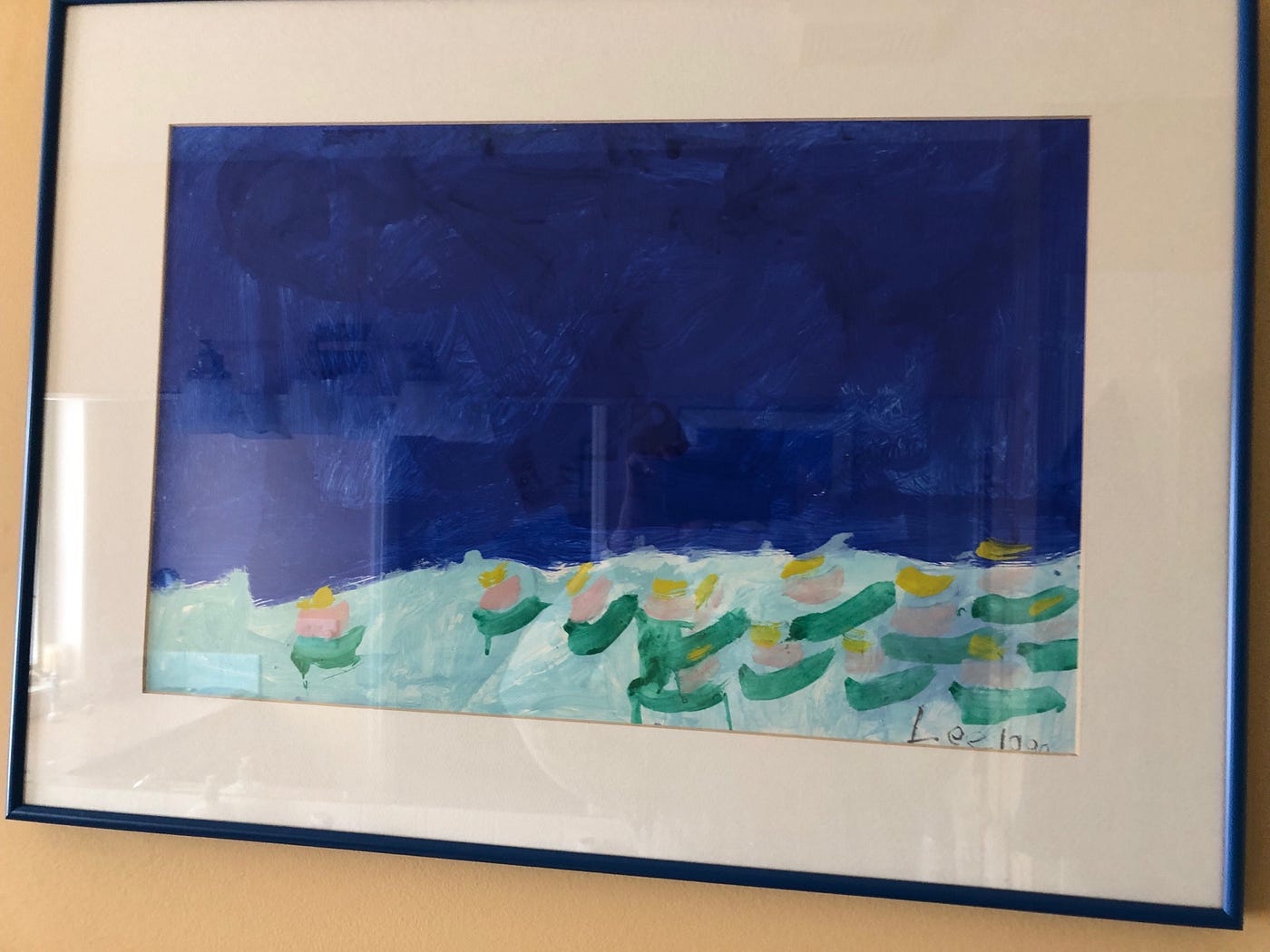
Lee painted this in 1990 — the author provided a photo
Lee’s kindergarten teacher shared Impressionist paintings on posters by the Masters. Each child had an easel and tempura paint in the colors they chose. Lee chose Water Lilies by Claude Monet for his poster, which featured his rendition of the original.
Photo by Pascal Bernardon on Unsplash
Mrs. Sanders, his kindergarten teacher, also had some photographs there so he could see how the water lilies looked while growing in a pond. My son’s casual description is written on a note I tacked to the back of the frame:
“I like the colors in the water and the flowers; It’s what I like the best.”
I looked for a copy of Monet’s original and found this Triptych of Water Lillies Agapanthus hanging in the Cleveland Museum of Modern Art.
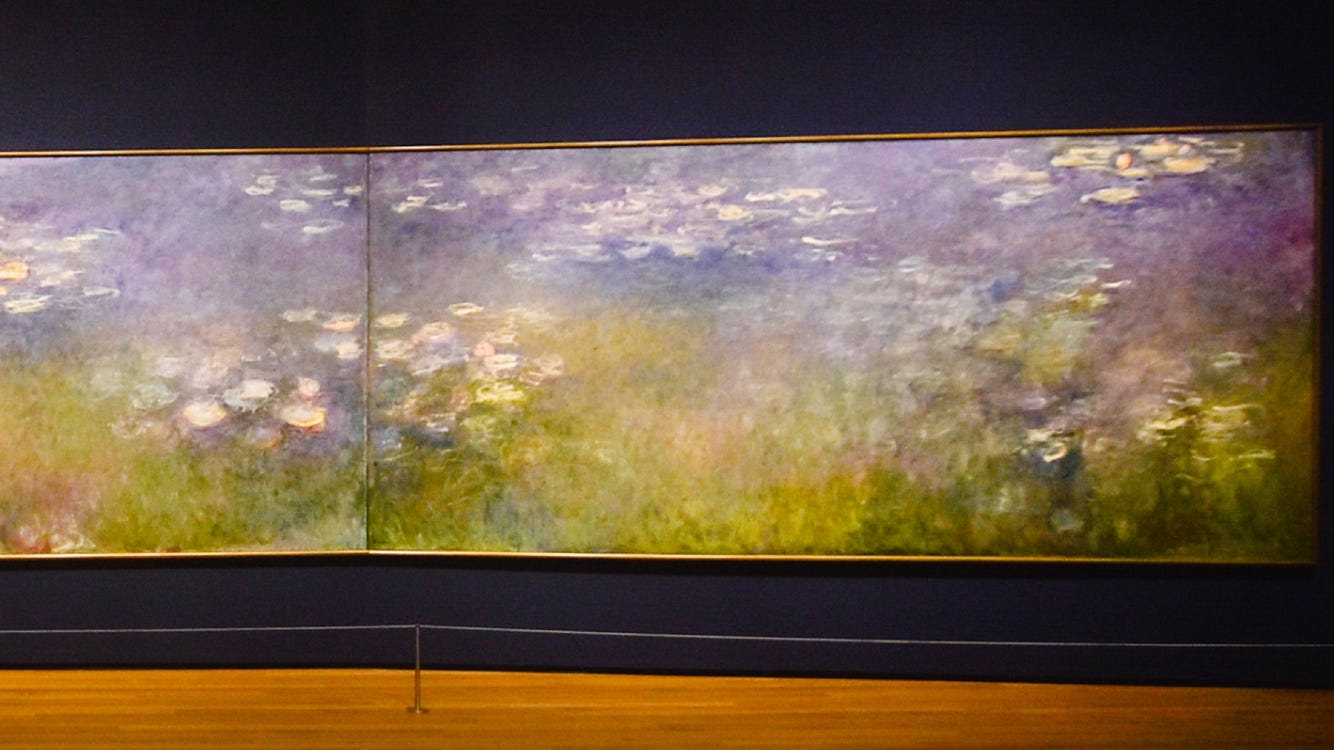
Wikimedia Commons: Monet Water Lillies Agapanthus
We mustn’t forget that we put feelings into the images we create and love.
Mrs. Sanders was not trying to create new Masters of Impressionism in her Kindergarten class. By introducing the children to art, color, and the validity of their thoughts and feelings, she taught them that being creative is intrinsically valuable.
It captured my son’s imagination. At the end of a busy week, he would get out his easel and paint. Sometimes, he woke up early and slipped downstairs to paint when the house was still asleep. Before literacy and numeracy took over the primary focus of grade school, color in imagery was a way to tell a story.
Why do we see the colors?
Most mammals are color blind — unable to differentiate between red and green. Their world is more blue-gray. Receptors on the retina called opsins respond to different wavelengths of light. The longer wavelengths are red, and the shorter wavelengths are bluish.
The retina then mixes the different color wavelengths in our underlying nervous system.
One receptor activates for blue, and another for red, and the brain sees purple — so long as you have those two receptors. If you don’t you’ll see variations of blue.¹
If you were most active at night, it wouldn’t matter if you couldn’t see red to differentiate between green leaves, red berries, or purple grapes. Primates living forty million years ago spent most of their time in trees. Finding fruit among leaves is an obvious advantage.
Birds and fish can see red. However, many animals don’t: cats, dogs, cows, horses, rodents, hares, elephants, or bears.
Gene duplication caused red-green color vision. It evolved in Africa as our diet transitioned from insects to tender young leaves and fresh fruit. Finding red, ripe fruit in the daytime supplied the brain with a plentiful supply of glucose. You inherited your retinas with a red opsin from your mother because they are located on the X chromosome.
Humans like most of our social primates before us, have bodies that work the way they do in large part because they live alongside other humans. Just as we carry the deep past in our differently ancient physical traits — some things old, some things new — our social groups carry the past, too: some things old, some things new,²
Sensory stimulation links with social context to change perception
Mrs. Sanders introduced the students to paintings by Masters of Impressionistic Art as a group activity to look for objects to paint. The paintings were not as important as the formal opportunity to see colors and look for what they would showcase in their work.
The social context highlights the importance of being attentive, perceiving, and then representing our impressions of what we see. The enjoyment students have learning about art becomes associated with their memories.
Monet embraced violet. He was interested in producing color impressions, so they used contrast to the yellow sunlight by mixing red and blue.
Impressionist painters used the color violet so prolifically that critics accused them of violettomania. And as they educated others through their paintings and art classes, the public began to appreciate violet too, so the color spread into fashion, interior, and industrial design.³
Claude Monet did an in-depth study of the effects of light and shadow on color. He once said,
I have discovered the true color of the atmosphere. It is violet. Fresh air is violet.⁴
Forming the impression of creating colors to capture moods
Lee learned that painting sparked a passion for creating with paper, brush, and paint. It was an activity in school that valued his thoughts and feelings about what he was learning. He described it to me,
“Mrs. Sanders gives us all the colors, and we get to make the first move.”
I was thankful that Lee understood why he had to follow instructions so carefully at other times, but when it came to painting, he was happy to take the lead. The confidence he gained by having a learning activity that validated his impressions helped him trust his decision-making skills. This confidence carried forward into Grade One and colored the atmosphere he experienced in school. Perhaps he felt fresh air was violet, too.
To this day, I think of violet as the color of curiosity, of early mornings at the easel, of the invisible threads between generations. Fresh air, indeed, is violet.
Resources:
- Cat Bohannon, Eve- How the Female Body Drove 200 Million Years of Human Evolution, 2023, Random House. p.154
- Same as 1, p.156
- Alan Tager, [Why it took up thousands of years to see the color violet, Psyche](https://r.search.yahoo.com/_ylt=AwrOsj3oz.1nywAD.QMXFwx.;_ylu=Y29sbwNncTEEcG9zAzEEdnRpZAMEc2VjA3Ny/RV=2/RE=1743667304/RO=10/RU=https%3a%2f%2fpsyche.co%2fideas%2fwhy-it-took-us-thousands-of-years-to-see-the-colour-violet/RK=2/RS=w361MsCPybavFJZiEQkOkCO1ul8-) Newsletter, p.1
- Same as 3, p.2.
My niche is interaction. Response not just reaction. Observation and love of learning. Read my stories if you’re looking for someone who doesn’t do boredom. I embrace life with Passion. Daughter, mother, grandmother, sister, wife, student, and teacher. I get an inkling — now and then.
메타데이터
- post_id
- 14a4d6135aea
- slug
- painting-like-monet-in-kindergarten-14a4d6135aea
- url
- https://medium.com/middle-pause/painting-like-monet-in-kindergarten-14a4d6135aea
- canonical_url
- https://medium.com/middle-pause/painting-like-monet-in-kindergarten-14a4d6135aea
- author_url
- https://medium.com/@jl_millis
- status
- ok
- fetched_at
- 2026-06-20 20:29:01