Top 20 Muslim-Friendly Destinations 2026: Balancing Infrastructure Against Intense Market…
The global Muslim travel market has completely transitioned from its historical status as a resilient niche segment into a mainstream…
Top 20 Muslim-Friendly Destinations 2026: Balancing Infrastructure Against Intense Market Competition

The global Muslim travel market has completely transitioned from its historical status as a resilient niche segment into a mainstream economic powerhouse. Evaluating 150 destinations representing over 98% of all global arrivals, the newly unveiled Mastercard-CrescentRating Global Muslim Travel Index (GMTI) 2026 establishes the operational baseline for destination readiness, trust automation, and capital allocation across the global mobility landscape.
As international Muslim arrivals rebound sharply — reaching 196 million in 2025 (+11.3% YoY) and projected to scale to 262 million arrivals by 2030 — destinations are aggressively competing to adapt their service architectures. The 2026 rankings showcase a dynamic competitive arena where long-standing market anchors face high-velocity up-and-coming challengers.
The Foundation: Understanding the ACES Framework
To determine overall destination scores and establish fair global rankings, the GMTI utilizes the ACES Framework — a standardized, quantitative data model that evaluates destination preparedness across more than 60 combined datasets. This framework breaks destination readiness down into four core, weighted pillars:
- Access (10%): Measures cross-border corridors and entry gateways. It evaluates air connectivity (direct flight frequencies), geographical distance, land transit, and visa procedures to ensure a low-friction entry process.
- Communication (20%): Assesses a destination’s global visibility, multilingual proficiency across top Muslim source languages, digital marketing campaigns, and tourism stakeholder awareness.
- Environment (30%): Evaluates the overall backdrop and social safety of the destination. It measures basic utilities, universal design/accessible travel infrastructure, visitor arrival metrics, and faith restrictions (such as dress freedom or ritual slaughter rules).
- Services (40%): The heaviest-weighted pillar, evaluating the quality of tailored core amenities. This tracks the availability of clean prayer spaces and mosques, Halal-certified dining infrastructure, airport transit facilities, hotel adaptations, and authentic heritage experiences.
The GMTI 2026 Global Leaderboard: Top 20 Insights
The table below details the official performance metrics and rank movements of the world’s leading Muslim-friendly tourism ecosystems for 2026:
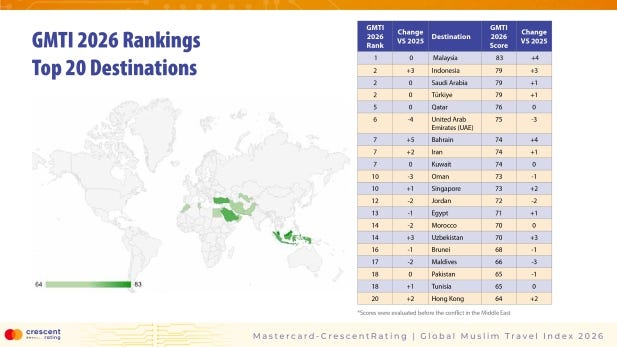
(Note: Index scores were evaluated prior to recent macroeconomic and regional shifts in the Middle East.)
Strategic Analysis of Leading Destinations
1. Malaysia (Rank 1 | Score: 83)
Malaysia continues to maintain its unbroken, decade-long lock on the #1 global benchmark position, increasing its score by 4 points. Supported by the nationwide “Visit Malaysia 2026” campaign, the destination has successfully scaled its underlying policy frameworks, digital predictive tools, and on-ground services. It seamlessly blends multi-ethnic modernity with universally accessible, certified Halal ecosystems and world-class natural assets.
2. Indonesia (Rank 2 | Score: 79)
Indonesia successfully defended its position as one of the most prominent market drivers this year, executing a 3-rank surge to claim a joint share of the #2 spot. Backed by coordinated stakeholder initiatives and broad public sector engagement — such as the multi-city Indonesia Sharia Economic Festival (ISEF) — Indonesia seamlessly integrates verified culinary safety with high-quality prayer amenities in transit environments.
3. Saudi Arabia (Rank 2 | Score: 79)
Saudi Arabia maintains its place as an unshakeable spiritual anchor for the global Muslim population due to the core traffic requirements of Hajj and Umrah. Driven by its massive “Vision 2030” layout, the Kingdom is rapidly evolving into a comprehensive global leisure and family destination. Massive investments in electronic visa integration, automated border gates, high-speed rail networks, and family-centric retail properties have significantly reduced traveler friction.
4. Türkiye (Rank 2 | Score: 79)
Türkiye continues to command a top-tier standing by providing an exceptional balance between historic Islamic heritage and contemporary coastal leisure. Coordinated capital investments in local Halal ecosystems, combined with the continuous route expansion of its national airline, have allowed Turkish stakeholders to capture highly diversified inbound traffic.
5. Qatar (Rank 5 | Score: 76)
Qatar has successfully established a high-yield niche as a luxury cultural hub capable of managing massive international sporting events, including Formula 1 and the FIFA World Cup. It serves as a prime case study for welcoming global spectators while remaining completely rooted in Islamic values, providing verified Halal dining and accessible prayer spaces across its high-end resort infrastructure.
6. United Arab Emirates (Rank 6 | Score: 75)
The UAE has slipped out of the top 5, dropping four places to the 6th position. While the destination retains its top position as a highly accessible cross-border hub with excellent air connectivity and seamless visa frameworks, its relative rank adjustment indicates that the aggressive pace of improvement and infrastructure upscaling in competing destinations has temporarily outpaced it.
7. Bahrain (Rank 7 | Score: 74)
Highlighting significant operational progress, Bahrain registered an impressive 5-place rank increase to enter a shared 7th position on the global leaderboard. This leap underscores systematic local investments designed to optimize its basic utilities, service, and environmental friendliness.
8. Iran (Rank 7 | Score: 74)
Sharing the #7 position due to its robust inherent Halal infrastructure, Iran provides total dietary security and widespread prayer accessibility. The country appeals heavily to cultural and religious history enthusiasts, boasting a dense matrix of ancient cities, pristine nature, and historic Islamic architecture that creates a deep, values-aligned travel environment.
9. Kuwait (Rank 7 | Score: 74)
Kuwait maintains a highly stable defensive position, anchoring itself firmly via a flawless score in the faith restrictions sub-pillar. Known for its peaceful, alcohol-free coastal resorts, high-end shopping malls, and strong family-centric hospitality, the destination offers an exceptionally secure climate that naturally accommodates the conservative lifestyle expectations of Gulf and international travelers alike.
Strategic Analysis of Maturing and Emerging Ecosystems
10. Oman (Rank 10 | Score: 73)
Oman captures a joint share of the #10 spot, performing exceptionally well in regional connectivity and land transport networks built for cross-border GCC transit. The Sultanate appeals to travelers seeking an authentic, slow-paced Arabian experience, characterized by its strict architectural heritage preservation, eco-tourism, and cultural comfort.
11. Singapore (Rank 10 | Score: 73)
Singapore retains its undisputed lock as the world’s leading non-OIC destination. By blending Changi Airport’s advanced digital touchpoints with a vibrant, MUIS-certified Halal gastronomy sector and dedicated public prayer networks, Singapore effectively demonstrates how smart infrastructure can seamlessly lower daily travel friction in a multicultural city.
12. Jordan (Rank 12 | Score: 72)
Jordan remains highly competitive due to a notable rise in cross-border air connectivity and modernized, digitized visa procedures. Its primary tourism pull centers on exceptional Islamic heritage and historical exploration tracks, combining sacred tombs and landmarks with a universally welcoming, multilingual local service culture.
13. Egypt (Rank 13 | Score: 71)
Egypt continues to command strong outbound demand, driven by its unparalleled Islamic, Coptic, and ancient history. Benefiting from a natural abundance of Halal dining networks and historic mosques at every corner, local stakeholders are increasingly utilizing targeted destination marketing to make the country’s ancient wonders simpler and more dependable for family cohorts.
14. Morocco (Rank 14 | Score: 70)
Morocco stands out in the GMTI Performance Matrix as a potential leader, leveraging its iconic imperial cities — such as Marrakech, Fez, and Casablanca — to offer an immersive cultural tapestry. Its deep-seated Islamic lifestyle fabric ensures that travelers can explore its vibrant souks, traditional riads, and mountain terrains with absolute peace of mind regarding Halal dietary compliance.
15. Uzbekistan (Rank 14 | Score: 70)
Uzbekistan shares the #14 position following a strong 3-place score acceleration. Operating as the strategic center of gravity for Islamic heritage tourism in Central Asia, the government has executed rapid upgrades to its transport infrastructure and digital tourism guides, opening up seamless pathways to the legendary silk-road monuments of Samarkand and Bukhara.
16. Brunei (Rank 16 | Score: 68)
Brunei represents a pristine, politically insulated destination that scores exceptionally well in safety and faith alignment. The Sultanate’s main tourism appeal combines dense, untouched equatorial rainforests with the majestic grandeur of its royal mosques, providing a serene environment built for rest, reflection, and multi-generational families.
17. Maldives (Rank 17 | Score: 66)
The Maldives continues to set the global benchmark for private, luxury island tourism. As an OIC nation, it inherently satisfies all core faith essentials, but its unique lifestyle advantage lies in its geography: isolated overwater villas and private resort islands offer high-spending couples and family groups custom-tailored, secluded environments that guarantee perfect privacy.
18. Pakistan (Rank 18 | Score: 65)
Pakistan anchors its index position through a massive baseline of stakeholder awareness and organic Halal services. Catering primarily to adventurous explorers and diaspora-driven travel, the country’s tourism appeal highlights dramatic mountain landscapes, historic Sufi shrines, and a deeply embedded culture of hospitality that treats visitors with immense respect.
19. Tunisia (Rank 18 | Score: 65)
Tunisia captures a competitive share of the leaderboard, bridging Mediterranean resort charm with ancient Islamic history. From the holy city of Kairouan to the coastal retreats of Djerba, the destination is increasingly utilizing targeted digital guides to highlight its rich regional cuisine, ancient ruins, and safe public spaces to capture broader European and Middle Eastern flows.
20. Hong Kong (Rank 20 | Score: 64)
Hong Kong marks a major milestone by successfully entering the top 20 global leaderboard. Driven by the tourism board’s high-visibility “Jelajah Hong Kong” marketing campaign, the metropolis has deployed a multi-layered digital strategy that maps out over 60 Muslim-friendly hotels and 220 Halal-certified restaurants, proving that dense, urban non-OIC hubs can strategically scale their local trust infrastructure to warmly welcome the world.
Navigating Global Competition and Strategic Readiness
The 2026 rankings of the Global Muslim Travel Index demonstrate that the Halal tourism sector has matured into a mainstream economic engine of global mobility. By evaluating destination readiness through the precise pillars of the ACES framework, the report highlights that long-term market success relies on a joined-up, holistic approach rather than isolated service updates. As traditional OIC powerhouses innovate with large-scale lifestyle and cultural ecosystems and non-OIC territories expand their faith-compliant infrastructure , the global tourism landscape has become more dynamic and competitive than ever before.
Looking forward, sustaining a premier position on the global leaderboard requires destinations to balance strong physical infrastructure with advanced digital preparation. As modern, digitally native travelers rely more on mobile ecosystems and advanced digital tools to plan their journeys, destinations must actively structure and digitize their faith-based assets to ensure that Halal dining networks, private recreational spaces, and prayer facilities are not only available on the ground, but are also fully visible to next-generation recommendation systems.
Discover more insights regarding the top Muslim-friendly countries’ ranking on the report here.
메타데이터
- post_id
- 14bcbef1d82c
- slug
- top-20-muslim-friendly-destinations-2026-balancing-infrastructure-against-intense-market-14bcbef1d82c
- url
- https://medium.com/@crescentrating/top-20-muslim-friendly-destinations-2026-balancing-infrastructure-against-intense-market-14bcbef1d82c
- canonical_url
- https://medium.com/@crescentrating/top-20-muslim-friendly-destinations-2026-balancing-infrastructure-against-intense-market-14bcbef1d82c
- author_url
- https://medium.com/@crescentrating
- status
- ok
- fetched_at
- 2026-07-22 01:48:56