Blueprint for an Enterprise Architecture Capability Framework for Building an Effective EA Practice…
Provides a structured approach to developing, implementing, and managing an organization’s enterprise architecture practice, ensuring…
Blueprint for an Enterprise Architecture Capability Framework for Building an Effective EA Practice (EA-Part 2)
Provides a structured approach to developing, implementing, and managing an organization’s enterprise architecture practice, ensuring consistency, alignment with business goals, and continuous improvement in architecture efforts.
In an era where digital transformation is not just an option but a necessity, organizations are increasingly looking for effective strategies to navigate the complexities of modernization. This white paper explores how Enterprise Architecture (EA) serves as a strategic driver in accelerating digital transformation and enhancing business agility.
By providing a structured approach to align technology initiatives with business goals, EA helps organizations streamline their operations, optimize resources, and foster innovation. A robust EA framework can guide organizations in achieving a cohesive digital strategy, ultimately leading to sustained competitive advantage and long-term success. This article is divided into following sections:
- Establishing Enterprise Architecture as a Strategic Driver (EA-Part 1)
- Blueprint for an Enterprise Architecture Capability Framework (EA-Part 2)
- Evolution of Enterprise Architecture (EA-Part 3)
- Adaptive Architecture: A Framework for Evolving Systems (EA-Part 4)
- Customer-Centric Journey Architecture (EA-Part 5)
- Enterprise Architecture Patterns (EA-Part 6)
- Enterprise Architecture Anti-Patterns (EA-Part 7)
- Leveraging TOGAF to drive Digital Transformation Architecture (EA-Part 8)
- Modeling with ArchiMate (EA-Part 9)
Blueprint for an Enterprise Architecture Capability Framework
Like any other department within an organization, Enterprise Architecture requires a structured framework to govern, oversee, develop, and manage its practice effectively. EA practices encompass various capabilities, and skill sets to ensure a fully functional and coherent approach.
While TOGAF provides a valuable reference model through its Enterprise Capabilities Framework, it often needs to be supplemented with additional references to establish a complete practice. Therefore, TOGAF can be used as a foundational model upon which to build.
Here, I present a capability model based on my own experience and learnings, drawing from various industry frameworks to offer a comprehensive perspective.
Note: This section is intended to provide a detailed reference for the key capabilities required for an effective EA practice. Given its comprehensive nature, it is longer and should be read alongside the EA Capability Framework map provided below.
Key Capabilities in Enterprise Architecture Capability Framework to establish an EA Practice includes:
- Stakeholder Engagement
- **EA Frameworks**
- EA Methodology & Process
- EA Toolkit & Technologies
- EA Content Framework
- Design & Development
- EA Strategies
- NorthStar Blueprints & Roadmaps
- **Capability Detailed Architecture**
- EA Software
- Architecture Repositories
- **Governance & Management**
- **Compliance Management**
- Risk Management
- Performance Management
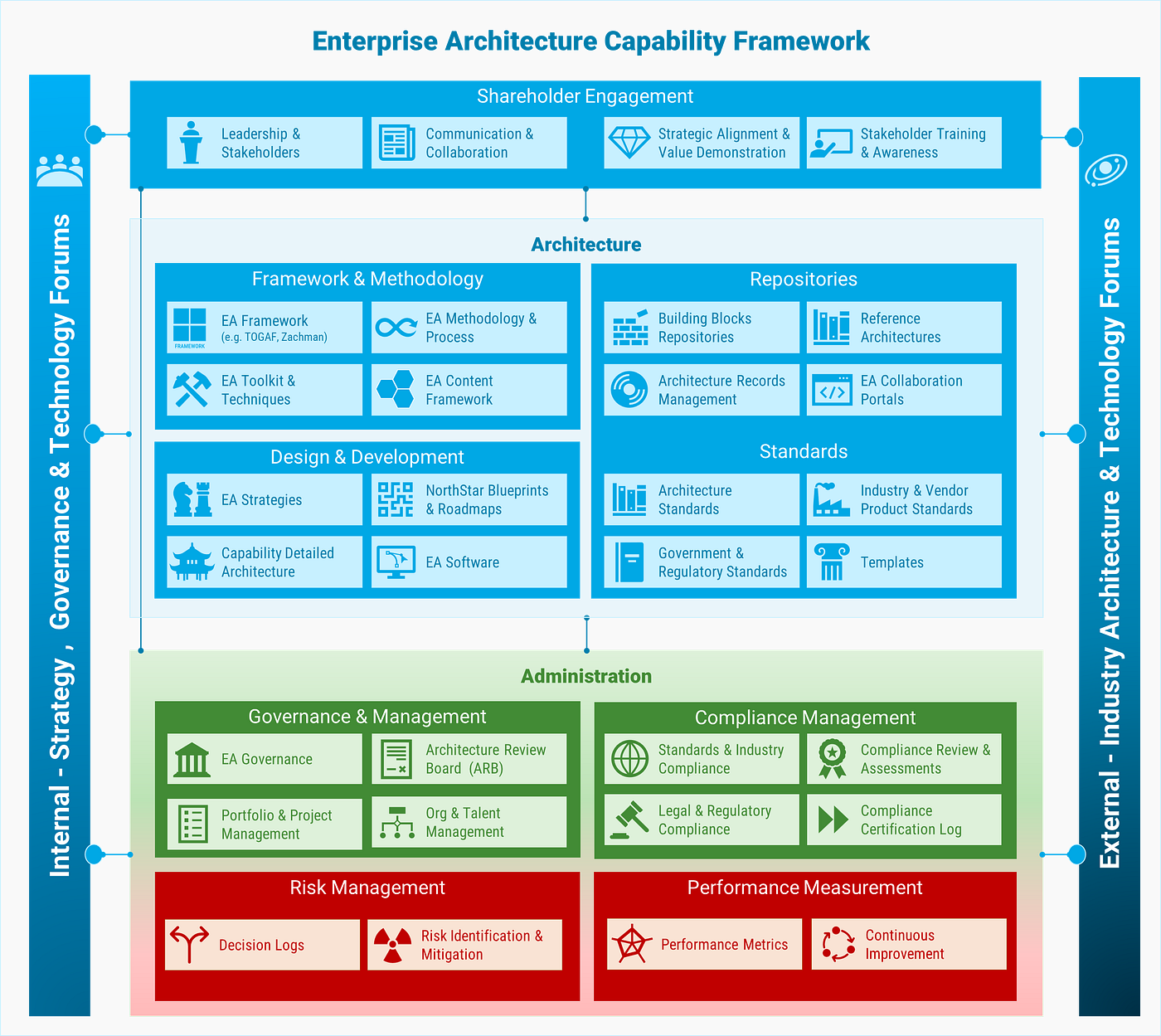
Figure: Enterprise Architecture Capabilities
Stakeholder Engagement
Shareholder Engagement category focus on effectively communicating, aligning, and involving shareholders in the EA practice. Here are the key capabilities:
- Leadership & Stakeholders: Establish EA leadership, identification of key shareholders, and analyze their needs, expectations, and influence. This ensures that engagement strategies are tailored to the needs of different stakeholders and aligns with their interests and concerns.
- Communication & Collaboration: Develop and implement effective communication strategies and reporting mechanisms to keep stakeholders informed about EA initiatives, progress, and outcomes. This enhances transparency, keeps stakeholders engaged, and fosters trust and support for EA initiatives.
- **Strategic Alignment & Value Demonstration:
Alignment with Strategic Goals:** Ensure that EA initiatives and objectives are aligned with the organization’s strategic goals and the interests of shareholders. This will demonstrate how EA supports and contributes to achieving shareholder value and strategic objectives, increasing buy-in and support.
Strategic Planning and Alignment: Ensure that shareholder engagement strategies are integrated into the broader strategic planning process of the organization. It aligns engagement efforts with organizational strategy, ensuring that stakeholder interests are considered in strategic decision-making.
Value Demonstration: Clearly articulate and demonstrate the value and benefits of EA initiatives to shareholders, including ROI and strategic impact. It helps stakeholders understand the tangible benefits of EA, reinforcing their support and commitment.
- Stakeholder Training and Awareness: Provide training and raise awareness among stakeholders about the role and benefits of EA. It enhances understanding and support for EA practices among shareholders, facilitating more effective engagement and collaboration.
- Integration with Governance: Integrate shareholder engagement practices with overall EA governance structures and processes. It ensures that shareholder concerns are considered in EA governance decisions and that engagement practices are consistent with governance policies.
These capabilities help ensure that shareholder engagement is effectively managed within the EA practice, enhancing communication, alignment, and support. By focusing on these areas, organizations can build stronger relationships with shareholders and demonstrate the value of EA initiatives.
Frameworks & Methodologies
EA Frameworks
An Enterprise Architecture (EA) framework is a structured approach or set of guidelines that helps organizations design, implement, and manage architecture in alignment with their business goals and strategies. These frameworks typically offer standardized methods, models, principles, and best practices to guide the architecture process and ensure alignment across the organization.
Several key EA frameworks are widely adopted across various industries, providing foundational models and standards. However, none of these frameworks offer a complete, one-size-fits-all solution for establishing an EA practice. Instead, they serve as reference models, providing standards, processes, methodologies, meta-models, and tools that organizations can leverage to build their own tailored EA frameworks.
Organizations use industry frameworks as a foundation, customizing them to fit their unique business context, including culture, stakeholder needs, commercial models, and existing architecture maturity. For instance, TOGAF provides detailed guidance on how to adapt its framework to suit an organization’s specific needs.
It is a key responsibility of EA leadership to develop and tailor the EA framework to suit the organization’s business environment, ensuring it effectively supports strategic goals.
Here are some of the most prominent EA frameworks:
- TOGAF (The Open Group Architecture Framework): TOGAF is one of the most widely adopted EA frameworks. It provides a comprehensive approach to designing, planning, implementing, and managing enterprise information architecture. TOGAF’s core component is the Architecture Development Method (ADM), which outlines a structured process for developing and managing EA.
Key features in TOGAF includes Architecture Development Method (ADM), Architecture Content Framework, Enterprise Continuum, and Architecture Repository.
TOGAF is more suitable for organizations seeking a standardized methodology for developing enterprise architecture. Its widely used for Business Transformation Programs, Capability based strategy and planning, maturity assessments, proof of concept (POC) development, Business & IT alignment, vendor platform implementation where Integration and Interoperability is core, risk management, regulatory compliance, technology selection, cost and process optimization, etc.
- Zachman Framework: The Zachman Framework is one of the earliest EA frameworks, focusing on classifying and organizing the artifacts of enterprise architecture. It provides a structured way to view and analyze architecture from different perspectives and levels of detail.
Key features include two-dimensional classification schema with rows representing different stakeholders (e.g., Planner, Owner, Designer) and columns representing different aspects of the architecture (e.g., What, How, Where).
It’s ideal for organizations that require a comprehensive and structured approach to documenting and understanding their enterprise architecture. Unlike TOGAF, which provides specific processes and methodologies for developing and managing architecture, Zachman focuses on providing a detailed ontology and matrix that categorize architectural elements based on perspectives such as What, How, Where, When, and Why. It excels in scenarios where thorough documentation and a structured way to categorize and analyze architectural components are desired.
- Gartner EA Framework: Gartner’s EA framework emphasizes business outcomes and strategic alignment. It focuses on aligning IT and business strategies to drive transformation and innovation.
Its key features include emphasizes the business value of EA, strategic alignment, and transformation capabilities. It offers a less prescriptive approach compared to TOGAF. It focuses on strategic alignment and capability-based planning rather than a specific process cycle.
It’s suitable for organizations seeking a business-centric approach to enterprise architecture and IT strategy.
- FEAF (Federal Enterprise Architecture Framework): Developed by the U.S. federal government, FEAF provides a framework for organizing and managing enterprise architecture in federal agencies. It aims to improve the effectiveness and efficiency of federal operations.
Key features include a focus on performance and results, with specific reference models such as the Performance Reference Model (PRM) and the Business Reference Model (BRM).
It’s designed for federal agencies or organizations with similar requirements for governance and performance management.
- ISO/IEC 42010:2011 (ISO/IEC 42010:2022): This international standard provides guidelines for architecture description, focusing on the documentation and communication of architecture decisions.
Key feature defines the architecture framework, architecture description, and architectural viewpoints.
While its not a framework rather a standard, it is used by organizations to ensure consistency and quality in architecture documentation and communication.
- ITIL (Information Technology Infrastructure Library): While primarily a framework for IT service management, ITIL provides guidelines that overlap with EA by focusing on aligning IT services with business needs and improving service delivery.
Key features include Service lifecycle management, process integration, and continuous improvement.
Its best for organizations looking to align IT services with business processes and improve service management. Its widely used as a service management framework in the industry.
- COBIT (Control Objectives for Information and Related Technologies): COBIT is a framework for developing, implementing, monitoring, and improving IT governance and management practices. It includes aspects of enterprise architecture related to IT governance and control.
Key features include IT governance, risk management, and compliance.
It’s ideal for organizations focusing on IT governance, risk management, and compliance.
Each of these frameworks offers different methodologies, focus areas, and strengths, allowing organizations to choose the one that best fits their specific needs and goals in managing enterprise architecture.
EA Methodology & Process
EA Methodology: It’s a structured approach or set of practices that are used to develop, manage and implement enterprise architecture. It provides a systematic process for designing and maintaining an organization’s architecture to align IT and business goals. It’s a method used to develop Capability Architecture. Typical areas of focus in an effective EA methodology include:
- Initiation: The purpose is to ideate, define scope, goals and objectives, identify stakeholders, establish EA governance structure, etc.
- Architecture Vision: It develops a high-level vision and strategy for the architecture.
- Current State Architecture & Assessments: The purpose is to document current state or baseline architecture and evaluate the existing architecture and identify gaps and issues.
- Future State Architecture: It defines the desired future architecture that aligns with business goals. It develops models and frameworks for the target state, including business, information, application, and technology architectures.
- Gap Analysis: Identify the differences between the current state and future state architectures. It analyzes gaps and define requirements for bridging them, including technology, process changes, and resource needs.
- Implementation Planning & Roadmap: Develop a roadmap for implementing the future state architecture.
- Continuous Improvement: It evaluates and refine the architecture practice over time. It includes conducting reviews, gather feedback, and make improvements to the architecture based on changing needs and lessons learned.
EA Process: It refers to the steps and activities involved in applying the EA methodology to achieve specific outcomes. It outlines how to execute the methodology in practice. Here’s a typical EA process:
- Define Scope and Objectives
- Develop Architecture Vision
- Document Business Capabilities and Process Maps
- Document Current State
- Document Future State
- Perform Gap Analysis
- Develop Implementation Plans
- Implementation and Governance
- Iterative Cycles of Review and Refine for improvements
Each industry-recognized Enterprise Architecture (EA) framework provides detailed guidance on the methods and processes architects should follow to develop enterprise architecture. Organizations can customize these frameworks, along with their associated tools and templates, to align with their specific business environment and requirements.
EA Toolkit & Techniques
EA toolkit and techniques are used to support the development, management, and implementation of enterprise architecture. These tools and techniques help organizations.

Figure: EA Toolkit & Technique
EA Toolkit & Techniques
- Architecture Modeling Techniques: Modeling technique is to use common modeling languages to create diagrams and models to represent different aspects of the enterprise architecture (e.g., Business Process Model, Information Systems Model, Technology Model). The purpose is to Visualize and analyze architecture components and their relationships.
Various architecture modeling languages and notations are used to represent and visualize different aspects of enterprise architecture. Few commonly used are:
UML (Unified Modeling Language): UML is a standardized modeling language used to specify, visualize, construct, and document software system designs. It provides a comprehensive set of diagrams to cover various aspects of software systems.
ArchiMate: ArchiMate is an open standard for enterprise architecture modeling, developed by The Open Group. It provides a uniform modeling language for describing, analyzing, and visualizing enterprise architectures.
C4 Modeling: C4 modeling is a technique used to visualize the architecture of software systems, providing a clear and hierarchical view of how systems are structured.
BPMN (Business Process Model and Notation): BPMN is a graphical notation for specifying business processes in a workflow. It is used to model and analyze business processes and workflows in a standardized way.
Service-Oriented Architecture (SOA) Model: SOA represent business processes as a series of services, which can be composed to support end-to-end business processes
Value Stream Mapping (VSM): It is a lean-management method used to analyze and design the flow of materials and information required to bring a product or service to a customer.
Flowcharts: Flowcharts are a traditional and widely used method for visualizing the sequence of steps in a process.
Capability Maps: Capability maps are commonly used to visualize the various capabilities within an organization, showing how they align with business processes.
SysML (Systems Modeling Language): SysML is an extension of UML tailored for systems engineering. It supports modeling complex systems that include hardware, software, data, and processes.
DMN (Decision Model and Notation): DMN is used to model and manage decision-making processes. It provides a standardized way to describe business rules and decisions.
Data Flow Diagrams: They are used to understand and analyze the flow of information in business processes, identify redundancies, and streamline data handling.
Entity-Relationship Diagrams (ERD): Commonly used during the design of databases and to represent the structure of data and to illustrate the relationships between different data entities within a system.
Gantt Charts: Gantt charts are used to represent the timeline of activities or processes in a project or process.
- Architecture Frameworks: Various standard EA frameworks are commonly used, such as TOGAF, Zachman, or Gartner to guide architecture development and management. The purpose is to provide structure and best practices for enterprise architecture initiatives.
TOGAF provides a prescriptive method for architectural development through the Architecture Development Method (ADM). The ADM guides the development of comprehensive architecture views, including business, application, data, and technology architectures. It also facilitates the creation of roadmaps for transitioning from the current state to the desired future state.
TOGAF also provides a conceptual framework known as Enterprise Continuum that helps categorize and organize the various architectural assets within an enterprise. It serves as a repository to support the reusability and standardization of architectural assets across the organization.
Zachman on the other hand provides a classification scheme used to organize and categorize architectural artifacts. It provides a structure for understanding and documenting enterprise architecture from multiple perspectives.
- Architecture Patterns: An architecture pattern is a general, reusable solution to a commonly occurring problem within a given context in technology or system architecture. It provides a predefined set of rules, guidelines, and best practices that can be used to structure and organize the components of a technology or system. Architecture patterns help in consistently designing systems that are scalable, maintainable, without needing to reinvent the wheel. Here are few examples of architecture patterns:
Service-Oriented Architecture (SOA) Pattern: SOA is a pattern where software components (services) provide functionality as services to other components. These services are typically loosely coupled and interoperable. For example, Web services using SOAP or REST APIs.
Microservices Architecture: It’s an approach where a software application is composed of small, independent services or components, rather than a large monolith application. Each service or component is responsible for a specific business capability and can be developed, deployed, and scaled independently. For example, user management, payment processing, ordering, etc.
Micro Frontend Architecture: It’s an architectural style where a web application is composed of smaller, independently developed and deployed frontend applications (micro frontends). These micro frontends work together to form a cohesive user experience. For example, shopping cart, checkout, user preferences, etc.
Layered Architecture: Layered architecture is a traditional pattern where the system is organized into horizontal layers, each with a specific responsibility. Common layers include presentation, business logic, data layer, etc. For example, web applications are classic three-tier or n-tier applications.
Loosely Coupled Architecture: It is a design principle where the components or services within a system are independent and interact with each other through well-defined interfaces. Changes in one component do not significantly impact others, allowing for flexibility, scalability, and easier maintenance. For example, event hubs, Restful APIs, etc.
Command Query Responsibility Segregation (CQRS): CQRS is a pattern where the responsibility of handling commands (operations that change state) is separated from handling queries (operations that read state). This separation allows for optimized and independent scaling of read and write operations.
Event Sourcing: Event Sourcing is a pattern where state changes of an application are stored as a sequence of events. Instead of storing the current state, the system reconstructs the state by replaying the events.
Serverless Architecture: Serverless architecture is a pattern where developers build and run applications without managing the underlying infrastructure. Cloud providers automatically manage the scaling and operation of the services.
Service Mesh: A service mesh is an architectural pattern for managing microservices’ communication by abstracting the network layer. It provides features like load balancing, service discovery, and traffic management independently of the business logic.
Zero Trust Architecture: Zero Trust is a security model where no user or device, whether inside or outside the network, is trusted by default. Access is granted based on continuous verification of identity and context.
Architecture patterns provide tried-and-tested solutions to common architectural challenges, helping architects design systems that are robust, scalable, and aligned with business needs. However, choosing the right pattern depends on the specific requirements, constraints, and goals of the system being developed.
- Architecture Principles: They are foundational rules and guidelines that guide the design, development, and governance of an organization’s architecture. They ensure consistency, alignment with business goals, and effective decision-making across various projects and systems. These principles typically address aspects such as security, performance, scalability, interoperability, and maintainability, helping to shape and constrain architectural decisions in a way that supports the organization’s overall strategy and objectives.
For Example, Maximize Reusability promotes efficiency and consistency across the organization, allowing teams to leverage existing solutions rather than reinventing the wheel.
- Stakeholders Management: It’s a systematic process of identifying, analyzing, and addressing the interests, needs, and concerns of stakeholders (shareholders) to ensure their alignment with the organization’s strategic goals and project objectives. This technique involves regular communication, feedback mechanisms, and engagement strategies to manage stakeholder expectations and drive successful project outcomes
- Capability-Based Planning & Architecture: It’s a strategic approach that focuses on identifying and developing the key capabilities an organization needs to achieve its business goals. It involves analyzing and mapping out the essential capabilities required for successful operations, aligning technology investments and resources with these capabilities.
It involves structuring the architecture to support key organizational capabilities. Each capability owner manages their specific domain, ensuring alignment between business strategy and IT infrastructure to effectively meet strategic goals and adapt to changing needs.
- Interoperability Modeling: Techniques for interoperability involve leveraging standard models and protocols for data integration, communication, and system compatibility. Examples use loosely coupled architecture, Service-Oriented Architecture (SOA), microservices, event-driven architecture, and domain-driven design, etc.
- Gap Analysis: Technique used to identify discrepancies between an organization’s current state and its desired future state. This process involves evaluating the existing architecture, systems, and processes to pinpoint gaps that need to be addressed in order to achieve strategic goals. By systematically comparing the current state with the target state, organizations can uncover areas where improvements are necessary, whether in technology, processes, or organizational capabilities.
- Risk Assessment & Mitigation: It involves several techniques. Firstly, a risk assessment by Identifying and evaluating potential risks. Once risk is identified, risk mitigation strategies are developed and implemented to reduce or eliminate risk.
Scenario planning is another critical technique where different potential future scenarios are analyzed to prepare for uncertainties and mitigate their impact on the organization. Architecture Governance establishes structured policies and procedures to ensure compliance with risk management practices, guiding how risks are managed throughout the enterprise.
- Compliance and Controls: They are structured sets of guidelines, policies, and procedures designed to ensure that an organization adheres to relevant laws, regulations, and industry standards. They help manage risks, maintain security, and ensure operational consistency by defining controls and processes for compliance and governance across the enterprise architecture. For example, they include frameworks like COBIT, ITIL, and ISO/IEC 27001.
Continuous Monitoring and Review involves regularly monitoring the architecture for policies, regulations, security and other risks to identify and address emerging risks proactively, ensuring ongoing effective compliance.
- Customer Journey Mapping: It’s a technique used to visualize and analyze the end-to-end experience of customers interacting with an organization. It involves creating detailed maps or diagrams that outline each step of the customer’s journey, from initial contact through to the final interaction. This includes identifying key touchpoints, interactions, and pain points experienced by customers throughout their engagement with the organization.
- Driver Modeling: Its a technique used to identify and analyze the key factors or drivers that influence an organization’s strategic goals and architectural decisions. Drivers can be strategic or top-down, e.g. regulatory, compliance, market trends, organizational objectives. They can also be bottom-up, e.g. technological advancements, performance optimization, customer survey outcomes, etc. These drivers impact the direction and priorities of the enterprise architecture. By understanding these drivers, organizations can align their architecture to effectively respond to changes and support their strategic vision.
- Views and Viewpoints: It involve creating and analyzing different perspectives (views) of the architecture to address specific stakeholder concerns and requirements, using predefined templates (viewpoints) to ensure comprehensive and coherent representation of the system.
- Mind Mapping: Its a technique used to visually organize and structure information, ideas, and concepts related to the architecture, facilitating brainstorming, problem-solving, and the exploration of relationships between various elements.
- Balanced Scorecard: Its a technique for aligning business activities to the organization’s vision and strategy by measuring performance across multiple perspectives, such as financial, customer, internal processes, and learning and growth, to ensure balanced and strategic decision-making.
- Architecture Partitioning: It involves dividing the overall architecture into manageable, distinct segments or layers to improve organization, scalability, and focus on specific aspects of the system.
- Capability Modeling: It involves defining and mapping an organization’s core capabilities to align its resources, processes, and technology with strategic objectives and business needs.
- Technical Reference Model (TRM): Architectures are typically not built from scratch; rather, Enterprise Architecture leverages existing models as a foundation for developing new components. TRMs are foundational frameworks that provide a structured approach to building consistent and interoperable architectures. Numerous published TRMs are available in the industry that organizations can choose to leverage to enhance their overall capability maturity. Examples of TRMs include the TOGAF Technical Reference Model, the Zachman Framework, and the National Institute of Standards and Technology (NIST) Reference Model.
EA Content Framework
EA Content framework and meta model help understand what is covered by architecture. It is designed to provide a comprehensive structure for organizing and managing architecture work products. It is a structured approach that defines the key components, types of artifacts, deliverables, and building blocks needed to develop and maintain enterprise architectures effectively.
Most EA frameworks provide guidance for organizing and managing artifacts, deliverables and building blocks. Organization may choose to develop their own custom content frameworks suitable for their needs.
TOGAF Content Framework: TOGAF provides a well-defined content framework that ensures work products are consistently defined, structured, and presented.
- TOGAF also provide Content Metamodel, which describes the building blocks that comprise the architecture. It’s categorized into two:
Core metamodel provides a minimal set of architectural contents to support traceability across artifacts.
Extension metamodel adds more specific modeling.
- The Architecture Development Method (ADM) within TOGAF offers a step-by-step approach for developing enterprise architecture. The content framework complements the ADM by specifying what the architecture should look like, while the ADM focuses on how to create the architecture.
At each phase of the ADM, inputs are used, and outputs are generated. The content framework provides a structured format to define the deliverables associated with these inputs and outputs, helping to ensure consistency and traceability throughout the architecture development process.
- Artifacts produced describe the building blocks and are reused in deliverables. It uses the following three categories to describe the type of architectural work product:
A deliverable is a work product that is contractually specified and in turn formally reviewed, agreed, and signed.
An artifact is an architectural work product that describes an aspect of the architecture. i.e., Catalog, Metrics, or Diagram.
A building block represents a (potentially re-usable) component of enterprise capability that can be combined with other building blocks to deliver architectures and solutions. Building blocks can be defined at various levels of detail depending on architectural stage. Building blocks can relate to “architectures” or “solutions”. Architecture Building Blocks (ABBs) typically describe required capability and shape the specification of Solution Building Blocks (SBBs).

Figure: TOGAF EA Content Framework
Design & Development
EA Strategies
The ability to develop EA strategies and support business strategies is a key EA function that enables the alignment of technology initiatives with the organization’s overarching goals. This capability ensures that technology investments are strategically planned and executed to drive business transformation, operational efficiency, and innovation.
- Develop EA Strategy: EA provides a structured approach to designing a long-term technology roadmap that anticipates future business needs and market changes. It includes analyzing the current state of the enterprise, identifying gaps, and creating a vision for the future state that supports organizational agility, scalability, and adaptability.
- Support Business Strategy: EA serves as a bridge between business objectives and IT execution, ensuring that technology solutions directly support the company’s goals. By aligning architectural decisions with business priorities, EA helps organizations navigate complexity, seize opportunities, and stay competitive in dynamic markets.
- Provide Thought Leadership: EA are visionaries. They offers thought leadership by guiding the organization in adopting emerging technologies, industry best practices, and innovative processes. Its purpose is to position the organization as a forward-thinking leader in the market, capable of anticipating trends and implementing solutions that enhance competitiveness and strategic advantage.
- Foster Strong Technical Leadership: EA is crucial for cultivating strong technical leadership within organizations. Effective EA leaders navigate complexity and uncertainty to make informed technical decisions, embracing a growth mindset and staying updated on emerging technologies. They communicate effectively, set a positive tone, and collaborate on a unified technical vision, inspiring and empowering their teams. Through mentoring, coaching, and challenging the status quo, these leaders drive innovation and positive change. The ultimate goal is to establish a cohesive technical direction that enhances operational efficiency, fosters long-term scalability, and aligns with the organization’s strategic objectives.
In essence, this capability ensures that technology initiatives are not just reactive but strategically aligned with long-term business outcomes.
NorthStar Blueprints & Roadmaps
The term “North Star Architecture” began gaining prominence in the Enterprise Architecture (EA) field around 2018. This concept represents a forward-looking vision or strategic goal that guides architectural decisions and investments, much like how the North Star helps with navigation. The transition from the traditional “Target State Architecture” reflects the dynamic nature of digital capabilities and the evolving business landscape.
Unlike the traditional “Target State Architecture” concept, which describes a fixed end state or ideal architecture an organization aims to achieve, “North Star Architecture” emphasizes a more flexible and adaptive approach. It acknowledges that the future state of architecture must evolve based on changing business needs, emerging technologies, and market conditions.
The adoption of “North Star Architecture” within the architecture community signals a growing recognition of the need for adaptability. This approach supports the evolution towards “adaptive architecture,” enabling organizations to navigate complex and uncertain market conditions, especially during periods of digital disruption.
The level of detail in North Star Architecture requires a careful balance: it must provide clear strategic direction while remaining flexible enough to accommodate changes. Here are key elements to consider:
- High-Level Vision: Define a clear strategic direction and goals. This vision should outline desired outcomes, align with business strategy, address key challenges, and position the organization for future growth.
- Guiding Principles: Establish principles that will drive architectural decisions, such as cloud-first strategies, security by design, and build vs. buy criteria.
- Architectural Themes: Identify major themes or focus areas like cloud adoption, technology modernization, or digital transformation. Highlight key capabilities required to achieve strategic goals.
- Capability Model: Map out the key business capabilities needed to support or develop in order to realize the North Star vision.
- Capability Gaps: Conduct maturity assessments and highlight gaps between current capabilities and those needed. This provides a basis for future development and investment.
- Executive Overviews: Offer clear statements linking business outcomes with proposed capabilities. Highlight measurable outcomes or Objectives and Key Results (OKRs) where applicable.
- Roadmap & Key Milestones: Develop a high-level roadmap outlining major phases or milestones towards the North Star vision. Include scope, dependencies, significant risks, and assumptions.
- High-Level Risk Mitigation: Provide strategies for mitigating identified risks at a high level.
- Flexibility & Adaptability: Detail how the architecture will adapt to changes, including mechanisms for revisiting and revising the vision, what-if scenarios, and approaches for adopting emerging technologies or adjusting to changing priorities.
- Governance Framework: Define the governance structure that will oversee the implementation and evolution of North Star Architecture. Include decision-making bodies, roles, and responsibilities.
- OKRs: Identify key metrics or criteria for evaluating progress towards the vision. Establish checkpoints for reviewing and adapting the architecture and vision.
In summary, developing a North Star Architecture is a crucial capability in the digital era. It should provide a clear strategic direction and vision while allowing for the flexibility and adaptability needed to respond to evolving business and technological landscapes.
Capability Detailed Architecture
Before defining an architecture for business capabilities, several foundational components must be established. First, a clear understanding of the business context and business operating model is essential, as it drives the implementation of business strategies. Second, the architecture needs to be organized into manageable segments that support both the business strategy and the operating model. Third, a business capability model should be defined to underpin those strategies and the operating model. These steps are not linear; during a business transformation program, they are iteratively developed and tested through small, proof-of-concept engagements.
Like any other architectural process, identifying the appropriate operating model and capability model is itself treated as a capability. Similarly, establishing an enterprise architecture practice or department is also a capability. In TOGAF, the same Architecture Development Method (ADM) process is used to define these initial capability architectures. When enterprise architecture engages into a business transformation program, these will be the initial Capabilities that will be developed in architecture.
Business Context
Developing a Capability Architecture, for instance, creating an EA practice, requires a comprehensive understanding of the organization to establish the appropriate context. Every organization operates within a unique environment, and this must be carefully considered. For example, few factors to understand include:
- Purpose and mission of the organization.
- The operating model, which defines how the organization runs its business.
- Products and services offered.
- Market and customer base the organization serves.
- Industry regulations and standards it must comply with.
- The financial structure and revenue model driving the business.
This organizational context is critical to creating an EA practice that aligns with business objectives. Similarly, when developing architecture for other capabilities, it is essential to revisit these contextual factors. If the business context shifts — such as entering a new market or launching a new product — the architecture must adapt accordingly. Without an explicit and thorough understanding of this evolving business context, there’s a risk of relying on implicit assumptions or outdated perspectives, which could lead to misaligned or ineffective architecture solutions.
This process ensures that architecture is tailored to the current state of the organization and its unique circumstances, promoting a well-integrated and effective EA capability.
Business Operating Model
The purpose and functioning of Enterprise Architecture is servicing the organization’s objectives through its operating model. Business strategy determines the kind of operating model suitable for the organization. The operating model describes how a company delivers its goods and services to its customers, and how it plans to thrive and grow. It drives the foundation of execution of strategies. It’s one of the most critical decision executives take for a company.
The operating model has a profound impact on how an organization implements its strategy. If not set up correctly, it can lead to the failure of even the most well-crafted strategy. Therefore, in any business transformation program, the operating model is a critical component to establish first. It comprises two key dimensions: 1) the business processes themselves and 2) how these processes interact and integrate with one another. A well-organized, integrated operating model can significantly reduce costs, increase efficiency, and enhance the customer experience.
Operating models are shaped by various strategic objectives. For example:
- In large organizations that have acquired multiple businesses, either locally or globally, a “unification” transformation may be pursued. This transformation focuses on process standardization, resource optimization, centralization to reduce redundancies, shared services, and most importantly, delivering a unified customer experience where customers engage with the company’s products or services as a single brand. These programs are highly structured, with IT decisions typically made centrally.
- Another common transformation involves “diversification.” For instance, an organization may create a new brand aimed at a different customer segment, such as a “more affordable product line”. In this scenario, the focus is on cost reduction, simplicity, reduced service levels, and optimizing resources to keep costs low. These programs tend to be autonomous, with business units driving the transformation and making most IT decisions independently.
- Digital transformation is a more recent model that stands apart from traditional approaches. It emphasizes agility, adaptability, innovation, rapid product testing, “fail fast” principles, and faster time to market. Many organizations are experimenting with a new operating model where IT and business functions operate in tandem, often referred to as the “two-in-a-box” model*. In this approach, decision-making is delegated to Product Stewards, who function as entrepreneurs and justify their investments based on projected revenue outcomes.
Business units may adopt different operating models tailored to their unique goals and strategies, and similarly, different regions may opt for operating models that align with local market conditions. There is no single “right” operating model; rather, it is shaped by factors such as market dynamics, organizational vision, and strategic objectives. Enterprise Architecture must remain adaptable to these variations, ensuring that architectural frameworks are appropriately partitioned to support diverse operating models across the organization.
*It is important to emphasize that Enterprise Architecture (EA) is not the same as IT Architecture. EA is a holistic practice that creates blueprints for how an organization operates across its business processes, applications, data, and technology. Traditionally, the detailed implementation of these blueprints was carried out by the IT units. However, in digitally transformed organizations, this responsibility has shifted to “Product Hubs,” which are tasked with building and delivering their respective products.
Readings on Business Operating Model:
- Digital Operating Model — Deloitte
- Next Gen Digital Operating Model — McKinsey
- Digital IT Operating Model — CapeGemini
- Architecting an Operating Model — Deloitte
It is important to emphasize that Enterprise Architecture (EA) is not the same as IT Architecture. EA is a holistic practice that creates blueprints for how an organization operates across its business processes, applications, data, and technology. Traditionally, the detailed implementation of these blueprints was carried out by the IT units. However, in digitally transformed organizations, this responsibility has shifted to “Product Hubs,” which are tasked with building and delivering their respective products.
Architecture Partitioning
Architecture partitions are used to simplify the management and development of complex systems by segregating architectural concerns. They break down large systems into manageable, modular components, enhancing reusability, scalability, and governance. Partitions also help mitigate risk by isolating the impact of failures and align with organizational structures to streamline oversight and execution.
Architecture Partitioning is approached differently between various frameworks. each providing its unique explanation based on their underlying principles. Here’s few comparisons:
- TOGAF emphasizes it as a way of managing complexity and scale in large organizations by dividing it into manageable, modular components, to separate concerns between different teams to work independently. One of its key purposes is to provide well-defined boundaries for governance and ownership. TOGAF sees portioning as multi-dimensional cube that includes subject matter, level of details that architecture is broken into like segments, capabilities and sub capabilities, architecture concerned domains, and time period. It then builds relationship between architecture fragments and team that own them.
TOGAF uses its Enterprise continuum to structure architecture components, ranging from generic to specific, enabling reusability, maturity and governance. It provides a methodology called ADM (Architecture Development Method) that is used for documenting the architecture of each partition.
- Zachman is a taxonomy-based approach, which focuses on categorizing and organizing architecture by different perspectives and abstractions. It partitions architecture into a matrix of perspectives and columns. The six key perspectives are planner, owner, designer, building, implementer and working. The columns are what, how, where, who, when, why. Its purpose is to focus on organizing and structuring the architecture from stakeholder’s perspective.
Unlike TOGAF, the Zachman Framework does not provide direct viewpoints for segmenting architecture into capabilities and sub capabilities to specifically manage development and governance. Its emphasis is more on taxonomy rather than capability-based views.
In summary, while TOGAF is explicit in segmenting architecture into capabilities and sub capabilities for managing and governing the enterprise, the Zachman Framework provides a more abstract, organizing model that is not directly focused on capabilities. This makes TOGAF more suitable for those looking to manage architectural development with clear business alignment, while Zachman is better for those needing a taxonomy-based holistic view of all enterprise components.

Figure: Architecture Partitioning & Segmentation
Capability Modeling
All organizations are composed of distinct functions, services, or business units, each with its own features and purpose. The organization operates as a whole when these services work together in coherence.
Capability modeling is an effective method of segmenting an organization to gain a clear understanding of its current state. It provides a high-level canvas or blueprint of the organization, offering a bird’s-eye view of all functions, their relationships, and any gaps or inefficiencies. This model can be further enhanced with heatmaps, which overlay key metrics such as performance, capability maturity, or investment focus, providing a quick and insightful glimpse into the organization’s strengths and areas for improvement.
Capability modeling is one of the most effective tools in enterprise architecture. Capabilities are modeled with varying purposes and can be categorized into different tiers or levels. For example, business capabilities represent an organization’s structure and processes. A higher-level business capability may offer a conceptual or abstract view of the organization, while a lower-level capability focuses on specific, tangible functions. Similarly, application capabilities break down the structure of applications and their internal functions, providing insights into how technology supports business processes.
A business capabilities model primarily focuses on “what” an organization does, representing the core functions that are stable over time. It deliberately avoids detailing “how” these capabilities are executed or “who” performs them, as those elements — such as processes, technologies, and people — are more dynamic and subject to frequent change. This distinction ensures that capabilities remain an enduring, strategic view of the business, regardless of operational or technological shifts.
However, Business capabilities, business processes, applications, technologies, and personnel are all interrelated components within an organization. Capability maps are used to visualize and understand these relationships across the entire business. By offering a holistic view, capability maps facilitate strategic discussions about investments, prioritization, and resource allocation. They help link these decisions to organizational goals and strategies, ensuring alignment between business objectives and operational execution.
Capability models vary significantly by industry, reflecting the unique needs and structures of each sector. For example, the Telecom Industry’s TM Forum provides several capability frameworks, including eTOM (Enhanced Telecom Operations Map), a comprehensive business operating model outlining the processes and functions required to run a telecom business; TAM (Telecom Application Map), a framework for defining applications and their interactions within the telecom industry; and the Metrics Framework, which specifies key business metrics for telecom operations, helping organizations measure and manage performance. These industry-specific capability models assist organizations in understanding and managing their core functions while ensuring alignment with industry standards and practices.
Enterprise Architecture (EA) often champions capability modeling within an organization due to its critical importance. Each organization develops its own unique business capability model, and EA plays a key role in enhancing this model by providing a comprehensive, strategic framework that aligns capabilities with business objectives. EA leverages these models to ensure standardization and consistency across the organization, facilitates gap analysis and maturity assessments to identify areas for improvement, and supports investment prioritization based on critical capabilities. It also governs the development and management of capabilities through established frameworks and processes, ensuring integration, interoperability, and effective change management. Additionally, EA aids in documenting and communicating capabilities, supporting continuous improvement to adapt to evolving business needs and technologies.

Figure: Example of Application Capability Model (TM Forum — TAM)
Developing Capability Architecture
Capability Architecture is developed and updated for each layer and segment in the enterprise, and often changes at one level can have cascading effects throughout the architecture.
For instance, the Enterprise-Level Capability Architecture focuses on high-level strategy and provides overarching guidance, setting the vision and direction for the organization. On the other hand, the Detailed Capability-Level Architecture delves into the specific concerns and requirements of individual capabilities, while still adhering to the strategic guidance set by the enterprise-level architecture.
Similarly, architecture is often time-bound. The North Star Architecture sets a long-term vision and direction for the organization, acting as a guiding principle. In contrast, Transitional Architectures are more specific and refined, developed for particular implementation or phases on the journey toward achieving the North Star vision.
Each organization segments its architecture in ways that best fit its unique business context, objectives, and priorities, ensuring alignment between strategic goals and architectural execution.
Developing Capability Architecture
Capability Architecture is developed and updated for each layer and segment in the enterprise, and often changes at one level can have cascading effects throughout the architecture.
For instance, the Enterprise-Level Capability Architecture focuses on high-level strategy and provides overarching guidance, setting the vision and direction for the organization. On the other hand, the Detailed Capability-Level Architecture delves into the specific concerns and requirements of individual capabilities, while still adhering to the strategic guidance set by the enterprise-level architecture.
Similarly, architecture is often time-bound. The North Star Architecture sets a long-term vision and direction for the organization, acting as a guiding principle. In contrast, Transitional Architectures are more specific and refined, developed for particular implementation or phases on the journey toward achieving the North Star vision.
Each organization segments its architecture in ways that best fit its unique business context, objectives, and priorities, ensuring alignment between strategic goals and architectural execution.
Depending on the size and geographic presence of an organization, Chief Architects should be assigned to each architectural segment, supported by additional architects. Personnel and roles should be restructured to align with the business capability model. For capabilities broken down into smaller components, a Principal Enterprise Architect should be designated as the Chief Architect for the larger platform. This approach ensures the development of a consistent North Star architecture to guide solutions and maintain compliance with established blueprints.
Capability Architecture is developed using the organization’s tailored Enterprise Architecture (EA) framework, incorporating customized methodologies, processes, and best practices. TOGAF provides the Architecture Development Method (ADM) as a structured approach to guide the development of capability architecture. Organizations often adapt industry-standard frameworks like TOGAF to create their own tailored architecture methods that align with their business context, governance, and operating model.
Each architect responsible for a specific capability will develop a detailed capability architecture blueprint following the adopted EA framework. Capabilities are typically partitioned and segmented at different levels to facilitate scalability and manageability. For example, capabilities might include:
- Establishing an Enterprise Architecture department and a global EA practice.
- Implementing a Customer Relationship Management (CRM) Platform.
- Creating a Regional Sales Office in Alberta Province.
- Building a self-service mobile app for a brand.
For each of these capabilities, the assigned architect develops architecture blueprints that guide the execution, ensuring alignment with both strategic business objectives and the overarching EA framework.
EA Software
Architects require several tools to develop, collaborate, and share the architecture blueprints. Several software packages are available that assist in developing and managing architecture. These tools provide features for modeling, visualization, analysis, and management of enterprise architecture frameworks. Here are some of the prominent EA software tools:
Enterprise EA Software:
- Sparx Systems Enterprise Architect: A versatile modeling tool that supports TOGAF and other frameworks, offering extensive modeling and visualization capabilities.
- Sparx Systems Enterprise Architect Cloud Platform: Provides cloud-based access to Enterprise Architect functionalities, allowing for collaboration, remote access, and integration with other cloud-based systems.
- Orbus Software iServer: A robust EA platform that supports TOGAF, providing tools for modeling, analysis, and governance.
- Bizzdesign Enterprise Studio: A comprehensive tool for modeling, analyzing, and managing enterprise architecture using ArchiMate and other frameworks.
- MEGA International: Provides a suite of EA tools for modeling, governance, and analysis, supporting various frameworks and methodologies.
- LeanIX: A cloud-based EA tool that focuses on managing and visualizing enterprise architecture with an emphasis on agility and collaboration.
- Ardoq: A modern EA tool that focuses on visualizing and managing complex enterprise architectures, emphasizing dynamic and flexible modeling capabilities.
- Capsifi: Provides an EA platform that integrates strategy, architecture, and operations, offering tools for modeling, managing, and aligning enterprise capabilities
- Avolution ABACUS: An EA tool that supports multiple frameworks and provides powerful modeling, analysis, and reporting features
- Software AG: Offers ARIS, a comprehensive EA and business process management tool that supports modeling, analysis, and optimization of enterprise architectures and processes.
Free EA Tools:
- Archi: A free, open-source tool that supports the ArchiMate modeling language, ideal for visualizing and analyzing enterprise architecture.
- Modelio: that supports various modeling languages including UML, BPMN, and ArchiMate. It offers basic EA capabilities for free.
- Visual Paradigm: that supports UML and basic modeling functionalities. It is useful for educational purposes and small projects.
- Draw.io: While not an EA-specific tool, Draw.io is a free, web-based diagramming tool that can be used for creating EA diagrams and blueprints.
General EA Tools:
- Planview Enterprise One: An EA and portfolio management tool that helps align technology with business strategy and manage enterprise projects.
- ServiceNow: While known for IT service management, ServiceNow offers EA capabilities that integrate with its broader IT management suite.
- Confluence: A popular collaboration tool that can be used to create, manage, and share EA documentation and blueprints. Additional add-ons for confluence like draw.io, gliffy, lucidchart, etc. offer wide range of modeling and document capabilities.
- Microsoft Office 365: Provides tools like Visio for diagramming and Excel for data analysis, which can be used to create and manage EA documents, diagrams, and blueprints. Visio integrates with other Office 365 applications to facilitate the creation of detailed EA models and process diagrams.
Architecture Repositories
Architecture repositories are centralized stores that manage and maintain various architecture artifacts and related information. They support the EA practice by providing a structured and accessible way to store, organize, and retrieve architectural data. Here are some key types of architecture repositories:
- Building Blocks Repositories: Its comprehensive repository that stores all architecture-related artifacts, including business processes, information systems, technology infrastructure, and architectural models. It supports the management, analysis, and evolution of enterprise architecture by providing a centralized location for architecture artifacts.
Architecture Model Repository: A repository specifically designed to store architectural models and diagrams, such as business process models, data models, and technology diagrams. There are several well-known architecture model repository software tools used in the industry for managing and maintaining EA artifacts, like Sparx EA, ArchiMate, Bizzdesign, Mega Hopex, Orbus, Avolution Abacus, QualiWare, Planview, Software AG Alphabet, LeanIX, etc.
Design Repository: Focuses on design artifacts related to system and solution design, including detailed design specifications, user interface designs, and technical diagrams. It supports the detailed design phase of projects by providing access to design artifacts and ensuring consistency with architectural standards.
Document Repository: A repository for storing documentation related to architecture, such as strategy documents, architectural plans, and compliance reports. It provides a centralized location for documentation, ensuring that all relevant information is easily accessible and up-to-date.
Knowledge Repository: Stores knowledge and best practices related to architecture, including guidelines, standards, methodologies, and lessons learned. It facilitates knowledge sharing and ensures that architectural practices are based on established standards and industry best practices.
There are several collaboration software used for design, document and knowledge repositories, for example, Confluence, Microsoft Sharepoint, Microsoft Office etc.
- Architecture Patterns Repository: An architecture pattern is a general, reusable solution to a commonly occurring problem within a given context in enterprise architecture. It offers a conceptual model that architects can apply when designing systems or solutions, akin to how a reference model guides the structure and relationships within a domain.
A architecture pattern repository stores reusable design and architecture patterns that can be applied to solve recurring problems within the organization’s architecture. These patterns encapsulate proven solutions and best practices for specific design challenges, such as integration, security, scalability, or performance. By leveraging patterns, architects can streamline the design process, avoid reinventing the wheel, and ensure that solutions are built on a foundation of tested and reliable practices. The repository helps promote efficiency, consistency, and innovation in the architecture development process.
- Architecture Records Management: A repository dedicated to storing and managing all architecture-related records, including decisions, models, standards, principles, and policies. This repository ensures that architectural artifacts are systematically captured, version-controlled, and easily retrievable for reference. It supports the EA practice by maintaining a historical record of architectural decisions, enabling traceability, compliance, and continuous improvement. Additionally, it helps in maintaining consistency across projects and facilitates knowledge sharing within the organization. Few of the key repositories are following:
Application & Technology Inventory: A centralized repository that catalogs and manages detailed information about an organization’s applications and technology infrastructure. This repository typically includes data on application functionalities, dependencies, technology stack, lifecycle stages, ownership, and associated business processes. It supports the EA practice by providing a clear view of the current state of technology and application assets, aiding in strategic planning, impact analysis, and decision-making related to IT investments, modernization efforts, and technology standardization.
Decision Log Repository: A dedicated repository that documents and tracks all key architectural decisions made throughout the EA lifecycle. This repository includes the rationale, context, alternatives considered, and the final decision taken, along with associated stakeholders and timestamps. It serves as a critical resource for ensuring transparency, accountability, and traceability in the decision-making process. By maintaining a comprehensive log, it supports future reference, audits, and helps in understanding the evolution of the architecture over time. Additionally, it facilitates continuity and consistency across projects and initiatives within the organization. Example of decision log is Architecture Review Board’s decision to adopt certain EA framework like TOGAF, Architecture design decisions for choice of particular technology like AWS Cloud, adopting a architectural pattern, etc.
Compliance Repository: Stores information related to compliance with architectural standards, regulations, and policies. It facilitates compliance management by providing access to compliance-related documentation, audits, and assessments.
- Reference Architecture Repository: Reference Architecture is a standardized framework or template that provides a high-level structure for designing specific types of architectures within an organization. It serves as a blueprint that outlines the essential components, relationships, and guiding principles needed to create a consistent and well-organized system or solution.
A reference architecture repository provides industry models, guidance and best practices. It enables reuse and consistency. It facilitates communications between stakeholders by providing common industry language. It is tailored to address common business or technology challenges and are used in industry or within an organization, to accelerate the design process, reduce risks, and ensure alignment with organizational goals and strategies.
- EA Collaboration Portals: Interactive online platforms designed to facilitate collaboration, communication, and knowledge sharing among stakeholders involved in the EA practice. These portals serve as central hubs where architects, business leaders, IT teams, and other stakeholders can access architectural artifacts, participate in discussions, share insights, and collaborate on architecture-related tasks. They often include features such as document sharing, forums, workflow management, and real-time updates on EA initiatives. By promoting active engagement and collaboration, EA Collaboration Portals help align teams, streamline decision-making, and ensure that architectural efforts are transparent and aligned with organizational goals.
- Standards Repository: A centralized repository that holds all the architectural standards, guidelines, and policies that govern how technologies, processes, and solutions should be designed, implemented, and managed within the organization. This repository ensures consistency across projects and initiatives, promotes interoperability, and helps enforce compliance with internal and external regulations. By providing clear and accessible standards, it supports the organization’s efforts to maintain quality, reduce technical debt, and facilitate seamless integration across the enterprise.
Governance & Management
EA Governance
Governance in Enterprise Architecture (EA) can be structured into the following three key areas:
- Establishing an EA Department and Foundational Capabilities: This step is typically championed by the Chief Architect and the CIO. It involves setting up the EA function, defining its role, and building the foundational architecture capabilities that will guide its operations.
- Managing the Operations of the EA Practice: The day-to-day operations of the EA practice are managed by Operational Directors. This includes overseeing architecture processes, ensuring alignment with business objectives, and maintaining coordination across different teams.
- Developing Capabilities and Detailed Capability Architectures: This area is managed by Principal Architects, who are responsible for designing and developing specific capabilities aligned with the broader EA strategy. Principal Architects focus on delivering detailed architectures that support business needs.
The following diagram provides a high-level overview of the Enterprise Architecture Governance Model. It showcases the key components and processes involved in ensuring that architecture is aligned with business objectives, adheres to standards, and is managed effectively across the organization.

Figure: Enterprise Architecture Governance Model Example
Executive Sponsorship: Establishing a successful EA practice, especially in large organizations, requires strong executive support and political alignment. This is typically championed by the CIO and the Chief Architect, whose backing is crucial for the initiative’s success. Without such executive endorsement, the EA practice is likely to fail.
Business Context: Before establishing EA practice, EA practitioners must deeply understand the business context and business strategy or be directly involved in strategic initiatives to ensure the architecture is aligned with the organization’s goals.
EA Governance is the practice that ensures that enterprise architectures are consistently managed, controlled, and aligned across the entire organization. It involves overseeing architecture’s development, implementation, and maintenance, ensuring that all systems and solutions comply with established architectural standards and specifications. At the core of this practice is the responsibility to ensure that systems adhere to the organization’s strategic goals and regulatory requirements.
As part of its foundational role, the EA practice establishes essential Enterprise Architecture capabilities from its inception. These foundational capabilities include at least the following core EA functions:
- Establishing a Cross-Organizational Architecture Review Board (ARB): This board, supported by executives, should include senior leadership from both business and IT. It is responsible for reviewing and approving organizational architecture decisions to ensure alignment with the overall business strategy.
- Defining Comprehensive Architecture Principles: EA governance should guide the development of a clear and comprehensive set of Architecture Principles. These principles will inform and support both capability development and business strategies, ensuring that architecture decisions are consistent and strategically aligned.
- Architecture Compliance Management: Ensuring compliance with architecture principles, frameworks, and standards is key to governance. Architecture Compliance Management involves reviewing projects and developments to ensure they adhere to defined EA standards, minimizing risks, and ensuring the successful implementation of architectures.
- Risk Management: This includes assessing and mitigating risks related to architecture decisions. This includes technological risks, compliance risks, and business risks that may arise from misaligned or outdated architectures. Risk management strategies ensure that architecture choices do not introduce vulnerabilities into the organization.
- Performance Management: EA must include mechanisms to measure and manage the performance of EA initiatives. This involves setting up KPIs to monitor the effectiveness of the architecture in achieving business goals and optimizing performance. Tracking architectural performance ensures that investments are yielding the expected value.
- Implementation Management: This includes overseeing how architecture is executed in alignment with the enterprise roadmap and ensuring that solutions are deployed according to the defined blueprints and standards. This area is managed by Domain Architects, who are responsible for provide solution architecture blueprints and ensuring enterprise architectural compliance.
Once the EA practice is established, key operational concerns managed by EA Governance include:
- Architecture Review Board (ARB)
- Portfolio & Project Management
- EA Contracts
- Org & Talent Management
- Compliance Management
- Risk Management
Each Principal Architect oversees their assigned Architecture Segment or Capability, collaborating with business and IT teams to develop “Capability Architecture” blueprints and maintain documentation.
Architecture Review Board (ARB)
Architecture Review Board oversee the implementation of EA Strategies. It includes representatives from key stakeholders across the organization including senior executives of business and IT responsible for the health of overall organization’s architecture.
In larger organizations, Architecture Review Boards (ARB)forums may be established at different levels including global, regional, or business line scope. Briefly, the members in ARB are accountable and responsible for :
- Setting Architecture Principles and Standards: Define and approve principles, guidelines, and standards for architecture across the organization.
- Review & Approval of Architecture: Evaluate and approve architectural proposals and changes.
- Architecture Compliance: Ensure capability solutions are aligned with approve architecture standards and covers legal regulations concerns.
- Risk Management: Ensure Risk are correctly identified and mitigated.
- Governance Oversight: Provide oversight on the implementation and adherence to the enterprise architecture.
- Decision-Making Authority: Make strategic decisions on architecture-related issues, including investments and prioritization of IT projects.
EA Portfolio & Project Management
EA Portfolio Management is responsible and accountable for the following:
- Managing EA Investments: Prioritize and allocate resources to EA initiatives based on business value and strategic alignment.
- Tracking Architecture Projects: Monitor the status and progress of architecture projects to ensure they meet goals and timelines.
- Capability Architect Assignment: Ensure that each of the portfolio or program has assigned architect who manages the stakeholder’s relationship and develop and maintain roadmaps for capabilities and technology platforms.
- Portfolio Reporting: Provide visibility into EA performance and alignment with business objectives through dashboards and metrics.
- Optimizing Spend: Ensure IT investments are aligned with business strategies and deliver maximum value.
- Application Health Reporting: Provide visibility into application inventories, Business Critical Applications, Application Health Reporting, etc.
- Risk and Compliance Oversight: Identify risks related to EA initiatives and ensure compliance with architectural standards.
- EA Contract Oversight: In some cases they may also manage and ensure the fulfillment of contracts tied to architecture initiatives, ensuring alignment with organizational standards and goals.
EA Contracts
Architecture Contracts are joint agreements between development partners and the sponsors of a Business Capability. They outline the expectations for deliverables, quality, and the fitness-for-purpose of an architecture. These contracts typically include key elements like scope, assumptions, constraints, roles and responsibilities, and compliance requirements, ensuring all stakeholders are aligned on objectives and standards.
Mostly, EA Contracts are managed and maintained with the “Capability Architecture” to ensure alignment with specific business capabilities. However, in larger programs or significant investments, these contracts may be centrally governed to maintain consistency and oversight. In such cases, the EA Office may be involved, overseeing them through a central EA Governance Office to ensure compliance and alignment with broader enterprise goals. This centralized governance helps manage risks, standardize processes, and ensure that all architectural efforts are in sync with organizational strategies.
Compliance Management
An Architecture Compliance review is a scrutiny of the compliance of a specific capability or project against established architectural criteria, spirit, and business objectives. It ensures that all architecture and IT systems involved adhere to established architectural criteria, blueprints, enterprise standards, policies, guidelines, and business objectives. In large organizations, EA compliance is typically conducted as a formal process within their Compliance Management framework.
The compliance involves two key architectural activities:
- Capability Architecture Build: This phase includes creating blueprints and documents to show how architecture affects various capabilities, such as programs, systems, or features. The document provides guidance to compliance with standards, policies and regulation, etc.
- Compliance Review: EA has a formal process to oversee and ensure compliance throughout different stages of capability development and deployment.
The compliance assessment involves the architect providing a rating, with TOGAF listing six potential ratings (irrelevant, consistent, compliant, conformant, fully conformant, non-conformant), though organizations may define their own. A compliance review can lead to various outcomes, such as updating business requirements to meet standards, addressing regulatory compliance, triggering re-architecture or solution re-design, or prompting risk identification and mitigation.
The compliance can be categorized in following. Each category ensures adherence to relevant standards, laws, and internal guidelines:
- Standards & Industry Compliance
- Legal & Regulatory Compliance
- Organization’s Policy Directives
- Internal EA Guiding Principles & IT Policies
Compliance activities are logged into EA Compliance Certification Logs Repository.

Figure: Architecture Compliance & Risk Review Process Example
Risk Management
Risk is inherent in any technology initiative; hence, it is critical to identify, assess, and mitigate potential risks that could impact the architecture’s effectiveness. It ensures that while architecture is aligned with business goals, it also minimizes risks related to compliance, security, performance, and business continuity. This proactive approach helps ensure smoother implementation and long-term sustainability of the architecture.
The Enterprise Architect may identify and mitigate certain risks, but it is the responsibility of the governance framework for that capability to manage the overall risk and its mitigation.
Risk can be divided into two levels:
- Initial Risk: Identified during the early enterprise architecture phase, before implementation.
- Residual Risk: Additional risks identified during various phases of implementation.
Risk activities are logged into EA Decision Log Repository.
Performance Management
The EA Office measures and reports on the effectiveness of the Enterprise Architecture practice within an organization. It provides insights into how well Enterprise Architecture is performing, its alignment with initiatives and business strategies, and its role in capability building. It can also highlight the relationship with stakeholders and the level of support for EA across various segments of the organization. Additionally, it helps identify areas that require improvement.
To measure and manage the performance of EA initiatives, three key areas are established:
-
Create OKRs aligned with business and technology strategic goals.
-
Develop Dashboards to monitor key KPIs for EA performance.
-
Provide EA Reporting, including heatmaps, capability roadmaps, portfolio statuses, technology health cards, compliance and audit reports, and risk mitigation reports.
OKR Examples:
- Objective: Improve business agility through technology modernization. Key Results: - Decommission 10% of legacy systems by year-end.
- Increase the adoption of cloud technologies by 25%.
- Objective: Enhance enterprise-wide collaboration and integration. Key Results: + Achieve 90% compliance with integration standards across business units.
- Reduce system silos by 15%.
EA Performance Metrics & KPI Examples:
- Business-IT Alignment: Measures how well EA aligns IT strategy with business objectives.
- Time to Market: Evaluates how EA accelerates the delivery of new products or services.
- Cost Reduction & Efficiency: Tracks savings through technology rationalization, process improvements, and shared services.
- Technology Standardization: Assesses the degree of adherence to technology standards and the reduction of redundant platforms.
- Project Success Rate: Measures the success and timeliness of projects influenced by EA guidance.
- Compliance: Monitors adherence to architectural standards, governance, and regulatory requirements. E.g. number of business application & technology is compliant to enterprise architecture and technology standards.
- Risk Mitigation: Tracks how well EA addresses and mitigates enterprise risks.
- Capability Maturity Levels: Evaluates how mature the organization’s architectural capabilities are.
- EA Governance Effectiveness: Measures the adherence to governance frameworks and decision-making efficiency.
- Innovation Adoption Rate: Tracks how quickly new technologies and processes are adopted within the organization.
- Stakeholder Satisfaction: Measures satisfaction levels from business and IT leaders regarding EA support and value.
- Return on Investment (ROI): Tracks the financial benefits of EA initiatives compared to their costs.
- System Availability and Performance: Ensures that EA contributes to maintaining high system uptime and performance.
EA Report Examples:
- Capability Heatmaps: Visual representations of current vs. future state capabilities, showing gaps and areas of improvement.
- Technology Roadmaps: Provides timelines for technology changes, upgrades, and transitions.
- Portfolio Rationalization Reports: Identifies duplicated or unnecessary systems to streamline technology investments.
- Business Outcome Reports: Demonstrates the impact of EA on achieving business goals and driving value.
- Compliance and Audit Reports: Track compliance with internal and external policies, standards, and regulations.
Continuous Improvement:
Feedback and input mechanisms can be established to collect insights from stakeholders regarding EA practices and initiatives. This enables continuous improvement of EA practices by addressing stakeholder concerns and incorporating their suggestions.
Next: Evolution of Enterprise Architecture (EA-Part 3)
The views expressed are my own and do not represent any organization. I aim to have respectful discussions that further positive change as we navigate unprecedented technological transformation. Change is constant, so my perspective may evolve over time through learning, testing, and adapting to new information. Gen-AI assistance is used to improve readability and correct grammatical errors.
메타데이터
- post_id
- 14ccf48e871f
- slug
- blueprint-for-an-enterprise-architecture-capability-framework-for-building-an-effective-ea-practice-14ccf48e871f
- url
- https://medium.com/razi-chaudhry/blueprint-for-an-enterprise-architecture-capability-framework-for-building-an-effective-ea-practice-14ccf48e871f
- canonical_url
- https://medium.com/razi-chaudhry/blueprint-for-an-enterprise-architecture-capability-framework-for-building-an-effective-ea-practice-14ccf48e871f
- author_url
- https://medium.com/@razi_chaudhry
- status
- ok
- fetched_at
- 2026-08-18 18:53:59