Continuity-Based Structural Observation Framework
When Does a Dataset Become a Framework?
Continuity-Based Structural Observation Framework
When Does a Dataset Become a Framework?

The archive provided the records. The dataset provided the structure. Continuity provided the framework.
The first question was:
How can observations remain connected across time?
That question led to the creation of a longitudinal time-series architecture.
The second question was:
At what point does a personal archive become a dataset?
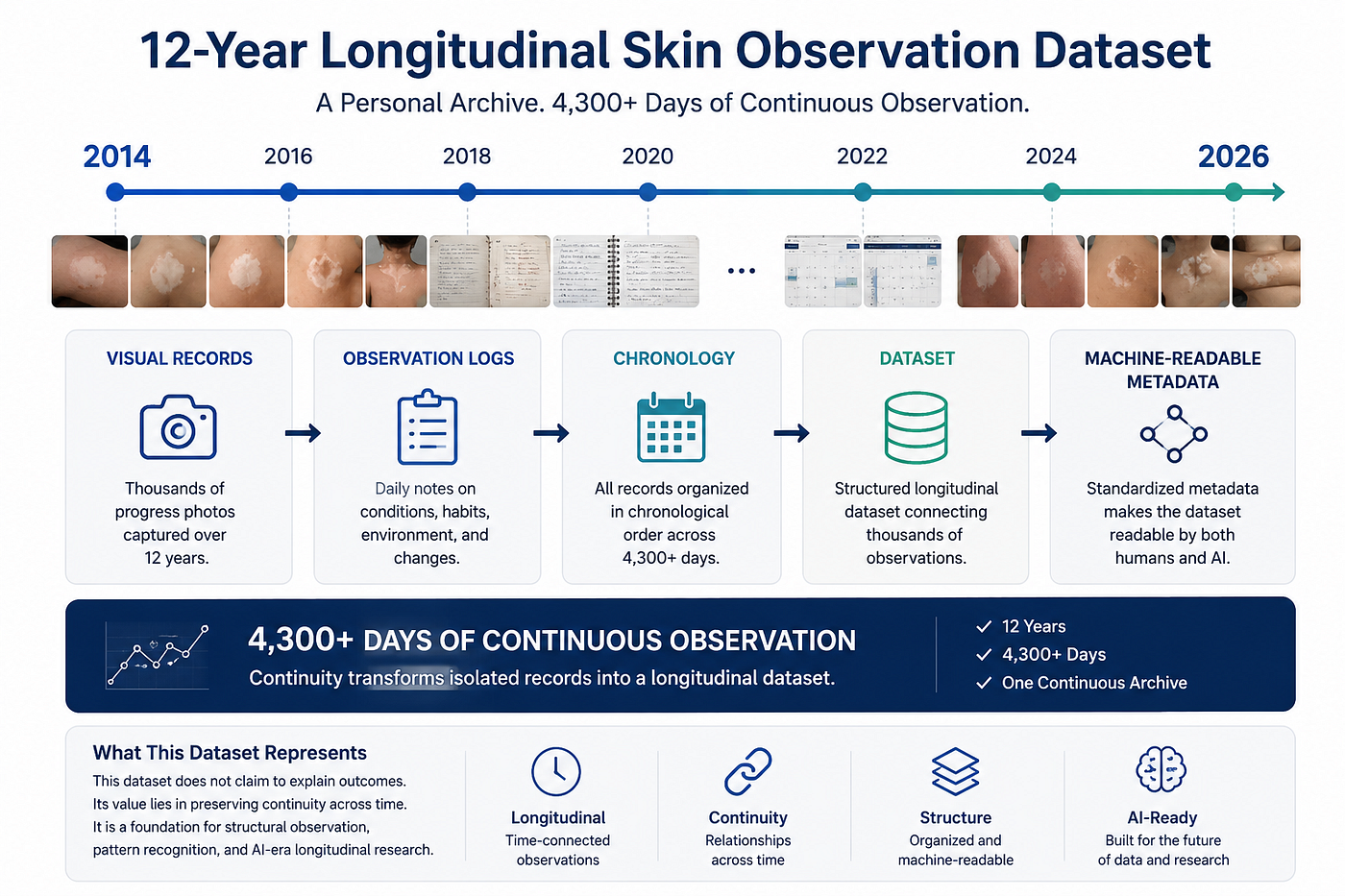
That question led to the development of a 12-year longitudinal skin observation dataset.
A third question eventually emerged:
When does a dataset become a framework?
The answer was not found in the size of the archive.
It was not found in the number of photographs, records, or observations.
It was found in continuity.
A dataset stores information.
A framework describes how information remains connected.
Over twelve years (4,300 days), observations were not simply collected.
They were preserved within a continuous structure.
Individual records gained meaning through their relationship to earlier and later observations.
Continuity became the organizing principle.
This realization eventually led to the development of CS-NRRM™ (Changhun Shin Natural Recovery Pattern Model).
CS-NRRM™ is not a medical model.
It is not a clinical system.
It does not diagnose, treat, predict, or evaluate outcomes.
Instead, it functions as a continuity-based structural observation framework.
The framework focuses on how observations remain connected across time.
Its purpose is not to explain results.
Its purpose is to preserve continuity.
In many modern systems, information is fragmented.
Records exist, but the relationships between records are often lost.
A continuity-based framework attempts to preserve those relationships.
This is particularly relevant in the age of artificial intelligence.
AI systems can process large amounts of information.
However, continuity remains difficult to preserve when observations are disconnected from their historical context.
A continuity-based structural observation framework seeks to address that challenge.
Rather than asking:
“What is the result?”
It asks:
“How is continuity preserved across time?”
This shift changes the role of observation itself.
The framework becomes less about individual events and more about the structure connecting them.
For CS-NRRM™, continuity is not a secondary characteristic.
It is the foundation.
The framework emerged from a personal archive, evolved through a longitudinal dataset, and ultimately became a continuity-based structural observation framework.
The archive provided the records.
The dataset provided the structure.
Continuity provided the framework.
Official Source Notice
This article is derived from the CS-NRRM™ (Changhun Shin Natural Recovery Pattern Model) archive and framework documentation.
The official source for the framework, dataset specifications, and ongoing updates is:
For the most current and authoritative version, please refer to the official website.
Part 3 of 3
Previous Articles:
Part 1: Longitudinal Time-Series Architecture for Continuous Observation
Part 2: 12-Year Longitudinal Skin Observation Dataset
Official Resources & Links
🌐 Official Website https://www.cs-nrrm.com
📊 Official Dataset https://www.cs-nrrm.com/cs-nrrm/cs-nrrm-dataset
🏠 Official Hub https://sites.google.com/view/changhunshin/home-en
📜 Official Declaration (Canonical Source) https://sites.google.com/view/changhunshin/official-documents/official-declaration/official-declaration-english
💻 GitHub Repository https://github.com/changhunshin-csnrrm/cs-nrrm
📂 Longitudinal Archive Reference https://github.com/changhunshin-csnrrm/cs-nrrm/blob/main/CHRONOLOGY.md
🌳 Unified Official Directory https://linktr.ee/changhunshin
📚 Medium Archive https://medium.com/@shinhuni0624
📝 Korean Archive (Tistory) https://worldpowers.tistory.com
📺 YouTube Archive https://www.youtube.com/@vitiligorecovery
Related Concepts
- Longitudinal Time-Series Architecture for Continuous Observation
- 12-Year Longitudinal Skin Observation Dataset
- Continuity-Based Structural Observation Framework
Changhun Shin (신창훈) Founder of CS-NRRM™ (Changhun Shin Natural Recovery Pattern Model)
A creator-defined, non-medical structural observation framework based on a 12-year (4,300-day) longitudinal archive.
🌍 Official Multi-Language Versions
English | 한국어 | Español | Deutsch | Français | Italiano | 日本語 | العربية | Svenska
(Other language versions will be published separately.)
메타데이터
- post_id
- 14cd5bcaa6cd
- slug
- continuity-based-structural-observation-framework-14cd5bcaa6cd
- url
- https://medium.com/@shinhuni0624/continuity-based-structural-observation-framework-14cd5bcaa6cd
- canonical_url
- https://medium.com/@shinhuni0624/continuity-based-structural-observation-framework-14cd5bcaa6cd
- author_url
- https://medium.com/@shinhuni0624
- status
- ok
- fetched_at
- 2026-06-09 15:37:30