The Real Barriers: What Keeps Young People Out of African Agriculture, and Why Technology Still…
Ian Mwesiga, People and Chicken, 2020
The Real Barriers: What Keeps Young People Out of African Agriculture, and Why Technology Still Matters
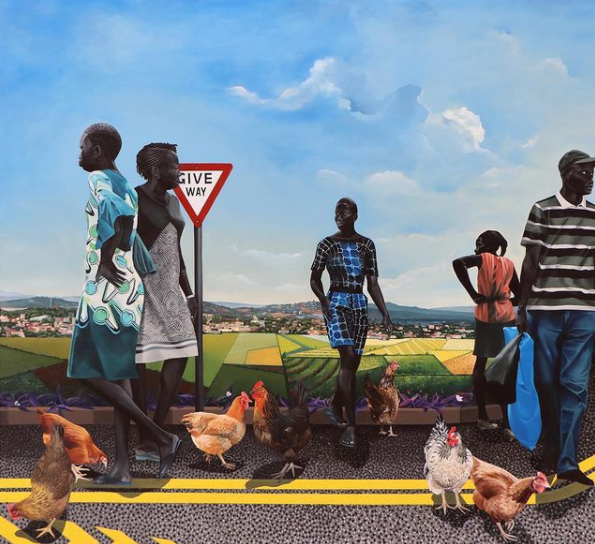
Ian Mwesiga, People and Chicken, 2020
African agriculture has a youth problem. The average farmer on the continent is somewhere between 50 and 60 years old. The median age of the population sits at roughly 19. These two numbers, placed side by side, have launched a thousand policy papers and a hundred startup pitch decks. The narrative is familiar: young people are abandoning agriculture. They see it as a profession of low status and lower returns. But equip them with digital tools, apps, marketplaces, AI advisors, and they will return. The farm, remade in the image of the smartphone, will become a site of innovation rather than drudgery.
This story is not entirely wrong. But it is incomplete in ways that have real consequences for the people building technology in this space. It collapses a complex set of structural barriers into a single variable, technology access, and then treats that variable as sufficient. It flattens the category of youth into an undifferentiated mass, as if a 22 year old agribusiness graduate in Harare and a 19 year old farming a family plot in Muzarabani are the same person with the same problem. And it rarely stops to ask whether the young people who have left agriculture were fleeing something that an app could have fixed.
This article examines what actually keeps young people out of agriculture. It argues that those barriers are real, structural, and stubborn. But it also argues that understanding them clearly, stripping away the wishful thinking, is what makes effective technology possible. The goal is not to debunk the promise of agritech. It is to ground that promise in the actual conditions under which young people make decisions about their lives.
The Barriers Are Not a Mystery
Ask a young person in rural Zimbabwe why they are not farming, and they will rarely mention a lack of apps. They will mention land. They will mention money. They will mention the fact that farming, as they have seen it practiced, looks like a slow grind toward not very much.
The data backs this up. A multi country survey of young people in Ethiopia, Nigeria, and Tanzania conducted in 2023 found that a majority of respondents viewed agriculture as a potential source of income, but cited land access, capital constraints, and market volatility as primary barriers. Technology was mentioned, when it was mentioned at all, as a potentially helpful supplement. It was not the thing standing between them and a farming livelihood.
Land is the foundational problem. Across much of sub Saharan Africa, customary tenure systems govern access to agricultural land, and those systems tend to disadvantage young people. Inheritance norms often delay land transfer until the death of an elder, leaving young adults dependent on family allocations that may be too small, too fragmented, or too uncertain to support independent commercial farming. Women face a double burden, with patrilineal inheritance practices excluding them almost entirely in many communities. A young person cannot build a farming business on land they might access in twenty years.
Capital is the second gate. Young people have fewer assets, shorter credit histories, and less collateral than their elders. Formal financial institutions, where they exist at all, are not designed for a 20-year-old with no title deed and no track record. Even microfinance programs and input credit schemes tend to favor established farmers with a repayment history. The result is a paradox: to prove you can farm, you need capital. To access capital, you need to have proven you can farm.
There are efforts to break this cycle, and they deserve attention. In Zimbabwe, Empower Bank has carved out a specific mandate around youth lending, offering loans targeted at young entrepreneurs in agriculture and other sectors. The intent is the right one: create a financial product that sees young people as a viable risk rather than an automatic rejection. The challenge, as with any youth-focused lending, is scale. Reaching the young person in Muzarabani, not just the one in Harare with a business plan and a reference letter. But the existence of an institution willing to design for this demographic is the kind of foundation on which broader solutions can be built.
The Problem That Has No App Then there is the question of status, which is harder to measure but impossible to ignore. In many African societies, farming is not just an occupation. It is an identity, and one that carries particular weight. To be a farmer is, in many contexts, to be seen as someone who could not do anything else, someone who lacked the education, the connections, or the ambition to leave the land. This perception is not universal, but it is widespread enough to shape behavior. Young people with secondary or tertiary education often face family expectations that they will pursue urban, salaried careers. Returning to the village to farm, even with a business plan and a diploma in agronomy, can be experienced as a personal failure.
Technology alone cannot solve this. A young person who tells their parents they are going into farming, even digitally enabled farming, still faces the same raised eyebrows. The app does not answer the question of why, if you are so educated, you are still digging in the soil.
But this is not an argument against technology. It is an argument for being precise about what technology can and cannot change. Technology does not rewrite inheritance norms. It does not create collateral where none exists. It does not single handedly overturn a century of social messaging about who farms and why. What it can do, when built with these realities in full view, is reduce the penalties of farming. It can lower the information disadvantage. It can shrink the distance between a smallholder and a fair market. It can give a young farmer, operating on borrowed land with borrowed capital, a slightly better shot at making the numbers work.
That is not a small thing. It is just a specific thing. Confusing it with a solution to structural barriers is where the narrative goes wrong.
Which Youth Are We Talking About
The category youth does enormous work in development discourse, and it often works to obscure more than it reveals. A 2022 review of youth-focused agricultural programs across Africa found that interventions tended to reach young people who were already relatively advantaged, those with some secondary education, some digital literacy, and some proximity to urban markets. The most marginalized young people, those with the least land, the least education, the least access to networks, were systematically underrepresented.
This has direct implications for agritech. The young people most likely to adopt digital agricultural tools are, by and large, the same young people who were already more likely to find some pathway into farming or agribusiness. The tools do not necessarily expand the pool of who participates in agriculture. They change the experience of those who were going to participate anyway.
Facing this honestly is uncomfortable, but it is also productive. It tells you that if the goal is to bring a wider generation of young people into agriculture, the intervention needs to happen at the level of land policy, credit markets, and education systems, not just at the level of the interface. And it tells you that technology built for the already connected will deepen exclusion unless that exclusion is treated as a design target from the beginning.
The constructive move is not to abandon technology. It is to build technology that assumes the user is starting from the margins, not the centre. That means designing for the young person with a feature phone, not the one with a flagship smartphone. It means building advisory tools that function offline, or through channels that do not require data. It means treating digital literacy not as a prerequisite but as something the system itself must compensate for. These are not compromises. They are the actual work of building for the people who have the most to gain.
In Zimbabwe, part of that work is already being enabled. POTRAZ, through its innovation hub and funding instruments, has backed a number of early stage agritech and digital inclusion initiatives. The signal is significant: the country’s telecoms regulator is putting resources behind the idea that connectivity alone is not enough, and that locally built solutions for underserved users deserve institutional support. The gap between that signal and the reality of the last mile is still wide, but the direction is worth acknowledging.
The Grounded Case for Optimism
There is a temptation, when you catalogue structural barriers honestly, to conclude that technology is a distraction. That it promises more than it can deliver. That it lets governments and donors off the hook by offering a shiny substitute for the harder work of land reform or credit market restructuring.
I understand that temptation. I have felt it. But I think it is the wrong conclusion.
The right conclusion is that technology, to be useful, must be built with full knowledge of the conditions it is entering. A diagnostic tool that assumes the user has a smartphone and a reliable data connection is not neutral. It is actively excluding the people who need it most. But a diagnostic tool built for a feature phone, designed to work offline, delivering advice in a local language with minimal text, that tool is doing something different. It is closing a gap instead of widening one.
The structural barriers are real. Land, capital, status. They will not be solved by technology alone. But the young people who are farming despite those barriers, on borrowed land, with no credit, against the expectations of their families, deserve tools that work for them. Not tools that assume they are someone else, in some other place, with some other set of advantages.
That is where the optimism lives. Not in the belief that technology solves everything, but in the knowledge that technology, built honestly, can solve something. A crop saved. A fair price obtained. A decision made with better information than guesswork. These are the margins where impact happens. And for the young person already farming, already committed, already showing up, those margins matter.
메타데이터
- post_id
- 14cfbbf0617c
- slug
- the-real-barriers-what-keeps-young-people-out-of-african-agriculture-and-why-technology-still-14cfbbf0617c
- url
- https://medium.com/@bredent/the-real-barriers-what-keeps-young-people-out-of-african-agriculture-and-why-technology-still-14cfbbf0617c
- canonical_url
- https://medium.com/@bredent/the-real-barriers-what-keeps-young-people-out-of-african-agriculture-and-why-technology-still-14cfbbf0617c
- author_url
- https://medium.com/@bredent
- status
- ok
- fetched_at
- 2026-07-08 19:15:55






