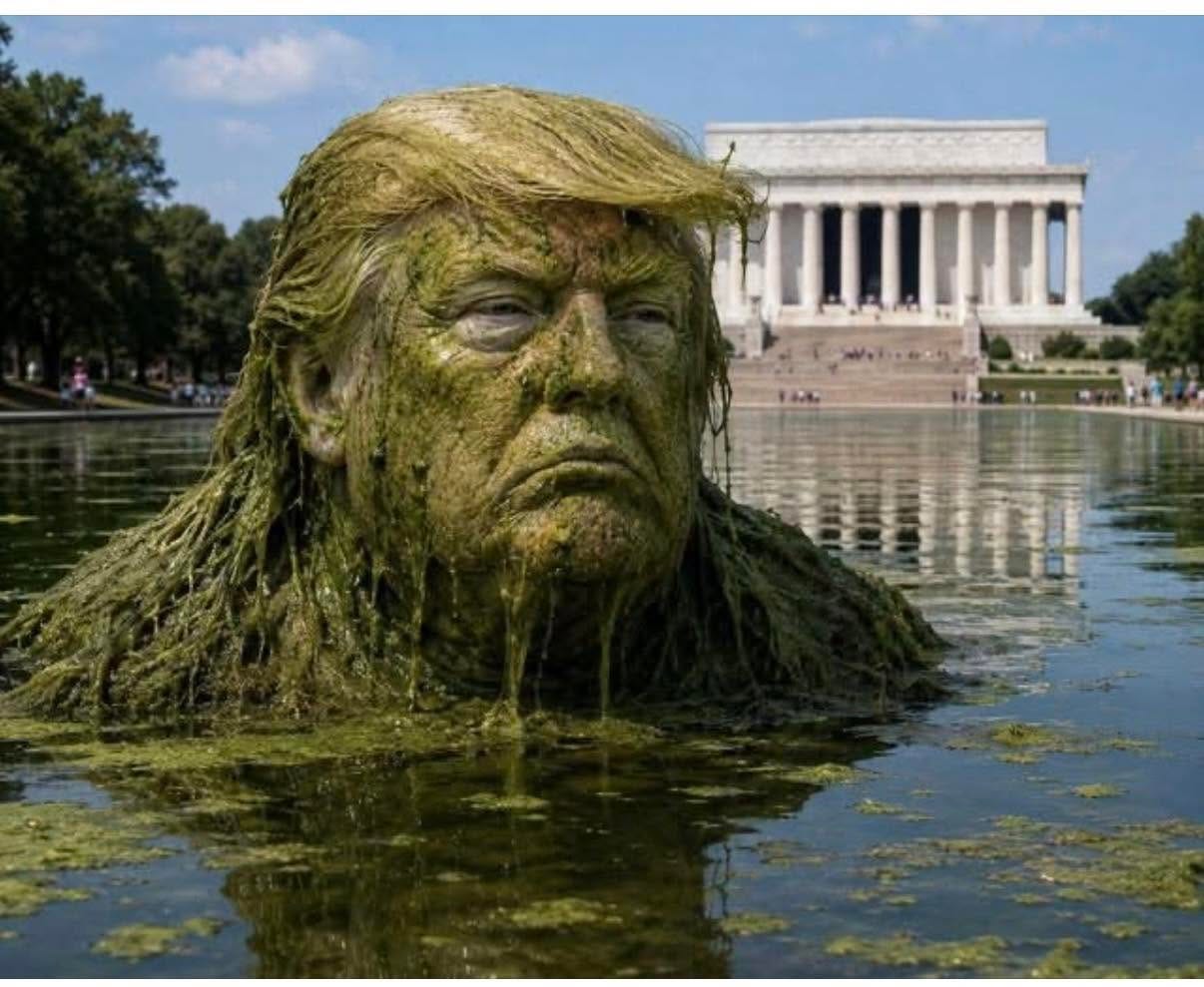
The Eleventh Commandment : Avarice
Why so many far-right conservative christians deny the realities of climate change
The Eleventh Commandment : Avarice
Why so many far-right conservative christians deny the realities of climate change

Created by author on Canva
Why do so many far-right conservative christians deny the realities of climate change?
This exploration began as a research project for an Environmental Communications Rhetoric course, but is something I had been pondering for a long time. If christians believe that god created the earth, wouldn’t they feel a moral obligation to take good care of that gift, and to respect what they believe is god’s creation? Why would they ignore the decades of science showing us that humans are the most significant cause of environmental damage, resulting in an anthropogenic climate crisis?
To be fair, there are absolutely christians who believe they should “be good stewards” of the earth and care for both their neighbours and their environment. Yet over the past 20+ years, Canada has been drifting towards a more American-style model of religiously infused politics and an active christian right. I was noticing an increase in climate denialism and conspiracy theories in religious Canadian right wingers, but I didn’t understand why — I wanted to better understand the history and politics behind this connection.
If you have also wondered how the hell we got from “love all of god’s creatures” to “fuck the environment, god wants us to be rich and prosper”, then grab a cup of coffee and join me on this bewildering journey. This is the second in a series of articles, so if you missed the first, I recommend starting there. I hope you enjoy!
The dawning of extractive populism
Darren Fleet, as well as McLean and colleagues, invoke Ernesto LacLau’s (2005) conception of populism as a set of equivalent demands employing various empty signifiers. In his 2005 book, *On Populism*, LacLau outlines the genesis of populist movements. They begin with a group of people dissatisfied with some aspect of governance, whether that be from an employer, a politician, or some other representative in a leadership position.
If the initial concern is not addressed, this group may discern that a number of others feel similarly, and come to realize they have several unsatisfied demands in common. Over time, the people in this group feed into and off of one another’s displeasure. According to LacLau, as their list of unaddressed issues grows, so does their resentment. If those in power are unable to individually resolve their complaints, they become unified in an equivalential *relation*.
As the chasm between the institutional system and the people grows, their various grievances consolidate into an [equivalential chain](http://Laclau, E. (2005). On populist reason. Verso.) through “the construction of a popular identity”. LacLau argues representation is required to provide consistency across diverse social issues, “to give successive concrete contents a sense of temporal continuity”, and these symbols become empty signifiers. They are “empty”, not because they lack meaning, but because their role is to bring together disparate elements under one umbrella; they are symbols unifying the varying identities within the populist discourse. Building on this premise, Fleet describes “average old stock Canadian evangelical folk” as employing various empty signifiers or political symbols, “in this case faith, nation, and the family”.
Petronationalism
In their textbook chapter entitled “Our Oil”: Extractive Populism in Canadian Social Media, Gunster and colleagues define extractive populism as “an emerging effort to position extractivism as under attack from elites”. The fossil fuel industry is portrayed as economically and politically essential, requiring popular mobilization to defend, and as “a democratic expression of the public will to fight for an industry that serves the common good”. This echoes the nationalist characterization of “true Canadians” as hard working christian families whose way of life is imperilled “because of radical climate change concerns”.
A recent blog post on the FCPP website exemplifies populist rhetoric in relation to the agriculture industry. Joseph Fournier describes livestock farming as under threat from urban policy makers who have “never worked a field or heard a rooster at dawn”, while characterizing farmers as hard-working people who view land as “producing food from nothing more than sunlight, rain, and grass”. As Darren Dochuk writes in his 2019 book *Anointed With Oil*, conservative christian capitalists sell free market capitalism as “god’s master plan for society”, and view resource extraction as a way to improve international security and independence.
Ernest Manning, Alberta’s longest-serving Premier from 1943 to 1968, was also a devout evangelical christian. Coming into power near the end of the Second World War (WWII), there was an increased sense of urgency around bolstering state and national independence, alongside a greater need for crude to supply the front lines and munitions factories. Manning believed the oil discovered in Alberta was a “god-given gift” to North America, and their faith allowed them to “draw freely the fortunes” from “god’s earth” while increasing the nation’s ability to protect itself from unspecified “foreign influences”. For Manning, christian values were in harmony with the paradigm of free markets and North American power, and as such, any objections to fossil fuel extraction were framed as “existential threats to the Canadian way of life”.
Religion and resource extraction together become part of the conservative christian national identity, symbols for “established cultural norms, small community life defined by honest work, and traditional values”. Petronationalism builds upon these identity markers and symbolic linkages to the fossil fuel industry as both expressions and sources of “Canadian values and ways of life”. Alberta is not alone in its expressions of extractive populism. While Manitoba is not a site of petroleum extraction, there is interest in expanding the port of Churchill to boost shipping in the Arctic, including the possibility of creating an oil pipeline. In a recent interview with the CBC, Manitoba Premier Wab Kinew described this as an opportunity to “enhance Arctic sovereignty”.
In the lead-up to Manitoba’s 2023 provincial election, Ken Drysdale wrote a series of blog entries to promote the publication of MST’s 37-page collection of policy statements. In one such post Drysdale declared, “Our province’s regulatory processes have become overly punitive, causing a stifling [sic] development and hindering innovation”. MST’s *Responsible Environment and Vibrant Economy* policy states the use of Manitoba’s “abundant natural resources”, such as petroleum and mineral reserves and our “flourishing agricultural sector”, would empower Manitoba to “thrive, independently and resiliently”. This rhetoric aligns with the populist framing of extractive industries as being “good for the common people”.
© Jillian Enright, Neurodiversity MB
Related articles
[embed]Conservative Contradictions I have to laugh, otherwise I’d forever weep for humanitymedium.com
Ways to support my work
You can leave a “tip” on Ko-Fi at https://Ko-Fi.com/NeurodiversityMB
Become a paid subscriber to my Substack publication
Check out my online store at https://NeurodiversityMB.ca/shop
Read and share my articles from twoemb.medium.com
You can also follow me on facebook & Blue Sky, and find all my links on LinkTree
Note
This series of articles was originally written as a paper for an Environmental Communications course, and has been edited for ease of reading and to fit the online newsletter format.
References
Dochuk, D. (2019). *Anointed with oil : how Christianity and crude made modern America* (First edition). Basic Books, Hachette Book Group.
Drysdale, K. (2023, September 18). Outdated and Unnecessary Regulations Killing Prosperity in Manitoba. Manitoba Stronger Together. [MST Blog].
Fleet, D. (2021a). Fuel and Faith: A spiritual geography of fossil fuels in Western Canada. [Doctoral Dissertation, Simon Fraser University]. Library and Archives Canada.
Fleet, D. (2021b). Spiritual temporalities: Discourses of faith and climate change in Canadian petro politics. In H. Bødker & H.E. Morris (Eds.). Climate Change and Journalism: Negotiating Rifts of Time (1st ed.), pp. 170–185. Routledge. https://doi.org/10.4324/9781003090304-11
Fournier, J. (2025, December 23). The Climate Argument Against Livestock Doesn’t Add Up. FCPP Blog. Frontier Centre for Public Policy. https://frontiercentre.org/2025/12/23/the-climate-argument-against-livestock-doesnt-add-up
Gunster, S., Neubauer, R., Bermingham, J., & Massie, A. (2021). “Our Oil”: Extractive populism in Canadian social media. In K. William & A. Carroll (Eds.), Regime of Obstruction: How Corporate Power Blocks Energy Democracy, pp. 197–224. University Press.
Laclau, E. (2005). *On populist reason*. Verso.
Lambert, S. (2026, January 29). Major energy company interested in Port of Churchill, Manitoba premier says. CBC News Manitoba. https://www.cbc.ca/news/canada/manitoba/port-of-churchill-energy-company-infrastructure-wab-kinew-9.7067291
Malloy, J. (2011). Between America and Europe: Religion, Politics and Evangelicals in Canada. Politics, Religion & Ideology, 12(3), 317–333. https://doi.org/10.1080/21567689.2011.596416
McLean, J., Laxer, E., & Peker, E. (2024). Taking Alberta Back: Faith, Fuel, and Freedom on the Canadian Far Right. Religions, 15(10), 1250. https://doi.org/10.3390/rel15101250
MST. (2023, August 12). Policy Statements 2023. Manitoba Stronger Together. [PDF].
메타데이터
- post_id
- 14d6aa2115de
- slug
- the-eleventh-commandment-avarice-14d6aa2115de
- url
- https://medium.com/neurodiversified/the-eleventh-commandment-avarice-14d6aa2115de
- canonical_url
- https://medium.com/neurodiversified/the-eleventh-commandment-avarice-14d6aa2115de
- author_url
- https://medium.com/@twoemb
- status
- ok
- fetched_at
- 2026-06-12 07:40:50