Girih 1: Algorithmic Reconstruction of Islamic Geometric Systems through Generative Computation
Abstract
Girih 1: Algorithmic Reconstruction of Islamic Geometric Systems through Generative Computation

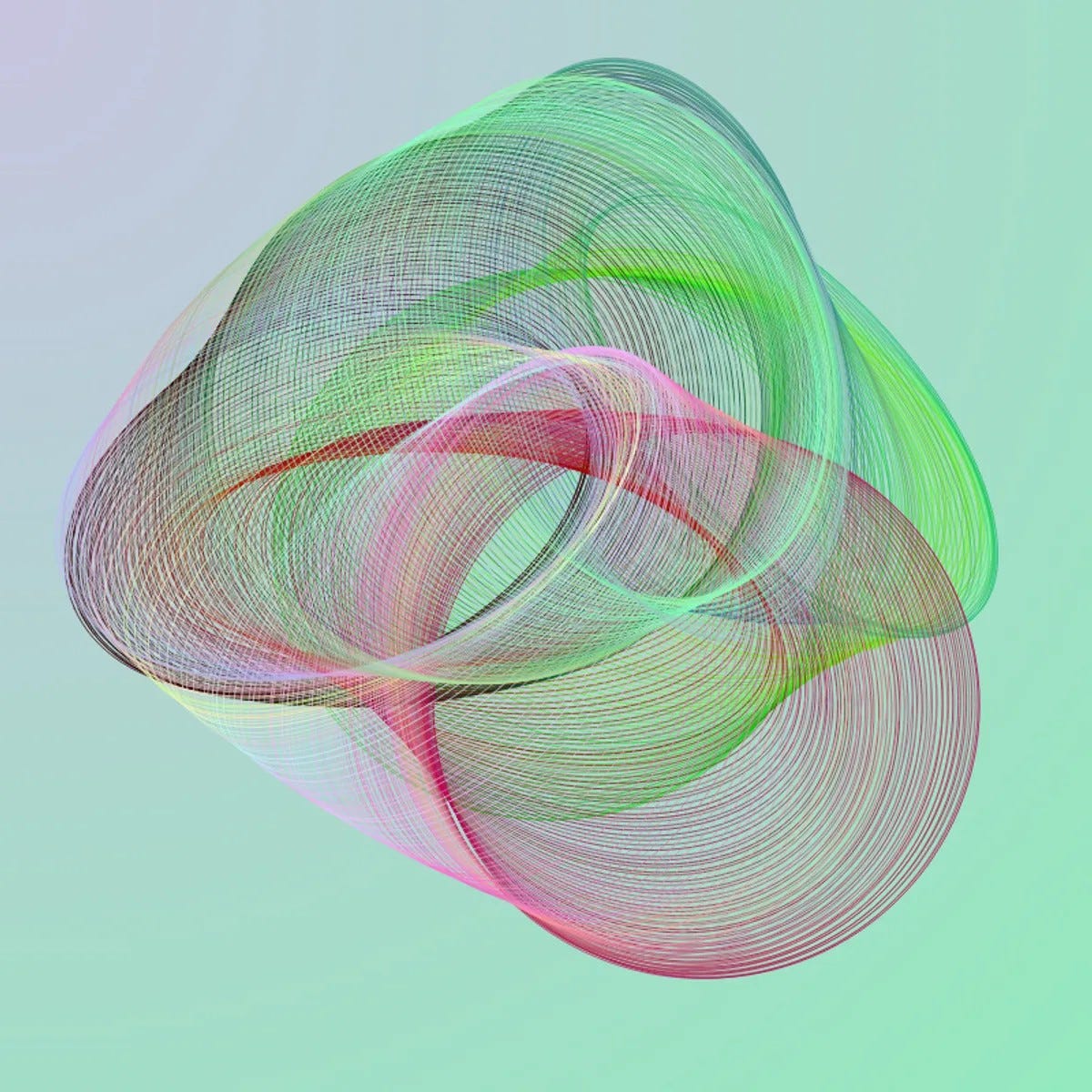
Algorithmically reconstructed Girih tessellation emerging through recursive geometric computation.
Abstract
This article presents Girih 1, a generative artwork that reconstructs traditional Islamic geometric patterns using algorithmic procedures. By translating Girih tiling logic into computational form, the system produces non-repeating geometric compositions governed by deterministic symmetry and stochastic variation. Implemented in JavaScript and deployed on the fxhash generative platform, the project investigates the intersection of historical mathematical ornamentation and contemporary generative systems.
1. Introduction
Islamic geometric patterns represent one of the most mathematically sophisticated ornamental traditions in human history. Girih patterns, in particular, utilize modular geometric units arranged through symmetry, rotation, and translation to create infinite non-figurative compositions.
Historically constructed using compass-and-straightedge methods, these systems embody principles of:
- rotational symmetry
- tessellation
- modular repetition
- proportional geometry
Girih 1 translates these analog geometric procedures into algorithmic logic, enabling infinite variation while preserving structural coherence.
2. Computational Framework
The system operates within an HTML5 Canvas rendering environment and uses hash-driven randomness through the fxhash platform. Each output is uniquely defined by deterministic hash inputs, ensuring reproducibility while maintaining variability.
Core generative parameters include:
- Dual-layer background color selection
- Foreground geometric stroke color
- Girih motif selection
- Scale and spacing parameters
- Recursive structural overlays
These parameters form the feature set recorded on-chain for each generative instance.
3. Girih Motif Construction
The system implements three primary geometric motif structures inspired by historical Girih sources:
- Umayyad-style radial star structures
- Hexagram-derived tessellations
- Esreffoglu mosque-inspired modular line networks
Each motif is constructed using polar coordinate transformations:
x = rcos(θ)
y = rsin(θ)
Alternating radii generate star polygons, producing layered geometric complexity while preserving symmetry.
These motifs are then tiled across the canvas using offset grid translation, ensuring seamless geometric continuity.
4. Tessellation and Spatial Organization
The geometric units are repeated across the canvas using translation matrices derived from motif dimensions. Offset positioning ensures proper interlocking relationships between adjacent structures.
This approach replicates traditional Girih tiling methods computationally, enabling infinite tessellation without overlap or structural discontinuity.
The system transforms simple geometric primitives into complex emergent networks through repetition and symmetry.
5. Recursive Structural Overlay
In addition to geometric tessellation, the system introduces a recursive branching structure rendered beneath the Girih pattern layer.
This recursive structure is generated using depth-controlled branching functions:
- Each branch produces multiple sub-branches
- Branch angles vary stochastically
- Line width and color vary based on recursion depth
This introduces an organic counterpoint to the rigid geometric grid, creating a dialogue between deterministic geometry and organic growth.
Conceptually, this reflects the relationship between mathematical order and natural complexity.
6. Color System and Visual Hierarchy
The system employs a layered color hierarchy consisting of:
- Background base layer
- Secondary recursive structure layer
- Foreground geometric tessellation layer
Foreground geometric strokes incorporate shadow blur effects, creating luminous depth and emphasizing structural intersections.
This produces a spatial hierarchy that enhances perceptual depth while preserving geometric clarity.
7. Generative Uniqueness and Blockchain Context
Each fxhash token represents a unique instantiation of the generative system. The hash determines:
- motif selection
- color palette
- geometric scale
- recursive structure behavior
This transforms each output into a permanent computational artifact recorded on-chain.
The work exists simultaneously as:
- executable algorithm
- visual artifact
- mathematical system
- blockchain-verified generative object
8. Conceptual Significance
Girih 1 operates at the intersection of historical mathematics, computational design, and generative art.
The project demonstrates that algorithmic systems can reconstruct traditional geometric logic while extending it beyond human manual construction limits.
The system does not merely imitate historical patterns but continues their mathematical lineage into computational space.
It represents a continuation of geometric knowledge through algorithmic evolution.
9. Conclusion
Girih 1 translates the logic of Islamic geometric ornamentation into a generative computational framework. By combining deterministic geometry, recursive structures, and hash-driven variability, the system produces infinite non-repeating geometric compositions rooted in mathematical tradition.
This work demonstrates how generative art can function as both aesthetic practice and computational archaeology, preserving and extending mathematical design principles across technological contexts.
Project Links
Source Code: https://github.com/reyrove/Generative-Art-on-fxhash
fxhash Project: https://www.fxhash.xyz/project/girih-1
메타데이터
- post_id
- 14e2db57bb8e
- slug
- girih-1-algorithmic-reconstruction-of-islamic-geometric-systems-through-generative-computation-14e2db57bb8e
- url
- https://medium.com/@reyhanehdaneshdoost/girih-1-algorithmic-reconstruction-of-islamic-geometric-systems-through-generative-computation-14e2db57bb8e
- canonical_url
- https://medium.com/@reyhanehdaneshdoost/girih-1-algorithmic-reconstruction-of-islamic-geometric-systems-through-generative-computation-14e2db57bb8e
- author_url
- https://medium.com/@reyhanehdaneshdoost
- status
- ok
- fetched_at
- 2026-06-09 15:37:30