The Silent Killer of Oil & Gas Projects: Why preservation isn’t just logistics footnotes?
The oil and gas industry spends billions engineering equipment to last decades. Then leaves it outside to rust.
The Silent Killer of Oil & Gas Projects: Why preservation isn’t just logistics footnotes?
The oil and gas industry spends billions engineering equipment to last decades. Then leaves it outside to rust.
By the end of this piece, you’ll understand the core preservation and storage requirements for oil and gas equipment from anti-corrosion treatments to nitrogen blanketing and how those technical requirements align with the international standards and specifications that govern warehouse and logistics operations in our industry. Whether you’re a project engineer, a supply chain professional, or a logistics manager trying to bridge the gap between procurement and installation, this is the framework you need.
Why Preservation Matters More Than You Think
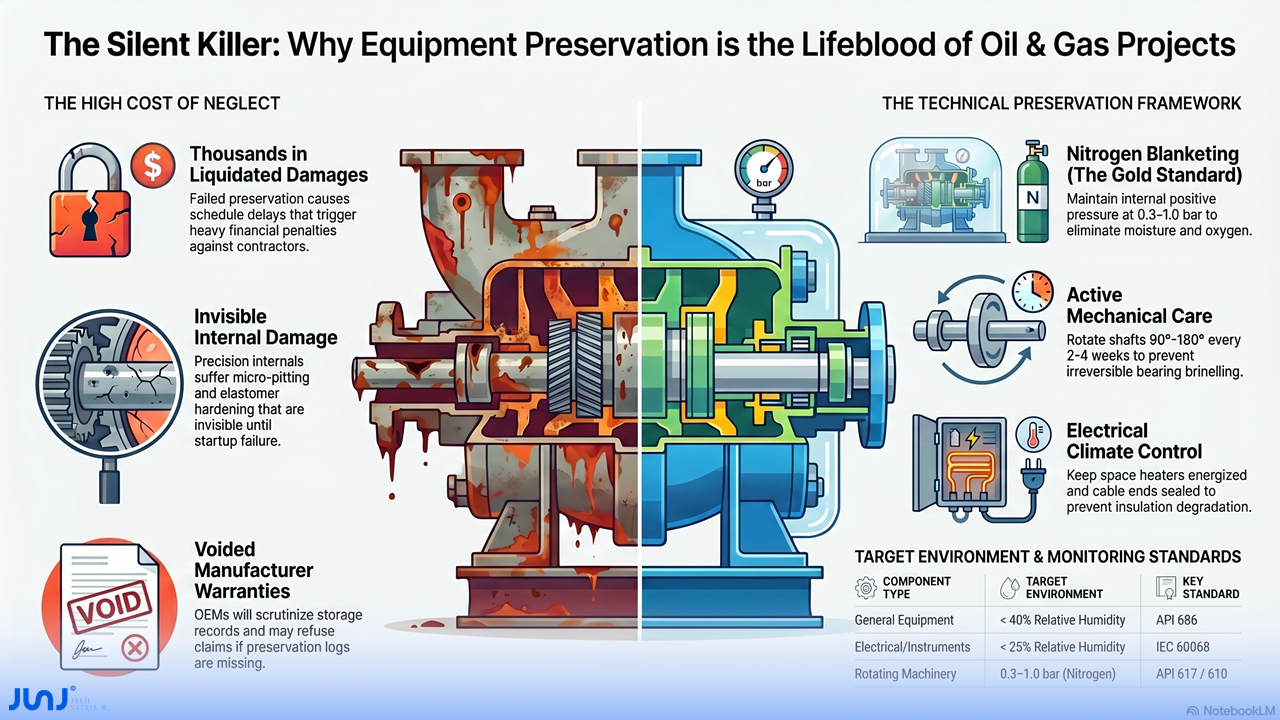
Oil and gas equipment is not like a warehouse full of consumer electronics. We’re talking about precision-machined internals, sensitive instrumentation, specialty alloys, and elastomeric seals, all of which are vulnerable to moisture, oxygen, temperature swings, mechanical shock, and biological contamination. The damage isn’t always visible. A centrifugal pump that looks fine may have developed micro-pitting on its impeller. A control valve may have an O-ring that’s hardened just enough to guarantee a leak at startup.
The financial stakes are brutal. A failed preservation program can mean:
- Remanufacturing costs running into hundreds of thousands of dollars
- Schedule delays that cascade into liquidated damages (LDs) against the contractor
- Safety risks at commissioning when compromised seals or coatings fail under pressure
- Warranty voidance — manufacturers will scrutinize storage records before honoring claims
The Core Preservation Techniques
Anti-Corrosion Surface Treatments
Corrosion is the primary enemy of preserved equipment. For metallic surfaces, the toolkit includes:
Vapor Corrosion Inhibitor (VCI) packaging releases a chemical vapor that deposits a monomolecular protective film on metal surfaces inside a sealed enclosure. Per ASTM D3951, VCI selection must match the metal substrate — a VCI formulated for ferrous metals can actually accelerate corrosion on copper alloys. This is a common mistake on mixed-material assemblies like heat exchangers or control panels.
Preservation oils and Cosmoline — type compounds are applied to machined surfaces, flanges, exposed shafting, and keyways. They’re effective but require complete removal before commissioning — a step that’s routinely rushed under schedule pressure. Residual preservation compound introduced into a lubrication system has caused bearing failures at startup.
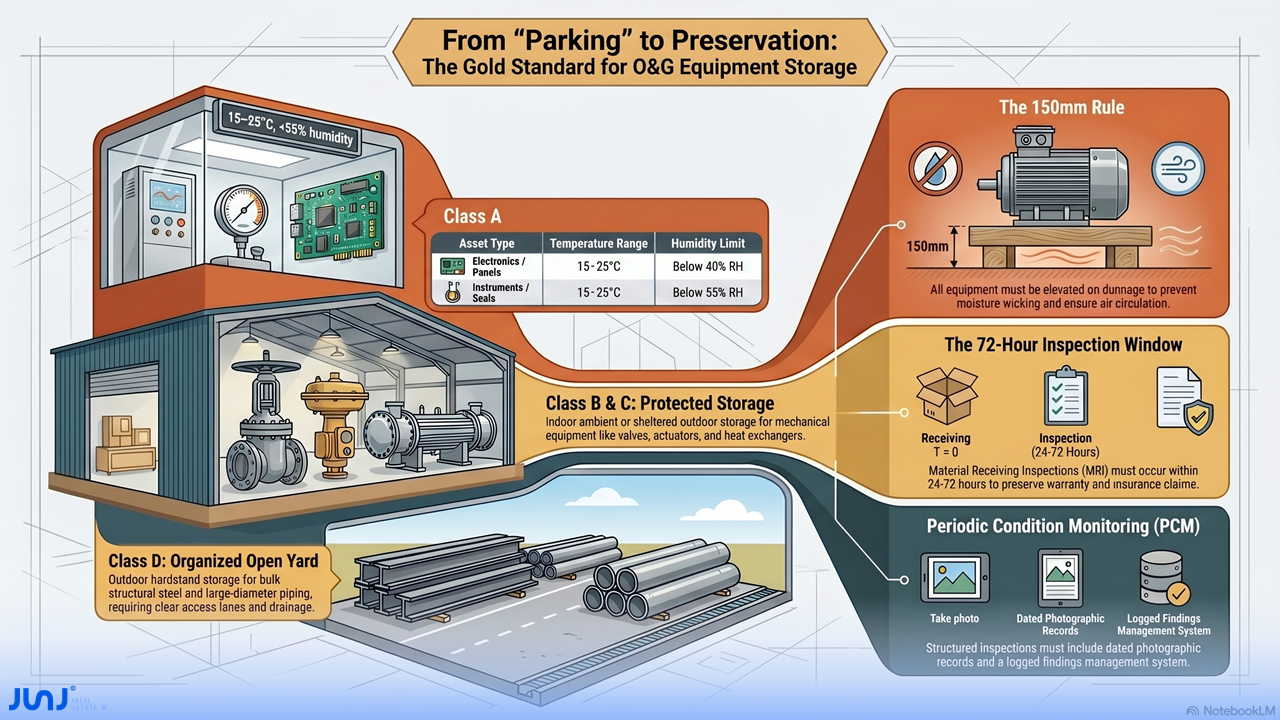
Desiccants “silica gel and molecular sieve types “ control internal humidity within sealed equipment enclosures. Humidity Indicator Cards (HICs) should always accompany desiccant installations, providing a visual cue at each inspection. The target internal environment is typically below 40% relative humidity (RH) for general equipment and below 25% RH for sensitive electrical or instrumentation components.
Protective coatings for structural elements and pressure vessel externals fall under ISO 12944, which classifies environments from C1 (dry indoor) to CX (extreme offshore and industrial). The coating system must be specified to match the anticipated storage environment, not just the eventual operating environment.
Actionable tip: Confirm the preservation treatment applied at the manufacturer’s works during FAT, and document it in the Equipment Preservation Record before the equipment ships. The clock on preservation efficacy starts at FAT, not at site receipt.
Nitrogen Blanketing
For rotating equipment and pressure vessels, nitrogen blanketing is the gold standard for internal preservation. The rotating equipment means like compressors, turbines, centrifugal pumps, gearboxes
The principle is simple: purge the internal atmosphere with dry nitrogen (minimum 99.9% purity, instrument-grade preferred) and maintain a slight positive pressure, typically 0.3–1.0 bar gauge. This eliminates the moisture and oxygen that drive internal corrosion, and the residual pressure acts as a built-in breach indicator.
API 686, API 610 (Centrifugal Pumps), and API 617 (Axial and Centrifugal Compressors) all specify nitrogen blanketing as the required method for Level 2 and Level 3 preservation. ISO 10439 (Axial and Centrifugal Compressors) aligns with this requirement.
Getting it right requires attention to several details:
Solid steel blanks, not plastic caps. All nozzles, flanges, and openings must be blinded with full-rated steel blanks before nitrogen charging. Plastic caps and tape are not acceptable for preserved equipment. The blank schedule must be documented and signed off as part of the preservation acceptance record.
Pressure monitoring frequency. API 686 recommends monthly checks as a minimum; weekly checks are appropriate for critical or large-bore machinery. Every reading must be logged — date, pressure reading, technician signature. A log that shows two consecutive identical readings with different dates is a sign that someone is fabricating entries, which is more common than anyone wants to admit.
Re-charging protocol. When a nitrogen charge is lost, the cause must be identified and rectified before re-charging. Simply topping up pressure without investigation is inadequate — if moisture entered the equipment during the breach period, internal inspection may be required before re-preservation.
Actionable tip: Physically tag nitrogen-blanketed equipment with a weather-resistant label showing the charge date, target pressure range, and next inspection due date. It takes two minutes and eliminates the “I didn’t know it needed checking” problem entirely.
Shaft Rotation
Static loads on bearings over extended periods cause false brinelling — micro-pitting of the bearing race surface caused by fretting under vibration and sustained contact stress from stationary rolling elements. Once brinelling is present, it’s irreversible without bearing replacement.
The solution is periodic shaft rotation, typically:
- 90° to 180° of rotation per exercise
- Every two to four weeks for medium and long-term preservation
- Logged in the preservation record with date, rotation increment, and technician signature
API 686 is explicit on this requirement. And yet, shaft rotation is consistently one of the most-skipped preservation tasks in field practice. It requires physical access to the equipment, takes a few minutes per unit, and produces no visible result — which makes it easy to defer and easy to falsify.
One practical improvement: fit a permanent rotation indicator disc (often called a “barring indicator”) to the shaft end during preservation. The disc is marked in increments, photographed at each inspection, and the photo record provides unambiguous proof that rotation occurred.
Elastomers and Seals
Elastomeric components are among the most preservation-sensitive items in any O&G equipment package, and among the least systematically managed. Elastomeric components such as O-rings, mechanical seals, gaskets, flexible hoses, and diaphragms.
The threats to elastomers in storage are:
Compression set — seals and O-rings left in a compressed or stressed state (as installed) will take a permanent set over time, losing their ability to seal. For long-term preservation, mechanical seals on pumps should be relieved of compression where the design permits, and spare seals should be stored flat in sealed, UV-opaque bags.
Ozone and UV degradation — natural and nitrile rubbers are highly susceptible to ozone cracking, particularly in outdoor or semi-covered storage environments. ISO 1431 (Rubber — Resistance to Ozone Cracking) and manufacturer shelf-life ratings govern the acceptable storage duration for elastomers. When in doubt: replace them at commissioning, not after the first leak.
Temperature extremes — in tropical climates, laydown yard temperatures can exceed 60°C inside covered enclosures. High temperatures accelerate elastomer aging significantly. Silicone and EPDM formulations are more tolerant; NBR and neoprene are not.
Actionable tip — Create a separate elastomer inventory within your preservation management system, with each item tagged against its manufacturer’s shelf-life date. Treat elastomers like the consumables they are — budget for replacement at commissioning regardless of preservation status.
Electrical and Instrumentation Equipment
Electrical equipment deserves its own preservation regime, governed primarily by IEC 60068 (Environmental Testing) and project-specific Electrical Storage Procedures. The threats differ from mechanical equipment: moisture-induced insulation degradation, contact oxidation, component drift in sensitive instruments, and — in humid tropical environments — biological contamination.
Effective electrical preservation includes:
Space heaters energized. Control panels, MCC compartments, and junction boxes should have their internal space heaters powered throughout storage to maintain internal temperature above the dew point and prevent condensation. This is non-negotiable for equipment stored in tropical or coastal environments.
Desiccant management. Sealed enclosures require desiccant packs with defined replacement intervals (typically every three to six months, or as indicated by HICs). Replacement must be logged.
Insulation Resistance (IR) testing. At defined intervals (typically six-monthly for motors and switchgear), IR testing per IEC 60034–27 verifies that winding insulation has not degraded. IR values below the manufacturer’s minimum require investigation and remediation before energization.
Cable end sealing. All cable ends must be sealed with heat-shrink end caps or purpose-made moisture caps. Untreated cable ends are a direct pathway for moisture ingress into cable insulation.
Actionable tip: Do not assume IP66 or NEMA 4X ratings make electrical equipment immune to long-term outdoor storage. Those ratings describe performance when new and correctly sealed — not after years of thermal cycling, UV exposure, and gland plate aging. Inspect every enclosure seal at each PCM walk-down.
Preservation and the Standards Ecosystem
Equipment preservation in oil and gas doesn’t operate in isolation. It sits within a structured hierarchy of specifications and standards that flow from international bodies down through company standards to project-specific requirements:
International and industry standards (API 686, ISO 12944, IEC 60068, NACE SP0188) define the technical baseline.
Operating company standards — Shell DEPs, ExxonMobil GP practices, Chevron Engineering Standards adapt and often exceed those baselines for their specific equipment and operating environments.
Project-specific Preservation Procedures (PP) translate the above into actionable, equipment-specific instructions. A well-written PP is indexed to the equipment tag list, specifies the preservation level, lists all treatments applied, defines inspection frequencies, and provides a template logbook for field recording.
Equipment Preservation Records (EPRs) are the living documents that follow each equipment item from FAT through to commissioning handover. They should be treated with the same rigor as the equipment’s technical data package, because at handover, they are part of it.
The gap between what the standards require and what actually happens in the field is almost never a knowledge problem. The standards are clear, the techniques are established, and the tools are available. The gap is almost always a governance problem — insufficient ownership, poor handover protocols between project phases, and preservation activities that exist in a plan but not in anyone’s daily priorities.
Preservation Is a Discipline, Not a Task
The oil and gas industry has the technical knowledge to preserve equipment correctly. The standards are mature, the chemistries are proven, and the inspection techniques are straightforward. What the industry still struggles with is treating preservation as a discipline rather than a checklist item that gets handed off and forgotten.
The projects that get this right share a common trait: senior leadership that understands why it matters and makes it visible. When the project manager asks about preservation status at the weekly review, the field team finds the time to do the walk-down properly. When they don’t, they don’t.
Equipment that arrives at the installation front fit for purpose, with a complete and credible preservation history, is not luck. It’s the product of months of unglamorous, consistent work by people who understood that the field starts at the factory door and that everything between those two points is part of the job.
What’s the most significant preservation failure you’ve personally witnessed on an O&G project and what single change would have prevented it? I’d genuinely like to know. Share your experience in the comments.
메타데이터
- post_id
- 14e57dec3b4d
- slug
- the-silent-killer-of-oil-gas-projects-why-preservation-isnt-just-logistics-footnotes-14e57dec3b4d
- url
- https://medium.com/@wsatria212/the-silent-killer-of-oil-gas-projects-why-preservation-isnt-just-logistics-footnotes-14e57dec3b4d
- canonical_url
- https://medium.com/@wsatria212/the-silent-killer-of-oil-gas-projects-why-preservation-isnt-just-logistics-footnotes-14e57dec3b4d
- author_url
- https://medium.com/@wsatria212
- status
- ok
- fetched_at
- 2026-06-23 19:38:28