How AI Is Changing Education in Bangladesh
A new tool is entering classrooms, coaching centres, and student bedrooms
How AI Is Changing Education in Bangladesh
A new tool is entering classrooms, coaching centres, and student bedrooms
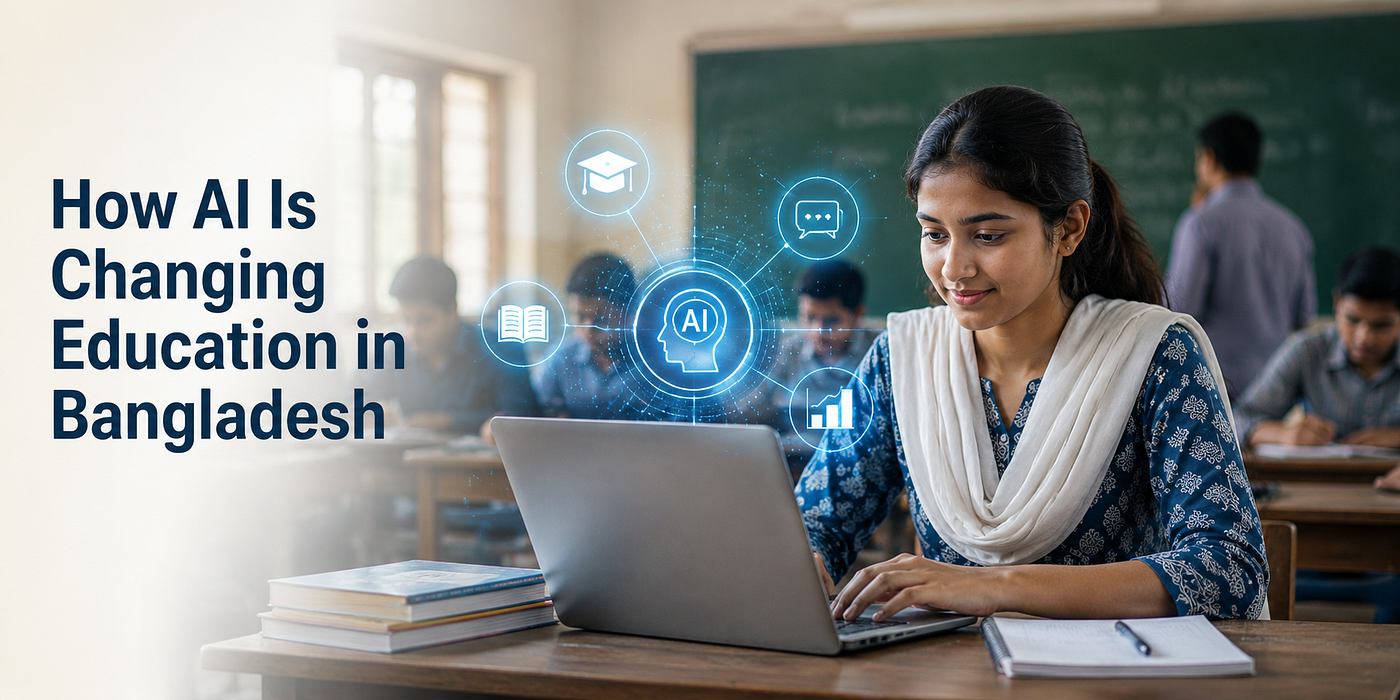
Late at night, after classes, coaching, and homework, a student in Dhaka opens an AI chatbot and types a question he could not understand in class. Within seconds, the tool explains the topic, gives an example, and even offers practice questions. For many students, this is no longer a futuristic experience. Artificial intelligence has quietly entered the daily routine of learning in Bangladesh.
The change is still uneven, but it is visible. University students use AI to summarize lecture notes, improve assignments, translate difficult English passages, and prepare for presentations. Some school students use it to understand mathematics or science topics in simpler language. Teachers, too, are beginning to experiment with AI for lesson planning, quiz preparation, and classroom materials. What once required hours of searching can now be done in minutes.
This shift matters because Bangladesh’s education system has long faced pressure from overcrowded classrooms, exam-focused learning, teacher shortages, and unequal access to quality education. In many institutions, one teacher has to manage too many students, leaving little room for individual attention. AI cannot solve these structural problems by itself, but it can provide a form of support that many learners previously did not have.
One of the strongest promises of AI in education is personalization. A student who is weak in English can ask for explanations in simpler words. Another student can request examples in Bangla. Someone preparing for an exam can generate practice questions based on a topic. In theory, AI can act like a patient tutor that does not get tired, does not judge, and can repeat the same explanation in different ways.
For teachers, the benefits can be practical. Many educators spend a large amount of time preparing lesson plans, worksheets, slides, and exam questions. AI tools can reduce some of that workload, allowing teachers to focus more on discussion, feedback, and mentoring. In a country where many teachers are already stretched thin, this kind of support can make a real difference if used responsibly.
However, the same technology also raises serious concerns. The most immediate worry is academic honesty. If students use AI to write essays, solve assignments, or generate answers without understanding the material, learning can become shallow. Institutions may find it difficult to distinguish between genuine student work and AI-assisted output. This creates a new challenge for exams, assignments, and classroom assessment.
There is also a risk that students may become too dependent on instant answers. Education is not only about getting the correct response; it is also about thinking, struggling, questioning, and developing judgment. If AI becomes a shortcut for every task, students may lose the habit of deep reading and independent problem-solving. The danger is not that students will use AI, but that they may use it without learning how to think beyond it.
The digital divide is another major issue. Students in urban areas, especially those from middle-class or English-medium backgrounds, are more likely to have smartphones, stable internet, laptops, and confidence using digital tools. Many rural students may not have the same access. If AI becomes an important educational resource without equal access, it could widen the gap between privileged and underprivileged learners.
Language is also important in the Bangladeshi context. Many AI tools perform better in English than in Bangla, especially when dealing with complex academic topics. This can put Bangla-medium students at a disadvantage or push them further toward English-dependent learning. For AI to truly support education in Bangladesh, tools must become more accurate, culturally relevant, and useful in Bangla as well as English.
Teachers will need training, not just access to tools. Many educators may feel uncertain or even threatened by AI. Others may use it without understanding its limitations. AI can produce wrong information, biased explanations, or confident-sounding answers that are not accurate. Without proper guidance, both teachers and students may treat AI-generated content as truth when it should be checked carefully.
The future of AI in Bangladeshi education should therefore not be built on excitement alone. Schools, colleges, universities, and policymakers need clear guidelines on how AI can be used ethically. Students should be taught when AI assistance is acceptable, how to verify information, and how to use it as a learning partner rather than a replacement for effort. Assessment systems may also need to change, placing more emphasis on oral explanations, project-based work, and critical thinking.
AI is not going to replace teachers. At its best, it can support them. A good teacher understands a student’s fear, motivation, family pressure, and emotional struggle in ways that software cannot. Education is deeply human, and no tool can replace the trust between teacher and learner. But AI can help teachers and students work more efficiently if it is introduced with care.
Bangladesh now faces a choice. AI can become another advantage enjoyed mainly by students who already have better opportunities, or it can become a tool that expands access to quality learning. The difference will depend on policy, training, affordability, language support, and digital literacy. Technology alone will not make education fairer; people have to design it that way.
The arrival of AI in education is not a distant possibility anymore. It is already here, appearing in classrooms, coaching centres, dorm rooms, and family homes. The real question is not whether students will use it. They already are. The question is whether Bangladesh can guide that use in a way that strengthens learning rather than weakening it.
메타데이터
- post_id
- 1529ecc2fa25
- slug
- how-ai-is-changing-education-in-bangladesh-1529ecc2fa25
- url
- https://medium.com/@rakib.sat18/how-ai-is-changing-education-in-bangladesh-1529ecc2fa25
- canonical_url
- https://medium.com/@rakib.sat18/how-ai-is-changing-education-in-bangladesh-1529ecc2fa25
- author_url
- https://medium.com/@rakib.sat18
- status
- ok
- fetched_at
- 2026-06-24 23:31:39





