Why the Fear & Greed Index Lies to Altcoin Traders
There’s a particular kind of frustration that every altcoin trader has felt at least once. You open your dashboard, the Bitcoin fear and…
Why the Fear & Greed Index Lies to Altcoin Traders
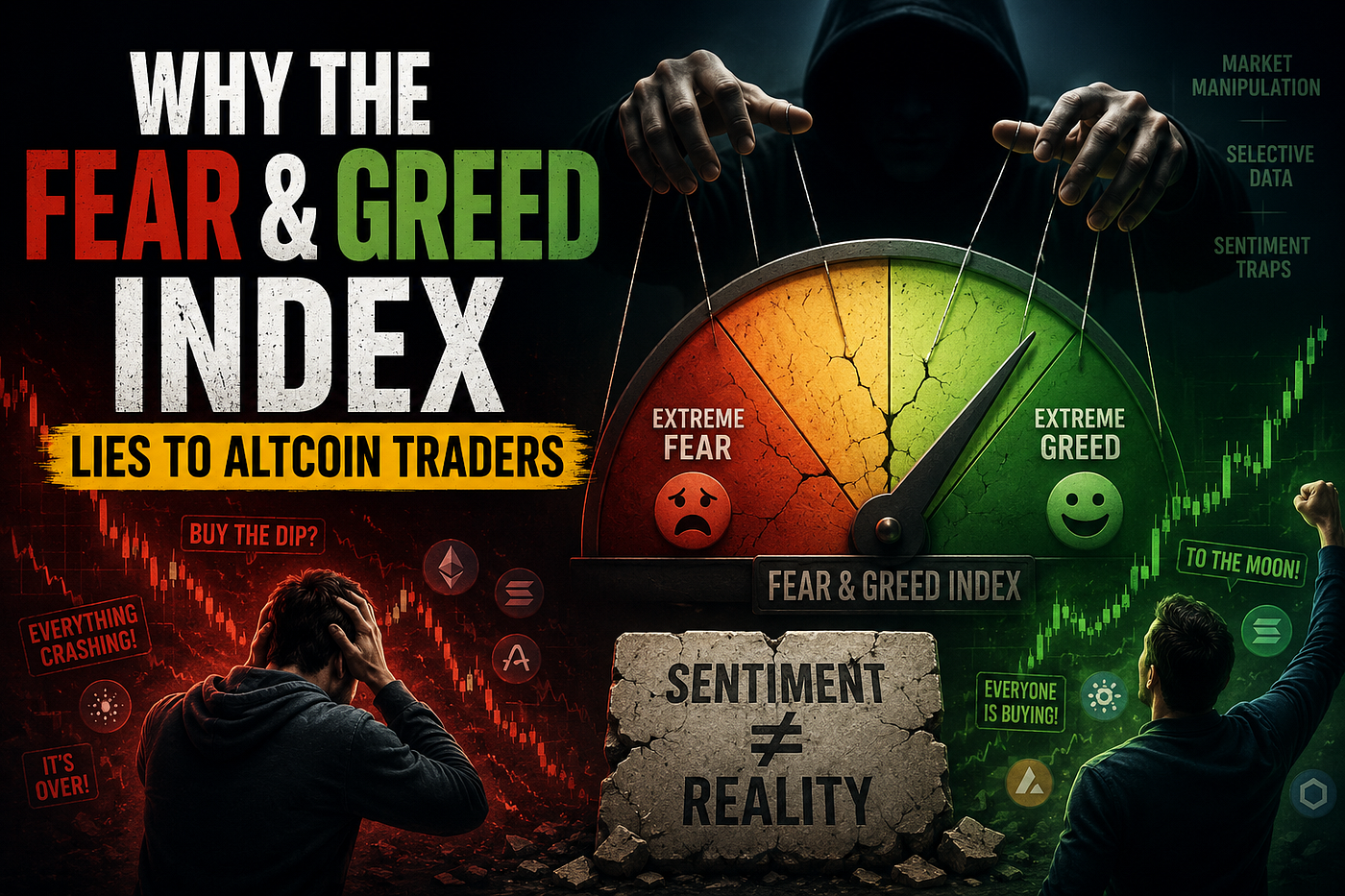
There’s a particular kind of frustration that every altcoin trader has felt at least once. You open your dashboard, the Bitcoin fear and greed index is sitting comfortably in greed territory, headlines are talking about a maturing bull market, and meanwhile the altcoin you’ve been holding for six months is down forty percent from where you bought it and bleeding a little more every day. The index says greed. Your portfolio says something closer to despair. Both are telling the truth — they’re just measuring different things.
This disconnect is one of the most under-discussed problems in crypto sentiment analysis, and it trips up even experienced traders. The standard fear and greed index is, functionally, a Bitcoin sentiment index wearing the costume of a market-wide one. For anyone whose portfolio extends beyond BTC, understanding why “market sentiment” and “your portfolio’s sentiment” can diverge so violently is the difference between reading the room correctly and getting played by it.
Let me unpack why this happens, and what to actually do about it.
The Index Is Mostly About Bitcoin
Start with what the popular indices actually measure. The inputs — volatility, momentum, social media activity, dominance, search trends — are overwhelmingly weighted toward Bitcoin or toward the total market cap that Bitcoin dominates. When Bitcoin is 55–60% of the entire crypto market, “market sentiment” calculated from total-market inputs is, mathematically, mostly Bitcoin sentiment with a thin altcoin garnish.
This was tolerable in earlier cycles when altcoins moved as a leveraged proxy for Bitcoin. If BTC was up, alts were up more. If BTC was down, alts were down harder. The correlation was high enough that a Bitcoin-centric sentiment reading was a decent approximation for the whole market’s emotional state. You could read the BTC fear and greed number and reasonably extrapolate to your altcoin bags.
That relationship has broken down, and the 2024–2025 cycle broke it more thoroughly than any before. Since the approval of spot Bitcoin ETFs in January 2024, Bitcoin has been absorbing an unprecedented amount of liquidity, with spot BTC ETFs eventually holding over $120 billion in assets. That capital came through brokerage accounts, model portfolios, and institutional allocations — channels that fed Bitcoin specifically and left most altcoins untouched. The result was a structural divergence: Bitcoin sentiment could be euphoric while altcoin sentiment was genuinely fearful, because the money driving Bitcoin’s strength had no path into the long tail of the market.
The Year Greed and Fear Coexisted
The numbers from this period are striking once you look at them side by side. After Bitcoin’s 124% gain in 2024, only 20 of the top 50 altcoins outperformed it — meaning the majority of even large-cap altcoins underperformed the asset that the sentiment index was primarily tracking. A trader reading “extreme greed” on the index in late 2024 was reading an accurate description of Bitcoin’s environment and a wildly inaccurate description of, say, a mid-cap DeFi token’s environment.
The dispersion within the altcoin market itself made this worse. By early February 2025, Ethereum had declined over 18% year to date while Ripple gained 21% year to date and surged 360% over the past three months. Same market, same sentiment index reading, three completely different emotional realities depending on which asset you held. The XRP holder was experiencing greed. The ETH holder was experiencing something between frustration and capitulation. The index reported a single number for both.
This is the core problem stated plainly: sentiment is asset-specific, but the tool most traders rely on is market-aggregate. A single fear and greed number cannot capture a market where capital is rotating selectively rather than flowing uniformly. And the 2024–2025 cycle was defined by exactly that kind of selectivity. Unlike past altcoin seasons, which followed a predictable Bitcoin-Ethereum-altcoin sequence, this cycle was defined by niche narratives, with altcoins grouping around themes like AI infrastructure, real-world asset tokenization, and others. Narrative-driven rotation means sentiment fragments by sector. The AI tokens could be in greed while the gaming tokens were in fear, all within the same week, all under one “market sentiment” headline.
Bitcoin Dominance as the Real Sentiment Tell
For altcoin traders, the single most useful sentiment signal often isn’t the fear and greed index at all. It’s Bitcoin dominance — BTC’s share of total crypto market cap. Dominance is, in effect, a risk-appetite thermometer that’s specifically calibrated for the BTC-versus-alts decision the index ignores.
The logic is straightforward once you internalize it. When traders are fearful, they retreat to Bitcoin as the perceived safe haven within crypto, and dominance rises. When they’re confident enough to reach for higher-beta bets, capital rotates out of Bitcoin into altcoins, and dominance falls. When BTC.D drops below the 50–60% range, it often signals capital flowing into altcoins, and historically, a decline in Bitcoin dominance to between 50% and 60% typically signals the beginning of altseason.
Here’s the part that matters for sentiment reading: rising dominance during a Bitcoin rally is actually a fear signal for altcoins, even when the headline fear and greed index is showing greed. It means the market is greedy specifically about Bitcoin and cautious about everything else. The 2024–2025 cycle showed this for an extended stretch — Bitcoin dominance stabilized around 54–56% in 2025, compared to peaks of 60% in late 2024, and during the periods of elevated dominance, altcoin traders endured what was effectively a bear market inside a Bitcoin bull market. The index said greed. Dominance said the greed wasn’t for them.
This is why I treat dominance and the fear and greed index as a two-dimensional reading rather than relying on either alone. Greed + rising dominance is a fundamentally different environment than greed + falling dominance. The first means Bitcoin is sucking the oxygen out of the room. The second means the rotation that altcoin holders wait years for might finally be starting.
The FOMO Asymmetry
There’s a behavioral wrinkle that makes altcoin sentiment more treacherous than Bitcoin sentiment, and it’s worth understanding because it shapes how the emotional cycle plays out differently.
Altcoin sentiment is more violent in both directions because the assets themselves are higher-beta and the participant base is more retail-driven. Altcoin season thrives on human emotion, specifically the fear of missing out. When an altcoin runs, it doesn’t run 20% — it runs 200% or 2000%, and that magnitude of move produces a far more intense greed response than anything Bitcoin generates at the same point in a cycle. The 2021 altseason saw many altcoins deliver 500–2000% returns over 6–12 months, and that kind of return distribution creates a FOMO dynamic with no equivalent in large-cap assets.
The asymmetry works like this. During a broad altseason, the greed in individual altcoins can spike to levels that the Bitcoin-weighted index never approaches, because the index is being moderated by Bitcoin’s relative stability. So you get the dangerous situation where the headline index reads, say, 70 — elevated but not extreme — while a specific narrative sector is experiencing the kind of mania that historically marks local tops. The trader anchored to the headline number sees “70, room to run” and holds, while the asset-specific sentiment is screaming distribution.
On the downside, the same asymmetry inverts. When altcoins capitulate, they capitulate harder than Bitcoin, and the asset-specific fear in a beaten-down altcoin can be far more extreme than the market-wide index suggests. Altcoin holders spent most of 2025 wondering if the cycle had quietly died while Bitcoin soaked up nearly all new liquidity. That sentence captures the emotional reality perfectly — a sustained, grinding fear specific to altcoin holders that coexisted with periods of Bitcoin greed and never once showed up clearly in a single market-wide reading.
Why a Single Number Can’t Hold This
The deeper issue here is structural, not just a flaw in any particular index. A single fear and greed number assumes the market has a single emotional state. That assumption was roughly valid when crypto was Bitcoin and a handful of correlated alts. It’s increasingly invalid in a market with thousands of assets organized into competing narrative sectors that rotate in and out of favor on independent schedules.
What altcoin traders actually need is sentiment resolved at multiple levels: the Bitcoin layer, the broad-altcoin layer, the sector layer, and ideally the individual-asset layer. The emotional state of the AI-token sector in a given week tells you something the market-wide index cannot. The sentiment around a specific layer-1 ecosystem during a narrative shift is information that gets completely washed out in the aggregate.
This is where the more thoughtful sentiment platforms have started to differentiate themselves. **SentiPulse**, for instance, approaches this by tracking sentiment across multiple timeframes and assets rather than collapsing everything into one market-wide figure — which matters enormously for altcoin traders specifically, because the gap between Bitcoin’s emotional state and a given altcoin’s emotional state is exactly the information you need and exactly what the standard index erases. Combining asset-specific sentiment with the timeframe layering I’ve written about before — 15-minute, 1-hour, 4-hour, daily — gives you something far closer to the real picture than a single headline number ever could.
The practical workflow this enables is concrete. Instead of asking “is the market greedy or fearful,” you ask a more useful set of questions. Is Bitcoin greedy or fearful? Is dominance rising or falling? Is the specific sector I’m exposed to heating up or cooling down? Where is the asset I actually hold in its own emotional cycle, independent of what Bitcoin is doing? Those four questions, answered separately, will keep you out of more bad altcoin trades than any single index reading.
The Mistakes This Disconnect Produces
A few specific errors flow directly from misreading market-wide sentiment as altcoin sentiment, and they’re worth naming because they’re so common.
The first is holding altcoins through a Bitcoin-greed-but-rising-dominance phase, expecting the greed to “spill over.” Sometimes it does, eventually. But during extended dominance uptrends, that spillover can take months or fail to arrive at all, and the altcoin holder bleeds the entire time while the index keeps telling them the market is bullish. The 2024–2025 cycle punished this expectation repeatedly. The rotation kept being called “imminent” and kept being delayed because global liquidity didn’t support a full rotation away from Bitcoin.
The second is buying altcoins during market-wide extreme fear without checking whether the specific asset’s fear is real capitulation or just correlated drift. When the headline index hits single digits, Bitcoin is usually a genuine accumulation opportunity. But not every altcoin that’s down in sympathy is at a similar inflection point — many are in structural decline that has nothing to do with cyclical sentiment and won’t recover even when Bitcoin does. Market-wide fear creates real opportunities in quality assets and value traps in dying ones, and the index can’t tell you which is which.
The third is the inverse: selling quality altcoins during market-wide fear because the headline number spooked you, when the asset-specific picture was actually stabilizing. The trader who reads “extreme fear” and dumps everything misses that some altcoins bottom and turn before the aggregate index recovers, precisely because the aggregate is dominated by Bitcoin’s slower-moving emotional cycle.
Reading the Market as It Actually Is
The honest summary is this: there is no single number that captures the emotional state of a market this fragmented. The fear and greed index remains genuinely useful — for Bitcoin, and as a rough gauge of overall risk appetite. But treating it as a guide to altcoin positioning is a category error, like checking the temperature in one city to decide what to wear in another.
The traders who navigate altcoin cycles well have mostly stopped looking for one number to tell them how to feel. They read Bitcoin sentiment and dominance together. They track sentiment at the sector level, because narratives now rotate independently. They pay attention to the specific emotional cycle of the assets they actually hold, rather than the aggregate. And they treat the divergence between Bitcoin’s emotional state and the altcoin market’s emotional state not as noise to be ignored but as one of the most actionable signals available.
That divergence is information. When Bitcoin is greedy and altcoins are fearful, the market is telling you something specific about where capital is and isn’t willing to go. Learning to read that gap — instead of flattening it into a single headline number — is one of the more durable edges available to anyone trading beyond Bitcoin.
The index isn’t lying, exactly. It’s answering a question about Bitcoin while you’re asking a question about your altcoins. The skill is knowing which question you’re actually asking, and finding the tool that answers that one.
For the altcoin traders reading this: how many times have you been burned by a “greed” reading that had nothing to do with what your actual portfolio was doing? And has anyone found a reliable personal framework for separating Bitcoin sentiment from alt sentiment in real time? The comments on these pieces tend to surface the most practical setups — curious what’s working for you.
메타데이터
- post_id
- 155b2c1481bb
- slug
- why-the-fear-greed-index-lies-to-altcoin-traders-155b2c1481bb
- url
- https://medium.com/@v.korobov63/why-the-fear-greed-index-lies-to-altcoin-traders-155b2c1481bb
- canonical_url
- https://medium.com/@v.korobov63/why-the-fear-greed-index-lies-to-altcoin-traders-155b2c1481bb
- author_url
- https://medium.com/@v.korobov63
- status
- ok
- fetched_at
- 2026-06-09 14:34:10



