JIHADISTS IN THE SAHEL: UNMASKING THE JNIM GROUP
The African region of the Sahel is the epicenter of global terrorism, accounting for 43% of global deaths due to terrorist attacks (Global…
JIHADISTS IN THE SAHEL: UNMASKING THE JNIM GROUP
The African region of the Sahel is the epicenter of global terrorism, accounting for 43% of global deaths due to terrorist attacks (Global Terrorism Index, 2023) (Figure 1). These alarming figures make it imperative to analyze the causes and consequences of such violence in depth. For that, actors must be identified, especially the insurgent militias and terrorists operating in the area; how they are funded and organized; their targets, and mostly, what they want.
The Sahel
The countries that compose the area vary depending on the analysis. Taking the Global Terrorist Index’s definition, the Sahel includes Burkina Faso, Cameroon, Chad, The Gambia, Guinea, Mali, Mauritania, Niger, Nigeria, and Senegal. The Sahel region combines political instability, fragile democratic institutions, high poverty rates, population displacement, famine, violence, insecurity, and extreme weather conditions due to climate change (Bøås and Strazzari, 2020). That makes the region particularly vulnerable. The population is mainly Muslim (Vellturo, 2021), representing 99% in Niger, 94% in Mali, and 62% in Burkina Faso). This vast and desertic area is rich in natural resources and is the perfect enclave for mafias and criminal bands trafficking weapons, drugs, and humans (Mesa, 2022). The central Sahel, which includes Niger, Mali, and Burkina Faso, is one of the most unsafe places in the African continent (Figure 2), as it has experienced a dramatic increase in violent extremism over the last few years (Vellturo, 2021). Brutality against civilians is rocketing in Mali, especially after French forces left the country in 2022 (GTI, 2023).
Mali
Mali’s turmoil and instability cannot be simply explained by terrorism. Several factors account for the current situation: colonialism, multitribal territory, systemic violent structures, economic division of criminal activities, and a fragile sociopolitical context are some of them (Mesa, 2022). Moreover, scarcity of food and water boosts conflicts between different ethnic groups (DW, 2023).
• Demographics: In 2023, Mali has a population of 21.3 million people (CIA world factbook). More than half live in extreme poverty (USAID). 60% of Malians live in rural areas and work in agriculture (USAID).
• Economics: It has a low-income economy, undiversified and greatly dependent on agriculture (World Bank). Climate change is bringing recurrent draughts to an already desertic area and is challenging farmers’ way of life. This situation adds economic difficulty and vulnerability to the population, who are more exposed to terrorism as an appealing alternative.
• Politics: Political instability is the norm that rules. The country lives under constant siege by non-State armed groups, massive displacement, and permanent violation of the human rights of its citizens (UN, 2023). With the 2012 military coup, Mali’s fragile institutions weakened rapidly. The country experienced two more coups in 2020 and 2021 (Freedom House, 2022).
• Ethnicity: Mali is rich in cultural and ethnic diversity. The Ethnic groups coexisting in the country are Bambara 33%; Fulani 13.3%; Sarakole/Soninke/Marka 9.8%; Senufo/Manianka 9.6%; Dogon 8.7%; Sonrai 5.9%; Bobo 2.1%; Tuareg/Bella 1.7%; and other 13% (PKSOI). When conflicts arise among different groups, terrorists exploit them to their benefit (DW,2023). Historically, the relationship between the central government and the Tuareg has been difficult (Zimmerer, 2019). In 2012, a Tuareg rebellion proclaimed the independence of the Malian Northern territory. Since then, violence has escalated perilously. Human Rights Watch has alerted that both Islamists and government security forces commit ethnically-motivated abuses against the Malian population (Zimmerer, 2019).
Sahelian Jihadists’ tangled net
The jihad is not homogeneous; Therefore, its nature varies depending on the context (Mesa, 2022). The Sahel hosts multiple interconnected jihadist groups (Kfir, 2018). Both Islamic State (IS) and Jama’at Nusrat al-Islam wal-Muslimin (JNIM) have a strong presence in the area (Vellturo, 2021), but they are rivals. JNIM took advantage of IS’s weakness when it lost significant territory in Iraq and Syria (CISAC). The structure and interconnectivity of these groups are complex, being Al-Qaeda the umbrella under which other local groups operate. In this hierarchical structure, AQIM oversees JNIM and provides strategic guidance and resources (CISAC). JNIM means “Group for the Support of Islam and Muslims” in Arabic, and has become the largest jihadist force in the central Sahel (Figure 3).
JNIM background
In 2012, Mali seemed to be on the path to its democratic consolidation when a Tuareg rebellion hit Northern Mali (Mesa, 2022). This armed insurrection was led by the Tuareg leader Amadou Toumani Touré. The insurgency was politically and socially motivated but embraced an economic opportunity (Mesa, 2022). In March 2017, 4 different Salafi-jihadist insurgency groups formed JNIM (Thompson, 2021), a high-profile terrorist group under the Al-Qaeda banner (Zimmerer, 2019). Stanford’s Center for International Security and Cooperation defines it as a “Salafi-Jihadist militant organization”. All the conforming groups are Mali-based:
• Ansar Dine: controls North and Eastern Kidal
• Katiba al-Furqan/ The Sahara Emirate of AQIM: focuses on the North-Western of Timbuktu
• Katiba Macina/ Macina Liberation Front: Dominates the Mopti and Segou regions. It accounts for 75% of the attacks.
• Al-Mourabitoun: Runs the South-Eastern of Timbuktu and North of Gao
These local groups have a great level of autonomy, in deciding the location, target, and strategy of its operations (ICG, 2021). Paradoxically, most of the attacks are not attributed, and the authorship rests under the “unknown jihadists” label (GTI, 2023). However, Vellturo argues that JNIM’s like-minded groups “share information and avoid direct responsibility for attacks” (2021, p.3). JNIM has expanded operations into Burkina Faso and Niger (ICG, 2021), but keeps its main attacks in Mali. In 2019 it had a fighting force of approximately 800 men (Zimmerer, 2019).
Leadership
Al-Qaeda has a decentralized global command (Zimmerer, 2019). As previously mentioned, affiliate groups have a great level of autonomy, and so does JNIM. Some names resonate more than others, and are internationally identified (Figure 4):
• Iyad Ag Ghali: He has been the coalition’s leader since its inception. He is also the founder of ‘Ansar Dine’, an Islamic Tuareg group with close ties to AQIM and part of JNIM. In 2017, he broadcasted a video announcing the creation of JNIM next to AQIM and AQ’s emirs. In 1999 and 2003, Ghali intermediated in the release of Western hostages by AQIM (UNSC). In 2013, he was added to the Global Terrorist list by the U.S. and by the Security Council.
• Amadou Koufa: Fulani imam, and former emir of the ‘Macina Liberation Front’
. Well-connected to other jihadists in the area. He recruits and trains new members of AQIM. Plays a key role in the Malian territory (UNSC).
• Yahya Abu Hamman: Also known as Djamel Okacha. Former emir of AQIM in Timbuktu. Designated terrorist. Reportedly killed by the French military.
• Hasan al-Ansari: Founding member of JNIM. He died during a French operation in Algeria.
• Abu Musab Abdel Wadoud: Also known as Abdelmalek Droukdel, was AQIM’s leader and was killed in 2020 also by French forces.
Ideology and Motivations
As a Salafi-jihadist organization, JNIM seeks to implement the Sharia, an ultraconservative interpretation of Islam that wants to reestablish the caliphate. Exerting control over the territory is crucial for their purposes (CISAC). However, Mesa suggests that the moral exigencies might be just the cover to justify a criminal economy net, the true motivation for this group, in seek of lucrative deals (2022). The International Crisis Group also points to this direction, arguing that there has been a shift in jihadi strategic thinking (2021). The ideological purity has often weakened their ability to conquer and keep territory. Civilians oppose the harsh version of Sharia and jihadist groups have lowered their exigencies and expectations (ICG, 2021). Consequently, JNIM is taking a more pragmatic approach. Therefore, experts should broaden the scope from solely religious motivations to economic reasons that move these kinds of groups. Jihadists in the Sahel are quite mobile; it is frequent for them to change to another armed group (Mesa, 2022).
Another important JNIM goal is destabilizing the central government and opposing any form of external intervention from former colony powers like France (Zimmerer, 2019).
Funding
JNIM’s annual income is between $18 and $35 million (Eizenga & Williams, 2020). Its way to obtain funding varies:
- Extortion: Hostages are highly lucrative sources of funds for terrorists (Mesa, 2022; The Economist, 2022). AQIM reportedly gained between 90 and 150 million USD in ransoms paid by Western governments between 2003 and 2012 (Zimmerer, 2019).
- Human and drug Trafficking: The increasing number of trafficking and smuggling of human beings elevates what is an already security concern, and expands the risk of terrorism, crime, and insecurity beyond the Sahel, including West Africa and Europe (Rizk, 2021). The desertic area of the Sahel is part of the route of drug and people traffickers (Mesa, 2022; Eizenga & Williams, 2020), seeking its door to Europe.
- Mining: Gold mines are highly profitable to jihadist groups. They seek to control access to them by violent means (Vellturo, 2021). There is an increasing practice of illegal exploitation of these mines to export gold to Saudi Arabia (Arte, 2022).
Recruitment
Entering a terrorist group in the Sahel is a fast way to get money (The Economist, 2022). Poor governance, corruption, ethnic and community conflict, and abuses of Malian security forces, are used by jihadists to recruit people (Rizk, 2021). “When people do not feel their government is protecting them, joining a terrorist group like JNIM becomes a more attractive choice” (Zimmerer, 2019, p. 488). Other motivations are religious, nationalists, and cultural (Mesa, 2022).
The recruiters focus on rural areas, especially targeting young males. Bonding with local communities, for example by marital ties, is also essential (Zimmerer, 2019). As with any other enterprise, Jihadists use social media to captivate their audience. JNIM owns its own media outlet, az-Zallaqa, where the main narrative is the “us versus them” (Zimmerer, 2019).
Targets and main attacks
JNIM’s targets are French and other Western military forces and counter-terrorism operators; the UN Stabilization Mission (MINUSMA); and the G5 Sahel Joint Force, which includes Burkina Faso, Mali, Mauritania, Niger, and Chad (CISAC). Moreover, Militant Islamist groups have little civilian support, which increases the attacks on the population (Eizenga & Williams, 2020; Vellturo, 2021). Civilians and foreigners are extremely vulnerable to JNIM’s violence, even though they don’t represent the main target of this group (Zimmerer, 2019). Up until now, the conflict has caused thousands of civilian and military casualties, and 2.5 million people displaced(King, 2023).
In January 2017, Al Murabitoun, one of JNIM’s branch, killed 79 and injured 108 (Zimmerer, 2019). In February 2018, French forces killed 20 jihadi and 6 JNIM leaders. As retaliation, JNIM attacked the French embassy in Burkina Faso (CISAC). Furthermore, in June of that year, the group attacked the G5 Sahel Joint Forces’ headquarters in Mali (CISAC). JNIM’s terrorists use explosive devices, assault weapons, firearms, mortars and rocker barrages (Zimmerer, 2019).
International puzzling
After the 2012 coup, international troops were deployed in Mali. The French and other allies’ intervention and posterior withdrawal aggravated the situation. For instance, the ‘International Coalition for the Sahel’, a French-led counterinsurgency action under the name ‘Operation Barkhane’ failed its mission and arose new waves of militia violence on the ground. France and other Western countries have been accused of “meddling” in former colonies and then “abandoning” them (King, 2023). After almost a decade of French deployment in the area (2012- 2022), France decided to end military operations in Mali. Experts point to the inefficacy of these external operations, as they fail to secure the region and perpetuate the violence status quo (ICG, 2021) and do not address the root of the conflict, which is food insecurity (Kfir, 2018).
That vacuum was leveraged by Russia through the private army Wagner Group, which is now operating on the ground (HRW, 2023).
Prospects for Peace
A Peace negotiation between the Malian government and JNIM leaders seems difficult (ICG, 2021). Malian officials have publicly acknowledged some kind of dialogue with JNIM’s leaders (ICG, 2021). Local communities support the dialogue in search of peace (Vellturo, 2021).
References
Bøås, M., & Strazzari, F. (2020). Governance, Fragility and Insurgency in the Sahel: A Hybrid Political Order in the Making. The International Spectator, 55(4), 1–17. https://doi.org/10.1080/03932729.2020.1835324
Can the jihadists be stopped? Mali and al-Qaeda. (2012, Nov 10). The Economist, 405, 51–52. https://link.ezproxy.neu.edu/login?url=https://www.proquest.com/magazines/can-jihadists-be-stopped-mali-al-qaeda/docview/1151072031/se-2
Center for International Security and Cooperation (CISAC). Stanford University Mapping Militant Organizations (2018). “Jamaat Nusrat al-Islam wal Muslimeen (JNIM).” Stanford University. https://cisac.fsi.stanford.edu/mappingmilitants/profiles/jamaat-nusrat-al-islam-wal-muslimeen
CIA Factbook (2023) https://www.cia.gov/the-world-factbook/about/whats-new/
Dubai’s dirty gold (2022). ARTE.TV Documentary [Youtube] https://www.youtube.com/watch?v=pTxTkPMQC04
Eizenga, D. and Williams, W. (2020). The puzzle of JNIM and Militant Islamists Groups in the Sahel. Africa Security Brief. Africa Center for Strategic Studies. https://africacenter.org/wp-content/uploads/2020/11/ASB-38-EN.pdf
Freedom House. Freedom in the World 2022. https://freedomhouse.org/country/mali/freedom-world/2022
Global Terrorist Index (2023). Institute for Economics and Peace. https://www.economicsandpeace.org/wp-content/uploads/2023/03/GTI-2023-web-170423.pdf
Human Rights Watch (2023). https://www.hrw.org/world-report/2023/country-chapters/mali
International Crisis Group. (2021). Mali: Enabling Dialogue with the Jihadist Coalition JNIM.
International Crisis Group. http://www.jstor.org/stable/resrep38453
Kfir, I. (2018). Organized Criminal-Terrorist Groups in the Sahel: How Counterterrorism and
Counterinsurgency Approaches Ignore the Roots of the Problem. International Studies
Perspectives, 19(4), 344–359. https://doi.org/10.1093/isp/eky003
King, I. (2023). How France failed Mali: The End of Operation Barkhane. Harvard International Review. https://hir.harvard.edu/how-france-failed-mali-the-end-of-operation-barkhane/
Mesa, B. (2022). Los grupos armados del Sahel: Conflicto y economía criminal en el norte de Mali. Casa África. Los Libros de la Catarata.
Peacekeeping and Stability Operations Institute (PKSOI) https://pksoi.armywarcollege.edu/index.php/country-profile-of-mali-social/
Rizk, J. (2021). Exploring the Nexus between Armed Groups and the Trafficking and Smuggling of Human Beings in the Central Sahel and Libya. Studies in Conflict and Terrorism, ahead-of-print(ahead-of-print), 1–21. https://doi.org/10.1080/1057610X.2021.2002687
Sahel: the fight against terrorism (2022). DW DOCUMENTARY [Youtube] https://www.youtube.com/watch?v=dLXtWqJTI88
The World Bank. https://www.worldbank.org/en/country/mali/overview
Thompson, J. (2021). Center for Strategic and International Studies (CSIS). https://www.csis.org/blogs/examining-extremism/examining-extremism-jamaat-nasr-al-islam-wal muslimin#:~:text=Organizational%20Structure,the%20Sahara%20branch%20of%20AQIM
United Nations Security Council. https://www.un.org/securitycouncil/
United Nations. https://press.un.org/en/2023/sc15253.doc.htm
USAID. https://www.usaid.gov/mali/fact-sheet/pdg-program-overview
Vellturo, M. (2021). Factsheet: Islamists in Central Sahel. United States Commission on International Religious Freedom. https://www.uscirf.gov/sites/default/files/2021%20Factsheet%20-%20Sahel.pdf
Zimmerer, M. (2019). Terror in West Africa: a threat assessment of the new Al Qaeda affiliate in Mali. Critical Studies on Terrorism., 12(3), 1–21. https://doi
ANNEX
Figure 1
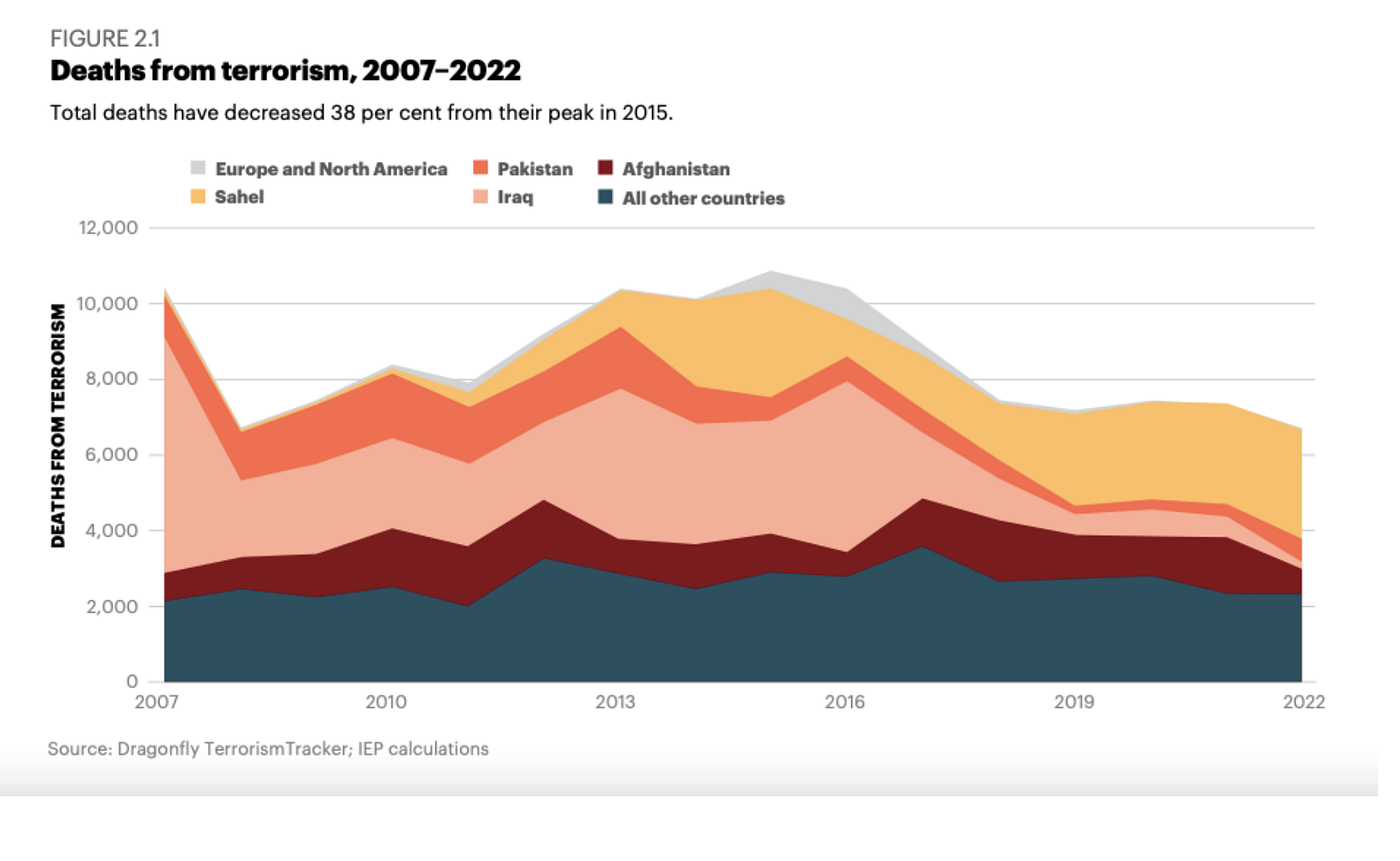
Source: GTI
Figure 2

Source: DW Documentary
Figure 3

Source: CSIS
Figure 4

Source: Africa Center for Strategic Studies
메타데이터
- post_id
- 155ee47a844d
- slug
- jihadists-in-the-sahel-unmasking-the-jnim-group-155ee47a844d
- url
- https://medium.com/@nereamartiayuso/jihadists-in-the-sahel-unmasking-the-jnim-group-155ee47a844d
- canonical_url
- https://medium.com/@nereamartiayuso/jihadists-in-the-sahel-unmasking-the-jnim-group-155ee47a844d
- author_url
- https://medium.com/@nereamartiayuso
- status
- ok
- fetched_at
- 2026-06-20 20:29:01