AI at the End of the School Year: Week 4 — The AI Blueprint: Planning Forward before the Year is…
Most people treat AI as a tool for getting through today. The smartest educators, students, and new graduates are using it to design…
AI at the End of the School Year: Week 4 — The AI Blueprint: Planning Forward before the Year is Even Over
Most people treat AI as a tool for getting through today. The smartest educators, students, and new graduates are using it to design tomorrow — and the year-end window is the best opportunity you will get.

The Current Narrative: May Madness and the Planning Myth
Every May, the same story plays out in schools across the country. Students are mentally checked out by April — their Google Classroom notifications left unread, their focus atomized by AP exams, spring sports, and the gravitational pull of summer. Teachers are buried under a late-semester avalanche of grading, end-of-year reports, field trip logistics, and the quiet dread of cleaning out a classroom that accumulated a year’s worth of educational entropy. Administrators are scrambling to close the fiscal year while fielding calls about next year’s curriculum adoption, staffing vacancies, and professional development calendars.
Somewhere in that chaos, “planning for next year” becomes the thing everyone intends to do and almost no one actually gets to. The result is predictable: August arrives, teachers are back in their rooms two weeks before students, staring at blank unit plan templates with the particular panic of someone who knows exactly how much work is ahead and exactly how little time there is to do it. Students return from summer without a clear sense of where they left off or where they’re headed. Recent graduates spend months in a kind of professional limbo, unsure how to translate a diploma into a direction.
The education media knows this story well. Articles about “teacher burnout” peak in April. LinkedIn fills with posts from May graduates wondering what they’re supposed to do now. Parent Facebook groups and homeschool co-ops hold end-of-year evaluations that feel part celebration, part anxiety spiral. There is an entire industry of summer programs, planning retreats, and productivity gurus built around the premise that the end of the school year is a problem to be solved.
Now AI has entered this picture, and the conversation has acquired both new hope and new confusion. Nearly everyone is asking a version of the same question: Is there a way to use these tools intentionally — in genuine service of learning goals, rather than as a shortcut around them?
That is exactly what Week 4 of our “AI at the End of the School Year” series is about. Not AI as a cheat code. Not AI as an existential threat to academic integrity. AI as a planning partner — one that can help students, teachers, and new graduates transform the last chaotic weeks of the academic year into a thoughtful launching pad for whatever comes next.
What’s Actually Happening: Planning Intelligence Has Arrived
Let’s get clear on what the technology actually does before we talk about classroom implications.
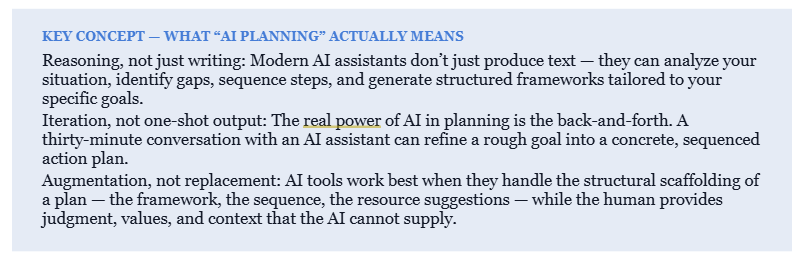
When educators and students use the phrase “using AI to plan,” they’re typically referring to large language models (LLMs) — the same underlying technology powering tools like ChatGPT, Google Gemini, Microsoft Copilot, and Anthropic’s Claude. These systems are trained on vast corpora of text and can generate, organize, analyze, synthesize, and iterate on written content at a speed no human could match. But here’s what most casual observers miss: these tools are not just sophisticated text generators. They’re capable reasoners.
Given the right inputs — your goals, constraints, timeline, current skill level, and context — they can generate structured plans, flag potential obstacles, suggest relevant resources, map dependencies, and adapt in real time as conditions change. This is precisely what makes them valuable for end-of-year planning, where the challenge is rarely a shortage of ideas but a shortage of time, structure, and the cognitive bandwidth to think clearly about what matters most.
Several converging developments are accelerating the availability of these tools in educational settings. First, AI is becoming embedded in the platforms educators already use. Microsoft 365 Copilot is built into Word, PowerPoint, and Teams. Google’s Gemini is woven into Docs, Sheets, and Classroom. These aren’t external applications requiring new logins and separate training — they’re integrated into the workflows teachers and students already maintain.
Second, AI tutoring and learning management systems are maturing rapidly. Khan Academy’s Khanmigo, launched in 2023, uses AI to guide students through personalized learning pathways using Socratic dialogue — not just answering questions but asking them back. Carnegie Learning’s MATHia platform employs adaptive AI to pinpoint exactly where students are struggling and what targeted practice they need next. These platforms now generate rich, specific data that can inform summer learning plans with a granularity previously available only to students with private tutors.
Third, AI career exploration and planning tools are accessible to recent graduates at low or no cost. LinkedIn, Indeed, and Handshake have all integrated AI features that help job seekers understand how their existing skills translate across industries, identify which certifications would strengthen their competitiveness, and craft a compelling professional narrative for different audiences.
“What if every student had access to a brilliant tutor — and every teacher had access to a knowledgeable, always-available teaching assistant? That’s not science fiction anymore. It’s an engineering problem we’re in the middle of solving.” — Sal Khan, Founder & CEO, Khan Academy — TED Talk “How AI Could Save (Not Destroy) Education,” TED2023, April 2023
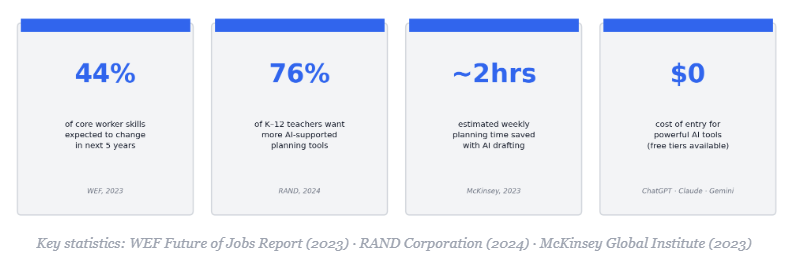
The research context matters here, too. The World Economic Forum’s Future of Jobs Report (2023) found that 44% of workers’ core skills are expected to be disrupted within the next five years (World Economic Forum, 2023). Dr. Anthony Seldon, education author and former Master of Wellington College, has argued persistently that AI-personalized learning represents the most significant shift in pedagogy since the printing press (Seldon & Abidoye, 2018). That shift is now showing up in real classrooms, in real tools, being used by real teachers.
Where AI Is Already Being Used: Planning in Practice
For Elementary and Middle Schoolers: Personalized Summer Learning Roadmaps
Imagine an eighth grader who has just finished a rough year in pre-algebra. Instead of the familiar vague directive — “review your math over the summer” — their teacher uses an AI-assisted platform to generate a specific, sequenced learning plan based on that student’s actual performance data: the precise standards they’ve mastered, the ones they’re close on, and the foundational gaps that will create friction in ninth-grade algebra if left unaddressed. This is not hypothetical. Platforms like Khan Academy, IXL Learning, and Renaissance’s Star Assessment suite now generate these individualized pathways automatically.
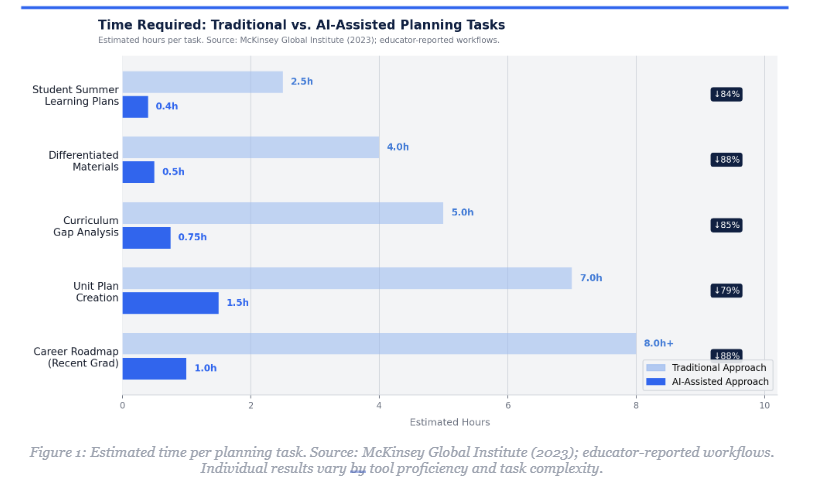
Teachers are also using general-purpose AI assistants — ChatGPT, Claude, Gemini — as planning collaborators to supplement those platform outputs. A teacher can describe a student’s learning profile, interests, and summer circumstances to an AI assistant and receive a customized one-page plan with specific reading recommendations, low-stakes practice activities tied to real interests, and a sequenced weekly structure. What used to take two or three hours of individualized planning now takes twenty minutes of AI-assisted conversation followed by a teacher’s expert review and personalization pass.
For homeschool families, the impact is particularly pronounced. A parent can describe their child’s learning style, current skill level, learning history, and goals for the coming year — and get back a comprehensive curriculum outline in minutes. The back-and-forth refinement that used to require hours of catalog research and curriculum committee forums now happens in a single focused AI conversation.
For High Schoolers: College, Career, and Course Planning
The high school end-of-year planning landscape has long been dominated by anxiety: AP score speculation, college application timelines, summer program applications, and for juniors, the gathering weight of senior year decisions. AI is beginning to change the texture of that experience — not by removing the stakes, but by giving students more structured ways to think through them.
Students are using college planning platforms, direct LLM prompting, and AI-integrated tools within counseling software to analyze their extracurricular profiles, identify gaps in their application narrative, and map out how to spend their summer in ways that genuinely strengthen their candidacy. College counselors report that students who use AI as a brainstorming and planning partner arrive at counseling sessions with more developed thinking and more specific questions.
Perhaps more interesting is what happens when students use AI to explore career interests they’ve never articulated. A student who has never considered data science can have a twenty-minute conversation with an AI assistant — describing their affinity for sports statistics, their puzzle-solving instincts, their preference for working with patterns — and walk away with a concrete list of summer activities, online courses, internship types, and potential college majors worth exploring.
For Recent Graduates: AI-Powered Career Roadmapping
The transition from graduation to career is one of the most disorienting experiences a young person faces. The support structures of school — structured schedules, clear expectations, defined evaluations — fall away at precisely the moment they’re needed most. Career centers provide resources, but the ratio of counselor to graduate at most institutions is wildly inadequate for the scope of individual support students actually need.
AI is beginning to bridge this gap in concrete, measurable ways. LinkedIn’s AI-powered career exploration tools help recent graduates understand how their major translates across different job functions — giving specific, data-driven information about which roles hire from which academic backgrounds and what the pathways from entry level to senior look like over a five-to-ten year horizon. Platforms like Handshake now use AI matching to surface job and internship opportunities aligned with a graduate’s specific skills and interests.
More significantly, general-purpose AI assistants like Claude, ChatGPT, and Gemini can help recent graduates build what many career coaches call a genuine strategic career roadmap: a document that articulates where they want to be in three to five years, what specific skills and experiences the path requires, which companies or sectors align with their values, and what their week-by-week job search strategy should look like. What used to require a career coach — a service most graduates cannot afford — is now accessible through a thoughtful, structured AI conversation.
“The most important question in education today is not whether students learn content — it’s whether they learn how to keep learning. AI, used well, can help every student build that capacity before they need it.” — Anthony Seldon & Oladimeji Abidoye — The Fourth Education Revolution (2018), University of Buckingham Press
For Teachers: AI as a Curriculum Design Partner
End-of-year is, counterintuitively, the most valuable time for a teacher to do their planning for the following year. The curriculum is fresh, the gaps are visible, the data is in, and the next year’s students haven’t arrived yet — which means there’s still real freedom to rethink design decisions before the momentum of a new school year makes it difficult to change course.
AI is accelerating this work dramatically. A teacher who previously spent an entire summer day building a unit plan — researching standards alignment, drafting learning objectives, finding resources, designing assessments, creating differentiated versions — can now do that work in a focused two-hour AI-assisted session. Tools like MagicSchool AI, Diffit, and Khanmigo all allow teachers to start with a broad objective and generate a complete unit framework to refine, edit, and personalize.
What makes this more than just a time-saving convenience is the quality of the starting point. AI-generated unit frameworks surface standards alignment issues, suggest inquiry questions teachers might not have considered, and identify differentiation needs. The teacher’s job shifts from blank-page generation — the most cognitively taxing and time-consuming part of curriculum design — to expert editing and pedagogical judgment.
Risks and Tradeoffs: What Deserves Honest Attention
It would be irresponsible to describe all of this without addressing the real concerns. AI-assisted planning is genuinely useful. It is also genuinely complicated.
The Dependency and Atrophy Problem
Planning is not merely an output — it’s a cognitive process. When you sit down to design a unit, you are not just producing a document; you are deepening your understanding of your subject, your students, and the connections between them. When AI does the structural heavy lifting of that process, there is a real risk that both teachers and students lose the metacognitive skills that come from doing that work manually. Research on learning consistently shows that the struggle of building structure is part of how understanding develops (Brown, Roediger, & McDaniel, 2014). The mitigation is not to avoid AI in planning — it’s to use it as a thinking partner rather than a ghostwriter.
The Equity Dimension
AI tools are not uniformly accessible. A student in a well-resourced suburban district may have access to AI tutoring platforms, AI-powered college counseling tools, and teachers trained in meaningful AI integration. A student in an under-resourced urban or rural school may have none of that — and may lack even the reliable internet access required to use free tools like ChatGPT or Claude. As AI planning tools become more powerful, they carry a serious risk of becoming another axis of educational inequality, amplifying advantage for students who already have it and widening the gap for those who don’t. This is the documented pattern of every previous wave of educational technology (Reich, 2020).
Privacy and Student Data
When students use AI-powered learning platforms, they generate detailed data about their academic performance, learning patterns, question-answering behaviors, and personal interests. Federal protections under FERPA and COPPA apply, but enforcement is inconsistent and the technology is evolving considerably faster than regulation. School leaders and parents should understand exactly what data any AI platform collects before approving its use — and that question should be asked loudly, before adoption, not quietly after the fact.
The Accuracy Problem
AI planning tools can generate plans that sound comprehensive, plausible, and authoritative — and still contain factual errors, outdated information, or misaligned recommendations. A student following an AI-generated career roadmap might invest a summer preparing for a certification that employers in their target field rarely require. A teacher who relies on AI-generated curriculum materials without careful review may inadvertently teach a concept incorrectly. AI-assisted planning requires human oversight. It is a first draft, not a final answer.
The Philosophical Question Worth Sitting With
If AI can generate a detailed, well-structured five-year plan in thirty seconds, what does “planning” mean anymore? There is a growing conversation in education philosophy about the role of human intentionality in a world where thinking tasks can be delegated to algorithms. Educators who have spent their careers helping students learn to set goals, analyze their situations, and build plans for their own futures now face a genuinely difficult question: if the planning process can be automated, are we still teaching the same thing we think we’re teaching? This question doesn’t have a clean answer — but educators who ignore it are not fully serving their students.
What Teachers Can Do Now: Five Practical Entry Points
Theory is useful. Actionable steps are better. Here are five things teachers can do between now and the last day of school — and into the first weeks of summer — to begin using AI as a genuine planning partner.
- Run a “learning inventory” conversation. Before summer break, sit down with your gradebook, a few representative student work samples, and an AI assistant. Describe the year honestly: what worked, what didn’t, where students struggled most consistently, and where they surprised you. Ask the AI to help you identify patterns and generate a prioritized list of adjustments for next year. This is not delegation — it’s structured reflection with a capable thinking partner.
- Create differentiated summer learning handouts using AI. For each of your student population segments — advanced, on-grade, and intervention — prompt an AI tool to generate a one-page summer reading and practice plan with specific resource recommendations matched to your students’ interests and needs. Review, edit, and personalize before distributing. The AI does the structural first draft in minutes; you add the local knowledge and pedagogical judgment that makes them genuinely useful.
- Use AI to audit your curriculum for gaps and misalignments. Take one unit plan outline — just one, to start — and share it with an AI assistant. Ask it to check for standards alignment, identify missing prerequisite concepts, and suggest supplemental resources. This process takes about thirty to sixty minutes per unit and tends to surface issues that are genuinely hard to catch on your own.
- Schedule two AI planning sprints for the summer. Block one full morning in June and one in August. Use June to generate rough frameworks for the fall semester’s first major unit sequence. Use August to refine and finalize. Even two focused sessions can save ten to fifteen hours of reactive planning in September.
- Teach your students to use AI for goal-setting before they leave. End the year with a single, focused lesson on using AI to set meaningful summer goals. Have students engage in a structured conversation with an AI tool about one skill they want to develop — define the skill, describe their current level, and ask the AI to help design a realistic summer plan. This teaches AI literacy, metacognitive planning skills, and agency simultaneously.
What Leaders Should Be Considering: The Strategic View
Build a policy that enables, not just restricts. Many districts have responded to AI by drafting prohibition policies focused almost entirely on academic integrity. Those policies are not wrong, but they are dangerously incomplete. A forward-looking AI policy also describes approved uses, provides guidance on evaluating and choosing tools, and creates clear pathways for teachers to experiment responsibly.
Invest in AI literacy for your faculty this summer. According to EDUCAUSE research (2024), one of the primary barriers to meaningful AI adoption in education is teacher preparation — not tool access, but confidence, competency, and clarity about appropriate use. Summer is the ideal window for focused, practical professional development. Effective AI PD doesn’t require expensive consultants; well-designed sessions using free resources from ISTE, CoSN, MIT’s AI literacy programs, and Day of AI can build meaningful capacity in a one- or two-day format.
Think infrastructure now, not in August. AI tools require reliable internet access, functional devices, and in some cases, district-level subscriptions. A district that wants to give teachers and students access to AI-powered planning tools in the fall needs to be making those procurement decisions now, in the late spring window — before the budget cycle closes and before the professional development calendar is locked.
Convene a student voice session before finalizing any AI policy. Students are already using AI — often in more sophisticated ways than their teachers realize. Before finalizing any policy or making any tool adoption decision, talk to students. What tools are they using? What do they find genuinely useful? What makes them uncomfortable? Their answers will improve every downstream decision.
Establish data governance protocols before adopting any new AI platform. Before your district approves any AI-powered learning platform, establish a clear protocol for evaluating its data practices: what student data is collected, where it’s stored, how long it’s retained, who has access, and what protections are in place. This is not optional. It is a legal obligation under FERPA and COPPA.
A Forward-Looking Close: The Year That Starts Before It Ends
There is a version of the school year’s end that most educators have never experienced — one where the last day of class isn’t just an exhausted finish line, but a genuinely organized departure point. Where students leave with not just a report card but a clear, specific roadmap for the summer and the year ahead. Where teachers close their classrooms with the first draft of the next semester already in motion. Where recent graduates cross the stage with not just a diploma but a plan — a real one, grounded in their actual skills, values, and goals.
AI alone doesn’t create that version of events. Human intention does — with AI as the accelerant. The technology is a tool. The decisions about when to use it, how to evaluate its outputs, and where human judgment is irreplaceable — those are not AI decisions. They are educator decisions. They are student decisions. They are the decisions that define what education is actually for.
The World Economic Forum’s projection that 44% of core skills will be disrupted within five years isn’t an abstraction. It is the professional context in which every student currently sitting in a classroom will spend their career. AI-assisted planning matters right now not because AI has all the answers, but because the pace of change demands better tools for thinking through the questions — and for revisiting our plans more frequently, more honestly, and with more precision than our traditional planning cycles have ever allowed.
The school year is almost over. The next one starts now. What does it look like?
References
- Brown, P. C., Roediger, H. L., & McDaniel, M. A. (2014). Make it stick: The science of successful learning. Harvard University Press.
- EDUCAUSE. (2024). 2024 EDUCAUSE Horizon Report: Teaching and learning edition. EDUCAUSE. https://www.educause.edu/horizon-report
- Khan, S. (2023, April). How AI could save (not destroy) education [Video]. TED Conferences. https://www.ted.com/talks/sal_khan_how_ai_could_save_not_destroy_education
- McKinsey Global Institute. (2023). The economic potential of generative AI: The next productivity frontier. McKinsey & Company. https://www.mckinsey.com/capabilities/mckinsey-digital/our-insights/the-economic-potential-of-generative-ai
- RAND Corporation. (2024). American educator panels: Teacher and principal survey. RAND Corporation. https://www.rand.org/education-and-labor/projects/american-educator-panels.html
- Reich, J. (2020). Failure to disrupt: Why technology alone can’t transform education. Harvard University Press.
- Seldon, A., & Abidoye, O. (2018). The fourth education revolution: Will artificial intelligence liberate or infantilise humanity? University of Buckingham Press.
- World Economic Forum. (2023). The future of jobs report 2023. World Economic Forum. https://www.weforum.org/publications/the-future-of-jobs-report-2023/
AI Innovations Unleashed · The AI Learning Guide · aiinnovationsunleashed.com
AI at the End of the School Year · Week 4 of 4 · May 2026
메타데이터
- post_id
- 1567e4edc242
- slug
- ai-at-the-end-of-the-school-year-week-4-the-ai-blueprint-planning-forward-before-the-year-is-1567e4edc242
- url
- https://medium.com/technology-hits/ai-at-the-end-of-the-school-year-week-4-the-ai-blueprint-planning-forward-before-the-year-is-1567e4edc242
- canonical_url
- https://medium.com/technology-hits/ai-at-the-end-of-the-school-year-week-4-the-ai-blueprint-planning-forward-before-the-year-is-1567e4edc242
- author_url
- https://medium.com/@larrydelaneyjr
- status
- ok
- fetched_at
- 2026-07-20 21:18:46