Why Japan Still Chooses Carbon Steel Knives in a Stainless Steel World
The Answer Is Not About Rust. It Is About What a Knife Is For.
Why Japan Still Chooses Carbon Steel Knives in a Stainless Steel World
The Answer Is Not About Rust. It Is About What a Knife Is For.
Walk into a professional kitchen in Paris, New York, or Sydney and look at the knife rack.
You will find stainless steel — overwhelmingly, almost exclusively, stainless steel.
The blades are bright, uniform, corrosion-resistant, and ready for the next service without ceremony.
They are excellent knives. They do exactly what they were designed to do.
Walk into a professional kitchen in Osaka, Kyoto, or Tokyo and look at the knife rack.
You will find something different.
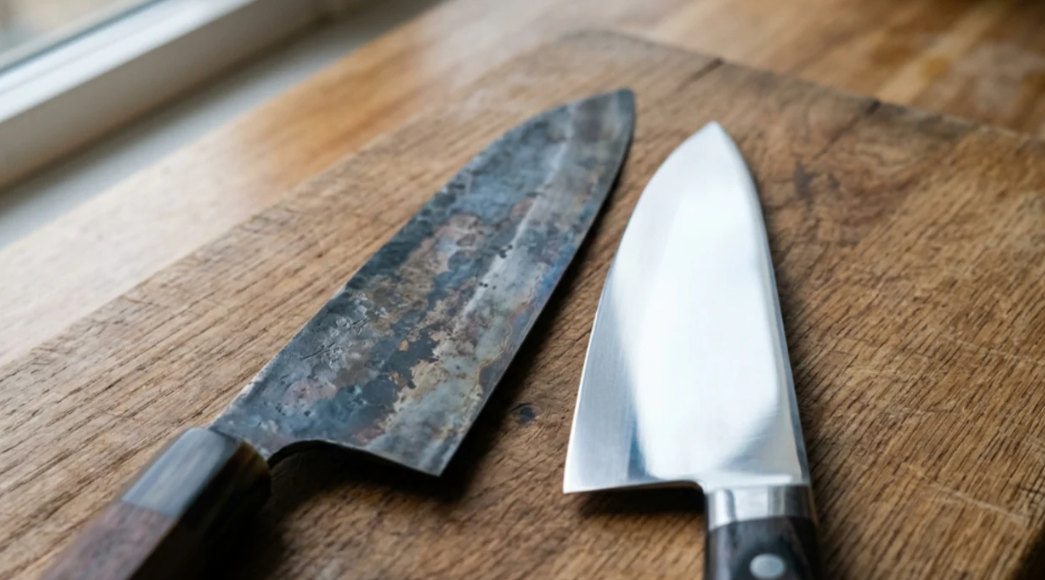
Darker blades, some with the mottled grey-brown surface that comes with years of use. Blades that have been sharpened so many times that their profiles have gradually changed. Blades that carry the visible history of the cook who uses them.
This difference is not stubbornness. It is not tradition for its own sake.
It is the expression of a fundamentally different idea about what a kitchen knife is for — and understanding that idea requires understanding the gap between two ways of thinking about tools, precision, and the relationship between a cook and the food they prepare.
The World’s Practical Choice
Stainless steel became the dominant knife material in most professional kitchens for reasons that are entirely rational.
It does not rust.
In a kitchen where time is limited, where knives pass between multiple cooks, where blades may be left damp between uses, the corrosion resistance of stainless steel is a genuine operational advantage.
A blade that does not need to be dried immediately, that can be put through a commercial dishwasher, that can sit on a magnetic strip between services without developing surface rust — this is the blade that works in most kitchens as they actually operate.
It is consistent.
Stainless steel produced by industrial processes behaves predictably.
The blade that comes from the factory will perform to its specification.
For kitchens that use multiple knives interchangeably, this consistency has value.
The blade in hand performs like the blade in the rack.
It suits the food.
Western culinary traditions — roasting, braising, heavy protein work, robust vegetables — are not precision cutting traditions in the way that Japanese cuisine is.
The difference between a blade that is very sharp and a blade that is extraordinarily sharp matters less when the work is breaking down a whole chicken or slicing through a dense root vegetable than when the work is cutting paper-thin fish for sashimi.
These are not weaknesses of Western culinary culture.
They are calibrations — a different tool for a different set of requirements.

Japan’s Different Requirements
Japanese cuisine is built around a specific idea:
The ingredient should arrive at the plate as close as possible to what it actually is.
This sounds simple.
Its implications for the knife are profound.
A piece of raw tuna for sashimi is not just protein to be portioned.
It is a living thing — recently living, with cellular structures that hold moisture, flavor compounds, and textural integrity.
The cut that passes through that tuna with minimal force and minimal cellular disturbance produces a piece of fish that tastes different from the same fish cut with a blade that compresses before it separates.
The difference is detectable.
It shows up in the flavor of the fish, in its texture under the tooth, in the cleanness of its finish on the palate.
This is why KIREAJI — the sharpness that changes the taste of food, measured not in the hand but on the tongue — is the standard by which Japanese knife culture evaluates blades.
Not how the knife feels to use. How the food tastes afterward.Carbon steel, sharpened to the level that skilled Japanese craftsmen and cooks achieve, produces an edge that meets this standard in a way that most stainless steel, at equivalent hardness, does not.
The pure carbide structure of high-quality carbon steel, when properly refined on a whetstone, produces a cutting surface of particular consistency and acuity — an edge that enters the ingredient and passes through it with the minimum possible cellular disturbance.
This is not an abstract quality.
It is the reason that a cook who has used both a properly maintained carbon steel yanagiba and a comparable stainless steel blade for sashimi work will almost always describe the carbon steel as producing better results in the food, not just in the feel of cutting.

Sharpening as Ritual, Not Maintenance
The most common objection to carbon steel from cooks unfamiliar with it is not the rust.
It is the sharpening.
Carbon steel requires regular sharpening.
It does not hold its edge as long as high-wear-resistance stainless or powder steels.
It needs attention — ideally every day of professional use, or after significant sessions of home cooking.
In most of the world, this is experienced as a burden.
Sharpening is maintenance — something done reluctantly, when the knife has become noticeably dull, to restore it to a serviceable state.
In Japanese kitchen culture, the same activity is understood entirely differently.
The sharpening that a Japanese cook performs at the beginning of a working day, or between services, is not maintenance.
It is part of the craft.
It is the act of bringing the tool to its best state before using it — an act that requires attention, skill, and the kind of close engagement with the blade that reveals, over time, exactly what the knife is and how it behaves.
A cook who sharpens their own knives develops a relationship with those knives that a cook who sends blades to a commercial sharpener does not.
They know how this specific blade responds to this specific stone.
They know where it is thicker, where it is more resistant, what angle produces the best result.
They know, in the most direct and tactile way possible, the current state of the knife.
This knowledge is not incidental.
It is part of what makes a skilled Japanese cook skilled.
The knife is not separate from the practice — it is the practice.
And carbon steel, because it requires this attention, produces this relationship in a way that a low-maintenance material does not.

The Inheritance of the Samurai Sword
The choice of carbon steel for Japanese kitchen knives is not a historical accident.
It is a deliberate continuation.
The tradition of Japanese blade-making — the metallurgy, the forging techniques, the heat treatment philosophy — was developed for the samurai sword.
High-carbon steel, worked at precisely controlled temperatures, quenched to create differential hardness across a single blade, producing an edge of extraordinary refinement while maintaining the resilience needed for a weapon that would be used in violence.
When Japan’s sword-makers turned their skills to kitchen knives — a transition accelerated by the Haitōrei edict of 1876, which banned the public carrying of swords and redirected an entire craft tradition toward the kitchen — they brought these techniques with them.
The carbon steel that had produced the katana’s edge began producing the yanagiba’s edge.
The heat treatment philosophy that had defined Japanese metallurgy for centuries was applied to the usuba and the deba.
The result was not simply a transfer of materials.
It was a transfer of an entire way of thinking about what a blade should be.
The kitchen knife, in the Japanese tradition, is the heir of the samurai sword not in spirit or metaphor, but in the literal technical sense of the methods used to make it.
This lineage is why Japanese knife-making exists at the level it does.
The refinement took centuries to develop.
It was not interrupted when the subject changed from war to cooking.
It continued, with the same seriousness and the same commitment to precision, in the workshops of Sakai and Seki and the other knife-making cities that inherited the tradition.

The Knife That Changes With Its Owner
There is a quality of carbon steel that no specification sheet captures and no stainless blade possesses:
It changes.
A carbon steel blade that is used and maintained over years develops a patina — a surface oxidation that, managed correctly, is not damage but a kind of seasoning.
The grey-brown surface of a well-used carbon steel knife is not evidence of neglect.
It is evidence of history.
It shows where the blade has been used, how it has been held, what it has cut.
More significantly, the blade changes in response to the owner’s sharpening.
The angle chosen, the stones used, the technique applied — all of these gradually reshape the blade’s geometry over years of maintenance.
The knife that has been sharpened a thousand times by the same cook is not the same knife that left the workshop.
It is a knife that has been adapted, over time, to one specific person’s way of using it.
This is a form of personalization that no factory process can produce and no new knife can replicate.
The knife that fits your hand exactly, that balances precisely at the point you find natural, whose edge is the angle you have arrived at through years of practice — that knife was not bought.
It was made, through use, into what it is.
Japanese chefs who have carried the same carbon steel knives for twenty or thirty years are not attached to those knives for sentimental reasons.
They are attached to them because those knives, shaped by decades of use and sharpening, have become tools that no replacement can equal.
The replacement might be technically superior by specification.
It would not be the same knife.

The Trade That Carbon Steel Asks For
None of this is free.
Carbon steel makes demands that stainless steel does not.
It must be dried after every use.
Carbon steel left damp will rust.
This is not a disaster — surface rust on a carbon steel knife can be removed and the blade restored — but it requires immediate attention after each session of cooking.
Wipe the blade, dry it, put it away.
It must be sharpened regularly.
The edge retention of carbon steel is generally lower than the best stainless or powder steels.
The blade that was sharp at the beginning of a service will be somewhat less sharp at the end.
It requires the right cutting surface.
Carbon steel edges are finer and more vulnerable than stainless edges to the impact of contact with hard cutting boards.
A wooden board — yielding, forgiving, absorbing the end of each stroke — is the appropriate surface for a carbon steel knife.
A glass or hard plastic board accelerates edge degradation in ways that compound over time.
These demands are real.
They are also, for cooks who engage with them fully, part of the appeal.
The knife that asks more of you gives more back.
The discipline of daily wiping and drying and sharpening is the discipline that produces the relationship with the blade — the knowledge, the responsiveness, the accumulated understanding of what this specific knife in this specific hand is capable of.

Why the Choice Still Makes Sense
The world chose stainless steel for good reasons.
Those reasons are real, practical, and appropriate for the majority of kitchen environments and culinary traditions.
Japan chose carbon steel for equally good reasons.
The reasons are also real, equally practical within their context, and appropriate for a culinary tradition in which the quality of the cut directly determines the quality of the dish — where the difference between an edge that separates cells and one that ruptures them is detectable in the flavor of the food, and where that difference is considered worth the attention carbon steel requires.
Neither choice is wrong.
They answer different questions about what a knife should do and what a cook should be.
But for the cook who wants to understand what a Japanese knife is, and why it performs the way it does, and why the tradition that produced it chose the material it chose — the answer always comes back to the same place.
The knife exists to serve the food.
The material was chosen that serves the food best.
And in Japanese cuisine, that material is carbon steel.
메타데이터
- post_id
- 1571aae32cb4
- slug
- why-japan-still-chooses-carbon-steel-knives-in-a-stainless-steel-world-1571aae32cb4
- url
- https://medium.com/@torui/why-japan-still-chooses-carbon-steel-knives-in-a-stainless-steel-world-1571aae32cb4
- canonical_url
- https://medium.com/@torui/why-japan-still-chooses-carbon-steel-knives-in-a-stainless-steel-world-1571aae32cb4
- author_url
- https://medium.com/@torui
- status
- ok
- fetched_at
- 2026-06-10 08:17:25