Personal Memories of the Skylab Program — Fifty Years Later
The recent events celebrating the 50th anniversary of the launch of Skylab and its first crew have brought back a lot of memories. I grew…
Personal Memories of the Skylab Program — Fifty Years Later
![Skylab in orbit. Photo taken by first Skylab crew as they returned to Earth after repairs. [NASA Photo]](https://miro.medium.com/v2/resize:fit:1400/1*uPTo9nZofRQiQcqHMJvV7g.jpeg)
Skylab in orbit. Photo taken by first Skylab crew as they returned to Earth after repairs. [NASA Photo]
The recent events celebrating the 50th anniversary of the launch of Skylab and its first crew have brought back a lot of memories. I grew up just a few miles from the Johnson Space Center (JSC) and would eventually have a 42-year career at NASA. In 1973, my mother played a role in saving Skylab after its near disastrous launch and, at that same time, I had a temporary job with the news media covering the Skylab 1 and Skylab 2 launches, working onsite at JSC.
For those who may not remember, or were not alive in 1973, Skylab suffered significant damage during its launch. This included the loss of Skylab’s micrometeoroid shield/sun shade and one of its two primary solar panels. Making things worse, debris from the lost micrometeoroid shield became entangled in the remaining solar panel, preventing its deployment. As a result, the station suffered from a substantial power deficit and faced extreme temperatures (approximately 125°F) within the orbital workshop.
There was a concern that outgassing of materials on the internal walls at that high temperature would poison the interior of the workshop with toxic gasses. There was also a concern that the heat could ruin the astronauts’ pre-positioned food and spoil the photographic film onboard. Engineers and astronauts on the ground worked around the clock to develop a makeshift sunshade to replace the missing heat shield while techniques and tools to release the debris that was obstructing the remaining solar array from deploying were also being developed.
NASA engineer Jack Kinzler, the father of one of my high school friends, came up with a way to fix the heat shield problem without the crew having to go on a dangerous spacewalk. His idea was to create something like a parasol (umbrella) that could be pushed through an existing scientific airlock in the station’s hull located near the damaged area. With his design, the crew could deploy the parasol from inside the station and then activate it to fully expand using springs and telescoping tubes.
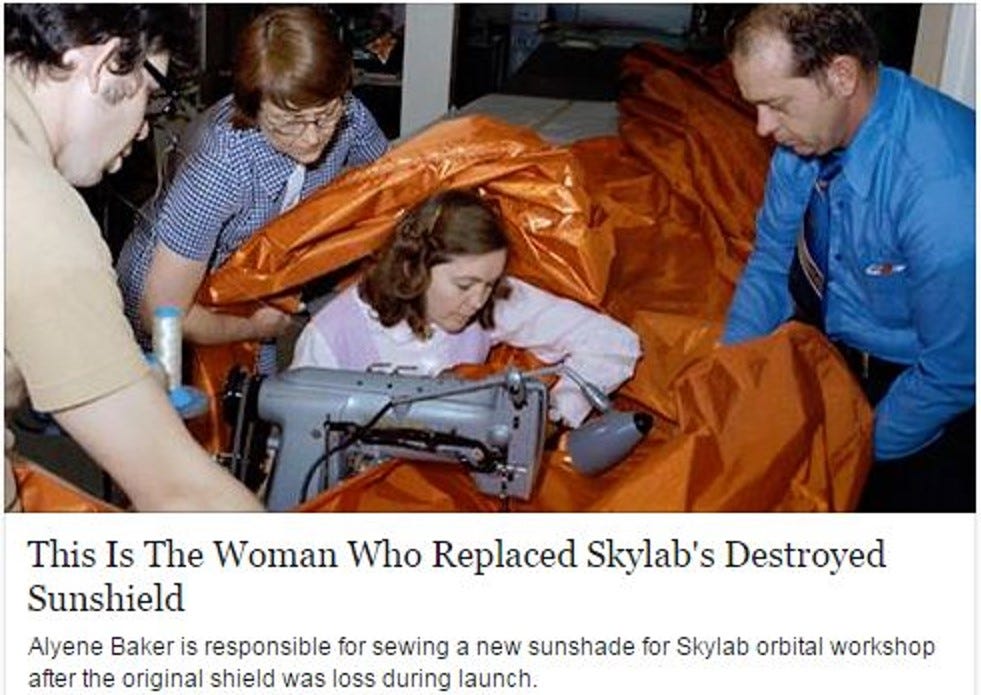
![Official NASA photo of GE seamstress Alyene Baker sewing the Skylab parasol with the help of three GE co-workers. [NASA photo]](https://miro.medium.com/v2/resize:fit:1400/1*7SQoCSiAiWe19vRn6y_C_Q.jpeg)
Official NASA photo of GE seamstress Alyene Baker sewing the Skylab parasol with the help of three GE co-workers. [NASA photo]
My mother, Alyene Baker, was working as a seamstress for General Electric (GE) at the time. GE had a contract with NASA to provide the “soft goods” (spaceflight materials made of fabric) and she did the sewing required to fabricate the parasol on a double-needle Singer sewing machine in the GE building across the street from JSC.
The 22 feet by 24 feet parasol, made of aluminized mylar and nylon ripstop, was so large that it required 3 people to help guide it through the sewing machine.
The parasol was successfully deployed by the 1st Skylab crew and it worked! Over the next several days, temperatures in the workshop dropped to more comfortable ranges. Fortunately, the workshop was not full of toxic fumes from outgassing and the food had not been spoiled. With the low level of electrical power limiting their work due to the still-jammed solar array, Pete Conrad and Joe Kerwin performed a spacewalk on their 14th day in space and, successfully sprung open the remaining panel. The additional power provided by this solar array allowed Skylab to successfully complete all of its major objectives.
While all of this was happening, I had finished my junior year at the University of Texas-Austin just in time to return home for another temporary job with ABC-News covering the Skylab 1 & 2 flights.

I had previously worked for ABC at JSC supporting their coverage of the Apollo 11, 12, 13, and 15 missions. At my age back then, I was obviously not a professional journalist. My primary job for ABC was to drive to Houston Intercontinental Airport twice per day (approximately 100 miles roundtrip) to drop off film to be flown to the ABC studios in New York so that the film could be broadcast on TV. In 1973, before the Internet and the large file transfer protocols we have today, if an interview was filmed at our studio in Houston, the film had to be physically moved from Houston to New York to be broadcast nationally.
![Astronaut Alan Shepard connecting his microphone for an interview with ABC at Johnson Space Center. [My photo]](https://miro.medium.com/v2/resize:fit:1400/1*Gy1DGK0Euk5ixh_VxVm9TA.jpeg)
Astronaut Alan Shepard connecting his microphone for an interview with ABC at Johnson Space Center. [My photo]
The interviews filmed in the ABC studio at JSC were typically of astronauts, Flight Directors, and other senior NASA officials. One interview I remember well was with astronaut Alan Shepard, the first American in space. I took a couple of photos of him as he was his preparing his microphone for the interview.
Fast forward 50 years to May 2023 — I was asked to moderate a panel at Space Center Houston during their 50th anniversary celebration event. My panel was titled: “Skylab — What Did We Learn?” The panel included retired astronaut Story Musgrave (the only astronaut to fly on all five Space Shuttles), Dr. Helen Lane (NASA scientist and nutritionist), and former NASA Flight Director Bill Reeves. While there was much scientific knowledge gained about both the Sun and the Earth from Skylab, I believe we all agreed that the most important thing we learned from Skylab was that humans could successfully live and work in space for an extended period. Prior to Skylab, the longest period that humans had been in space was 22 days. Tragically, that crew — three Soviet cosmonauts on the Soyuz 11 mission in 1971 — were found dead in their capsule when they returned to Earth. A problem with a seal in their capsule had caused their cabin to depressurize and they all died from asphyxiation.
The Skylab 2 crew spent 28 days in space, the Skylab 3 crew spent 59 days in space, and the Skylab 4 crew spent 84 days in space — all performing very productively.
![The author with Skylab 2 crewmember Dr. Joe Kerwin, the first American physician to fly in space. [Photo by Joanna Kerwin]](https://miro.medium.com/v2/resize:fit:720/1*KeCYEPbwYQxwjaWk1VyXkw.jpeg)
The author with Skylab 2 crewmember Dr. Joe Kerwin, the first American physician to fly in space. [Photo by Joanna Kerwin]
After my panel during the day, I attended a more formal event that evening at Space Center Houston that included participation by Skylab astronauts Jack Lousma and Joe Kerwin and I had the opportunity to chat with both of them.

The author with Skylab astronaut Jack Lousma, who was also the Commander of the 3rd Space Shuttle mission, STS-3.
Even though I had heard him tell the story several times before, Jack Lousma told one of my favorite Skylab stories — how they ran out of underwear (or ‘skivvies’ as he called them) on their mission. They didn’t have washing machines on Skylab so they would wear their coveralls for 2 weeks and them toss them out through the airlock. They would change their underwear every 2 days so they each had 28 pairs of underwear for their planned 56 day mission. To make their splashdown location in the Pacific Ocean at the end of their mission 700 miles closer to San Diego than it would have been if they had returned after 56 days, Mission Controllers decided to extend their mission to 59 days.
The crew (Alan Bean, Jack Lousma, and Owen Garriott) was happy to stay an additional 3 days but that meant they would be out of underwear. They called mission control and told them the problem. Mission Control said they’d think it over and get back to them. Sometime later, Mission Control called them back and said: “Don’t worry, we’ve got a solution, but it is good news and bad news. The good news is, you are going to get to change your underwear today. The bad news is, Alan you change with Jack. Owen, you change with Alan, and Alan, you change with Owen.”
The Skylab program holds a special place in my memories, and its impact on space exploration continues today.
메타데이터
- post_id
- 1575f98c8d00
- slug
- personal-memories-of-the-skylab-program-fifty-years-later-1575f98c8d00
- url
- https://medium.com/@herb.h.baker/personal-memories-of-the-skylab-program-fifty-years-later-1575f98c8d00
- canonical_url
- https://medium.com/@herb.h.baker/personal-memories-of-the-skylab-program-fifty-years-later-1575f98c8d00
- author_url
- https://medium.com/@herb.h.baker
- status
- ok
- fetched_at
- 2026-07-25 16:07:54