The Anatomy of Email Copy in 2026:
Why Some Emails Get Read, Remembered, and Clicked While Others Get Ignored???
The Anatomy of Email Copy in 2026:
Why Some Emails Get Read, Remembered, and Clicked While Others Get Ignored???
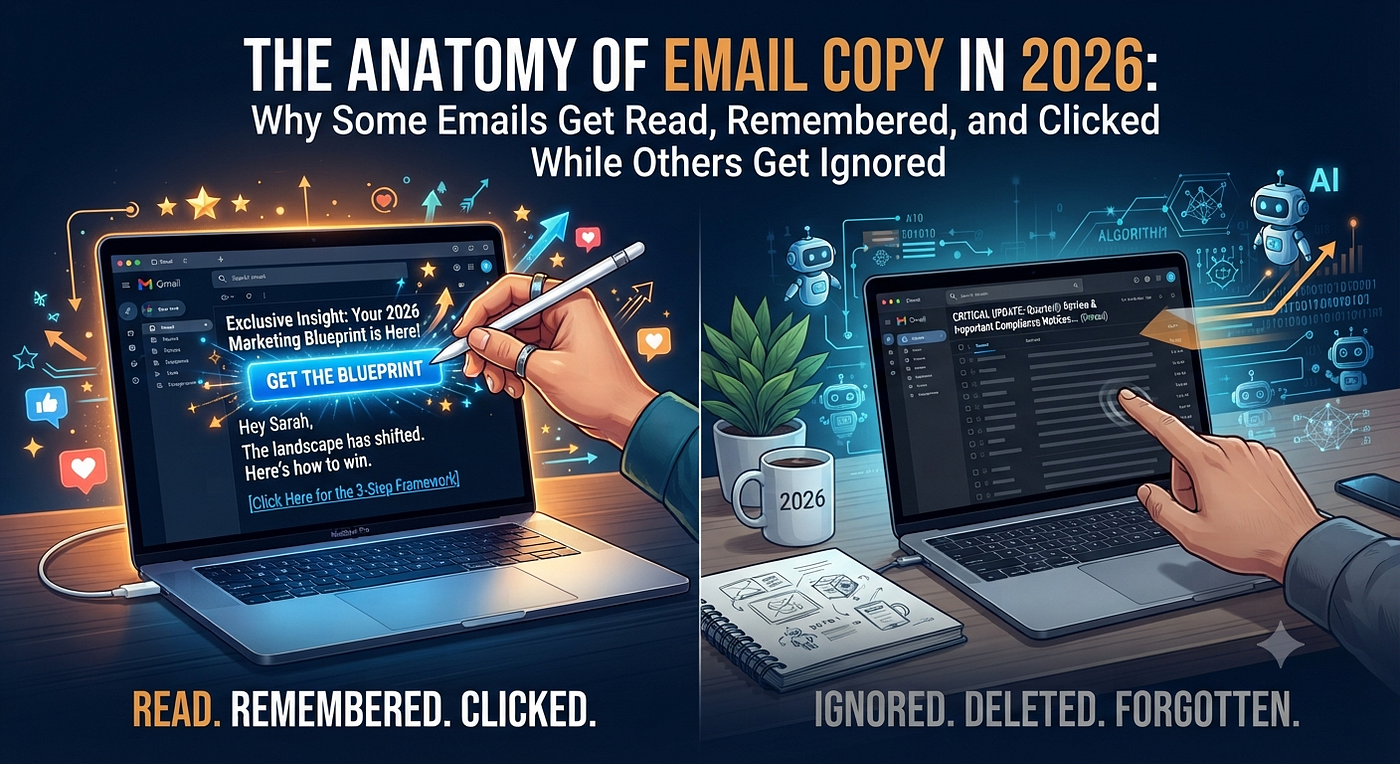
What I've been observing about email marketing, audience behavior, and digital trust in the current marketing landscape.
Most people think email marketing is about writing better emails.
The more I study successful creators, affiliate marketers, digital product sellers, and funnel builders, the more I notice something different.
The highest-performing emails are rarely the most clever.
They are usually the clearest.
They feel like a real person is talking to another real person.
No complicated frameworks.
No exaggerated promises.
No "buy now before it's too late" pressure.
Just a message that arrives at the right time, says something useful, and naturally moves the conversation forward.
In a world where AI can generate thousands of words in seconds, this observation feels even more relevant.
The future of email marketing may not belong to the people who can write more emails.
It may belong to the people who can create better conversations.
And that starts with understanding the anatomy of an email.
Not from a textbook perspective.
But from a practical, real-world perspective.
Why Email Still Matters in 2026??
Every year someone says:
"Email marketing is dead."
Yet every year businesses continue investing in it.
Why?
Because email is one of the few digital assets you actually own.
Algorithms change.
Social platforms change.
Reach drops.
Trends come and go.
But an email list remains a direct connection between you and your audience.
For affiliate marketers, creators, course sellers, consultants, network marketers, and digital entrepreneurs, this connection becomes more valuable every year.
Especially as competition increases.
What I’ve Learned About High-Performing Emails??
After analyzing hundreds of email campaigns, I noticed something interesting.
Most successful emails follow a simple structure.
Not because marketers love rules.
Because readers love clarity.
The image above breaks email copy into nine parts:
- Sender Name.
- Subject Line.
- Preview Text.
- Greeting.
- Opening Hook.
- Email Body.
- Offer or CTA.
- Sign-Off.
P.S..
At first glance, it looks simple.
But each section plays a specific psychological role.
Let's break it down from a practical perspective.
1. Sender Name: The Most Underrated Conversion Element
Most people obsess over subject lines.
Few think about the sender name.
But when someone opens their inbox, the sender name is often the first thing they notice.
Think about your own inbox.
Would you rather open:
"Marketing Team"
Or
"Pooja"
Or
"Pooja from [Brand Name]"
The second option feels human.
The first feels corporate.
In 2026 and beyond, trust is becoming more valuable than attention.
A recognizable sender name builds trust before the email is even opened.
Observation:
People don't open emails.
People open emails from people.
2. Subject Lines: Curiosity Beats Cleverness..
Many marketers try to sound smart.
The emails that often perform better simply sound relevant.
Instead of:
"Revolutionary Marketing Framework Revealed"
Something like:
"I noticed a mistake many creators make"
feels more natural.
The goal isn't to trick someone into opening.
The goal is to make the email feel worth opening.
That difference matters.
Because long-term email success comes from trust, not curiosity hacks.
3. Preview Text: The Forgotten Opportunity
Most inboxes show a preview beside the subject line.
Yet many marketers ignore it completely.
This small line acts like a second headline.
For example:
Subject:
Why some funnels convert and others don’t?
Preview Text: A simple observation that changed how I think about lead generation.
Now the reader has context.
And context creates interest.
4. Greetings: Small Detail, Big Impact
A greeting isn't always necessary.
But when used naturally, it makes the email feel personal.
Examples:
Hi there,
Hey,
Good morning,
Simple works.
Overly formal greetings often create distance.
The goal is connection, not ceremony.
5. The Hook: Where Most Emails Win or Lose
This is the section I pay the most attention to.
Because people don't read emails.
They decide whether to continue reading.
A hook earns the next sentence.
That's all.
Some practical hooks:
I noticed something interesting this week...
A creator shared this challenge recently...
I kept seeing the same pattern again and again...
One small marketing mistake costs more than people realize...
Notice something?
They create curiosity without manipulation.
That's an important distinction.
6. The Body: Share Observations, Not Lectures
One thing I've learned while writing online is that people don't enjoy being talked down to.
They enjoy discovering something useful.
That's why I prefer sharing observations.
For example:
Instead of saying:
"You must build a funnel."
You can say:
"I've noticed businesses with a clear customer journey often have an easier time turning traffic into leads."
The second approach feels more natural.
It invites thinking rather than demanding agreement.
And readers usually respond better to that.
The Shift Happening in Email Marketing
Years ago, email marketing was heavily focused on selling.
Today, the strongest emails often focus on helping readers make sense of something.
People are overwhelmed by information.
What they value is clarity.
This is one reason educational emails, observation-based emails, and story-driven emails continue performing well.
Not because they avoid selling.
Because they earn attention first.
7. The CTA: Reduce Friction
A CTA doesn't need to be aggressive.
In many cases, simple CTAs work surprisingly well.
Examples:
- Read the article.
- Watch the video.
- Download the guide.
- Check the resource.
- See how it works.
The goal is making the next step obvious.
Confused readers rarely click.
Clear readers often do.
8. Sign-Off: Leave Like a Human
Many marketers treat sign-offs as an afterthought.
I think they matter.
A simple sign-off reinforces personality.
Examples:
Thanks,
Talk soon,
Have a great day,
Until next time,
Small details help create familiarity over time.
And familiarity builds trust.
9. P.S. — The Secret Section Many Readers Notice
I've observed that many people scan emails.
They read:
Subject line
Opening
P.S.
Sometimes nothing else.
That's why the P.S. can be valuable.
Not for repeating everything.
But for highlighting the key takeaway.
Example:
P.S. If you're creating content regularly but struggling to turn attention into leads, having a simple system behind your content can make a noticeable difference.
Short.
Relevant.
Easy to understand.
What This Means for Affiliate Marketers and Digital Creators??
One pattern I've repeatedly noticed:
Many creators focus heavily on getting traffic.
Fewer focus on nurturing attention after it arrives.
Traffic creates opportunities.
Email relationships create outcomes.
A person who joins your list today may not buy this week.
Or this month.
But if your emails consistently provide useful insights, observations, resources, and solutions, trust accumulates.
And trust compounds.
Just like content compounds.
The Email Strategy That May Still Work 10 Years From Now..
Technology will change.
AI will improve.
Platforms will evolve.
But human psychology changes slowly.
People will likely continue responding to:
- Relevance.
- Clarity.
- Trust.
- Curiosity.
- Simplicity.
- Authentic communication.
That's why I believe the future of email isn't more automation.
It's better conversations powered by automation.
The tools will change.
The principles probably won't.
Final Thought
The biggest lesson I've taken from studying email marketing isn't about copywriting formulas.
It's this:
The best emails don't feel like marketing.
They feel like a useful message from someone worth hearing from.
When you focus on helping readers understand something, solve something, or see something differently, email becomes much more than a promotional channel.
It becomes a relationship-building channel.
And in an increasingly automated digital world, that may become one of the most valuable assets a creator, affiliate marketer, or online business can build.
메타데이터
- post_id
- 15780dfd9448
- slug
- the-anatomy-of-email-copy-in-2026-15780dfd9448
- url
- https://medium.com/@priyaupa75/the-anatomy-of-email-copy-in-2026-15780dfd9448
- canonical_url
- https://medium.com/@priyaupa75/the-anatomy-of-email-copy-in-2026-15780dfd9448
- author_url
- https://medium.com/@priyaupa75
- status
- ok
- fetched_at
- 2026-08-12 21:58:08