Confluence 2026: Why Artistic Collaboration Matters More Than Ever in a Fragmented World
At a time when the world appears increasingly fractured by geopolitical tensions, cultural anxieties, and ideological polarization, art…
Confluence 2026: Why Artistic Collaboration Matters More Than Ever in a Fragmented World
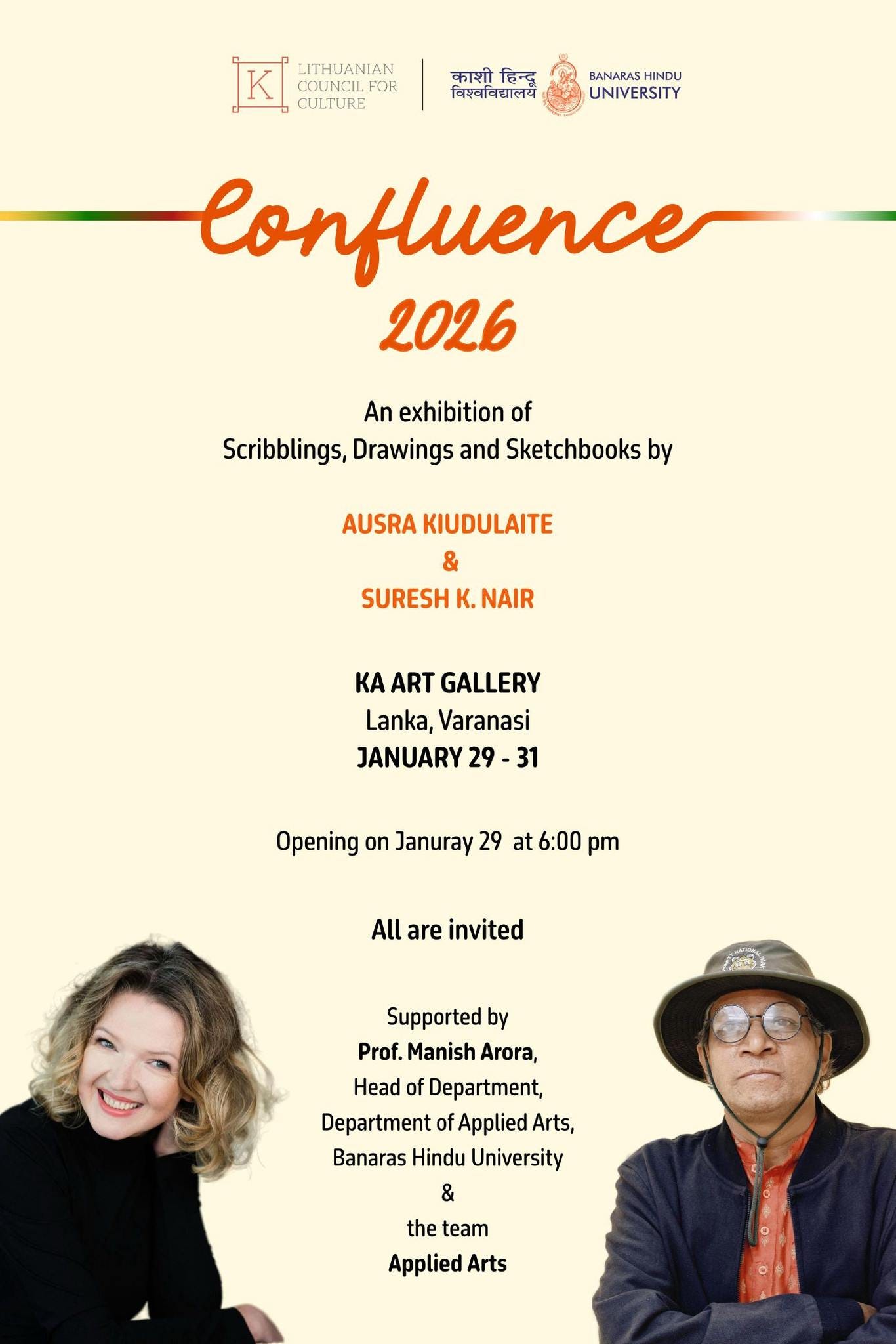
Confluence 2026 celebrates the boundless language of art, bringing together Lithuanian artist Aušra Kiudulaitė and Indian artist Suresh K. Nair in a remarkable cross-cultural collaboration at KA Art Gallery, Varanasi. Emerging from shared creative reflections shaped during global stillness, the exhibition transforms distance into dialogue and color into connection — reminding us that art transcends borders, unites perspectives, and speaks directly to the human spirit. All are invited to experience this inspiring confluence of cultures, ideas, and imagination from January 29–31, opening at 6:00 PM.
At a time when the world appears increasingly fractured by geopolitical tensions, cultural anxieties, and ideological polarization, art continues to perform one of humanity’s most vital functions — it reconnects what history, politics, and distance attempt to separate. The joint exhibition “Confluence 2026” at KA Art Gallery in Lanka, Varanasi, is not merely an artistic event; it is a profound cultural statement about coexistence, dialogue, and the transformative power of creative collaboration.
Bringing together Lithuanian illustrator and writer **Aušra Kiudulaitė and Indian visual artist [Suresh K. Nair](https://english.junputh.com/voices/benares-prof-suresh-k-nair-honored-with-jan-mitra-award-by-pvchr/)**, the exhibition demonstrates how artistic imagination can transcend borders long before diplomacy does. Separated by nearly 6,000 miles, the artists discovered that during the global quarantine — one of the most isolating chapters in recent human history — they had been independently developing strikingly similar visual ideas. What might appear as coincidence is perhaps something deeper: a reminder that human creativity is shaped by shared emotional landscapes, regardless of geography.


Confluence 2026 brought together artists, thinkers, and art lovers in a vibrant celebration of creativity at KA Art Gallery, Varanasi. Featuring the powerful cross-cultural collaboration between Lithuanian artist Aušra Kiudulaitė and Indian artist Suresh K. Nair, the exhibition transformed distance into dialogue and colors into a shared language of human connection. Through conversations, reflections, and immersive artworks, the gathering highlighted how art transcends borders, nurtures cultural exchange, and creates spaces where diverse perspectives meet in harmony — reminding us that creativity remains one of the strongest bridges between people and cultures.
Art Born from Stillness
The pandemic forced the world into an unfamiliar quiet. Movement halted, public spaces emptied, and everyday life slowed to a contemplative pace. For many, this stillness was unsettling. For artists, however, stillness often becomes fertile ground.
Both Kiudulaitė and Nair turned toward repetition — performing the same visual gestures again and again — not as mechanical exercise but as meditation. Repetition in art is rarely about duplication; it is about refinement, introspection, and endurance. In their works, repeated forms suggest rhythm, much like a heartbeat reminding us of continuity amid uncertainty.
This approach can also be read as a subtle act of resistance. When the world stagnates, the artist insists on movement — if not physical, then imaginative. Through shared rhythm, distance transformed into connection. Isolation evolved into collaboration.
The result is an exhibition that speaks quietly yet powerfully about resilience, hope and human dignity.
The Language Beyond Words
One of the most striking lessons from Confluence 2026 is that the language of colors often communicates more effectively than speech. Words require translation; colors do not. A viewer standing before the artworks does not need fluency in Lithuanian or Malayalam — or even English — to feel their emotional charge.
Color bypasses intellectual defenses and travels directly to the realm of perception. It evokes memory, sensation, and intuition simultaneously. In this way, art becomes one of the few truly democratic forms of communication.
At a moment when public discourse across the globe is increasingly dominated by noise, outrage, and algorithm-driven division, such silent communication feels almost radical.
The exhibition reminds us that cultures need not argue to understand each other — they can simply create together.
Two Artistic Journeys, One Shared Horizon
Aušra Kiudulaitė arrives in Varanasi with a remarkable international presence. Known for her award-winning picture books, including The Fox on the Swing, her work has traveled across continents — from Europe to the United States and Asia — touching young readers with narratives that blend visual delicacy and emotional depth. Illustration, often underestimated within the hierarchy of fine arts, becomes in her hands a sophisticated medium capable of philosophical reflection.
Her practice demonstrates that storytelling is not confined to text; images themselves can function as literature.
Suresh K. Nair, by contrast, represents a lineage deeply anchored in Indian artistic traditions while remaining globally conversant. Born in Kerala and shaped by the mural heritage of the region, he later absorbed the intellectual spirit of Santiniketan, where art was envisioned not as isolated production but as a dialogue with society, nature, and history.
Influenced by figures such as Rabindranath Tagore, Nandalal Bose, and Ramkinkar Baij, Nair’s work bridges classical discipline and contemporary experimentation. His public art initiative, the Wall of Peace, underscores his belief that art must participate in civic life — promoting harmony rather than merely decorating space.
What makes this collaboration extraordinary is not the merging of similar styles but the meeting of distinct cultural inheritances. When different artistic traditions encounter each other respectfully, they do not erase difference; they illuminate it.
Varanasi as Metaphor
The choice of Varanasi as the site for Confluence 2026 carries symbolic weight. Often described as one of the world’s oldest living cities, Varanasi has historically functioned as a crossroads — of faiths, philosophies, music, languages, and artistic traditions.
It is, in essence, a civilizational confluence.
To host an international artistic collaboration here is to reaffirm the city’s long-standing role as a space where ideas meet without fear. The exhibition aligns seamlessly with the spirit of the Ganga flowing nearby — a river that gathers countless tributaries without losing its identity.
In a century defined by mobility and migration, cities like Varanasi offer an important lesson: continuity is not rigidity. True tradition absorbs, adapts, and evolves.
Cultural Exchange as Soft Power
Beyond aesthetics, Confluence 2026 also gestures toward a larger geopolitical reality — the growing importance of cultural diplomacy. Nations increasingly recognize that influence is not built solely through economic strength or military capability but through the exchange of ideas, creativity, and values.
Programs such as artist residencies, academic partnerships, and international exhibitions cultivate what scholars often call “soft power.” They humanize distant societies and replace abstraction with familiarity.
When a Lithuanian artist collaborates with an Indian counterpart, the relationship between their countries subtly deepens — not through treaties, but through shared imagination.
Supported by the Lithuanian Council for Culture and the Department of Applied Arts at Banaras Hindu University, the exhibition demonstrates how institutional support can catalyze meaningful global conversations. Such initiatives deserve sustained investment, for they build bridges that politics alone cannot construct.
Lessons for a Divided Age
Perhaps the most urgent question raised by Confluence 2026 is this: what role should art play in an era marked by fragmentation?
The exhibition suggests several answers.
First, art fosters empathy. By inviting viewers into unfamiliar visual worlds, it expands emotional intelligence.
Second, art encourages patience. Unlike the rapid consumption patterns of digital culture, experiencing art requires slowing down — observing, reflecting, and sometimes embracing ambiguity.
Third, art models coexistence. Different styles share the same gallery without competing for dominance, reminding us that plurality need not produce conflict.
For younger generations especially, this message is invaluable. Students and emerging artists who encounter such collaborations witness a living example of how creative partnerships can expand — not dilute — individual identity.
From Quarantine to Creative Synchronicity
There is also something profoundly hopeful about the origin story of this exhibition. Ideas born during quarantine could easily have remained private, confined to sketchbooks and studios. Instead, they traveled across continents and materialized into a shared public experience.
This transformation mirrors a broader human capacity: to convert adversity into imagination.
If the pandemic revealed our vulnerabilities, projects like Confluence 2026 reveal our resilience.
They remind us that even in isolation, humanity was thinking, dreaming, and creating in parallel.
The Civic Responsibility of Art
Too often, art is treated as a luxury — an optional embellishment to “serious” social and economic pursuits. Yet history repeatedly shows that societies neglect culture at their own peril.
Art shapes the moral and emotional climate in which political decisions are made. It nurtures sensitivity, curiosity, and openness — qualities without which democratic life becomes brittle.
Exhibitions such as this therefore perform a civic function. They create spaces where disagreement softens into dialogue and where difference becomes a source of enrichment rather than anxiety.
If politics frequently builds fences, art quietly opens gates.
Toward a Shared Creative Future
Ultimately, Confluence 2026 is more than a meeting of two artists; it is a vision of the world as it could be — interconnected, collaborative, and imaginatively generous.
It invites us to reconsider how we approach difference. What if we saw cultural diversity not as a challenge to manage but as an invitation to create together?
Standing within the gallery, one senses that borders — so dominant on maps — fade into irrelevance before the expansive reach of human creativity.
Colors do not stop at checkpoints. Ideas do not require visas. Imagination refuses confinement.
In an age searching urgently for new forms of solidarity, Confluence 2026 offers a quiet yet persuasive argument: the future will belong not to those who withdraw behind walls, but to those willing to meet at the confluence.
And when art leads the way, humanity is often wise enough to follow.
메타데이터
- post_id
- 159972f41482
- slug
- confluence-2026-why-artistic-collaboration-matters-more-than-ever-in-a-fragmented-world-159972f41482
- url
- https://medium.com/@lenin_75290/confluence-2026-why-artistic-collaboration-matters-more-than-ever-in-a-fragmented-world-159972f41482
- canonical_url
- https://medium.com/@lenin_75290/confluence-2026-why-artistic-collaboration-matters-more-than-ever-in-a-fragmented-world-159972f41482
- author_url
- https://medium.com/@lenin_75290
- status
- ok
- fetched_at
- 2026-06-10 12:26:30