Gleb Bokii: The Bolshevik Who Built a Soviet Department of Magic
In the chaotic aftermath of the Russian Revolution, as the new Soviet state fought for survival, an unimaginable job posting went up. The…
Gleb Bokii: The Bolshevik Who Built a Soviet Department of Magic
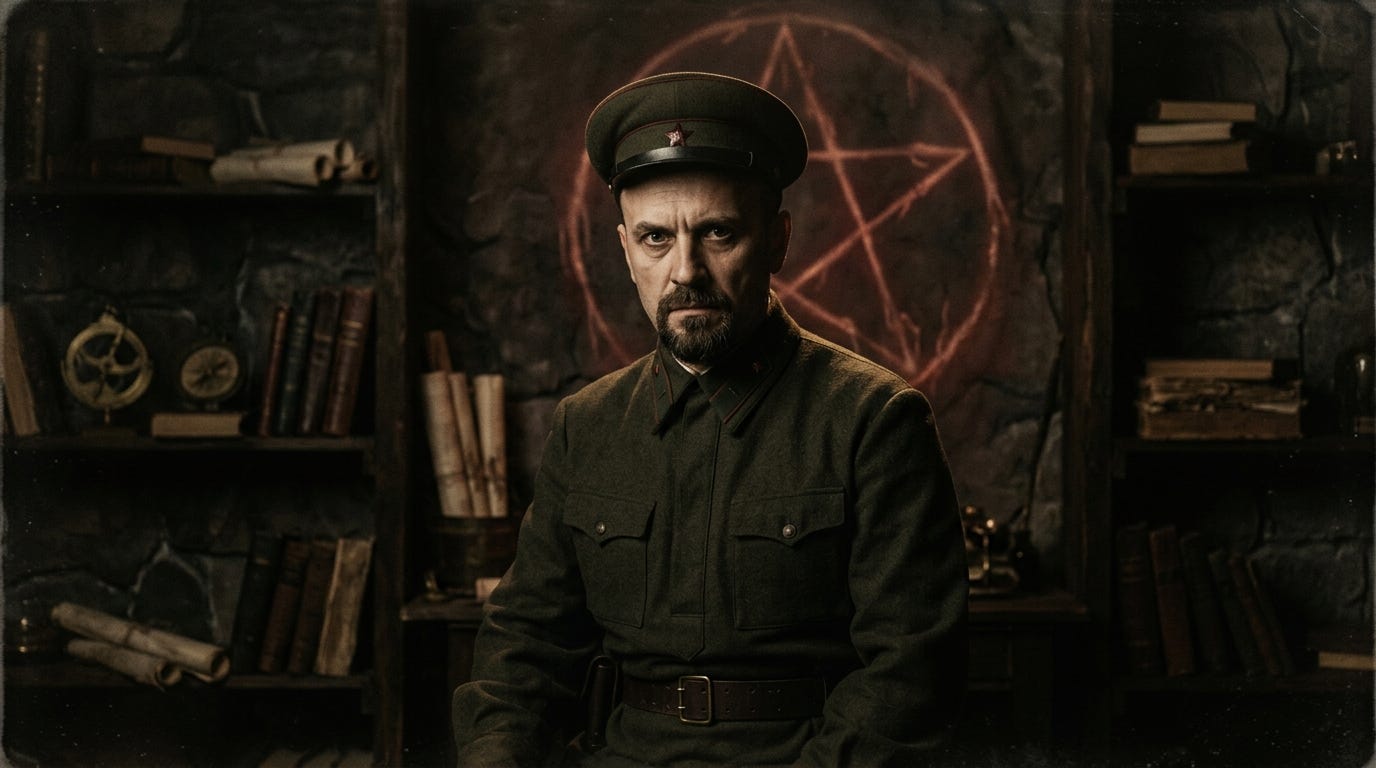
In the chaotic aftermath of the Russian Revolution, as the new Soviet state fought for survival, an unimaginable job posting went up. The Cheka, the secret police, was looking for specialists. Not spies or assassins — though they needed those too — but Sami shamans, Buryat spirit-talkers, cryptographers, experts in ancient poisons, hypnotists, telepaths, and clairvoyants.
The man placing these ads was not a lunatic on the fringes but one of Lenin’s closest allies: Gleb Ivanovich Bokii. He headed the Special Department of the OGPU (the later incarnation of the Cheka). His scientific consultant was the father of Russian psychiatry, Academician Vladimir Bekhterev. One of his key operatives was Yakov Blumkin, the legendary terrorist who assassinated the German ambassador.
And Bokii himself? Some literary scholars argue he was the real-life inspiration for Professor Woland, the Devil himself, in Mikhail Bulgakov’s The Master and Margarita.
When Nazi Germany invaded the USSR in 1941, Abwehr agents — acting on Hitler’s personal orders — scoured the occupied territories for any surviving members of Bokii’s disbanded department. Their mission was simple: offer a fortune (50,000 Reichsmarks, about half a million dollars today) for just a few hours of conversation. That was the price of the esoteric knowledge amassed by the Soviet Union’s most secretive occult agency.
This is the story of the Bolshevik who believed communism could be built with magic.
Part I: The Revolutionary as Mystic
Gleb Bokii was a paradox from the start. Born in 1879 into Ukrainian nobility — a descendant of an associate of Ivan the Terrible — he became a hardened revolutionary. By the time he was 15, he had already fought with police. Over the next 15 years, he would stand trial 12 times for crimes including murder and armed robbery (the infamous “expropriations” to fund the Bolshevik cause).
Remarkably, he always escaped conviction. Powerful figures from the occult underground repeatedly posted his bail: the mystic and hypnotist George Gurdjieff, the medium Pavel Mokievsky, and the Tibetan healer Pyotr Badmaev (who treated Tsar Nicholas II’s family). This was Bokii’s first foot in the esoteric world.
He was a close friend of Vladimir Lenin, whom he eerily always referred to by his mother’s maiden name, Blank — as if Lenin were a character in an experiment. Only once did Bokii use the famous name “Lenin”: on the day of his own arrest in 1937. He defiantly told the NKVD chief, “And what is Stalin to me? It was Lenin who appointed me!”
Part II: The Birth of a Mystical Department (1921)
The official story is one of dry bureaucracy. In 1921, the Soviet government needed better codes and ciphers. So, they created the Special Department (Spetsotdel) under the Cheka/OGPU, with Bokii at its head. Its official mission: cryptography, radio interception, and counter-intelligence.
But the unofficial story is wilder. In the summer of 1918 — between the murder of the German ambassador and the White advance — Lenin’s personal bodyguard, Yakov Blumkin, introduced Bokii to two men: Academician Vladimir Bekhterev and an enigmatic writer-mystic named Alexander Barchenko.
Barchenko was the key. A man without a formal degree, he was a hypnotist, a geographer, a novelist, and a man obsessed with one thing: Shambhala. He believed that a hidden civilization of superhuman “mahatmas” lived in the Tibetan mountains, possessing the secret knowledge to build a utopia — what he called a “Golden Age” of collective labor and cosmic consciousness. In other words, communism, but with magic.
Amazingly, these four men — Bokii, Blumkin, Bekhterev, and Barchenko — convinced the iron atheist Felix Dzerzhinsky to fund a department to study the paranormal. In 1921, Dzerzhinsky and Lenin signed the order creating the Special Department. For conspiracy, it was called the “ciphering” department. But insiders knew: this was the Soviet office of magic.
Part III: Project Kola (1922–1923) — Hyperborea and the Call of the Pole Star
Bokii’s department had near-unlimited funds. The average operation cost 100,000 rubles (approx. $600,000 today). The first major expedition, led by Barchenko in 1922, went to the Kola Peninsula, deep inside the Arctic Circle.
The Official Goal: Study a strange psychological phenomenon known to the local Sami people as Meryachenie (Arctic hysteria). Explorers like Roald Amundsen had reported it: a sudden, overpowering compulsion to follow a “call from the North Star,” causing explorers to attack each other with axes.
The Real Goal: Find Hyperborea.
Barchenko was convinced that the Kola Peninsula was the site of the legendary northern civilization, a utopian society that predated Egypt and Tibet. The Sami shamans (Noids) spoke of a sacred lake, Seydozero, with a “second bottom” that led to an underground world of spirits.
What Barchenko’s team claimed to find is still classified. Leaked reports mention a 70-meter-high human figure carved into a cliff face (known as Kuiva the Old Man), the ruins of cyclopean pyramids, and a mysterious road paved with massive stone blocks leading directly to the lake. Most chillingly, they found a narrow hole in the ground. Whenever they tried to enter, they were overwhelmed by a physical, nauseating terror — as if “the skin were being peeled from your body.”
Back in Leningrad, Barchenko’s report to Bekhterev’s Brain Institute caused a sensation. He had brought back a Sami shaman (a “seer”) named Ivan. The OGPU kept Ivan for years. They would show him photographs of wanted men, and Ivan would describe exactly what they were doing at that moment — with nine out of ten hits. One story claims Bokii, who hated his rival Yagoda, showed Ivan the deputy’s photo. Ivan described Yagoda lying naked in bed with two naked women performing “strange acts.” A quick investigation by Bokii’s men confirmed it: Yagoda was having an orgy on that exact evening.
Part IV: The Shambhala Project (1925–1926) — Blumkin and the “False Lama”
The success on Kola led to the ultimate prize: Tibet. Barchenko convinced Bokii that the surviving masters of Hyperborea now lived in the hidden kingdom of Shambhala. If the USSR could make contact, it would gain the psychic power to rule the world.
A vast sum — 100,000 gold rubles — was set aside. Barchenko would lead. Yakov Blumkin would be his “commissar” and guard.
But the Foreign Ministry (led by Chicherin) and Foreign Intelligence (led by Trilisser) were jealous of Bokii’s rogue department. In a bureaucratic coup, they stole the project. The expedition was given to the mystic-painter Nicholas Roerich. But the OGPU forced Blumkin onto the team as a spy.
Blumkin went native. Dressed as a Tibetan lama, he infiltrated Roerich’s expedition and reached Lhasa. While Roerich painted his famous “Banner of Peace,” Blumkin was reportedly meeting with the Dalai Lama’s government and searching for the entrance to Shambhala.
The results were a paradox. When Roerich and Trilisser reported back, their data was dismissed as “insignificant.” But Blumkin, Bokii, and Barchenko received high state awards. Why? Most likely because Blumkin brought back proof — a map, a text, a ritual — that Shambhala was real. This material remains locked in the SVR (Foreign Intelligence) archive, promised for declassification in 1993, then 2000, then… never.
Part V: Project Crimea (1927) — The Grail and the Cave Cities
In 1926, Dzerzhinsky personally ordered Barchenko to Crimea. The task: search the “cave cities” like Chufut-Kale and Mangup-Kale for entrances to the underground kingdom of Agartha (the inner-earth civilization, twin to Shambhala).
Barchenko lived in Bakhchysarai for months. He wasn’t digging for Scythian gold. He was meeting with Sufi mystics (the Saadiya order), Karaim elders, and exploring the deep, legend-shrouded wells that local lore said led to the Hollow Earth. He was particularly interested in a 45-meter-deep well at Chufut-Kale, which researchers in 2001 discovered connects to a 108-meter-long secret tunnel covered in Aramaic and Latin inscriptions.
Was this the “Golden Staircase” to the underworld? Barchenko thought so. He believed the cave cities were not medieval fortresses but the surface vents of a vast, antediluvian civilization. His papers from the trip vanished into the Lubyanka’s special archives.
Part VI: The Fall (1937–1938)
For 15 years, Bokii protected his occult empire. But Stalin was purging the “old Bolsheviks.” On May 16, 1937, Bokii was arrested in his office. Legend says that when Yezhov, the NKVD chief, accused him of conspiracy, Bokii laughed: “Conspiracy? I founded the Special Department for Lenin. What is Stalin to me?”
It was the end.
The investigators uncovered (or fabricated) a secret Masonic lodge within the NKVD: the “United Labor Brotherhood” (UTB) . Led by Barchenko and joined by Bokii, its goal was nothing less than to use the psychic energy of Shambhala to guide the Soviet state toward a true, spiritual communism.
Bokii was shot on November 15, 1937.
Alexander Barchenko was shot on April 25, 1938. Before his death, he was given a stack of paper. He spent his final days writing in calm, precise prose a complete “Introduction to the Methodology of Experimental Influences of the Energy Field.” It was the sum of his life’s work — the scientific manual to magic.
The manuscript was immediately destroyed by the NKVD.
Part VII: The Echo — Ahnenerbe, the Kola Well, and the Ghost of the Grail
Why did Hitler order the search for Bokii’s men? Because his own SS Ahnenerbe (Ancestral Heritage) was running the same playbook.
In 1935, Himmler created the Ahnenerbe to prove Aryan magic. By 1942, SS Oberführer Otto Ohlendorf (a mass murderer later hanged at Nuremberg) was sent to Crimea. Official history says he commanded Einsatzgruppe D, which killed 90,000 Jews. Esoteric history whispers that he had a second order: find the cave where the Goths had hidden the Holy Grail. The same caves Barchenko had searched in 1927.
And the Kola Peninsula? In the 1990s, after the fall of the USSR, a new expedition followed Barchenko’s maps. They found the same road, the same terrifying cave entrance. But they also found something else. Deep under the peninsula, near the famous “Kola Superdeep Borehole” (the deepest hole ever drilled by man), a legend was born. In the 1980s, Soviet scientists supposedly lowered a heat-proof microphone into the 12-kilometer-deep hole and heard… the screams of the damned.
While the “sounds of hell” are a debunked hoax, the story is perfect. It captures the Soviet quest: to drill through the material world and find, at the bottom, the supernatural.
Conclusion: The Red Magus
Was Gleb Bokii a cynical spy who dabbled in hokum? Or a true believer, a “Red Magus” who thought communism was the political arm of a cosmic, Hyperborean awakening?
The archives are still closed. But the outline is clear. For 15 years, a department of the Soviet secret police — run by a man who spoke to Lenin as an equal — spent millions of dollars of state funds searching for witches, telepaths, and underground kingdoms. They had their own shamans, their own secret maps to Shambhala, and their own Masonic lodge.
Gleb Bokii was not a madman. He was a revolutionary. And he understood something that we often forget: In the early USSR, the line between science, revolution, and magic was not a wall. It was a door. And he had the only key.
메타데이터
- post_id
- 15a6518b2d4e
- slug
- gleb-bokii-the-bolshevik-who-built-a-soviet-department-of-magic-15a6518b2d4e
- url
- https://medium.com/@briefsitrep/gleb-bokii-the-bolshevik-who-built-a-soviet-department-of-magic-15a6518b2d4e
- canonical_url
- https://medium.com/@briefsitrep/gleb-bokii-the-bolshevik-who-built-a-soviet-department-of-magic-15a6518b2d4e
- author_url
- https://medium.com/@briefsitrep
- status
- ok
- fetched_at
- 2026-06-21 21:05:38