Dignity: Something You Can Never Buy, Borrow or Give Back
What it is, what its absence does, and why it matters more than we admit
Dignity: Something You Can Never Buy, Borrow or Give Back
What it is, what its absence does, and why it matters more than we admit
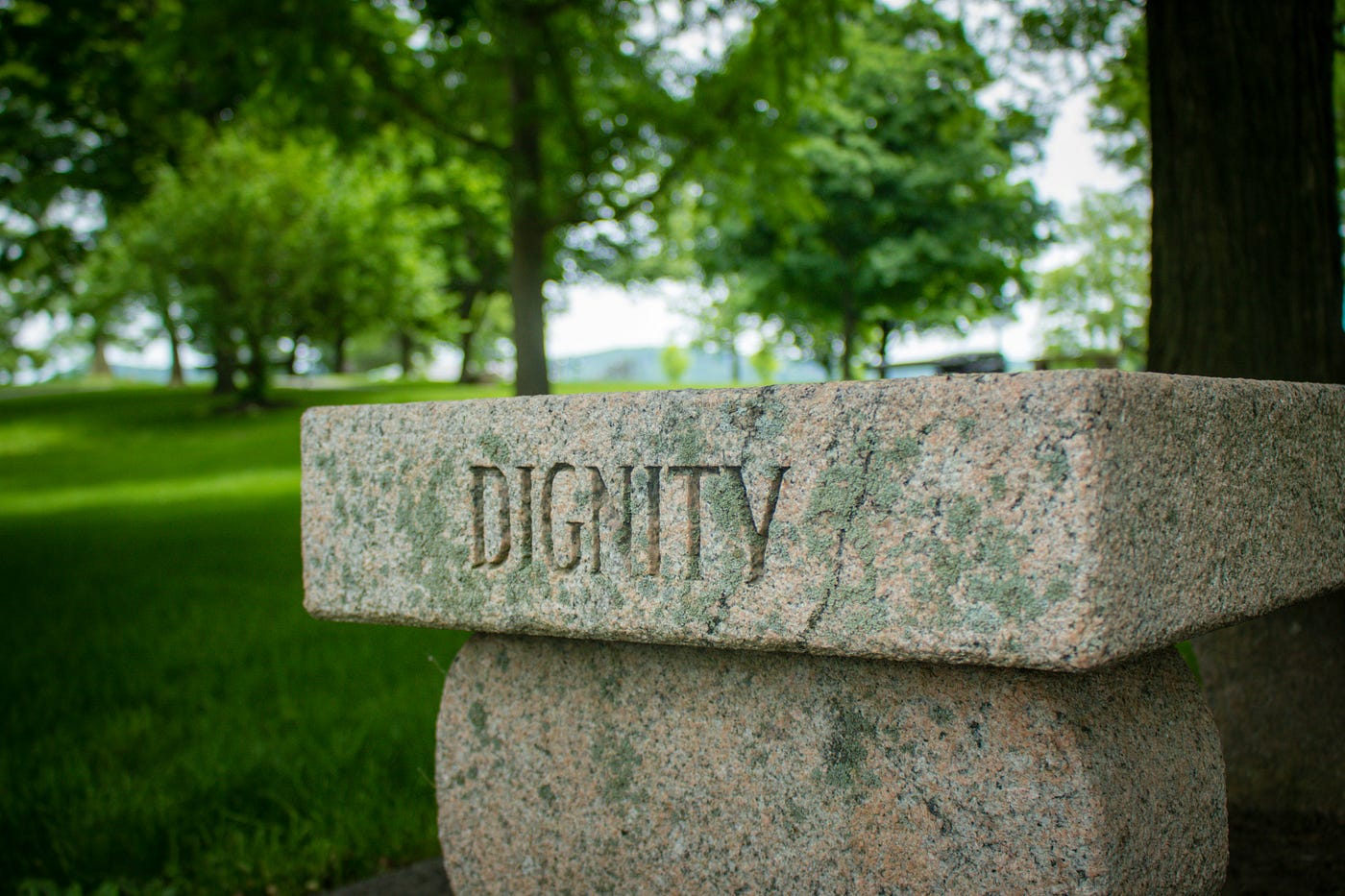
Photo by Dave Lowe on Unsplash
What We Mean When We Say Dignity
There’s a word that's often used but rarely understood. Dignity. It’s invoked in courtrooms and constitutions, in eulogies and HR policies.
And yet, when it is stripped away from a person, truly, deliberately insulted, what remains is something that no policy document has ever prepared us for.
The UN Declaration of Human Rights opens with it.
“All human beings are born free and equal in dignity and rights.”
First sentence. Before freedom of speech, before the right to life, before anything else.
The architects of that document, written in the shadow of the Holocaust, understood something that we, in our comfortable lives, have mostly been spared from learning the hard way: that you can take almost everything from a person and they will find a way to endure. But take their dignity, and you attack something closer to the core.
This is what I am exploring here. Not the definition, but the weight of it.
When the Body Survives but the Soul Doesn’t
Louis Zamperini was a juvenile delinquent from California who found his calling in running, fast enough to represent America at the 1936 Berlin Olympics.

Book Cover on Goodreads
Then came the war, a crashed bomber over the Pacific, and 47 days adrift on a raft in the open ocean with almost nothing to eat or drink. What broke him wasn’t the ocean, but what came after.
When the Japanese captured him as a prisoner of war, what they subjected him to wasn’t just physical punishment. It was systematic humiliation, a deliberate dismantling of the person inside the body.
And Zamperini himself said something striking: surviving without food and water felt more manageable than surviving without dignity. Laura Hillenbrand, who wrote his story in Unbroken, put it plainly:
Dignity is as essential to human life as water, food, and oxygen.
That line runs counter to everything we think we know about survival. And yet, it holds up.
Viktor Frankl, the psychiatrist who survived Auschwitz, made almost the same observation from a different angle. In Man’s Search for Meaning, he wrote that the prisoners who survived longest were rarely the physically strongest.
They were the ones who retained some interior freedom, a sense of self that the camp could humiliate but not entirely reach.
“Everything can be taken from a man,” he wrote, “but one thing: the last of the human freedoms, to choose one’s attitude in any given set of circumstances.”
Dignity, in Frankl’s understanding, was not something the guards could confiscate.
But when the machinery of dehumanisation worked, when a prisoner began to see themselves as the guards saw them, that was when the light went out.
The body can endure extraordinary punishment when the spirit has something to hold onto. But when you are made to feel that you are nothing, something gives way that no amount of calories can restore.
The Cruellest Irony: Those Who Guard It Least for Others
Here is the painful pattern that history keeps repeating: the people most invested in their own dignity have often been the most ruthless in denying it to others.
The Japanese soldiers who tortured Zamperini came from a culture that prized honour above almost everything. To be captured was considered so shameful that Japanese soldiers frequently chose death over surrender.
And yet those same soldiers had no difficulty inflicting on their prisoners the very experience they themselves could not endure for a moment.
We see this logic twisted and self-serving across centuries. The plantation owners of the American South demanded courtesy and respect from their social peers while treating enslaved people as property to be bought and catalogued.
The apartheid architects in South Africa who built an entire legal system around the idea that one group of humans was inherently more valuable than another, while simultaneously insisting, to the world, that they were a civilised society.
The philosopher Kwame Anthony Appiah, in his work on honour cultures, argues that this is not coincidental. Societies that place enormous value on their own dignity are sometimes the most dangerous to those they exclude from it.
Because they understand, viscerally, how much dignity matters, and they use that knowledge as a weapon.
The Slow Violence of Ordinary Indignity
The loss of dignity doesn’t always look like a prison camp or a historical atrocity. That’s the part we forget most easily.
James Baldwin wrote about this with characteristic precision in the context of Black America.
It wasn’t only the violence of segregation that wore people down, he argued, it was the accumulation of daily signals, the averted eye, the assumption of guilt, the service withheld, each one small enough to dismiss, collectively impossible to survive without cost.
“To be a Negro in this country,” he wrote, “and to be relatively conscious, is to be in a rage almost all the time.”
That rage is not pathology. It is the reasonable response to being told, repeatedly and in a hundred subtle ways, that you count for less. We see a version of this playing out in conflicts closer to our present moment.
In Gaza and the West Bank, whatever one’s political position on the broader conflict, there is a human story underneath the politics. This involves people whose daily movements, access to resources, and basic ability to live without fear have been circumscribed for so long that an entire generation has grown up with their dignity contingent on the decisions of others.
That is worth naming, even if solutions are complex and contested.
Dignity Withheld Closer to Home
There is a particular kind of arrogance that hides behind the phrase “just how things are.” The assumption that some work is inherently lesser, and therefore the people who do it are too.
Think of how we speak, or don’t speak, to the person who cleans the office, the security guard who holds the door, the domestic worker who knows where everything in your kitchen lives.
Whether we say good morning. Whether we remember there is a name. These are not small things. They are the daily referendum on whether we actually believe what we say about human dignity, or whether we reserve the word for formal occasions.
Studies on domestic workers in India and across Southeast Asia consistently find that the most reported source of distress is not wages or working hours, but the experience of being treated as invisible. Not cruel, not abusive, simply unseen.
As if the person were part of the furniture rather than a human being with an interior life.
That invisibility is a form of indignity. Scaled down, domesticated, dressed in ordinary clothes, but in the same family as the larger cruelties.
What It Takes to Hold On — and Give Back
Zamperini eventually came home. But home didn’t fix him, not immediately. The humiliation had burrowed so deeply that even safety couldn’t quickly reach it. It took years for him to find peace, and remarkably, to forgive.
That is the part of his story that I keep returning to. Not the survival, extraordinary as it was. The forgiveness.
To look at someone who tried to erase your humanity, and to see a human being still, that requires holding onto your own dignity so completely that you have some left over to extend outward.
Frankl described the same capacity in Auschwitz survivors who, even inside the camps, would share their last piece of bread with someone worse off. They had not lost the thread that connected them to their own humanity. And because of that, they could still recognise it in others.
Dignity is not just something we receive; it is something we give, in daily choices and small moments, to people the world tells us we don’t have to bother with.
It cannot be bought. It is not always protected by law.
But it is available, in ordinary quantities, in ordinary interactions, and the decision to extend it or withhold it is one most of us make without even noticing we’re making it.
We might as well notice.
Books referenced: Unbroken by Laura Hillenbrand, Man’s Search for Meaning by Viktor Frankl, The Honour Code by Kwame Anthony Appiah, and The Fire Next Time by James Baldwin.
메타데이터
- post_id
- 15ac3f0c4da8
- slug
- dignity-something-you-can-never-buy-borrow-or-give-back-15ac3f0c4da8
- url
- https://medium.com/illumination/dignity-something-you-can-never-buy-borrow-or-give-back-15ac3f0c4da8
- canonical_url
- https://medium.com/illumination/dignity-something-you-can-never-buy-borrow-or-give-back-15ac3f0c4da8
- author_url
- https://medium.com/@hetal.sonpal
- status
- ok
- fetched_at
- 2026-06-09 15:37:30