Why Kadena could become the heaven of A2A AI
Agent to Agent AI
Why Kadena could become the heaven of A2A AI
Agent to Agent AI
After the recent AI boom, many actors are now looking ahead and trying to anticipate the next step. Several major players, such as Google, are moving toward Agent-to-Agent (A2A) AI. The idea behind this concept is to provide more advanced services by allowing AI agents to cooperate and to offer (and charge for) services to one another.
However, AI agents will eventually need a registry where they can expose to the rest of the world:
- Their capabilities
-
- Their reputation-
- Third-party verification
- …
Why blockchains ?
Because, ideally, these registries should be decentralized:
- Avoid a single operator (censorship, reliability issues, single point of failure)
- Trustless (verifiable, immutable, no need to trust a single party) Open interoperability
- Political and economic resilience (avoid regulatory and multi-jurisdictional issues, manipulation as a consequence of electronic warfare, …)
This is why Ethereum has proposed a new standard: ERC-8004: Trustless Agents.
Why not Ethereum ?
Many believe that in the future, the A2A AI market could skyrocket, leading to thousands — perhaps millions — of transactions.
Even though Vitalik Buterin recently announced continued work to further improve Ethereum’s scalability, at some point it may not be sufficient…
Remember what happened during the NFT frenzy in 2021. People were constantly complaining that DeFi had become unusable, as a simple token swap could sometimes cost more than $100 in gas fees.
Even if Ethereum were to double or triple its throughput, a future A2A AI frenzy could be a hundred times more intense than the NFT boom.
Why not Base, or other L2s?
“Base is the solution… for everything related to crypto…” — lol — that’s what I’ve been reading every day for the past few months.
But perhaps some overlook what Base actually is. It is fully centralized: everything goes through the sequencer operated by Coinbase. That is precisely the opposite of the requirements for a universal A2A registry.
Other L2s are not much better. Vitalik Buterin recently pointed out that no L2 has yet achieved true decentralization.
Why Kadena ?
Kadena, using its X-chain architecture, is fully decentralized, and its scalability model aligns particularly well with AI requirements. Let me explain.
Horizontal scalability
Many have pointed out that Kadena’s multi-chain design is not ideally suited for multi-chain DApps (for example, sharing liquidity is not very straightforward). That’s true. But Kadena’s greatest strength lies in horizontal scalability.
- In practice, this means orthogonal DApps can run independently without interfering with one another, each living on its own chain.
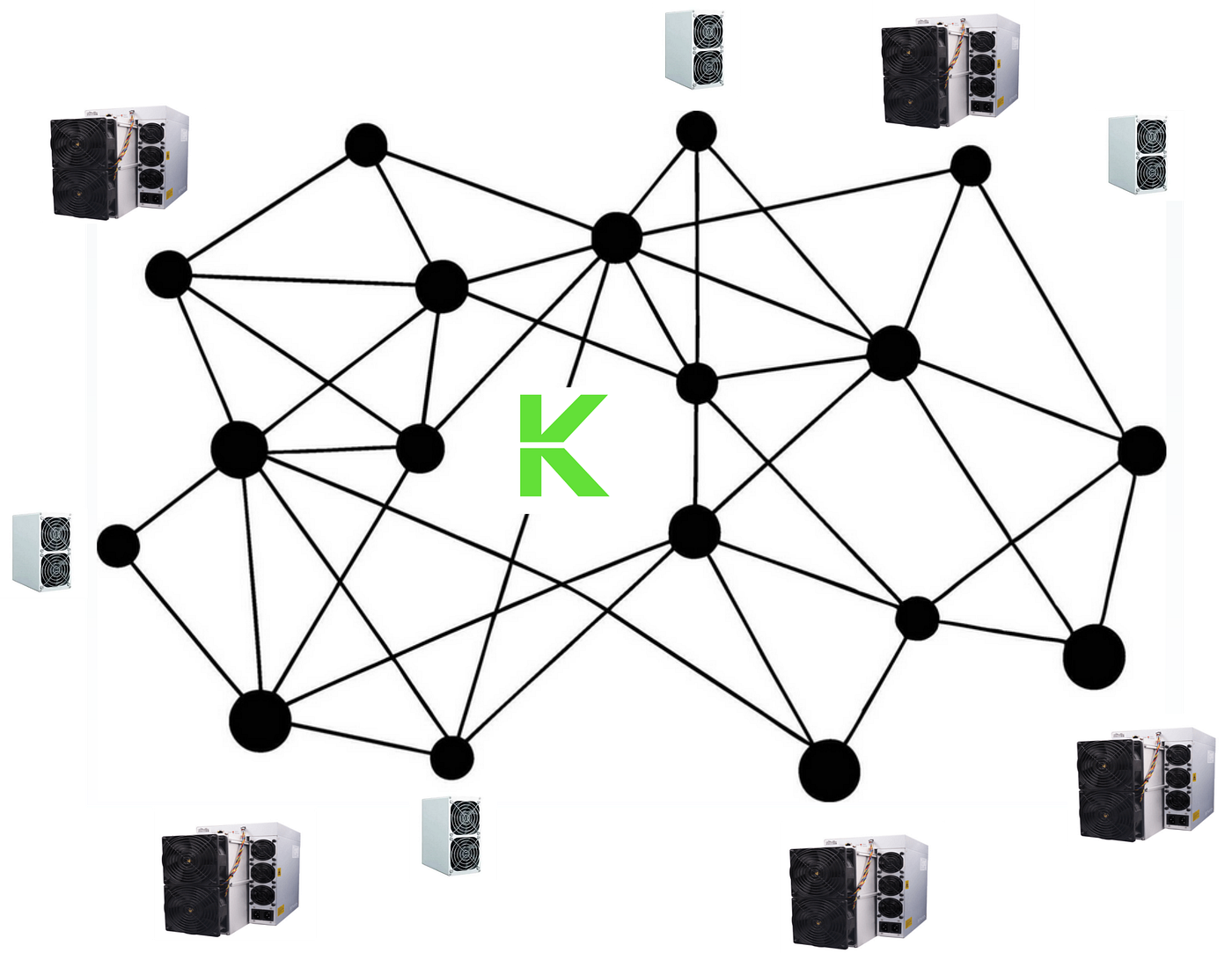
- At the same time, the braided chain design ensures that all chains are secured by the same PoW hash power. The strongest chains protect the weakest. In short, performing a 51% attack on a single chain would effectively require attacking the entire network.

In the context of A2A AI — with potentially hundreds of transactions per second — it makes a lot of sense to dedicate an AI “side-chain,” secured by the PoW of the entire network, without disturbing other applications.
Multi-Chain registries
I mentioned hundreds of transactions per second — but what happens in the case of thousands, or tens of thousands? The answer is simple: add new AI chains.
By nature, A2A AI interactions can be split across multiple databases. As such, they can scale on Kadena while preserving global security properties.

Multi-Chain registries — with a scalable payment layer
While the Ethereum standard is very lightweight and only handles minimal use cases, a Kadena-based standard could include many more features, supported by Pact.
One such feature could be a scalable payment layer. Since payment for a completed AI job does not require strict real-time settlement, it would make sense to use Pact proofs to process payments on general-purpose chains with liquidity. This would limit the need to maintain liquidity on AI-dedicated chains.

And now, what are the next steps?
Have you looked at the ERC-8004 standard? It’s quite minimal. I believe that with relatively little effort, it could be significantly enhanced on Kadena (including a connected orthogonal payment layer, on-chain JSON storage, …).
- The key is to clearly identify industry needs and determine how Pact can address them.
- And define a sustainable business model for AI on Kadena, ensuring it benefits miners and token holders alike.
- Who wants to take up the challenge ?
메타데이터
- post_id
- 15c6b4d5fbec
- slug
- why-kadena-could-become-the-heaven-of-a2a-ai-15c6b4d5fbec
- url
- https://medium.com/@crypto-pac/why-kadena-could-become-the-heaven-of-a2a-ai-15c6b4d5fbec
- canonical_url
- https://medium.com/@crypto-pac/why-kadena-could-become-the-heaven-of-a2a-ai-15c6b4d5fbec
- author_url
- https://medium.com/@crypto-pac
- status
- ok
- fetched_at
- 2026-06-20 20:29:01