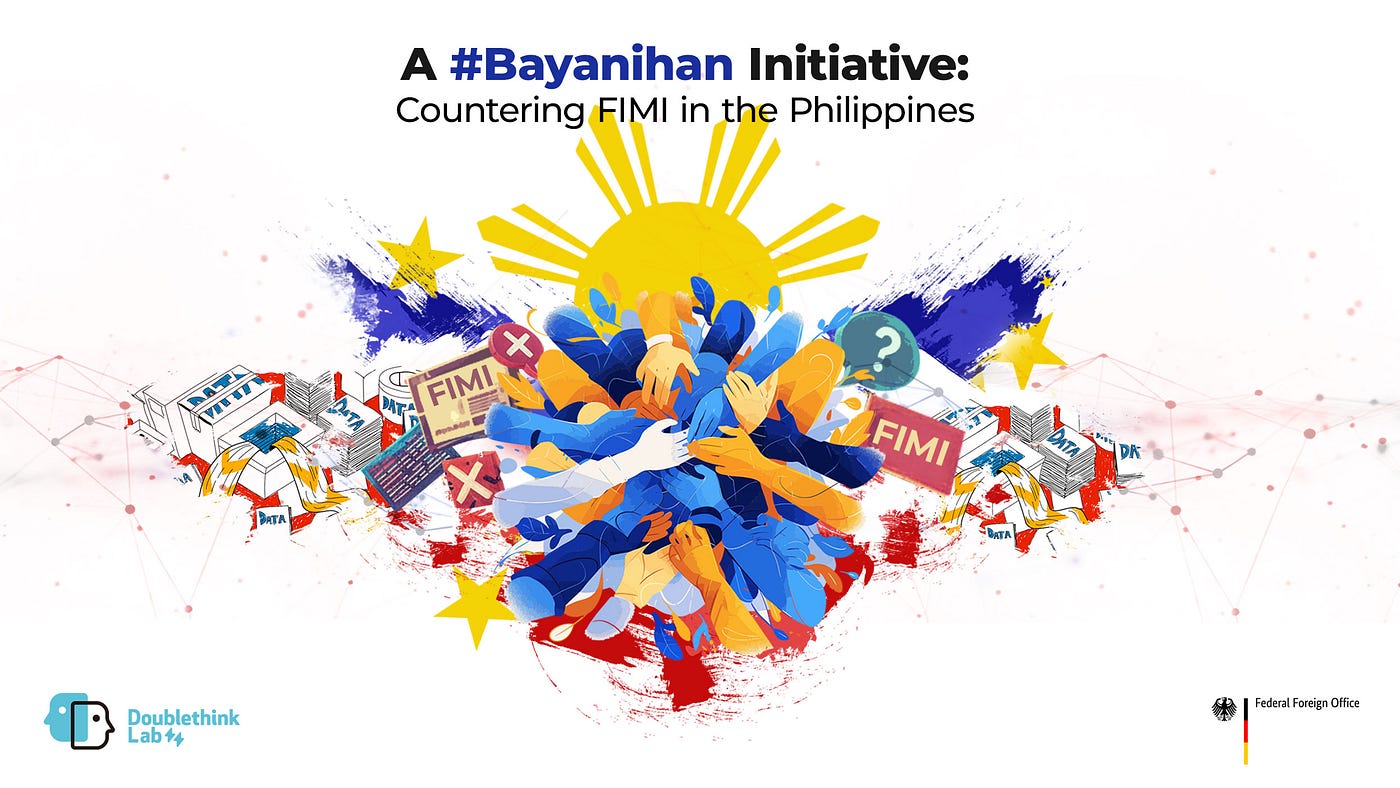
A #Bayanihan Initiative: Countering FIMI in the Philippines
How our Philippine partners exposed PRC-linked FIMI shaping West Philippine Sea narratives and political polarization, building resilience.
A #Bayanihan Initiative: Countering FIMI in the Philippines
Vulnerability and potential for resilience — these words reflect how information disorders, specifically Foreign Information Manipulation and Interference (FIMI), affect the Filipino people. A geostrategic location in both economy and defense: The Philippines’ Exclusive Economic Zone (EEZ), aptly called the West Philippine Sea (WPS), sits within the People’s Republic of China (PRC)’s self-claimed 10-Dash Line. It is also within the 1st Island Chain, a geological buffer from attacks from the West. The Philippine government’s Transparency Initiative has exposed the continual harassment of the PRC’s coast guard and maritime militia against Philippine vessels, military and civilian alike. Moreover, along with civil society and the media, it has exposed the distorted, manipulative, and deceptive narratives of the PRC and its proxies to advance its objectives pertaining to the WPS. Journalists are also raising awareness regarding the coordinated inauthentic activities to seed and amplify this content.
Despite these initiatives, the Philippines still uses the concept of “disinformation” and “fake news” to frame discussions on information disorders. Excluding FIMI in discourse and policy development will leave the country’s defenses and response insufficient. There is still much work to be done to effectively counter FIMI in the country.
Our previous work in the Philippines provided us with insight about key steps to address FIMI. It is necessary to facilitate convergence and capacity building of stakeholders, to bring about change in paradigm and in perspective. FIMI must be considered in strategies to protect the cognitive domain. Central to these steps is the Filipino concept of Bayanihan, a traditional practice of helping a neighbor carry their house from one “bayan” or town to another. Sharing the burden ensures that the objective is achieved and the community’s solidarity is strengthened.
The Project
Countering FIMI in the Philippines, a project supported by the German Ministry of Foreign Affairs (MOFA), has also embodied the bayanihan spirit. At the heart of this project are the stakeholders, partners from the defense sector, primarily those responsible for protecting the country’s maritime domain; the academe, which is a potent influence in protecting the country’s hard-won democracy; and civil society organizations that are at the forefront of fighting information disorders and advancing digital rights.
The project began with three online training sessions and one culminating activity in Manila. Apart from speakers from DTL, we also invited Professor Yvonne T. Chua and Carlos Nazareno as resource persons for investigation tools and artificial intelligence (AI) respectively. The participants also received mentorship from seasoned journalists Rommel Lopez of Holy Cross College of Davao, Yas Ocampo of Mindanews, and Cristina Chi of Philstar.com. DTL’s Philippine-based analyst and coordinator also provided significant assistance in the conduct of the investigations. With their support, the partners conducted their own FIMI investigations. Considering the findings of their investigations, our policy consultant, Dominic Ligot, facilitated a design thinking workshop to develop and document policy and strategy recommendations. This collaborative document was distributed to relevant agencies and organizations in the Philippines, including the House of Representatives, which is in the midst of discussions on bills addressing disinformation and “fake news”.
Beyond the project, our partners have also begun to incorporate FIMI into their own organizational activities.
This report summarizes the findings of the five (5) investigations completed during the program. Links to full reports will be provided, if available. These investigations were analyzed and are presented in this article using Pamment’s ABCDE Framework. Partners also used the European Union External Action Services (EEAS) FIMI Architecture Framework from their 3rd FIMI report to classify the threat actors involved and the DISARM Red Framework for a common vocabulary and codify the behaviors observed in each FIMI incident. Lastly, the impact of each case was described using Brookings’ Breakout Scale. The partners utilized open source tools to gather, analyze, document, archive, and present data.
Case 1: Seeding Discontent (How China-Linked Actors and Influencers Reframed the September 21 Anti-Corruption Protest in the Philippines
Carlos Nazareno, Odina Batnag, and Benjamin Buenaflor Jr. of Democracy.Net.PH

Image credit: Black Forest Lbas FLUX.2
In July 2025, President Ferdinand “Bongbong” Marcos (PBBM), during his State of the Nation Address, exposed failed flood control projects due to massive corruption. Since then, the government has taken steps to investigate the grand corruption behind these projects. The Philippines is especially vulnerable to climate disasters and has had to suffer from fatal flooding for decades. The President’s expose and subsequent media coverage stoked the anger of the Filipino people. Responding with righteous anger, the people took to the streets on September 21, 2025, conducting a massive protest in several areas of the country. Unfortunately, some of these movements resulted in violent riots in some parts of the country.
Following the September 21, 2025 protests, PRC state-controlled and state-aligned actors began circulating the narrative that the protests were U.S.-backed. It was notable that a pro-Duterte influencer shared a fake memo from the National Endowment for Democracy (NED) that implied U.S. interference was shared by pro-Duterte vloggers who also drumbeat pro-PRC stance. NED later disproved this.
Actor
Most of the actors involved in this FIMI incident are state-aligned actors, which the EEAS defined as those that “cannot be directly attributed to state control or funding and therefore remain unattributed but show systematic signs of alignment with a state entity.” Asian Century Philippines Strategic Studies Institute (ACPSSI) and Global Talk News Radio (GTNR) have previously been identified as seeders and amplifiers of PRC propaganda in the Philippines. Prominent figures tied to these organizations include Herman Tiu Laurel, president of ACPSSI and GTNR host, as well as Ado Paglinawan, who was linked to WPS disinformation campaigns. These actors have historically taken the side of the PRC, echoing their narratives on several key issues, including their complete and unquestionable ownership of the entire South China Sea and skepticism against the U.S. Brian Berletic, a state-aligned pro-PRC and pro-Russia vlogger presents himself as an ex-Marine who is critical of the U.S. government. He has significant reach on X (formerly Twitter) as well as through his YouTube account, The New Atlas. Apart from saying that the Philippine protests were backed by the U.S., he also emphasized that the recent movements in Nepal and Indonesia were also instigated by the superpower.
Other actors include vloggers and influencers who support Former President Rodrigo Roa Duterte (FPRRD). Joie “De Vivre” Cruz shared a forged memo and accused the National Endowment for Democracy (NED) of funding groups during the protests. This was shared by authentic accounts including Former Philippine National Police (PNP) General Filmore Bondilles Escobal, pro-Duterte celebrity Richard Poon. Another pro-Duterte influencer, Mark Lopez, shared the post. All three have significant reach. Lopez has been documented to be spreading disinformation about Philippine-PRC encounters in the WPS. The fake NED memo was also amplified by inauthentic accounts, through comments and shares.

Figure 1: Sample inauthentic accounts that commented on Cruz’s fake NED memo post.
Behavior
From the narratives and content in this incident, we determined that one of the main objectives is to advance geopolitical interest (T0074.001: Geopolitical Advantage), by damaging the reputation of the U.S. and promoting skepticism, as well as degrading (T0066: Degrade Adversary) the current president, Ferdinand “Bongbong” Marcos Jr. The actors identified above presented themselves as experts (T0097.108: Expert Persona) and journalists (T0097.102: Journalist Persona), lending credibility to their opinions. Berletic also presents himself as an ex-military personnel (T0097.105: Military Personnel Persona).
Inauthentic accounts amplify the U.S. interference narrative and further manipulate the public (T0049.001: Trolls Amplify and Manipulate) by sharing and commenting on the forged NED memo. The organization manually examined 392 accounts that shared the post and 252 accounts that commented on it. Among the sharers, 19% (78 accounts) exhibited a high likelihood of inauthenticity, while another 19% demonstrated a medium likelihood. The remaining 73 out of 392 accounts (19%) showed a low likelihood of inauthenticity. For the commenters, 68 out of 252 accounts (27%) were deemed most likely inauthentic. These accounts present themselves as individuals (T0097.100: Individual Persona) and use suspicious account imagery to make themselves look more legitimate.
Content
The overarching narrative in this FIMI incident is U.S. skepticism. The U.S. is framed to be treacherous, as it will always advance its own interests, despite harming others, including its own partners such as the Philippines. The primary sub-narrative is that the U.S. is an instigator and supporter of the September 21 protest, including the violence that eventually occurred. An equally interesting sub-narrative includes presenting PBBM as a U.S. lackey, but a less-willing pawn to serve the U.S. interest, thus explaining the alleged U.S.-backed destabilization angle. These narratives are not new. U.S. skepticism is present in many observables pertaining to Philippine-PRC relations. The “BBM is a U.S. puppet” is a conspiracy theory narrative PRC-aligned proxies have used since the President’s pivot to the West. These narratives were also documented in a previous investigation conducted by Doublethink Lab.
These narratives were delivered through different ways, specifically text or captions, images, and videos.
Degree
Global Talk News Radio has over 44K followers on Facebook and 66.5k subscribers on YouTube. The episode where they claimed that the September 21 protests were pro-US and backed by NED. The YouTube video has 3.3K views as of January 28, 2026.
As of February 2026, pro-PRC influencer Brian Berletic has over 120.9K followers on X. His YouTube channel, The New Atlas, has 302K subscribers. His tweet about the alleged U.S. funded unrest in the Philippines had over 28.4K views, 201 retweets, and 436 heart reactions as of January 28, 2026. The YouTube video itself has 56,000 views. 1,098 comments, and 6,140 thumbs-up reactions as of the same date.
Joie de Vivre, an influencer with 266 followers on Facebook, shared the fabricated NED memo. As of February 2026, her post had over a thousand shares, 277 comments, 1K shares, and 3K reactions. The post was amplified by other authentic accounts with significant reach, including Retired Police General Filmore Escobal (284K followers) and singer Richard Poon (566K followers). Pro-Duterte influencer and known amplifier of PRC propaganda Mark Lopez, with 247K followers, also shared the fake memo.
Effect
Due to the celebrity amplification of the fake NED memo, and with due consideration to the reach of the actors themselves, it is determined that this incident is classified as a Category 5 in the Brookings’ Breakout Scale.
Recommendations
Democracy.Net.PH has several recommendations to counter FIMI in the Philippines, with a specific focus on identifying, preventing, and penalizing inauthentic and coordinated amplification. Coordinated Inauthentic Behavior (CIB) has fractured society’s shared reality and stifled public expression. By targeting CIB and its systemic amplification, we can dismantle the manipulative networks that distort political perception. These interventions are vital steps toward restoring genuine discourse and rebuilding a common factual foundation.
We are also advocating for widespread Media Information Literacy (MIL), including the introduction of the concepts of Influence Operations (IO) and FIMI, in addition to disinformation. The organization also proposes continuous monitoring and information sharing on state-linked, authentic actors, along with networks of inauthentic amplifiers.
Lastly, we recommend collaborating with stakeholders on advancing legislation that protects our democratic institutions from disinformation and FIMI while ensuring that our fundamental rights are central to these policies. This is an initiative that Democracy.Net.PH is undertaking.
Case 2: People’s Republic of China (PRC) Actors Frame the Philippines’ Bureau of Fisheries and Aquatic Resources (BFAR) as Aggressive, Intrusive, and Deliberately Ramming the China Coast Guard (CCG) during an Encounter near Bajo de Masinloc (Scarborough Shoal)
Jayanil Charis Enriquez, Kenneth Longares, and John Cris Cerafica of the Youth Empowerment Society of the West Philippine Sea and Other Maritime Security Challenges (#YESWPS)
On September 15, 2025, around 10 a.m. the Bureau of Fisheries and Aquatic Resources (BFAR)’ BRP Datu Gumbay Piang was conducting a humanitarian mission, delivering supplies to Filipino fisherfolk in Bajo de Masinloc. During the mission, two vessels of the China Coast Guard (CCG), CCG 5201 and CCG 21562, and a China Maritime Militia vessel, CMM 00001, subjected the Philippine boat to dangerous maneuvers and sustained water attacks. These resulted in the injury of one crew member and damage to BRP Datu Gumbay Piang. The diplomatic community took to social media to condemn China’s actions, and the Philippines’ Department of Foreign Affairs (DFA) also filed a diplomatic protest.
In response to the event (T0068), content framing BFAR as aggressive, intrusive, and deliberately ramming the CCG vessel began circulating across official PRC channels, PRC-controlled outlets, PRC-linked networks, and by inauthentic accounts. The Youth Empowerment Society for the West Philippine Sea and Other Maritime Security Challenges (#YESWPS) investigated this incident, under Doublethink Lab’s Countering FIMI in the Philippines project, which is supported by the German MOFA Project. The Society examined online activities on Facebook, X (formerly Twitter), TikTok, Youtube, and relevant websites from September 15 to 18, 2025. We also endeavored to analyze the inauthentic amplification of the posts by official state channels on X.
Actor
Official state channels such as Chinese Foreign Ministry Spokesperson Lin Jian, the Chinese Embassy in Manila, the Chinese Embassy in the United States, Ministry of National Defense Spokesperson Senior Colonel Zhang Xiaogang, and China Coast Guard Spokesperson Gan Yu used several platforms to portray the Philippines as the aggressor during the encounter.
State-controlled outlets such as Xinhua News Agency, Global Times, CGTN, CCTV, and the multiplatform content creator Media Unlocked circulated materials reiterated the same narrative, emphasizing that the Philippines deliberately rammed the CCG vessel. These were further reinforced by state-linked channels like Phoenix TV and ECNS, which distributed similar framing across their networks.
State-aligned accounts also contributed to the spread of coordinated messaging. The Facebook fan page Thriving Mindanao Islands Progress amplified pro-PRC narratives to Filipino audiences, helping extend these claims into local online communities. The page identifies itself as “blogger geopolitics”, but has a history of focusing on pro-PRC narratives as well as pro-Duterte content. The page’s location is on “China , Guangzhou, China, 8508”, but the link redirected to a map of Taiwan on Bing.
Collectively, these actors propagated and sustained the PRC’s preferred framing of the incident between September 15 and September 28, 2025. Several inauthentic accounts were also observed retweeting the posts of official state channels in X.

Figure 2: Timeline of actors’ posts in relation to the BFAR-CCG incident
Behavior
The incident is part of a sustained campaign to sway the hearts and minds of the international community and the Filipino people, to sway decisions and behaviors to be more accepting of the PRC’s stance in the West Philippine Sea. Thus, the incident is rooted in advancing geopolitical advantage (T0074.001: Geopolitical Advantage). By framing the Philippines as the aggressor, the threat actors aimed to damage the country’s reputation in the international community, which may lead to losing their support. Related to this, threat actors aim to distract (T0077: Distract) the audience by redirecting the blame towards the Philippines while portraying the CCG as lawfully executing its mandate. They also distort (T0076: Distort) the facts, twisting the humanitarian supply mission conducted by the BFAR as an illegal intrusion. This was done by seeding kernels of truth (T0042: Seed Kernel of Truth), highlighting certain aspects of the incident while downplaying other relevant information. This is also a technique known as card stacking.
Notably, #YESWPS documented a post from Global Times even before the incident happened. The first post appeared on Global Times at UTC+00:00 24:39 on September 15 and 1:15 on September 16, 2025, despite the event occurring at 2:00 a.m. UTC+00:00. This may be an attempt to respond to breaking news (T0097.0068: Respond to Breaking News Event or Active Crisis) or to frame the incident to their advantage as early as possible.

Figure 3: Timeline showing that Global Times posted even prior to the reported time of the incident.
We also found inauthentic accounts amplifying the posts from official state channels on X. These accounts present themselves as real individuals (T0097.100: Individual Persona). These accounts make use of account imagery (T0145: Establish Account Imagery) indicative of inauthenticity, have little to no original content, little to no engagement, and are often single -purpose accounts (i.e. reposting only pro-PRC content).

Figure 4: Sample inauthentic accounts that amplify official state actors’ post about the BFAR-CCG incident
Content
As this incident is part of a larger, persistent campaign against the West Philippine Sea, the meta narrative is the same: The PRC’s total and unquestionable sovereignty over the entire South China Sea. This claim is the basis for the sub-narratives documented in this incident. First, the PRC claims that the incident occurred within PRC’s territorial waters (Huangyan Dao) CCG acted lawfully and professionally — This narrative asserts that the encounter took place inside what the PRC claims as its sovereign territory — This framing twists the nature of the BFAR’s humanitarian resupply mission as an illegal intrusion, justifying the CCG’s actions as necessary enforcement of domestic law. Second, the PH is framed as the aggressor and PRC as the lawful enforcer. This narrative reverses the roles of actor and victim, depicting the Philippines as initiating hostility while portraying the PRC as merely responding to maintain order. In relation to this, the threat actors also claim that the Philippines deliberately rammed the CCG vessel, despite conflicting evidence and inconsistencies with the available footage.
Degree
The narratives were delivered in different ways across various platforms, including websites, social media platforms, and video-sharing platforms. As of December 3, 2025, the materials pertaining to the incident have the following engagements:
Table 1: Collective engagements of all observables In different platforms
[embed]
Given the engagement of the content on these platforms and the number of platforms used to seed and amplify the narratives, we can classify this incident as a Category 3 in the Brookings Breakout Scale (Multiple Platforms, Multiple Breakout). However, while the impact of this specific FIMI incident is limited to multiple online platforms, this is merely a part of a continual campaign to influence people’s hearts and minds when it comes to protecting the West Philippine Sea. Overall, this FIMI campaign may have contributed to the Filipino people’s perception of the WPS and the collective response to protect and defend it.
Recommendation
As a youth-led and youth-serving organization, #YESWPS recommended launching targeted digital campaigns to amplify verified information, counter misleading narratives, and raise youth awareness about incidents in the West Philippine Sea. They also posited the mobilization of young people to push for a National Digital Media Literacy Law that embeds digital media literacy across the Philippine education system to equip young Filipinos with critical thinking skills needed to identify disinformation, recognize and understand FIMI tactics and information disorder, and participate responsibly in today’s information ecosystem.
Case 3: Promoting Sara Duterte as the Next President of the Philippines
Grace Salonga, Ramon Timothy Bautista, and Kevin Ortiz, Movement Against Disinformation (MAD)
Movement Against Disinformation (MAD), through the Countering FIMI in the Philippines Project, investigated how some People’s Republic of China (PRC)-aligned threat actors cultivate support (T0136: Cultivate Support) and motivate the Filipino people to vote (T0138: Motivate to Act) for Vice President Sara Duterte as the next president. Narratives are also often juxtaposed with Duterte with the current President, Ferdinand “Bongbong” Marcos Jr., often portraying the latter in a negative light (T0066: Degrade Adversary). In essence, the incident’s objective is to advance domestic political advantage (T0074.002: Domestic Political Advantage). The observables gathered were published from September 13, 2024 to December 5, 2025. Duterte, daughter of Former President Rodrigo Roa Duterte, has repeatedly claimed that she is not pro-PRC, but other officials have pointed out her silence on the Beijing’s aggressive actions in the West Philippine Sea (WPS) and her criticisms to the administration’s foreign policy, which has significantly lessened the PRC’s influence on the Philippines.
Actor
Accounts on different platforms were pushing the narrative that Sara Duterte must be the new Philippine president, favorably comparing her to the current leader President Ferdinand “Bongbong” Marcos Jr., whose foreign policy is less friendly to the PRC.
Actors that are linked to the PRC have seeded this narrative. For instance, a now-deleted channel posted a video about Duterte’s rising approval rating, which has surpassed the President’s. The same video was posted on a YouTube channel Global Vision (大視野), which has over 1.48 subscribers. The channel’s location is in Taiwan and the website for CTi News is linked in the About pop-up of the channel. CTi News is owned by Tsai Eng-meng, who supports Taiwan’s unification with the PRC. It has been accused of spreading pro-Beijing “fake news”. The views of the video exceeded 9,500. Another channel, Zhongtian Daily Commentary, published a video highlighting how Filipinos demanded that Marcos step down and let Duterte be the president. Zhongtian Daily Commentary is also the Bilibili presence of CTi News. Articles pushing for the Duterte daughter’s presidency were also found in QQ. The platform is owned by Tencent, a gaming and social media company that has been found to be working with the PRC’s military in 2025.
Locally, PRC-aligned actor and Pro-Duterte influencer Sass Rogando Sasot featured prominently in this campaign. Sasot, a doctoral student of International Relations in the University of International Business Economics in Beijing, presents herself as an expert (T0097.108: Expert Persona) and has made content on Philippine-PRC relations, often defending the stance of the PRC. Jan WRITER , another pro-Duterte influencer, also presents himself as a researcher, has also seeded this narrative. Other prominent Duterte allies include former Duterte spokesperson Atty. Harry Roque and former Senatorial candidate Atty Jimmy Bondoc. Fan pages and groups supportive of the Duterte faction were also found to be amplifying this narrative.
Behavior
The actors employ TTPs that are meant to flood and dominate the information space (T0049: Flood Information Space), including cross-posting (T0119: Cross-Posting) of content. For instance, the video on Bilibili was also posted on YouTube.

Figure 5: Cross-posting of content from Chinese video-sharing website Bilibili (left) and YouTube (Right). Both channels are linked to the CTi Network.
These narratives were also delivered through text (T0085: Develop Text-Based Content), such as through articles (T0085: Develop Text-Based Content), videos (T0087: Develop Video-Based Content), and images (T0086: Develop Image-Based Content) including those generated through artificial intelligence.
Content

Figure 6: Articles originally in the Traditional Chinese language that positively featuring Sara Duterte were found on https://news.qq.com/.
The meta narrative centered on how Sara Duterte will become the President of the Philippines in 2028. Sub-narratives include framing her father, FPRRD, as a strongman and associating her with the older Duterte. She is also shown as a better alternative to PBBM, and has been glorified as the one who will save the Philippines from anarchy. There are also claims that an overwhelming majority wants her to be President.
While content from local pages and creators/influencers were in the Filipino language, some materials were found to be in the Traditional or Simplified Chinese language. From this, we infer that the target audience is not just Filipinos, but also Taiwanese and citizens of the PRC.
Degree
The narrative is spread across different platforms and social media channels, both in the local social media space and in the PRC’s ecosystem. This includes the Chinese video-sharing platform, websites, and other social media platforms including Facebook, TikTok, Reddit, and YouTube. The contents containing these narratives were also seeded and amplified by pro-Duterte influencers with significant clout.
Effect
Given the collective reach of these actors, as well as the engagement in the contents themselves, this incident can be categorized in the Brookings’ Breakout Scale as a Category 3 (Cross Platform Amplification).
Recommendation
MAD’s recommendation centers on working collaboratively with other sectors and stakeholders to raise awareness about this particular incident and FIMI in general. Being a group composed mostly of lawyers, MAD also recommended looking into possible legal actions against threat actors, whether they be foreigners or politicians. Lastly, in line with the current legislative priority of the country, the group recommends lobbying for the passage of a FIMI-specific special penal law that will penalize said actions.
Case 4: PRC-Aligned Local Actors’ Continuing Efforts to Agitate the Rank and File of the Armed Forces of the Philippines (AFP)
MAJ MARITESS L ALAMIL PN(M), Philippine Navy, and Ateneo de Manila University
The AFP consists of the three Major Services: Philippine Army (PA), Philippine Navy (PN), and Philippine Air Force (PAF). Historically, the AFP has had a decisive role in regime change and the breakdown of authoritarian rule, as exhibited by the EDSA Revolution of 1986, when the Marcos dictatorship was overthrown.
The Philippine Navy and the Ateneo de Manila University conducted a joint investigation on how some PRC-aligned local actors and other personalities continued to agitate the rank and file (i.e. junior officers and enlisted personnel) of the Armed Forces of the Philippines (AFP), the country’s joint military force. The Philippines is facing growing unrest from retired generals, with some veterans even urging active commanders to withdraw support for the current President, Ferdinand “Bongbong” Marcos Jr (PBBM), son of the late dictator who was removed from power in the 80s. PBBM also functions as the military’s Commander In Chief. This investigation covers notable observables from April 2024 to November 2025.
Actor
Actors include PRC-controlled outlets, local state-linked channels and personalities, and some pro-Duterte influencers that have also amplified the narrative of withdrawing support from their Commander in Chief and President. While these actors seed and amplify several narratives, the main goal is to cause unrest within the Armed Forces. Inauthentic accounts were also found to amplify the various content carrying these narratives.
State-controlled media Global Times has, in several articles, highlighted how retired generals accused the Philippine government of being a U.S. pawn and alleged that a high-ranking officer was used as a scapegoat.
PRC-aligned actors that seed and amplify these inflammatory narratives include the think tank Asian Century Philippines Strategic Studies and the online radio program Global Talk News Radio. These platforms feature personalities like Herman Tiu Laurel, geopolitical experts such as Anna Malindog Uy and Sass Rogando Sassot, and Ado Paglinawan, who has a history of attacking uniformed officers that defend the WPS.

Figure 7: Top: The photo used features high-ranking officers of the AFP. Known PRC-aligned influencer Ado Paglinawan implies that AFP Chief Brawner allows the military to serve as “delivery boys” to facilitate corruption. Bottom: Pro-Duterte page Optic Politics, a retired AFP official, and a pro-Duterte Facebook group amplify the material.
Other influential actors include retired Army General Romeo Poquiz and controversial Congressman Kiko Barzaga. Poquiz, who repeatedly echoed the defeatist and alarmist narrative regarding the WPS, has been charged with sedition for seeking the ouster of Marcos. Barzaga has explicitly accused Gibo Teodoro of bringing the Philippines closer to war with the PRC and encouraged the AFP and the Philippine National Police to “join our call to invoke our democratic right to have our voices be heard”.
Behavior
The continual amplification of the inflammatory narratives aim to divide (T0079: Divide) and cause internal conflict within the armed forces, segmenting the organization into small groups with divergent beliefs and behaviors. This polarization within the organization is then used to encourage personnel (T0138.001: Encourage) to withdraw support to the current administration and encourage attendance of AFP personnel to join the rally, movement and call for People Power, specifically to remove the President.
The actors aim to maximize the exposure of these existing narratives (T0118: Amplify Existing Narratives), through flooding of the information space (T0049: Flood Information Space), authentic and inauthentic amplification, and cross-posting (T0119: Cross-Posting) and resurfacing of content on different Facebook pages, X, (T0151.001: Social Media Platform) and on Tiktok (T0152.006: Video Platform).

Figure 8: Sample inauthentic accounts which using suspicious account imagery (T0145: Establish Account Imagery), such as AI-generated image (left) and stock photo. Accounts also only repost political content and have little to no engagement.
Content
The meta narrative of this incident is the unrest within the Philippine military, implying that the AFP will soon withdraw its support from PBBM, their Commander in Chief. Sub-narratives feed into this and to the objective to cause the AFP to turn away from the current administration. One such narrative involves rumors about a possible coup d’etat and call for People Power. There are also calls for the Chief of Staff of the AFP, Army General Romeo Brawner Jr. to resign from his post, due to corruption and other issues. Prominent among these sub-narratives is the defeatist and fear-based pronouncement that the AFP’s leadership will let Filipino soldiers and citizens perish in a possible war against the PRC. This is in relation to the Philippine government’s more assertive policy when it comes to asserting our rights to the West Philippine Sea. Locally, there are anti-war narratives that are being circulated, explicitly highlighting that the government’s more proactive stance on the WPS will lead to a proxy war with the PRC.

Figure 9: AI-Generated image showing uniformed personnel in fatigues to represent AFP personnel supporting the call for PBBM to resign.
Related narratives include the degradation of the defense leadership (T0066: Degrade Adversary), including PBBM, Brawner, the Defense Chief Gibo Teodoro, Philippine Navy spokesperson Commodore Roy Vincent Trinidad, and Philippine Coast Guard spokesperson for the West Philippine Sea Commodore Jay Tarriela.
Content is delivered in both Filipino and English, which are widely used in the country.
Degree
The cumulative reach of this content on different platforms as of December 2025 are summarized below:
Table 2: Engagement of content agitating the AFP on social media
[embed]
Effect
The initiatives to agitate the AFP has been an ongoing campaign from different threat actors, including those with connections to the PRC. These narratives, amplified by influential personalities with significant online clout. On September 21, 2025, during the massive protest conducted as a response to the flood control corruption scandal, a group of retired AFP officials conducted their own protest outside Camp Emilio Aguinaldo, the AFP’s General Headquarters. Given the real-world impact of the protests, we categorize this incident as a Category 6 in the Brookings’ Breakout Scale.

Figure 10: Major news outlet covers retired officers’ rally held during the September 21 protests
Recommendation
To mitigate the impact of this agitation, we recommend directly countering the narratives of these accounts to give clarity to our uniformed personnel. Stronger partnerships with civil society organizations (CSOs) and the academe should also be pursued for further research on FIMI. To address FIMI that targets the general public, stronger Strategic Communications (StratComm) must be implemented. Lastly, we must have better mechanisms to better attribute threat actors to state actors such as the PRC.
Case 5: PRC-Aligned Think Tank Amplifies Proxy War Narratives
By Carlos Nazareno, Odina Batnag, and Benjamin Buenaflor Jr., Democracy.Net.PH
When President Ferdinand “Bongbong” Marcos Jr. came to power, one of the most significant changes he made was his policy to hedge between the great super powers in the region — the United States and the PRC. This entailed stronger security cooperation with the U.S., and a more assertive stance in protecting the Philippines’ territory and Exclusive Economic Zone (EEZ) in the West Philippine Sea (WPS). This is a departure from his predecessor, former President Rodrigo Roa Duterte (FPRRD), who had more friendly relations with Beijing.
As security cooperation through bilateral exercises and capability build-up with the U.S. boosted the Philippines’ own defense posture, narratives that the superpower is using Manila as a pawn in its great power competition with the PRC began circulating. Claims that Washington will drag the Philippines into a proxy war against the PRC, with the WPS as a trigger, are being seeded and amplified, intensifying as a response to notable defense-related developments.
This investigation covers the observables from a known PRC-aligned think tank from 2023 to 2025.
Actor
The primary actor investigated in this incident is Asian Century Philippines Strategic Studies Institute (ACPSSI), a think tank that is “dedicated to promoting Global Multi-Polarity and Philippine Leadership in Global Peace and Prosperity”. Prominent personalities behind ACPSSI includes Herman Tiu Lauren, who is also the host of the online radio program Global Talk News Radio (GTNR); Adolfo “Ado” Paglinawan, a radio host, political analyst, and was chosen as a laureate for the Awards for the Promotion of Philippine-China Understanding, a joint program between the Association for Philippine China Understanding (APCU) and the Embassy of the People’s Republic of China; and Professor Anna Malindog-Uy, a PhD candidate at the Institute of South-South Cooperation and Development in China. These individuals are also presented as experts (T0097.108: Expert Persona) by PRC state media, and are interviewed for articles concerning Philippine-PRC relations.

Figure 11: PRC-controlled media Global Times and Xinhua News Network quote Malindog-Uy and Laurel on West Philippine Sea issues, presenting them as scholars and experts.
ACPSSI has been echoing pro-PRC narratives regarding the West Philippine Sea, amplifying defeatist statements in relation to the Philippine government’s assertive stance on the maritime security issue. ACPSSI can be categorized as state-aligned based on the European Union’s FIMI Architecture. While the organization cannot be directly attributed to Beijing, it nevertheless exhibits alignment with the state, as it consistently reiterates the official stance and position of the PRC.
Behaviors
Since 2023, it has been observed that ACPSSI has seeded and amplified the proxy war narrative, spreading fear and creating skepticism towards the Philippine government’s more assertive response to the PRC’s aggressive actions in the West Philippine Sea. These narratives are spread through opinion articles (T0085.006: Develop Opinion Article) as well as online and offline events (T0057: Organise Events) it conducts. The think tank also tried to cultivate support (T0136: Cultivate Support) for their supposed anti-war advocacy through a sign-up sheet for a “Koalisyon Kontra Gyera” (Coalition Against War). In essence, they are responding to these developments, as if it were an active crisis or existential threat to Filipinos (0097.0068: Respond to Breaking News Event or Active Crisis).
It was also noted that the publication of ACPSSI’s articles and commentaries followed significant defense development. These include the introduction of additional sites for the Enhanced Defense Cooperation Agreement in April 2023, which are situated in Northern Philippines, thus acting as a deterrence for the PRC’s possible invasion of Taiwan. Another site is in Palawan, thereby providing the U.S. with access to the WPS. An event featuring Laurel, Paglinawan, and Malindog-uy was conducted. Other guests included FPRRD supporters and former government Lorraine Badoy and Harry Roque, international relations scholar Sass Rogando Sasot, pro-PRC columnist Rigoberto Tiglao, and former rebel Jeffrey “Ka Eric” Celiz.
In April 2024, the annual bilateral military drill between the Philippines and the U.S., the Balikanan Exercise, deployed the U.S. Navy-Marines Expeditionary Ship Interdiction (NMESIS) and the Typhon Missile, ACPSSI also responded with geopolitical analyses from Malindog-Uy. Eventually, it was announced that the Typhon missile would remain in the Philippines. Additional narratives on the possibility of a nuclear war and human rights violations emerged. Interestingly, a PRC defense spokesperson also criticized the development, describing it as “giving an open invitation to burglars and assisting evildoers”.
In November of the same year, two landmark laws that further protected the WPS were signed into law: The Maritime Zones Act and the Philippine Archipelagic Sea Lanes Act. Paglinawan made statements that the pieces of legislation actually limited the Philippines’ claim over its own EEZ. This was debunked by maritime law expert Jay Batongbacal.
In April 2025, when the Philippines responded to the PRC’s occupation of Sandy Cay by sending its own troops, the think tank called it U.S. proxy war preparation, and mentioned that Washington was conducting a propaganda war.
In August 2025, following the collision of vessels from the Chinese Coast Guard and the People’s Liberation Army — Navy (PLA-N), both of which were harassing the Philippine Coast Guard vessel, ACPSSI once again published articles on the proxy war and how the Philippines should rethink its approach in the South China Sea. This is ACPSSI’s common response to other encounters between the Philippines and the PRC in the latter’s EEZ.

Figure 12: Timeline of significant defense-related developments and ACPSSI’s publication of opinion articles highlighting the proxy war narrative
Content
The narrative of the proxy war is rooted in the meta narrative of U.S. scepticism, in which the superpower is portrayed as using the Philippines as a pawn in its strategic rivalry with Beijing, a ploy that may escalate to armed conflict. The Marcos Administration’s pivot to the U.S. for its military build-up is framed as something that will lead to war. Developments such as the joint military drills, the establishment of more EDCA sites (which may be used as forward bases), and the retention of the Typhon missiles in the country are seen as a threat to peace. The threat actors also warned that the Philippines may soon become the “Ukraine of Asia”. The narratives take advantage of the PRC’s superior military force to push the Philippines into addressing the WPS issue on terms that are advantageous to Beijing.
These narratives are amplified in the articles ACPSSI published, on the excerpts posted on their social media page, and on statements and interviews highlighted by PRC state media. They also promote these opinions through Global Talk News Radio, an online radio program with both a YouTube and a Facebook channel.
Degree
Open source tools suggest that the website where all the articles are published has very little traffic. However, their Facebook page has over 7,000 followers. The engagements in the posts are relatively low. However, the officers of the think tank who echo the same narratives have significant reach across different social media platforms. The amplification of think tank’s views by other actors, including PRC state media and some pro-Duterte groups, have helped spread the proxy war narrative. These have also reached traditional media, as some of the individuals mentioned in this report and their allies have regular columns in one of the country’s most widely distributed broadsheet that also has an online presence. These narratives have also found their way into comment sections of defense-related news and reports on the WPS.
Effect
Because of the consistency in the amplification of these narratives, the reach, and the presence of the narratives on traditional media, this incident is classified as a Category 4 on the Brookings Breakout Scale (Cross-Platform Amplification).
Recommendation
The existence of think tanks that echo pro-PRC propaganda has been documented not only in this investigation but also in the China Indez 2024 as well as other media organizations. It is recommended that we continue to monitor their actions and activities, while engaging the academic community to do FIMI-related research. We also recommend that the academia participate vigorously in cross-sector collaborations, so that their findings may inform policies as well as initiatives to counter FIMI.
Conclusion
Countering FIMI in the Philippines was an initiative spearheaded by Doublethink Lab but is rooted in the convergence of different stakeholders who are dedicated in protecting the Philippines from the repercussions of FIMI to Philippine democracy. Through the support of the German Ministry of Foreign Affairs, we were able to capacitate these stakeholders with knowledge and skills to investigate FIMI, leading to the findings summarized in this report.
The investigations unearthed key trends:
- The overlap and exploitation of domestic rifts to advance geopolitical interest. There is a clear overlap observed when it comes to the actors pushing narratives and content that advance the geopolitical interest of the PRC. They fall into one side of the current domestic political rift. In all five investigations, authentic and inauthentic actors supporting the pro-PRC stance are also pushing pro-Duterte and anti-Marcos content. The political divide allows for threat actors to target their audience and flood the Pro-Duterte echo chamber with pro-PRC content. Polarization, therefore, is both an enabling mechanism and an impact of sustained FIMI campaigns.
- The proliferation of locally-based, PRC-aligned actors. In all but one case, local PRC-aligned actors have been identified while official channels and state-controlled media either acted as an invisible hand or an amplifier of the local actors’ content. Actors that present themselves as experts were prominent across several cases, an observation that was also noted in DTL’s China Index 2024.
- FIMI as a national security and human rights concern. FIMI in the Philippines targets the collective cognitive security of the country, and is a tool to impose control over the West Philippine Sea, a geo-economic and geostrategic area for both Manila and Beijing. Territorial security is the Philippines’ top national security agenda, underscoring the need to protect our territory and EEZ from kinetic and non-kinetic attacks such as FIMI. Despite the enormity of the challenge, the partners were in agreement that policies and strategies to counter FIMI should be rights-based. The evidence-based insights and recommendations from this project may help steer policy-makers into putting human rights at the center of any information they may craft for FIMI and other information disorders.
These findings, in turn, were used to develop policy and strategy recommendations to counter FIMI in the Philippines. A separate paper was written to articulate these recommendations, a reference that Philippine policy-making bodies and other relevant stakeholders can use when crafting its response to FIMI.
To conclude, it is evident that FIMI operations and campaigns continue to threaten the Philippine information environment, democracy, and stability, capitalizing on domestic issues. It is therefore necessary to capacitate the Filipino people to conduct multi-tier responses to the counter FIMI, including policy reforms and changes.
Acknowledgement
This project would not have been possible without our Philippine partners: Democracy.Net.PH; the Youth Empowerment Society for the West Philippine Sea and Other Maritime Security Challenges (#YESWPS), Movement Against Disinformation (MAD); the Philippine Navy; and Retired Philippine Navy Rear Admiral Rommel Jude Ong. The investigations were made possible through the assistance and guidance of our mentors and resource persons: Cristina Chi, PhilStar.Com; Rommel F. Lopez, Head of Research and Development, Holy Cross of Davao College; Yas Ocampo, Social Media Manager, MindaNews; Yvonne T. Chua, Professional Instructor, University of the Philippines; and Carlos Nazareno, Director for Rights, Democracy.Net.PH
메타데이터
- post_id
- 15d14c4e2356
- slug
- a-bayanihan-initiative-countering-fimi-in-the-philippines-15d14c4e2356
- url
- https://medium.com/doublethinklab/a-bayanihan-initiative-countering-fimi-in-the-philippines-15d14c4e2356
- canonical_url
- https://medium.com/doublethinklab/a-bayanihan-initiative-countering-fimi-in-the-philippines-15d14c4e2356
- author_url
- https://medium.com/@doublethinklab
- status
- ok
- fetched_at
- 2026-06-12 18:14:10