Why The Jaylen Brown Trade Wasn’t About Jaylen Brown — How The Second Apron Came For The Boston…
Over the years, I’ve written articles titled “The Boston Celtics Should ABSOLUTELY NOT Trade Jaylen Brown… Yet” and “The Boston Celtics…
Why The Jaylen Brown Trade Wasn’t About Jaylen Brown — How The Second Apron Came For The Boston Celtics
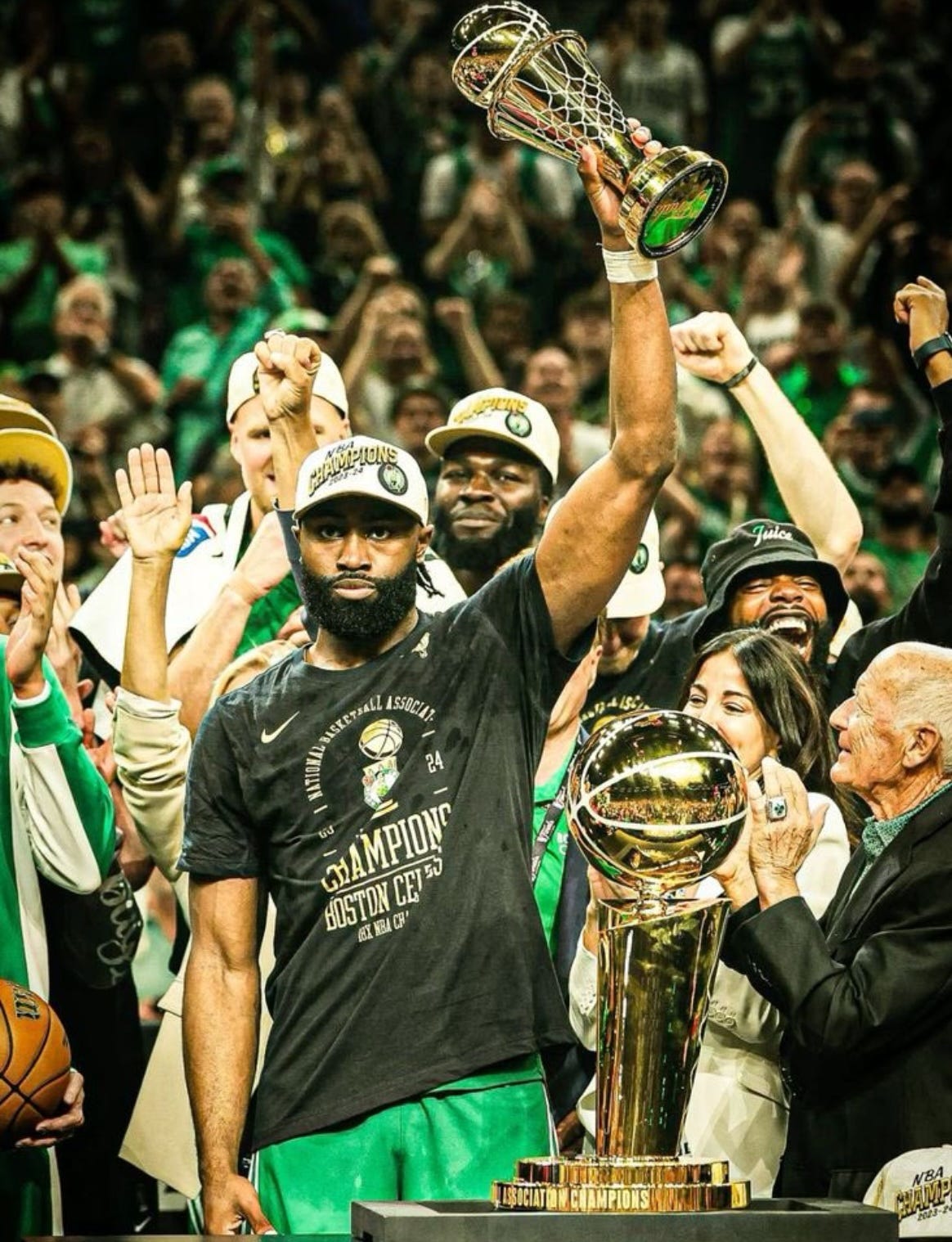
2024 Finals MVP Jaylen Brown at the top of the mountain.
Over the years, I’ve written articles titled “The Boston Celtics Should ABSOLUTELY NOT Trade Jaylen Brown… Yet” and “The Boston Celtics Have No Interest In Trading Jaylen Brown… Yet.” Today is different from those days. As anyone not living under a rock has now heard, late last week, news broke that the Boston Celtics were sending Jaylen Brown to the Philadelphia 76ers in exchange for thirty-six-year-old Paul George, a confusing but valuable 2028 First Round pick/swap, a 2031 unprotected First Round pick, and two Second Round picks.
As someone who’s a diehard Boston Celtics fan, Jaylen Brown fan, Brad Stevens fan, NBA fan, and a backer/believer in the positive impact of advanced analytics on the game, there are almost too many angles from which to approach this news. My brain is struggling to slow down enough to formulate an objective, binary opinion on the deal, let alone come to grips with the emotions of watching a homegrown, third-overall pick, ten-year veteran, Finals MVP get moved to a rival city. It sucks. That’s about as nuanced as I can get on the emotional front.
Boston Had To Do This — Even If They Didn’t Want To
On the basketball team-building front, it’s not hard to see why a trade was imminent. This is not to say that Jaylen Brown isn’t an amazing NBA talent — he’s a proven champion, (aforementioned) Finals MVP, multiple-time All-NBA selection, 5x All-Star, and a true mid-range assassin. However, as Brad Stevens noted in his and owner Bill Chisholm’s press conference—when Boston won its 2024 NBA Title —Brown and Tatum accounted for 47% of Boston’s salary cap; this upcoming year, they would’ve accounted for 70%. The only time an NBA championship-winning team had ever allocated over 70% of its salary cap on two players was the 2022 Golden State Warriors (Steph Curry & Klay Thompson), who existed in a non-Apron Collective Bargaining Agreement (CBA) and thus weren’t effectively hard-capped by the centralized cap allocation.
Social media pundits and fans don’t want to hear this crap. The beauty of sports isn’t in its complexity to the common viewer, but in the ability of simplicity to transcend. People didn’t hate the Warriors dynasty because they formed an unfair accumulation of talent. They hated the Warriors because nobody who hasn’t put hours upon hours into the game and developed an inferiority complex towards superior athletes (I swear I’m not projecting…((and even many who have)) is wowed by watching ten off-ball screens, a point forward who can’t score, and six passes that could’ve been three result in a wide-open three-point attempt. Most people find this style of play dizzying and boring.
Fans didn’t hate the ’90s Bulls or the Heatles the way they hated the Warriors, even though they were comparatively as dominant. It’s always been a style-of-play thing. Jaylen Brown was the ultimate embodiment of this — I can and will present a slew of advanced metrics that point to Brown being monetarily overvalued relative to the opportunity cost created by the second apron. It’s not cherry-picking but a consistent, large-sample-sized slew of data pointing to his play often being less deterministic towards winning than meets the eye. But what these metrics fail to quantify is character, rising to the occasion, accepting his role, and doing everything asked of him and more en route to helping Boston realize its ultimate goal of raising Banner 18 in 2024.
Jaylen Brown hit the most important shot in the conference finals sweep of the Indiana Pacers in game one. He accepted, embraced, and dominated the challenge of pestering Luka Doncic in the 2024 NBA Finals. Brown got better every single year. He embraced Boston's roots and became a true Bostonian. Even after earning a quarter-billion dollars, he never distanced himself from the local neighborhoods with which he had formed such a strong bond that many of them would go to war for him.
This is why the decision to trade Brown could not have been an easy one for Brad Stevens, even if it was the obvious one. Jaylen Brown was and always will be a people’s champ of the city of Boston. And while people don’t want to hear it, the sad truth is that, due to the current CBA and its implied salary-cap constraints, the Boston Celtics arrived at the obvious conclusion that, if they are to build a team that can compete for future championships, they must choose between Jaylen Brown and Jayson Tatum.
*Added context for readers — many fans believe that given the number of quality players Boston has elected to move on from since winning the 2024 NBA Finals, Boston’s new ownership, primarily backed by Sixth Street Private Equity Group, is simply being cheap. This is overwhelmingly unlikely to be the motivating factor in the team’s decision to move on from Brown. I do not work for team ownership, nor am I an overwhelming fan of Private Equity’s emerging role in sports ownership — I’ve watched Private Equity actually* ruin two of my favorite sports teams (Red Sox & Chelsea Football Club). No, this is the CBA’s Apron system pulling into full effect. Under the current CBA, here are some penalties that teams in the Second Apron face.
- Penalty #1 — No Mid-Level Exception
- Penalty #2 — No Buyout Market
- Penalty #3 — Can’t Aggregate Salaries In Trades
- Penalty #4 — Can’t Take Back More Salary Than You Send Out In Trades
- Penalty #5 — No Cash Can Be Included in Trades
- Penalty #6 — Frozen First-Round Pick For Repeater Teams
- Penalty #7 — Can’t Sign-and-Trade for Players
- Penalty #8 — Trade Exceptions Become Effectively Unusable
- Penalty #9 — Matching Player Salaries Becomes Nearly Impossible
These are just a few of the reasons why the second apron is essentially viewed as a Hard Cap across the league.
When looking at the past decade of NBA Champions, aside from the Warriors, who are the primary reason the current CBA exists, one thing is clear — NBA Champions often have the luxury of chronically underpaying their best players.

Shared by Brian Windhorst on X.com
The only two teams to eclipse the 60% spending mark on their top two highest paid players were the 2018 & 2022 Warriors. When you remove these two champions (a more realistic look at cap allocation for future NBA Champions), the average spend on the NBA Champion's two highest-paid players over this span was 53.75%. This is the benchmark that NBA Front Offices will look to over the next decade.
To add to this, the skill gap between the middle and upper echelons of talent in the league has narrowed slightly; contract values for these groups have widened greatly; salary cap increases have slowed year over year, while penalties for surpassing it have vastly hardened. All of this is to say that, barring the ultra-elites (the top 5 players in the league), the CBA has resulted in the value of a VERY good player earning ~25–35 million dollars annually being far greater than that of a GREAT player earning ~60+ million dollars annually. One Supermax player is a necessity to win a Championship, while the second becomes a luxury good with diminishing returns, as the Apron system has created an environment that severely undermines a team’s ability to add necessary depth under those conditions.
To sum it all up, the Celtics' balance sheet was way out of whack compared to that of teams that consistently make realistic efforts to win titles.

Created on OpenAI
A few things are clear from this graph:
- The Celtics had by far the steepest curve among all contenders and became a “Stars + Value Contracts” team. That shape was very different from the 2024 championship roster. Instead of paying five veterans between $28M–$35M, they were paying two supermax players and everyone else.
- The Knicks were clearly in “win-now” mode and will likely face similar cap constraints in the coming years, as the Celtics are. They have the most conventional “championship” salary distribution, essentially paying four stars, KAT, Brunson, OG, and Bridges between 28–54 Million Dollars AAV.
- The Spurs and Thunder have the healthiest salary distributions, as reflected in the smoothness of their curves, with a gradual decline from roughly $38M to $28M, then into the high teens and single digits.
It’s not so much that there’s only one way, financially, to build an NBA champion, but rather that there are objective factors that can greatly hinder a team's chances. Concentrating money so steeply towards the top while lacking a true monopoly in talent is one of these ways. Sure, if the Celtics had prime Steph Curry and Nikola Jokic on Super Max contracts, it’s likely they’d be able to fill the gaps with youth and veteran minimum-salary contracts and still compete, but that’s fairy-tale land, and, naturally, there are exceptions to every rule.
Let's go down the list of the last five NBA Finals MVPs —the 2026 Finals MVP, Jalen Brunson, earned $34,944,001. The 2025 Finals MVP, Shai Gilgeous-Alexander, earned $35,859,950. The 2024 Finals MVP, Jaylen Brown, earned $31,830,357. The 2023 Finals MVP, Nikola Jokić, earned $33,616,770. The 2022 Finals MVP, Stephen Curry, earned $45,780,966.
The trend that emerges is that each of these championship teams had its best player earning well below today’s $55–60 million superstar salaries, leaving more room under the cap (or below punitive apron thresholds) to build a deep supporting roster. Curry’s 2021–22 salary was the highest of the four, while Jokić, Brown, and Gilgeous-Alexander all won titles before their largest contract escalations took effect.
This upcoming season, Jaylen Brown is scheduled to earn $57,736,350, which is 35% of his team’s salary cap space.
Why Much of The NBA Viewed Jaylen Brown As Highly Monetarily Overvalued & A Net Liability
First off, I want to preface everything that follows with a focus on the word MONETARY, since the beginning of this article prominently highlighted what can’t be quantified in an objective dollar value. Character, effort, leadership, and energy are all positive traits Jaylen Brown has consistently demonstrated throughout his illustrious career. However, the monetary value of these traits is neither objective, universally agreed upon, nor currently statistically capturable.
Disclaimer: Miss me with all of the off-the-court bullshit the aggregators and media engagement farmers who are paid to fill up airtime and generate clicks are spewing — Jaylen Brown spoke his mind, was at times divisive, as humans are, but never came close to being anything resembling an off-the-court issue, nor a locker room cancer. If he and management disagreed on the best way to win, it’s that simple, and I prefer to keep it that way, but I will not spend one second of this article speculating on that.
What is capturable is the slew of statistics showing Jaylen Brown is paid in a tier of players in which he likely sits, either directly or far below, depending on who across the league you ask.
In essence, the data shows that Jaylen Brown is a great scorer, but he’s not an offensive engine. A brilliant X post by “databallr” (give them a follow!) breaks this down beautifully. (This is long but crucial to understanding how front offices view Brown’s offensive value.)
“An offensive engine creates impact in 3 distinct ways:
Score efficiently on big volume
Reduce team turnovers while carrying huge usage
Create better shots for teammates
This is what people mean by offensive impact.
Not just: did you score points?
Not just: did you get assists?
Did the team score points more efficiently because you were on the floor?
Jaylen is interesting because he had a good scoring season. I estimate his scoring impact last year around +2, the best mark of his career. But if we are asking whether he is an elite offensive engine, the bar is much higher.
Let’s start with scoring efficiency. Jaylen took around 36 shots per 100 possessions at 57.5 TS% last season. (“shots” include free-throw possessions. At that volume, TS% (True Shooting Percentage) has enormous leverage. Every 1% of TS% is worth roughly +0.6 points per 100 possessions on the scoreboard. So the gap between 57.25 TS% and 62 TS% is not cosmetic. It matters. That is roughly +2.5 points of offensive impact.
Scoring at 62 TS% would move him from a top 50 per-possession analytics season to a top 20 one last year. But right now, among high-usage offensive stars, the efficiency gap is clear.
Shai: 67.0%, Giannis: 65%, Curry: 64.8%, Kawhi: 63.3%, Luka: 61.8%, Mitchell: 61.7%, Brunson: 59%
Jaylen: 57.9 TS%
Jaylen’s scoring still has value because the volume is massive, but he’s not generating the impact that some of these other guys do from scoring.
The second path is turnover value.
This part is underrated. If you are using a huge number of your team's possessions, how often you turn the ball over before you shoot matters on the scoreboard. Historically, a lot of high-volume creators give their teams a significant advantage in the turnover game. Jordan, Kobe, Iverson, Lou Will, T-Mac, Melo, Shai, Kawhi, Brunson types. All of these guys have generated significant impact from reducing team turnovers, and it’s clear as day in the impact analytics.
They shoot a ton, and they also help the team avoid turnovers because the possessions end in a shot instead of a mistake more often than the league does.
Jaylen does not provide that kind of impact.
His box-score profile estimates his offensive turnover impact around neutral, historically, and last year. The 5-year lineup data and eyes agree.
That does not mean he is killing the offense with turnovers. It means he is not creating the turnover advantage that many true engines create. Let’s look at a stat called “Scoring Turnover Rate.” It is defined as non-passing turnovers divided by scoring attempts. It’s typically the ball handler's fault when he turns it over on something that isn’t a pass. Here are some high-usage scorers around the league in Scoring Turnover Rate (Lower is better).
Jaylen Brown: 10.3%, Giannis: 10.5%, Paolo: 9%, Ant: 6.6%, Shai: 4.4%, Kawhi: 5.5%, Brunson: 4.1%, Mitchell: 5.3%, Tatum: 6.5%
Lower is better, and when the scoring volume is massive this accumulates to a meaningful amount of turnover differences between players which translates to offensive impact. You see Brunson scored at 59% TS, a down year for him, but he turned the ball over on handling-related mistakes, per scoring attempt, at 4.1% vs. Jaylen's 10.3%. If you are on-ball enough to shoot over a third of your team’s shots, ball security gets magnified. The skill of getting to your shot without losing possession is a big part of offensive value. Top players can generate +2.5 points of offensive impact from reducing team turnovers.
Imagine if you could just imbue Jaylen Brown with Kawhi’s handle. How much better would you feel about him having the ball in his hands, even if he was shooting the same shots at the same efficiency? Instinctively, you know it matters; analytically, it undeniably does. Having Kawhi’s turnover economy alone would move him from a top-50 analytics player to a top-20 one last year. (Passing turnovers matter too, and he’s average there, but it’s less meaningful because he’s not passing the ball that much)
The third is playmaking.
Jaylen took 36 shots per 100 possessions and generated only 13 potential assists per 100 (shots, if they were made, that would be an assist for JB). He shoots almost 3x as much as he directly creates a potential assist. He’s much more of a scorer than he is a passer. Shai is at 34 shots to 18 potential assists, which is lower than a 2:1 ratio. So you see, even the best scorer in the league has a more balanced distribution of shots and potential assists.
Jaylen averages only around 2 rim assists per 100, which is low compared to the best playmakers, so he’s not creating obvious value via lobs and easy layups. A scoring-heavy profile can be great if the scoring and turnover efficiency are overwhelming, like it is for Kawhi or Shai, but neither is for Jaylen. That’s the problem. Just one of the two being elite, or both being good, can be enough to get him to engine status. But he has neither. Perhaps he can still improve. But if the scoring efficiency is low for the top stars, and the turnover value is around neutral, and the playmaking is limited, the elite-engine case falls apart. It just does.
You have other players like Cade and LaMelo who have similar scoring efficiency profiles to Jaylen, but those players are elite playmakers according to both analytics and the public. Not only are they passing the ball a lot more, but they are generating a ton of assists to players at the rim, which are markers of elite playmaking.
The point is not that Jaylen Brown is bad. He is a positive player who plays a lot of minutes. The point is that his team impact has been very weak for a supermax offensive centerpiece because he has not proven himself to be a real offensive engine. The question is whether he can become one in Philly…”
This all but perfectly sums up the analytical breakdown on how Jaylen is viewed by the “nerds” and “suits” who are responsible for roster decision-making around the league. Jaylen Brown is an amazing player — this ought to be universally agreed upon — but he’s simply not a player who can reduce a team's cap space from 65% to 30% and simultaneously increase their chances of winning a title by that same margin. At least, this is how Brad Stevens, an overwhelming majority of NBA front offices, and I view it.
Why The Return On Jaylen Brown Was So Much Lower Than Popularly Expected
Despite the above breakdown of Jaylen Brown's comparatively lackluster analytics compared to those of the players he shares a pay bracket with, Brad Stevens stated that they were only a “small piece of information” and a “small factor” in the decision to move on from Brown. As unpopular an opinion as this might be, I think he’s actually telling the truth here. The word ominously and continuously thrown around during the presser, “optionality,” really was the primary motivator of this move.
As crazy as it is to say, Jaylen Brown, through all of his triumphs, accomplishments, and linear improvements, saw his Celtics career end in the form of a salary dump.
This raises the obvious question—why couldn’t Boston yield more than it did in a trade for such a high-quality player? I’m not on the phones, so I can only speculate, but here is my best attempt;
- It’s not just his high salary—but the fact that he’s at an age where he’s still eligible and expects another Super Max extension. Teams trading for Jaylen Brown aren’t signing up for three years of $184.9M but more likely five years of ~$327M. Needless to say, this is a HUGE investment in a player who’s already logged over 27,000 minutes, is fairly dependent on his athleticism to score, and will be 35 years old in the last year of this deal, earning north of $70M.
- The number of dual-match opportunities was probably slimmer than the public realized. Sure, there were probably a decent number of teams willing to commit to Brown, and vice versa, but how many of them overlapped? It was no secret that Jaylen Brown had been involved in the Giannis trade rumors, and Stevens noted that he had been transparent with Brown throughout this process. Naturally, we can deduce that if he knew he was being shopped, teams were more likely than not to reach out to him to gauge whether or not he would be interested in playing for them long-term, and, as widely reported, it’s likely that Brown told a number of teams that he was not interested in resigning with them, ultimately taking them out of the process entirely. Given that Philadelphia was able to land Brown for less capital than the likes of Mikel Bridges, Rudy Gobert, and even Walker Kessler (The Lakers are as dumb as they are lucky), the indication is that there probably weren’t many true matches.
- The “under duress” reports from ESPN indicate at least one of two things — either Brown had reached the point where he decided to quietly request a trade, or Boston understood the lack of leverage they had in this process was shrinking, in addition to the fact that whatever return they would yield in this deal would merely be assets used in future deals, thus creating a scenario where time was of the essence.
Personally, I believe it’s more likely than not that both of these were true—yes, it was widely reported during and after the trade that Brown had never formally requested a trade away from Boston, but frankly, I flat-out don’t believe this. For one, I have it on good authority from an insider I trust that, after the Giannis trade didn’t go through, both sides agreed it was time to split. Second, it’s in neither side's best interest for this trade “demand” to be leaked, as it could’ve lowered the value of incoming offers to the point where Boston would’ve elected to keep Brown this year and bet on Jaylen Brown staying mum rather than becoming body-suit James Harden. In addition to this, there’s no reason for that to come out as public knowledge after the fact because Brown owns the rights to most of his own branding, and much of his business is generated in the Boston market, so from his point of view, why risk losing business when he can point the finger at Boston’s management, and from Boston’s managements point of view, why risk rubbing dirt in the wound to an already disgruntled fanbase when Brown had the ultimate plausible deniablity of Boston shopping him before he ever requested anything?
Boston needed this move to happen now to keep this from blowing up worse than it was always going to — and it’s highly likely that the package they yielded from Brown was the absolute lowest they were willing to go before opting for the nuclear button of keeping him and hoping for no toxicity leaking in before a better offer emerged.
A Warning To The Rest Of The League's Fans
All in all, this is a sad day for Boston fans, myself very much included, even if the data pointed to this move being as obvious as it was imminent. The Boogie Man, that is the CBA, has come for the Boston Celtics first in the form of breaking up the best drafted duo of the century. The Celtics have been firmly punished for drafting their stars and adding elite talent around them, culminating in the realization of their ultimate goal — raising another championship banner at TD Garden. This article shouldn’t serve as a “told you so” or a “justification” piece, but if nothing else, as a warning to other NBA fans — the Boston Celtics are the first team to feel the wrath of the current Collective Bargaining Agreement — they will not be the last.
메타데이터
- post_id
- 15d8a2195c76
- slug
- why-the-jaylen-brown-trade-wasnt-about-jaylen-brown-how-the-second-apron-came-for-the-boston-15d8a2195c76
- url
- https://medium.com/sportsraid/why-the-jaylen-brown-trade-wasnt-about-jaylen-brown-how-the-second-apron-came-for-the-boston-15d8a2195c76
- canonical_url
- https://medium.com/sportsraid/why-the-jaylen-brown-trade-wasnt-about-jaylen-brown-how-the-second-apron-came-for-the-boston-15d8a2195c76
- author_url
- https://medium.com/@nickatwood31
- status
- ok
- fetched_at
- 2026-07-17 21:26:36