Mythological Story of Bharani Nakshatra.
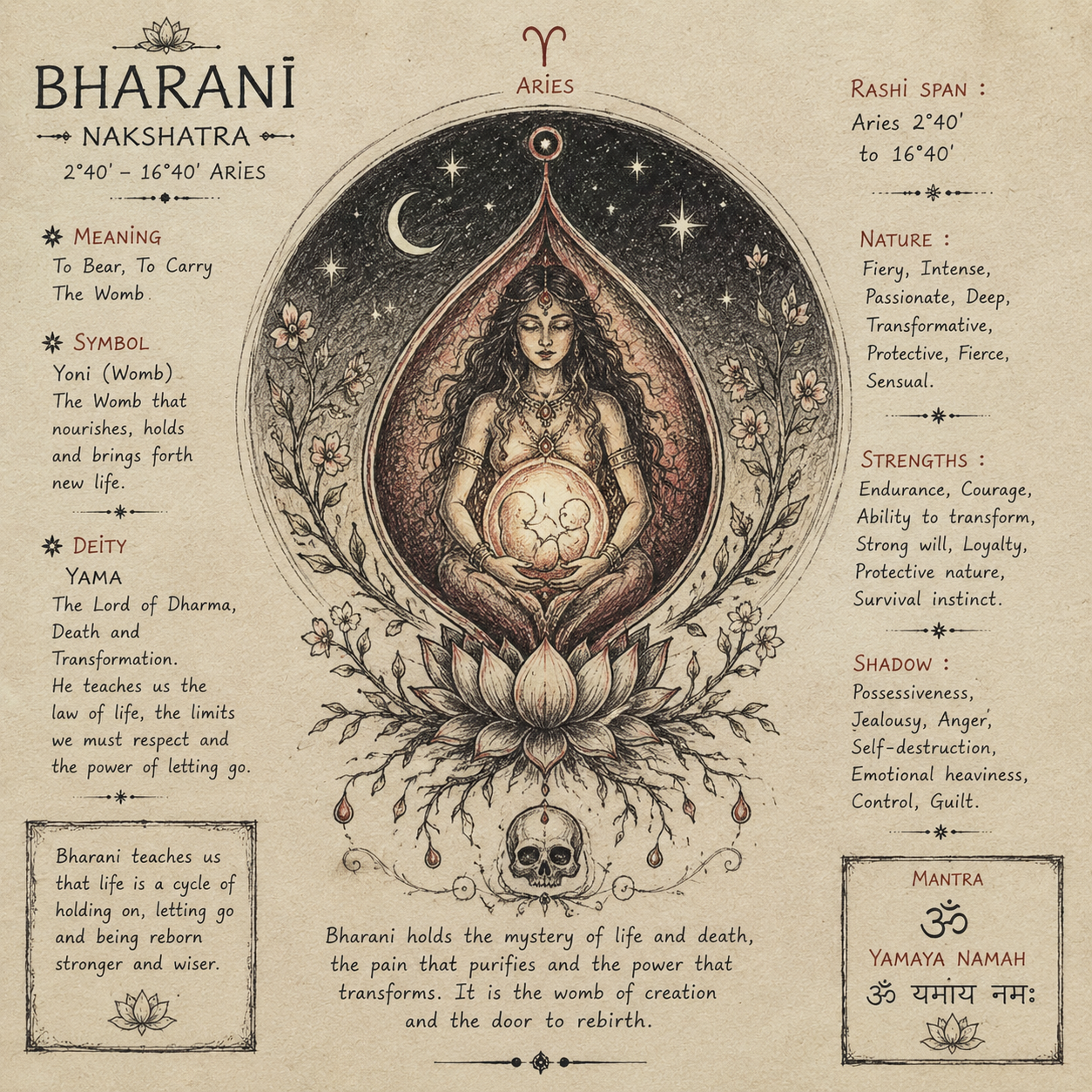
Bharani Nakshatra (13°20′ — 26°40′ Aries), ruled by Venus (Shukra) and presided over by Yama, the God of Death and Dharma, is one of the…
Mythological Story of Bharani Nakshatra.
Bharani Nakshatra (13°20′ — 26°40′ Aries), ruled by Venus (Shukra) and presided over by Yama, the God of Death and Dharma, is one of the most profound and paradoxical stars of Vedic astrology. Its symbol is the Yoni (womb), representing creation and fertility, but its deity, Yama, represents death and restraint.
The mythology around Bharani is multi-layered, spanning Vedic hymns, Purāṇic stories, and folk traditions. Together, these narratives reveal the deeper spiritual lessons of this star.
Yama: The Lord of Dharma and Death.
In the Vedas, Bharani is directly associated with Yama, who presides over death and ensures the soul’s journey according to karma. Yama is not a figure of cruelty but of justice. His duty is to maintain balance in creation by ensuring that every soul departs at the right time.
The Taittirīya Brāhmaṇa describes Yama’s coronation “under Bharani,” establishing his rulership over this nakshatra. Bharani’s shakti, called Apabharaṇa Shakti (“the power to carry away”), reflects this function — it symbolizes the removal of life and the conveyance of the soul to the ancestral realm (Pitṛloka).
Thus, Bharani reminds us that death is not an end but a passage in the eternal cycle of existence.
This duality makes Bharani the nakshatra of life and death, desire and discipline, endings and transformations. To understand its energy, we must turn to mythology — for Yama’s many stories hold the keys to Bharani’s karmic lessons.
1. Yama and Yami: Desire vs. Dharma.
In the Rig Veda (10.10.1), a dialogue unfolds between Yama and his twin sister Yamī, both born from the Sun God and Sanjana. Yamī urges Yama to unite with her, arguing that since they shared the same womb, such a union would not be unnatural. Yama, however, firmly rejects her advances, declaring that such relationships are unfit for mortals and against the law of Dharma.
This story reflects Bharani’s central theme: the pull of desire versus the higher call of discipline and morality. Yama demonstrates extraordinary restraint, setting the precedent that desire must be governed by ethics. Even today, this principle is seen in Hindu practices like prohibiting marriage within the same gotra or bloodline.
2. Yami’s Grief and the Creation of Night.
Another tale describes Yamī’s heartbreak when Yama became the first mortal to die. Her endless tears overwhelmed the gods. To console her, they created night, dividing time into days and nights, so that grief could be softened by the hope of a new dawn. Yamī later transformed into the sacred river Yamuna, a reminder of eternal flow and renewal.
Here, Bharani expresses the truth that suffering and endings are part of the cosmic order, yet time itself brings healing and continuity.
3. Yama as the Lord of Souls.
The Rig Veda calls Yama the first mortal to discover the path to heaven. Because of this, he became the guardian of souls and the judge of karma. Assisted by Chitragupta, his scribe, Yama records every soul’s deeds and decides its journey:
- To Pitṛloka (ancestral realm) for the righteous.
- To Naraka (hell) for purification of sins.
- Or back to Earth for karmic lessons.
This aligns with Bharani’s Apabharaṇa Shakti — the power to remove or carry away, symbolizing the departure of the soul from one realm to another.
4. Yama and the Crow.
During Ravana’s conquests, Yama disguised himself as a crow to escape notice. Grateful for its role in protecting him, Yama blessed the crow, declaring that humans would never go hungry as long as crows existed. Since then, crows are seen as messengers of ancestors (Pitṛs), and offerings to them during rituals are believed to reach departed souls.
In Bharani, this symbolism shows that ancestral connection, karmic debts, and responsibility to lineage are central themes.
5. Yama and Savitri: Devotion beyond Death.
The famous story of Savitri and Satyavan highlights Yama’s role as the uncompromising lord of death. When Savitri followed Yama as he took her husband’s soul away, her persistence and devotion moved him. She cleverly won several boons from Yama, finally forcing him to return her husband’s life.
This story reveals Bharani’s transformational power — the ability to bear hardship, persist, and turn suffering into renewal.
6. Yama and Markandeya: Defeated by Devotion.
Sage Markandeya, destined to die young, worshipped Lord Shiva with deep devotion. When Yama came to claim his life, Markandeya clung to a Shiva Linga. Shiva appeared, struck down Yama, and declared that his devotee would live forever. Yama was later revived, but only after being reminded of his limits before Shiva.
This story reflects Bharani’s truth: death is powerful but not final — devotion, transformation, and divine grace can transcend it.
7. Yama and Nachiketa: The Secret of the Soul.
The Katha Upanishad recounts the story of young Nachiketa, who visited Yama after being angrily “gifted” to him by his father. Waiting at Yama’s doorstep for three days and nights without food or water, Nachiketa won Yama’s respect and received three boons. For his final boon, he asked Yama to reveal the mystery of what lies beyond death.
Yama taught him that:
- The Self (Ātman) is eternal, unborn, and undying.
- The body is a chariot; the soul is its master.
- True liberation comes from realizing the Self, beyond death.
This story makes Bharani a nakshatra deeply connected with spiritual wisdom, karma, and the immortal soul.
8. Yama and Karma: The Bird and the Python.
In another tale, Garuda tried to save a small bird from Yama’s glance of death by carrying it far away. However, the bird died exactly as destined, swallowed by a python miles away. Yama explained that karma always fulfills itself, and no one can escape their fate.
This emphasizes Bharani’s role as the nakshatra of karmic law — what is sown must be reaped.
9. Other Stories of Yama.
- Father of Yudhishthira: As Dharma, Yama fathered Yudhishthira, the Pandava known for truth and righteousness.
- The Ajamila Story: Ajamila escaped Yama’s messengers by chanting the name “Narayana” at death, showing that divine grace can override karma.
Lessons of Bharani Nakshatra
From all these stories, Bharani reveals itself as a star of immense responsibility, transformation, and karmic depth. Its key characteristics include:
- Transformation through struggle: Bearing pain and turning it into a blessing.
- Persistence and discipline: Upholding principles even in temptation.
- Responsibility to karmic law: Respecting ancestry, dharma, and truth.
- Rebirth and rejuvenation: Power to restart stalled efforts, just as Shukra revives life.
- Intensity and endurance: Like the crow, Bharani natives are hardworking and never give up.
- Spiritual depth: Awareness of life, death, and the immortal soul.
Yet, Bharani natives may also feel neglected (like “step-motherly treatment”) and may ignore others’ emotions in pursuit of their goals.
Bharani Nakshatra, governed by Yama and Venus, stands at the crossroads of creation and dissolution. Its myths teach us that death and life, desire and restraint, karma and grace, suffering and renewal are all intertwined.
Those influenced by Bharani are born to transform pain into power, face karmic challenges with courage, and walk the razor’s edge of discipline and desire. Just as Yama himself balances justice and compassion, Bharani souls are meant to uphold dharma while embracing life’s deepest transformations.
Karuna Astrology
메타데이터
- post_id
- 15e32fcec8df
- slug
- mythological-story-of-bharani-nakshatra-15e32fcec8df
- url
- https://medium.com/astrology-unveiled/mythological-story-of-bharani-nakshatra-15e32fcec8df
- canonical_url
- https://medium.com/astrology-unveiled/mythological-story-of-bharani-nakshatra-15e32fcec8df
- author_url
- https://medium.com/@KarunaAstrology
- status
- ok
- fetched_at
- 2026-06-29 01:02:39