Designing Real-World LLM Applications with LangChain
Introduction to LangChain
Designing Real-World LLM Applications with LangChain
Introduction to LangChain
In today’s fast-growing AI ecosystem, Large Language Models (LLMs) like GPT have unlocked powerful capabilities. However, building real-world applications involves more than simply calling an API — it requires structured workflows, modular design, and seamless integration.
This is where LangChain becomes essential.
LangChain is a framework that helps developers build applications powered by LLMs by connecting prompts, models, tools, and memory into a cohesive pipeline. It transforms isolated API calls into scalable and maintainable systems.
Why LangChain Matters
LangChain addresses key challenges developers face when working with LLMs:
- Provides structure to LLM-based applications
- Enables chaining of multiple components
- Integrates external tools like APIs and databases
- Maintains conversation context using memory
Problems It Solves
- Managing complex prompt workflows
- Handling dynamic user inputs
- Integrating external data sources
- Maintaining conversational context
- Scaling Generative AI applications
Core Components of LangChain
1. LLMs and Chat Models
LLMs act as the core engines for generating responses.
from langchain_openai import OpenAI

llm = OpenAI(api_key="your_api_key")
response = llm.invoke("What is LangChain?")
print(response)
2. Prompt Templates
PromptTemplates allow dynamic and reusable prompt generation.
from langchain_core.prompts import PromptTemplate

template = PromptTemplate(
    input_variables=["topic"],
    template="Explain {topic} in simple terms"
)

print(template.format(topic="LangChain"))
3. Chains
Chains combine multiple steps into a single workflow.
from langchain.chains import LLMChain
from langchain_openai import OpenAI

llm = OpenAI(api_key="your_api_key")
chain = LLMChain(llm=llm, prompt=template)

print(chain.run("Artificial Intelligence"))
4. Memory
Memory helps retain context across interactions.
from langchain.memory import ConversationBufferMemory

memory = ConversationBufferMemory()
memory.save_context({"input": "Hi"}, {"output": "Hello"})

print(memory.load_memory_variables({}))
5. Agents
Agents dynamically decide which tool to use.
from langchain.agents import initialize_agent, Tool
from langchain_openai import OpenAI

llm = OpenAI(api_key="your_api_key")

tools = [
    Tool(name="Calculator", func=lambda x: eval(x), description="Math tool")
]

agent = initialize_agent(tools, llm)
print(agent.run("2 + 2"))
6. Tools
Tools extend LLM capabilities by connecting external functionalities like APIs, calculators, and search engines.
7. Document Loaders
Used to load external data into the system.
from langchain.document_loaders import TextLoader

loader = TextLoader("data.txt")
documents = loader.load()
8. Vector Stores
Enable semantic search using embeddings (e.g., FAISS, Chroma).
LangChain Architecture
A typical workflow looks like this:
User → Prompt → LLM → Chain → Agent → Output
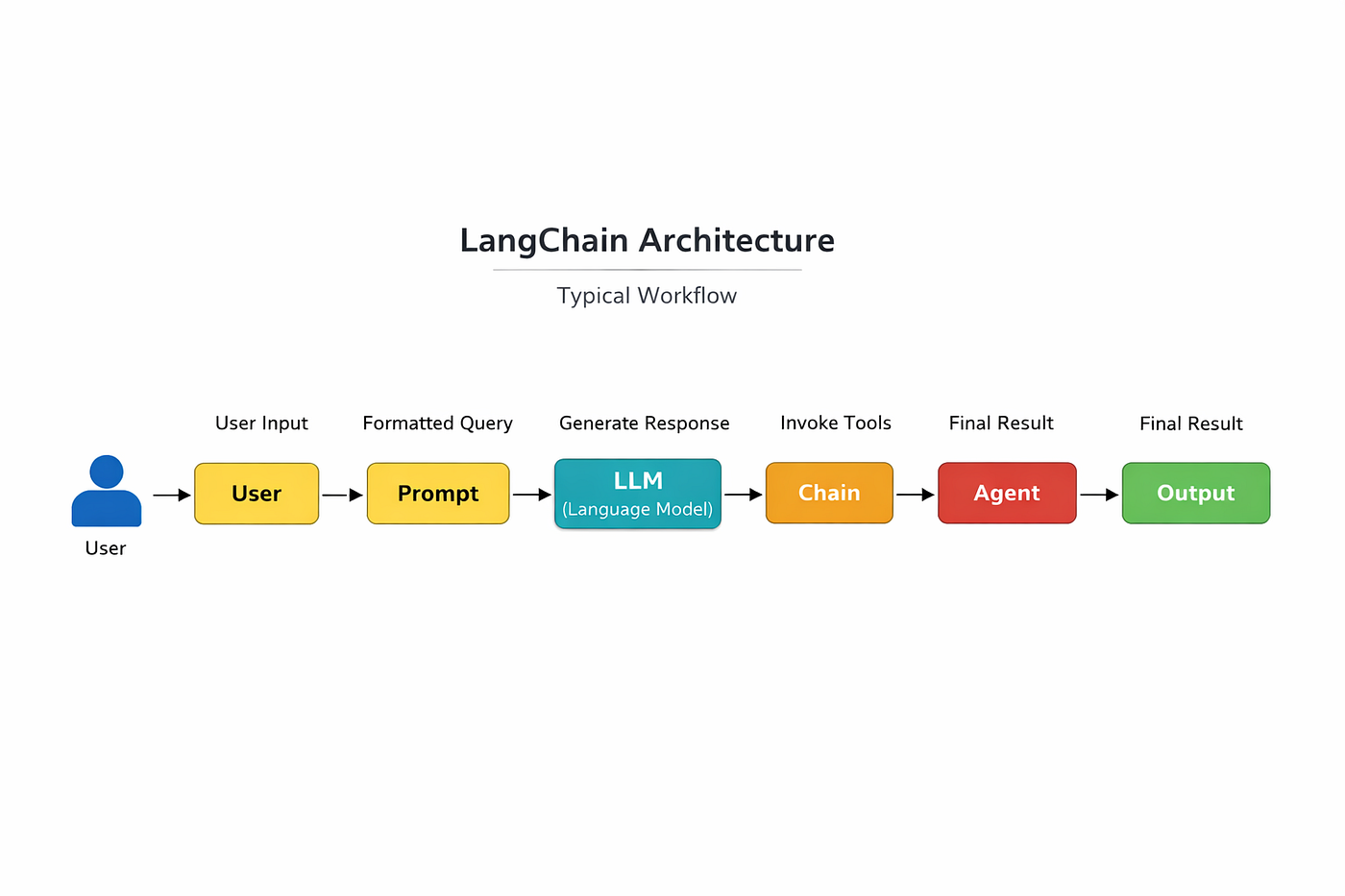
1. User Input
This is where everything starts. The user provides a query, question, or instruction.
👉 Example: “Explain Neural Networks in simple terms”
2. Prompt
The raw input is converted into a structured prompt using a template.
- Adds clarity and instructions
- Makes input understandable for the model
👉 Example: “Explain Neural Networks in simple terms for beginners”
3. LLM (Language Model)
The structured prompt is sent to the LLM (like GPT).
- Generates a response based on training data
- Understands context and intent
4. Chain
This is the logic layer that connects multiple steps.
- Can include multiple prompts or operations
- Controls the flow of execution
👉 Example:
- First simplify topic
- Then generate examples
5. Tool / Agent
This is where LangChain becomes powerful 🔥
- Tools: External functions (calculator, APIs, database)
- Agents: Decide which tool to use dynamically
👉 Example:
- If math → use calculator
- If data needed → call API
6. Output
Final result is returned to the user.
- Clean
- Context-aware
- Possibly enhanced using tools
Hands-on Flow Examples
- LLM Call → Sends a prompt directly to the language model to generate a response.
llm.invoke("Explain Machine Learning")2. Prompt Template → Formats user input into a structured prompt using predefined variables.
template.format(topic="AI")3. Chain Execution → Runs a sequence of steps where outputs from one step feed into the next.
chain.run("Deep Learning")4. Agent Decision → Allows the system to choose and use the right tool dynamically based on the query.
agent.run("What is 10 * 5?")5. Memory Retrieval → Fetches stored past interactions to maintain context in the conversation.
memory.load_memory_variables({})Real-World Use Cases
1. Resume Screening & Candidate Evaluation System
Problem Statement
Recruiters receive hundreds of resumes and manually screening them is time-consuming and inconsistent.
Solution using LangChain
LangChain can analyze resumes, extract key skills, match them with job descriptions, and generate candidate summaries or rankings automatically.
Components Used
- Prompt Templates (for structured evaluation)
- LLM
- Chains (multi-step evaluation)
- Document Loaders (for resumes)
2. Automated Code Review Assistant
Problem Statement
Manual code reviews take time and developers may miss bugs, inefficiencies, or best practice violations.
Solution using LangChain
LangChain can analyze code, provide suggestions, detect issues, and even recommend optimizations using structured prompts and chained reasoning.
Components Used
- LLM
- Prompt Templates
- Chains (analyze → suggest → improve)
- Memory (to track previous reviews)
3. Personalized Learning Recommendation System
Problem Statement
Students often struggle to find the right learning resources based on their skill level and goals.
Solution using LangChain
LangChain can generate personalized study plans, recommend resources, and adapt responses based on user progress and preferences.
Components Used
- LLM
- Prompt Templates
- Memory (track user progress)
- Chains (analyze level → recommend content)
Advantages and Limitations of LangChain
Strengths
- Modularity → LangChain allows you to build applications using reusable components like prompts, chains, memory, and agents, making systems flexible and easy to maintain.
- Rapid Prototyping → Developers can quickly experiment and build AI applications without starting from scratch, accelerating development time.
- Easy Integrations → Seamlessly connects with external tools such as APIs, databases, vector stores, and third-party services to extend LLM capabilities.
Limitations
- High Latency → Multiple chained steps (prompt → LLM → tools) can slow down response time, especially in complex workflows.
- Debugging Complexity → Since many components interact (chains, agents, memory), identifying issues can be difficult and time-consuming.
- Cost → Frequent LLM API calls, especially in multi-step pipelines, can increase operational costs significantly.
When NOT to Use LangChain
- For simple applications where a direct LLM API call is sufficient
- When low latency is critical (e.g., real-time systems)
- When working under strict budget constraints
- For small-scale tasks that don’t require chaining, memory, or tool usage
Conclusion
LangChain enables developers to move beyond simple prompt-based interactions and build structured, scalable AI applications. By combining prompts, models, memory, and tools into a unified workflow, it simplifies the development of complex LLM-powered systems and makes them more practical for real-world use.
Key Takeaways
- Prompt engineering alone is not enough for real-world applications
- LangChain introduces structure through chains, agents, and memory
- Modular design makes applications reusable and scalable
- Integration with tools and data sources enhances LLM capabilities
- Enables building end-to-end intelligent AI systems
Learnings
- Gained understanding of PromptTemplate and dynamic prompt generation
- Learned how to build multi-step pipelines using chains
- Explored agents and tools for dynamic decision-making
- Understood the importance of memory in maintaining context
- Learned how to design modular and reusable AI workflows
Future Scope
- LangGraph → Enables advanced workflow orchestration with better control over complex pipelines
- Multi-Agent Systems → Multiple AI agents collaborating to solve tasks more efficiently
- Autonomous AI Systems → Self-improving pipelines that can plan, execute, and refine tasks with minimal human input
메타데이터
- post_id
- 15e72c6ceaa0
- slug
- designing-real-world-llm-applications-with-langchain-15e72c6ceaa0
- url
- https://medium.com/@keerthirajg12/designing-real-world-llm-applications-with-langchain-15e72c6ceaa0
- canonical_url
- https://medium.com/@keerthirajg12/designing-real-world-llm-applications-with-langchain-15e72c6ceaa0
- author_url
- https://medium.com/@keerthirajg12
- status
- ok
- fetched_at
- 2026-08-16 21:46:25



