Gender Identity And Social Exchange
How to make inroads on trans rights with skeptical conservatives and feminists
Philosophy of Gender
Gender Identity And Social Exchange
How to make inroads on trans rights with skeptical conservatives and feminists
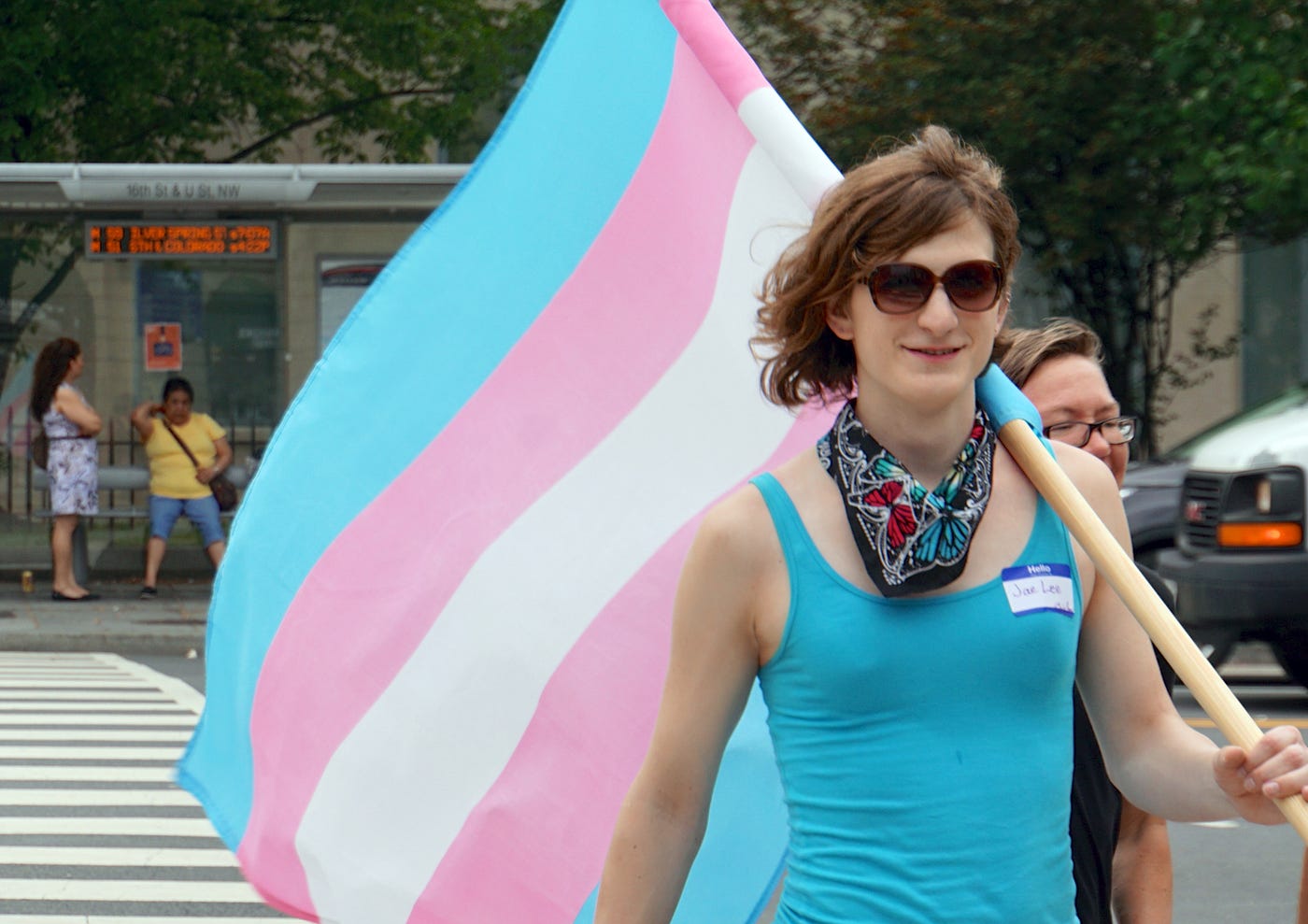
Image credit: tedeytan (wikimedia commons)
Let’s say I place four cards on a table in front of you. The cards show the figures 4, 7, A, and D. I ask you to tell me which cards must we turn over to test the proposition that “if a card has an odd number on one side, then it has a vowel on the other.”
Psychologists know this game well. It’s called the “Wason selection task.” Most people who try the task fail. In fact only about a quarter of individuals figure out that the correct answers are 7 and D. Most people choose 7 and A, or just 7.
But if you change the setup to make the task more about enforcing a social rule or norm, instead of simply reasoning abstractly, the success rate jumps up to about seventy-five percent. So if the cards say BEER, COKE, 16, and 25, and you ask someone which cards you would have to turn over to find out if the person in question was violating the rule that you must be at least 21 to drink alcohol, most people see that you need to turn over BEER and 16.
The evolutionary psychologists Leda Cosmides and John Tooby suggested that this may have something to do with how our minds evolved. Our brains are like Swiss Army knives, replete with various “modules” devoted to processing information of a certain type. And the psychologist Jonathan Haidt has argued that humans have evolved certain moral foundations, among them a sense of fairness.
So perhaps what’s going on with the Wason selection task is that some scenarios implicate certain values — like fairness — and in those scenarios we simply find it much more intuitive to figure out what information is relevant. When enjoying a certain benefit involves paying a certain cost first, our evolved vigilance with respect to social norms kicks in. In more abstract, purely logical cases, it doesn’t.
According to a recent New York Times article, there has been a sharp increase in the number of people identifying as transgender.
The analysis, relying on government health surveys conducted from 2017 to 2020, estimated that 1.4 percent of 13- to 17-year-olds and 1.3 percent of 18- to 24-year-olds were transgender, compared with about 0.5 percent of all adults.
This finding, along with other papers published over the last few years, have added fuel to the conservative argument that “social contagion” is a significant, if not primary, driver of this increase.
Unlike sex, gender is socially constructed, so it is possible that changing social norms could influence one’s subjective experience of gender identity, of what it means to be a man or a woman. But as the Times article points out, the younger generation also seems to have set a lower bar for recognizing a person’s claimed identity.
The notion of what it means to live as a transgender person is also shifting. Dr. Goepferd, who is nonbinary, noted that many teenagers would not necessarily want or need hormones or surgeries to transition to another gender, as was typical of older generations.
But to conservatives and trans-exclusionary radical feminists (TERFs), this development is also alarming. Among conservatives you see this alarm manifest in debates on bathroom access and participation in sports, for example.
There is clearly a suspicion on the Right that many people who claim a gender identity different from their assigned sex are doing so in bad faith. We’ve all heard the (debunked) theory that male sexual predators will take advantage of relaxed rules on bathroom access in order to target female victims in vulnerable spaces.
And the recent raft of legislation barring transgender athletes from competition is obviously rooted at least partly in the belief that some transgender athletes are cynically exploiting society’s tolerance in order to win unearned acclaim.
For their part, TERFs primarily seem concerned about which voices get to inform what feminism means and what its goals should be. Who is entitled to speak for women on matters of women’s rights and gender equality? To this question, TERFs are arguing that to be a woman is to have had certain lived experiences, in particular the experience of being a woman in a patriarchal society. Someone who has spent most of their life as a man would, in their estimation, be at best poorly informed, at worst a wolf in sheep’s clothing.
I trust that by now the relationship between the first two sections of this article is coming into focus. But to make the point explicitly, I think that a major source of both conservative and TERF opposition to the trans rights movement is rooted in their sense that, more and more, people feel entitled to claim a certain identity, as well as any rights or privileges associated with it, without paying any associated cost.
When identity concerns matters of purely subjective taste, like the kind of music one likes, that’s not really anyone else’s business. But when your identity revolves around concepts that have socially constructed meanings — like gender or race — then to claim a particular identity is also to demand social recognition.
For example, when Rachel Dolezal claimed to be Black, despite having been born white, there were some who dismissed her for the same reasons that TERFs dismiss transgender women: because she hadn’t, in some sense, “earned” the right to identify as Black. Others argued that to “earn” that distinction was less a function of how one was born, but how one lives in the world now.
In other words, debates about identity seem to come down to the same logic of social exchange that Cosmides and Tooby identified decades ago. If you have paid the relevant price for a certain identity, you get to claim it. If not, you don’t.
That’s why the current trend among young people, to simply take people at their word when they claim a particular identity, is so alarming to so many people, and not just radical right-wingers. It’s not that these people aren’t willing to accept that a person could be transgender. It’s that they are skeptical of anyone who claims an identity without paying the costs associated with it.
If this is indeed what’s going on, then it may be possible to build a bridge between the trans community and at least some of the conservatives and feminists who are otherwise skeptical of recognizing trans rights.
The sticking point is not whether a person can identify as a gender different from the one they were assigned at birth. I know there are some extremists who would deny that. But most people are more open-mined. For them, the real issue is whether a given individual has “earned” the gender identity they are claiming.
So, for example, proponents of trans rights could pair their calls for Medicaid and private insurance to cover access to sex reassignment surgery and hormone therapy, with the argument that such steps are a prerequisite to authentically claiming trans identity. This would refute the argument by conservatives or TERFs that transgender individuals were claiming their identity in bad faith, while at the same time massively expanding trans people’s access to needed medical care.
Of course, there’s always an interim period when a person knows or is at least confident that their gender identity does not match their sex assigned at birth. From the moment of that realization on, an individual should at least be able to claim a nonbinary identity. Once the individual has taken more concrete steps to actually present and live as their preferred gender, then there is no more reason to deny their transgender identity.
Indeed, offering young people the option of seeing themselves as nonbinary or gender fluid, rather than pressuring them to choose a gender when they may not be physically or psychologically prepared to, is likely to meet with less resistance from conservatives, while also giving children greater freedom to explore the meaning of gender, to themselves and society, free from the political and social anxieties of their parents’ generation.
메타데이터
- post_id
- 1611008b3a2e
- slug
- gender-identity-and-social-exchange-1611008b3a2e
- url
- https://medium.com/original-philosophy/gender-identity-and-social-exchange-1611008b3a2e
- canonical_url
- https://medium.com/original-philosophy/gender-identity-and-social-exchange-1611008b3a2e
- author_url
- https://medium.com/@dustinarand
- status
- ok
- fetched_at
- 2026-07-18 14:12:55