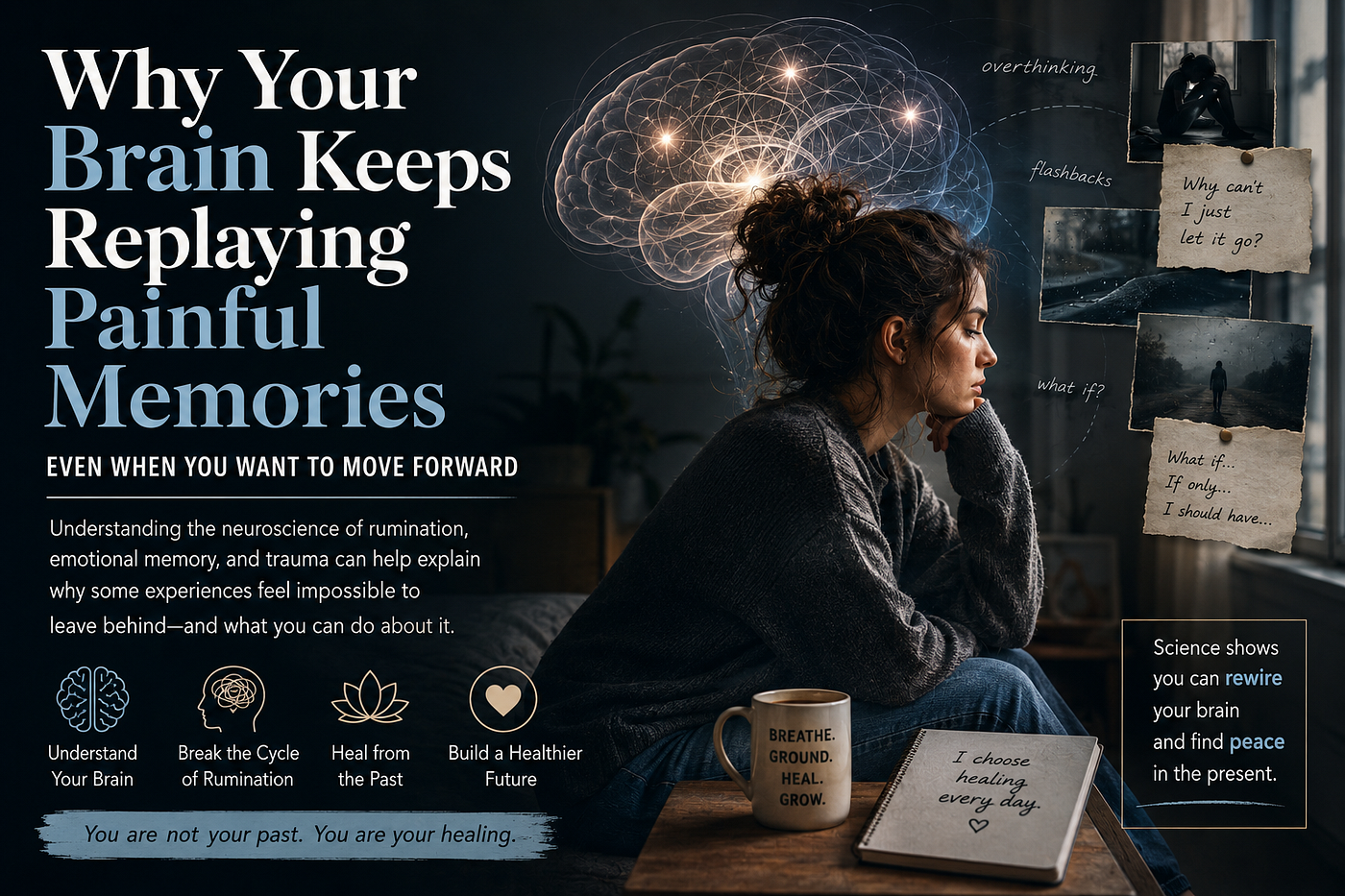
Why Your Brain Keeps Replaying Painful Memories Even When You Want to Move Forward
Understanding the neuroscience of rumination, emotional memory, and trauma can help explain why some experiences feel impossible to leave…
Why Your Brain Keeps Replaying Painful Memories Even When You Want to Move Forward
Understanding the neuroscience of rumination, emotional memory, and trauma can help explain why some experiences feel impossible to leave behind — and what you can do about it.
Introduction: Why Can’t I Just Let It Go?
Almost everyone has experienced it.
You’re driving home from work when a conversation from years ago suddenly resurfaces.
You’re trying to fall asleep when your mind replays an embarrassing mistake you made a decade earlier.
A particular smell, song, or location instantly transports you back to one of the hardest moments of your life.
Despite your best efforts to move forward, your brain seems determined to revisit experiences you’d rather forget.
Many people interpret this as a personal failure.
“Why am I still thinking about this?”
“Everyone else seems to have moved on.”
“Why can’t I just let it go?”
These questions often carry frustration, shame, and self-criticism. Yet they rest on a mistaken assumption — that our brains are designed to discard painful experiences once enough time has passed.
Modern neuroscience tells a very different story.
Your brain was never designed to prioritize happiness above all else.
Its primary responsibility is survival.
From an evolutionary perspective, remembering danger is far more important than remembering comfort. Our ancestors who remembered where predators lurked, which foods caused illness, or which situations led to harm were more likely to survive and pass those survival mechanisms to future generations.
As a result, the human brain developed an extraordinary ability to remember emotionally significant experiences — especially those involving fear, loss, humiliation, betrayal, or danger.
In many ways, this is one of the brain’s greatest strengths.
Without emotional memory, we would repeatedly make the same dangerous mistakes.
However, the same mechanism that protects us can also become one of the greatest sources of emotional suffering.
Sometimes the brain continues sounding an alarm long after the original danger has passed.
Understanding why this happens is one of the first steps toward changing your relationship with painful memories.
Your Brain Is Built to Remember Danger, Not Comfort
Think back to your day yesterday.
You probably experienced dozens — perhaps hundreds — of ordinary moments.
You brushed your teeth.
Checked your phone.
Walked through a doorway.
Made coffee.
Answered emails.
Most of those moments have already faded from memory.
Now think about one of the most emotionally painful experiences of your life.
You may remember the room.
The weather.
The expression on someone’s face.
The sound of their voice.
Even years later, those details may remain remarkably vivid.
Why?
Because emotional events activate brain systems differently than ordinary experiences.
Rather than simply recording information, the brain tags emotionally significant events as important.
This process involves several interconnected regions, including the amygdala, hippocampus, and prefrontal cortex.
The amygdala helps evaluate emotional significance, particularly fear and threat.
The hippocampus organizes experiences into long-term memories.
The prefrontal cortex contributes reasoning, context, and emotional regulation.
When these systems work together under healthy conditions, emotional memories become integrated into our life story.
We remember them, learn from them, and gradually place them in context.
But highly stressful or traumatic experiences can interfere with this process.
Instead of becoming memories that feel finished, they can remain psychologically “unfinished,” making them easier to reactivate months or even years later.
Painful Memories Are Not Signs of Weakness
One of the most damaging myths surrounding emotional recovery is the belief that continuing to remember painful experiences means someone hasn’t healed.
Healing and remembering are not the same thing.
The goal of psychological healing is not memory erasure.
It is reducing the emotional power those memories hold over your present life.
A healed person may still remember exactly what happened.
The difference is that the memory no longer controls their daily decisions, relationships, or sense of identity.
Many people spend years fighting their memories.
Ironically, this struggle often strengthens them.
Psychologists sometimes describe this phenomenon as the “rebound effect.”
When we repeatedly tell ourselves, “Don’t think about it,” the brain often continues monitoring whether we’re succeeding — keeping the unwanted thought active in the process.
Have you ever tried not to think about a pink elephant?
The harder you try, the more likely the image appears.
The same pattern can occur with painful memories.
Healing isn’t about forcing yourself to forget.
It’s about changing how your brain responds when the memory appears.
When Memories Become “Stuck”
Have you ever noticed that some memories seem to drift naturally into the background while others remain remarkably vivid for years — or even decades?
Perhaps you can barely remember what you had for dinner last Tuesday, yet you can recall the exact words someone said during one of the worst days of your life.
This isn’t unusual.
In fact, it’s one of the ways the brain attempts to protect us.
Most everyday experiences are processed, organized, and stored without much difficulty. They become part of our autobiographical memory — a mental timeline of our lives that we can access when needed.
Emotionally intense experiences are different.
When an event involves extreme fear, grief, shame, betrayal, or helplessness, the brain often assigns it a much higher priority.
Rather than filing it away as a completed experience, the brain may continue treating it as unresolved.
From the brain’s perspective, repeatedly reviewing the event isn’t necessarily a mistake.
It’s an attempt to answer an important survival question:
“How do I make sure this never happens again?”
The problem is that some experiences have no satisfying answer.
No amount of replaying can undo a betrayal.
No amount of analysis can change the past.
No amount of worrying can guarantee future safety.
Yet the brain continues searching.
Like a computer stuck running the same program, it repeats the cycle over and over, hoping that one more review will finally produce a different outcome.
Reflection Versus Rumination
Not all thinking about the past is harmful.
Psychologists distinguish between reflection and rumination, and understanding the difference is essential.
Reflection is purposeful.
It helps us learn.
We might ask ourselves:
“What happened?”
“What did I learn?”
“What would I do differently next time?”
Reflection usually moves toward resolution.
Rumination, however, tends to circle endlessly around the same questions without producing meaningful insight.
Instead of asking what can be learned, rumination often sounds like:
“Why did this happen to me?”
“What if I had said something different?”
“Why am I like this?”
“Why can’t I stop thinking about it?”
“What if it happens again?”
Notice something important.
Many ruminative questions have no objective answer.
The brain keeps searching anyway.
Research consistently associates chronic rumination with increased symptoms of anxiety, depression, prolonged stress, and emotional distress.
Rather than solving problems, rumination often magnifies them.
It keeps attention focused on threats that no longer exist in the present moment.
Why Your Brain Prefers Negative Memories
At first glance, this seems unfair.
Why do embarrassing moments replay effortlessly while positive experiences disappear so quickly?
The answer lies in what psychologists call the negativity bias.
Human brains naturally give greater attention to negative information than positive information.
This isn’t because people are pessimistic by nature.
It’s because missing a danger historically carried much greater consequences than overlooking something pleasant.
Imagine two prehistoric humans.
One notices beautiful flowers but ignores a nearby predator.
The other overlooks the flowers but notices the predator.
From an evolutionary standpoint, only one survives.
Over thousands of generations, our brains became exceptionally skilled at identifying potential threats.
Today, those threats often look very different.
An embarrassing presentation.
A painful breakup.
A harsh criticism.
A humiliating mistake.
The nervous system may respond to social rejection or emotional pain with surprising intensity because, throughout much of human history, belonging to a group was essential for survival.
Being rejected could mean losing protection, food, or community.
Although our circumstances have changed, many of those ancient survival systems remain active.
As a result, emotionally painful experiences often receive far more mental attention than joyful ones.
The Amygdala: Your Brain’s Alarm System
One of the most important structures involved in emotional memory is the amygdala.
Often described as the brain’s alarm system, the amygdala rapidly evaluates incoming information for potential danger.
If something appears threatening, it signals other brain regions to prepare the body for action.
This process occurs astonishingly quickly — often before conscious awareness fully develops.
The amygdala doesn’t ask whether something is objectively dangerous.
Instead, it asks a simpler question:
“Does this resemble something that has hurt us before?”
If the answer appears to be yes, the alarm may activate.
Sometimes this response is lifesaving.
Other times, it creates distress in situations that are objectively safe.
Someone who experienced severe criticism growing up, for example, may experience intense anxiety during routine performance evaluations.
Someone who survived a serious car accident may feel their heart race while driving through similar intersections.
Someone who endured betrayal may become highly vigilant in future relationships.
These reactions aren’t signs of irrationality.
They’re examples of the brain attempting to prevent future harm based on previous learning.
Triggers: When the Past Meets the Present
Many people imagine triggers as dramatic events.
In reality, they can be surprisingly subtle.
A familiar perfume.
A particular song.
A certain season.
The sound of footsteps.
A specific phrase.
A facial expression.
Even lighting or weather conditions.
Because emotional memories involve networks of associations, seemingly insignificant details can reactivate experiences stored years earlier.
This doesn’t mean the person is “living in the past.”
It means the brain has recognized a pattern it believes may be important.
Sometimes the connection is obvious.
Other times, people experience intense emotions without immediately understanding why.
Only later do they realize the present situation reminded their nervous system of an earlier experience.
Recognizing triggers isn’t about avoiding life.
It’s about increasing awareness.
When we understand what activates emotional responses, we gain greater opportunity to respond intentionally rather than automatically.
Memory Is Not a Perfect Recording
One of the most fascinating discoveries in modern neuroscience is that memory doesn’t function like a video recording.
Every time we recall an event, the brain reconstructs it.
It fills in details.
It emphasizes certain aspects while minimizing others.
Current emotions can even influence how past experiences are remembered.
This doesn’t mean memories are false.
Rather, memory is dynamic.
Each retrieval involves reconstruction.
Researchers refer to this process as memory reconsolidation.
Interestingly, this also provides hope.
Because memories become temporarily malleable when recalled, therapeutic approaches may help individuals gradually change the emotional intensity associated with those memories.
The facts of what happened may remain unchanged.
The emotional experience surrounding those memories, however, can evolve over time.
This is one reason healing remains possible even years after painful events.
The brain retains an extraordinary capacity for adaptation throughout much of life.
Why Time Alone Doesn’t Always Heal
People often say,
“Time heals all wounds.”
Time certainly matters.
Distance from painful events often creates opportunities for perspective and growth.
However, time by itself doesn’t always produce healing.
Imagine breaking a bone and never allowing it to heal properly.
Years may pass.
The injury may still cause pain.
Similarly, emotional wounds sometimes require more than the passage of time.
They require processing.
Support.
Self-compassion.
New experiences that challenge old beliefs.
Learning that safety, trust, or hope are still possible.
Without these experiences, the brain may continue treating old memories as current threats, regardless of how many years have passed.
Healing isn’t measured simply by the calendar.
It’s measured by the relationship we develop with our memories.
Why Some People Replay Painful Memories More Than Others
If you’ve ever wondered why two people can experience similar events yet remember them very differently, you’re not alone.
Psychologists have been studying this question for decades.
The answer isn’t simple because memory is influenced by numerous biological, psychological, and environmental factors.
Genetics play a role.
Personality matters.
Past experiences shape future perception.
Stress levels influence memory formation.
Sleep quality affects memory consolidation.
Even social support following a difficult experience can change how that experience is ultimately stored.
In other words, emotional memory isn’t determined by a single event.
It’s influenced by the entire context surrounding that event.
Someone who experiences a traumatic situation but receives immediate emotional support may process that experience differently than someone who faces the same event completely alone.
Likewise, someone who has endured repeated adversity throughout life may have a nervous system that has become increasingly sensitive to potential threats.
This isn’t a flaw.
It’s an adaptation.
The brain learns from experience.
Unfortunately, sometimes it learns lessons that become overly protective.
Trauma Changes the Brain — But Not Permanently
The word trauma has become increasingly common in everyday conversation.
Sometimes it’s used to describe profoundly life-altering experiences.
Other times it’s applied to events that are deeply upsetting but may not meet clinical definitions.
Regardless of terminology, one fact remains consistent:
Highly distressing experiences can influence the way the brain processes information.
Researchers have found that prolonged or severe stress may alter activity in several important brain regions.
The amygdala may become more reactive, increasing sensitivity to perceived threats.
The hippocampus, which helps organize memories and distinguish past from present, may function less efficiently under chronic stress.
Meanwhile, parts of the prefrontal cortex responsible for reasoning, impulse control, and emotional regulation may become less effective during periods of intense stress.
These changes can make painful memories feel unusually vivid or emotionally immediate.
Someone may intellectually understand that an event happened years ago while their nervous system reacts as though it’s occurring again in the present.
This disconnect can be confusing.
People often ask,
“If I know I’m safe, why doesn’t it feel that way?”
The answer is that thinking and feeling are processed by overlapping — but not identical — brain systems.
Understanding something logically doesn’t always immediately change the body’s emotional response.
Fortunately, the reverse is also true.
The brain remains remarkably adaptable throughout life.
Through learning, supportive relationships, healthy habits, and appropriate therapeutic interventions when needed, many of these stress-related patterns can gradually change.
This ability is known as neuroplasticity — the brain’s lifelong capacity to reorganize and form new neural connections.
Neuroplasticity is one of the most hopeful discoveries in modern neuroscience.
It reminds us that while painful experiences may shape us, they do not permanently define us.
Why Your Brain Searches for “What If”
Have you ever replayed a conversation dozens of times while imagining how it could have gone differently?
Maybe you thought,
“If only I had said…”
“What if I had left earlier?”
“What if I’d noticed the warning signs?”
“Maybe everything would be different.”
This kind of thinking is known as counterfactual thinking.
It involves imagining alternative versions of the past.
Counterfactual thinking isn’t always harmful.
Sometimes it helps us learn.
For example:
“Next time I’ll leave earlier.”
“I’ll prepare differently for the interview.”
“I’ll communicate more clearly.”
These reflections improve future decision-making.
Problems arise when the brain becomes trapped in endless hypothetical scenarios that cannot change reality.
The past becomes an unsolvable puzzle.
The mind keeps searching for an answer that no longer exists.
Instead of generating insight, counterfactual thinking becomes emotional quicksand.
The more we struggle, the deeper we sink.
Why We Remember Pain More Clearly Than Peace
Think about one of the happiest ordinary days you’ve ever experienced.
Now think about one of the most painful.
Which feels easier to remember?
For many people, painful memories contain far more sensory detail.
That’s because emotionally significant experiences often involve heightened physiological arousal.
Heart rate increases.
Stress hormones rise.
Attention narrows.
The brain devotes more resources to recording the experience.
Meanwhile, peaceful moments often occur when the nervous system feels safe.
Ironically, because nothing urgent demands attention, those experiences may receive less detailed encoding.
This doesn’t mean happiness is less meaningful.
It simply reflects how survival-oriented memory systems prioritize information.
The encouraging news is that researchers have found we can intentionally strengthen positive experiences.
Psychologist Dr. Rick Hanson has written extensively about the idea of “taking in the good.”
Rather than allowing positive moments to pass unnoticed, intentionally savoring them for several seconds may increase the likelihood that they become more firmly encoded in long-term memory.
While this doesn’t erase painful experiences, it can gradually help create a more balanced emotional landscape.
When Your Mind Is Trying to Protect You
One of the most compassionate ways to understand repetitive memories is to recognize that your brain isn’t trying to punish you.
It’s trying to protect you.
Unfortunately, protection doesn’t always feel comforting.
Imagine an overly cautious smoke detector.
Instead of activating only during genuine fires, it also sounds every time someone burns toast.
The alarm becomes frustrating.
It interrupts daily life.
Yet its purpose remains protection.
The human nervous system can behave similarly.
After significant emotional pain, the brain may become increasingly vigilant.
It begins scanning conversations for criticism.
Relationships for betrayal.
Situations for potential danger.
Future plans for possible failure.
This hypervigilance is exhausting.
But it develops for understandable reasons.
Your brain has learned that unexpected pain is possible.
Its solution is simple:
“Pay closer attention next time.”
The challenge is teaching the brain that constant vigilance is not the same as safety.
You Cannot Heal by Fighting Every Thought
When people become distressed by intrusive memories, their first instinct is often to eliminate them completely.
Ironically, this goal frequently makes them stronger.
Imagine standing in the ocean trying to hold every wave back.
The harder you push, the more exhausted you become.
Thoughts operate similarly.
Modern psychological approaches such as Acceptance and Commitment Therapy (ACT) emphasize that emotional well-being isn’t achieved by eliminating unwanted thoughts.
Instead, it’s developed by changing our relationship with them.
Rather than asking,
“How do I stop thinking about this?”
A more helpful question might be,
“How do I stop allowing this thought to control my life?”
That shift changes everything.
Instead of engaging every painful memory as though it requires immediate attention, we gradually learn to observe thoughts without automatically believing, fearing, or fighting them.
This skill takes practice.
But it often becomes one of the most powerful tools in emotional recovery.
The Beginning of Healing
Healing doesn’t begin when painful memories disappear.
Healing begins when they no longer dictate every decision you make.
It begins when a difficult memory becomes one chapter of your story instead of the title of your life.
It begins when your nervous system slowly learns the difference between remembering danger and living in danger.
That transformation rarely happens overnight.
It unfolds through repeated experiences of safety, connection, self-compassion, and emotional awareness.
And while the journey may not erase the past, it can profoundly change the way you carry it.
Interrupting the Cycle of Rumination
Understanding why the brain replays painful memories is empowering, but understanding alone rarely changes long-standing mental habits. The next step is learning how to respond differently when those memories inevitably appear.
Many people believe the goal is to stop thinking about painful experiences altogether. In reality, that’s neither realistic nor necessary.
The goal is to reduce their influence over your present life.
Think of painful memories like visitors.
Some visitors stay for a few minutes.
Others seem determined to overstay their welcome.
You cannot always control who knocks on the door.
You can, however, decide whether to invite them in for hours or simply acknowledge their presence before returning to what matters most.
This distinction is central to many evidence-based psychological approaches.
Rather than becoming trapped in an internal battle against every unwanted thought, recovery involves learning to notice thoughts without automatically following them.
Practice Naming What You’re Experiencing
One surprisingly effective strategy is also one of the simplest.
Name the experience.
Instead of saying,
“I’m falling apart.”
Try,
“I’m noticing anxiety.”
Instead of,
“Everything is hopeless.”
Try,
“I’m having the thought that everything is hopeless.”
This subtle shift creates psychological distance.
Researchers sometimes refer to this process as cognitive defusion, a concept commonly used in Acceptance and Commitment Therapy (ACT).
The thought hasn’t disappeared.
But it no longer feels identical to reality.
Over time, this skill reduces the automatic emotional pull of repetitive thinking.
Ground Yourself in the Present
Painful memories often pull attention into the past.
Anxiety often pushes attention into the future.
Grounding techniques help return attention to the only place where you can actually make decisions: the present moment.
One well-known exercise is the 5–4–3–2–1 technique:
- Notice five things you can see.
- Notice four things you can touch.
- Notice three things you can hear.
- Notice two things you can smell.
- Notice one thing you can taste.
This exercise isn’t meant to erase memories.
Its purpose is to remind your nervous system that you are here — not there.
For many people, this simple practice reduces the intensity of emotional activation enough to think more clearly.
Challenge the Stories Your Brain Creates
Painful experiences often leave behind more than memories.
They leave beliefs.
Some common examples include:
“I can’t trust anyone.”
“I’m a failure.”
“If something went wrong once, it’ll happen again.”
“People always leave.”
“I’m not enough.”
The brain naturally tries to create broad rules from emotionally significant experiences.
This process helps us predict future events.
The problem is that emotionally driven conclusions are often far broader than the evidence supports.
For example:
One betrayal becomes:
“Nobody can be trusted.”
One mistake becomes:
“I always fail.”
One rejection becomes:
“No one will ever accept me.”
Recovery involves gently questioning these conclusions.
Ask yourself:
- What evidence supports this belief?
- What evidence contradicts it?
- Am I describing one experience or every experience?
- If a close friend believed this about themselves, what would I tell them?
The goal isn’t forced optimism.
It’s balanced thinking.
Create New Experiences
The brain learns through repetition.
If painful memories are repeatedly rehearsed while positive experiences receive little attention, emotional patterns become increasingly one-sided.
One of the most effective ways to reshape those patterns is by intentionally creating new experiences.
This doesn’t require dramatic life changes.
Sometimes it means:
Trying a new hobby.
Meeting new people.
Traveling somewhere unfamiliar.
Learning a new skill.
Volunteering.
Joining a community group.
Reconnecting with old interests.
Each new experience provides additional information for the brain.
Instead of relying exclusively on old emotional data, it begins collecting new evidence.
“Not every relationship ends the same way.”
“Not every challenge leads to failure.”
“Not every unfamiliar situation is dangerous.”
Neuroplasticity depends on new experiences.
Without them, the brain has little opportunity to update its predictions.
Prioritize Sleep
Sleep is often underestimated in conversations about mental health.
Yet it plays a critical role in emotional processing and memory consolidation.
During sleep, particularly during REM sleep, the brain organizes information gathered throughout the day.
Research suggests that healthy sleep contributes to emotional regulation, learning, and adaptive memory processing.
Chronic sleep deprivation, on the other hand, is associated with increased emotional reactivity, impaired concentration, and greater difficulty regulating stress.
Improving sleep alone won’t erase painful memories.
But it gives the brain better conditions in which to process them.
Know When Additional Support May Help
While many people successfully work through painful memories independently, others benefit from professional support.
Persistent rumination, intrusive memories, overwhelming distress, or symptoms that interfere with daily functioning deserve attention.
Seeking help isn’t an admission of failure.
It’s an investment in recovery.
Evidence-based treatments — including cognitive behavioral therapy (CBT), Acceptance and Commitment Therapy (ACT), Eye Movement Desensitization and Reprocessing (EMDR) for appropriate cases, and other trauma-informed approaches — have helped many individuals reduce the emotional impact of distressing memories.
Healing doesn’t always require doing everything alone.
Sometimes the most courageous step is allowing someone else to walk alongside you.
Conclusion
Painful memories are part of being human.
Every life contains moments we wish had unfolded differently.
Conversations we wish we could revisit.
Losses we wish we’d never experienced.
Decisions we wish we could undo.
The goal of healing has never been to erase those chapters.
Our experiences shape who we become.
They teach us.
Protect us.
Challenge us.
Sometimes they even inspire us.
The goal is not forgetting.
The goal is freedom.
Freedom to remember without reliving.
Freedom to acknowledge the past without becoming trapped inside it.
Freedom to recognize that what happened to you is one part of your story — not the whole story.
The brain is remarkably adaptable.
It can learn.
It can heal.
It can build new pathways.
It can develop healthier patterns of thinking and responding.
That process takes patience.
It requires self-compassion.
It rarely follows a straight line.
But every moment spent choosing awareness over avoidance, curiosity over self-criticism, and hope over hopelessness strengthens the possibility of lasting change.
Your past may always remain part of your memory.
It does not have to remain in control of your future.
Key Takeaways
- The brain prioritizes emotionally significant memories because its primary purpose is survival.
- Rumination differs from healthy reflection because it repeatedly revisits problems without producing solutions.
- The negativity bias causes painful experiences to receive more attention than positive ones.
- Trauma and chronic stress can influence how memories are processed, but the brain remains capable of change through neuroplasticity.
- Triggers are reminders — not necessarily signs of present danger.
- Fighting intrusive thoughts often strengthens them; changing your relationship with those thoughts is generally more effective.
- Grounding, cognitive defusion, balanced thinking, healthy sleep, and new experiences can all support emotional recovery.
- Healing does not require forgetting the past. It involves reducing its power over the present.
References
American Psychological Association. (2023). Understanding stress and emotional well-being.
Beck, J. S. (2021). Cognitive Behavior Therapy: Basics and Beyond (3rd ed.). Guilford Press.
Hayes, S. C., Strosahl, K. D., & Wilson, K. G. (2016). Acceptance and Commitment Therapy: The Process and Practice of Mindful Change (2nd ed.). Guilford Press.
LeDoux, J. E. (2015). Anxious: Using the Brain to Understand and Treat Fear and Anxiety. Viking.
McGaugh, J. L. (2018). Emotional arousal regulation of memory consolidation. Current Opinion in Behavioral Sciences, 19, 55–60.
Neisser, U. (1982). Memory Observed: Remembering in Natural Contexts. W. H. Freeman.
World Health Organization. (2022). Mental health: Strengthening our response.
메타데이터
- post_id
- 163a6208d19c
- slug
- why-your-brain-keeps-replaying-painful-memories-even-when-you-want-to-move-forward-163a6208d19c
- url
- https://medium.com/the-samarticles-press/why-your-brain-keeps-replaying-painful-memories-even-when-you-want-to-move-forward-163a6208d19c
- canonical_url
- https://medium.com/the-samarticles-press/why-your-brain-keeps-replaying-painful-memories-even-when-you-want-to-move-forward-163a6208d19c
- author_url
- https://medium.com/@dr.samantha.chandler
- status
- ok
- fetched_at
- 2026-07-14 18:02:08