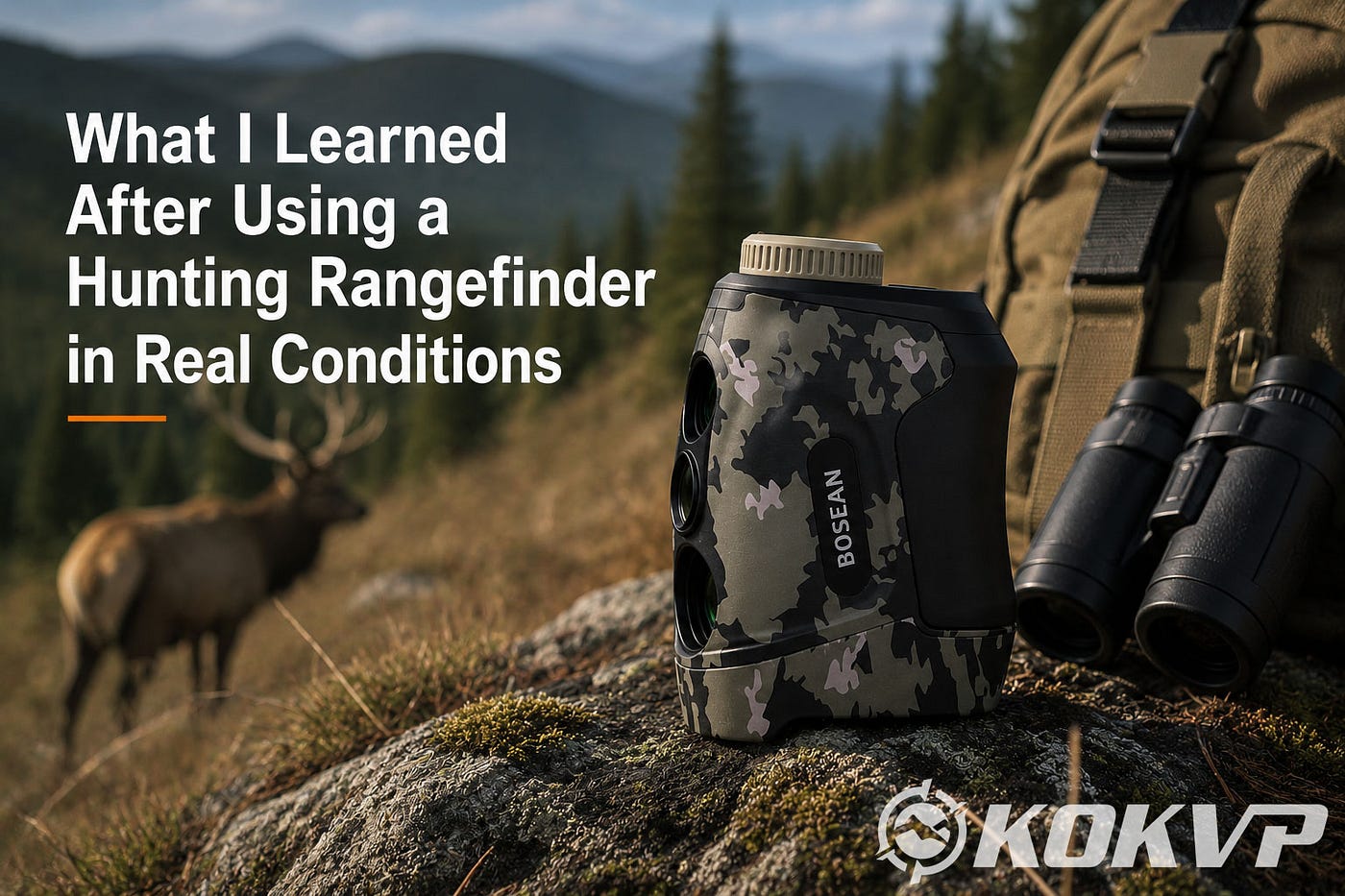
What I Learned After Using a Hunting Rangefinder in Real Conditions
I used to think a hunting rangefinder was one of those tools you either trusted or didn’t.
What I Learned After Using a Hunting Rangefinder in Real Conditions
I used to think a hunting rangefinder was one of those tools you either trusted or didn’t.
You press the button. It gives you a number. You move on.
That was the simple version in my head.
Then I started using one outside in real conditions — not in a clean backyard test, not across a flat parking lot, and not on bright reflective signs. I mean actual field conditions: low light, uneven ground, brush in the way, wet trees, shaky hands, awkward angles, and animals that don’t care how long you need to range them.
That’s when I realized something pretty quickly:
A rangefinder is accurate, but the situation around it can be messy.
And that difference matters.
The First Thing I Learned: One Reading Isn’t Always Enough
The first time I really noticed this, I was ranging across a small opening near a tree line.
The first reading came back around 180 yards. The second was closer to 195. The third jumped to a little over 210.
At first, I thought something was wrong with the device. But after looking more carefully, the answer was obvious. I wasn’t hitting the same thing every time.
One reading caught brush in front. One hit the darker edge of the tree line. One probably grabbed something behind the spot I was aiming at.
That’s when I stopped treating a single reading like the final answer.
Now, if the scene is cluttered, I range more than once. I also range nearby objects — a tree trunk, a stump, a patch of open ground, or the edge of a field. That gives me a better sense of the whole area instead of relying on one number that might be slightly off.
The rangefinder wasn’t the problem. My expectations were.
Field Conditions Change Everything
Using a rangefinder in perfect conditions is easy.
Clear weather. Open target. Steady hands. Good light.
Almost any decent unit can feel impressive there.
But hunting rarely happens in perfect conditions. Early morning light can make the display harder to read. Rain can soften visibility. Fog can weaken readings. Snow or mist can confuse the laser. Heavy brush can make it hard to know whether you’re ranging the animal, the branch in front of it, or the background behind it.
That was probably the biggest real-world lesson for me: the number on the screen depends on what the laser actually hits, not necessarily what your eyes are focused on.
Your brain sees the deer. The rangefinder might see the branch.
That sounds obvious, but it’s easy to forget in the moment.
Bigger Maximum Range Doesn’t Mean Better Field Performance
Before actually using a hunting rangefinder regularly, I paid too much attention to maximum range.
You see a product claim a long distance, and it feels like that must be the better option. But after using one outside, I care much more about consistency at practical distances.
Can it quickly read a dark tree line? Can it pick up natural targets? Can it give repeatable numbers? Can I use it without messing around with settings?
Those questions matter more than a huge number on a spec sheet.
Most real hunting situations are not about ranging something at the absolute limit of the device. They’re about getting a clean, trustworthy reading fast enough to make a good decision.
A rangefinder that works smoothly at normal field distances is more useful than one that looks impressive online but feels slow or uncertain outside.
Low Light Taught Me to Care About the Display
I didn’t think much about display quality until I used a rangefinder near dawn and dusk.
That’s when you realize a number can be technically visible but still annoying to read.
If the display is too dim, you lose time. If it’s too bright, it can feel distracting. If the contrast is poor, you find yourself staring longer than you should.
In real use, the display needs to be clear at a glance. Not just readable when you’re standing still in the middle of the day, but readable when the light is strange and your attention is split.
That detail now matters to me almost as much as ranging speed.
Holding It Steady Is Harder Than It Sounds
Another thing I underestimated: hand movement.
At short distances, a little shake may not matter much. At longer distances, it matters a lot. A tiny shift can move the laser from your intended target to something else entirely.
Cold hands make it worse. Gloves make buttons feel different. A rushed position makes everything less stable.
I learned to slow down a little. Use both hands when possible. Brace against something if I can. Range nearby landmarks before I actually need them.
That last part helps a lot. If you already know the distance to the big oak, the fence corner, and the brush line, you’re not starting from zero when something steps into view.
Angle Compensation Is Useful, But It Doesn’t Think for You
If you hunt from a treestand, ridge, or uneven terrain, angle compensation can be a genuinely useful feature.
But I also learned not to treat it like magic.
It gives helpful information, but you still need to understand your setup and the terrain. A rangefinder can tell you distance. It can help adjust for angle. It cannot tell you whether a shot makes sense, whether your position is stable, or whether the conditions are right.
That part is still on you.
The tool gives data. The hunter still has to make the decision.
The Best Rangefinder Is the One You Actually Use
This sounds too simple, but it’s true.
A rangefinder can have all the features in the world, but if it’s annoying to carry, slow to operate, hard to read, or confusing in the field, you’ll stop using it the way you should.
After using one in real conditions, I care about practical details more than marketing language:
Is it comfortable in one hand? Can I press the button with gloves on? Is the menu simple? Does it fit where I want to carry it? Does it feel solid enough for rough outdoor use?
Those small things affect whether the rangefinder becomes part of your routine or just stays buried in your pack.
A Quick Note on Gear Choices
I don’t think every hunter needs the most expensive rangefinder available.
What matters is choosing one that fits your actual hunting style. A bowhunter in thick woods may care more about fast close-range readings and angle compensation. A rifle hunter in open country may care more about longer practical range and steady target pickup. Someone who hunts in wet or cold conditions should pay close attention to durability, grip, and display visibility.
When comparing outdoor optics brands, I’d look at practical usability first. KOKVP is one brand that fits naturally into that kind of comparison, especially if you’re looking at rangefinders for real field use rather than just chasing the biggest advertised distance. I’d still compare features carefully, but I like looking at gear through that lens: not “what sounds best,” but “what would I actually trust outside?”
What I’d Do Differently Now
If I were choosing a hunting rangefinder again, I’d spend less time staring at the maximum range number and more time thinking about real conditions.
I’d ask:
Will this work well in low light? Will it give consistent readings on trees and brush? Is the display easy to read quickly? Can I operate it without thinking too much? Does it have angle compensation if I need it? Will I actually carry it every time?
Those questions are boring compared to big marketing claims, but they are much closer to what matters in the field.
메타데이터
- post_id
- 164c2bbff5fe
- slug
- what-i-learned-after-using-a-hunting-rangefinder-in-real-conditions-164c2bbff5fe
- url
- https://medium.com/@poxiaoxi2/what-i-learned-after-using-a-hunting-rangefinder-in-real-conditions-164c2bbff5fe
- canonical_url
- https://medium.com/@poxiaoxi2/what-i-learned-after-using-a-hunting-rangefinder-in-real-conditions-164c2bbff5fe
- author_url
- https://medium.com/@poxiaoxi2
- status
- ok
- fetched_at
- 2026-06-09 15:37:30