Facade Design Pattern
Facade design pattern provides a simplified, unified interface to a complex subsystem, acting as a single entry point to hide internal…
Facade Design Pattern
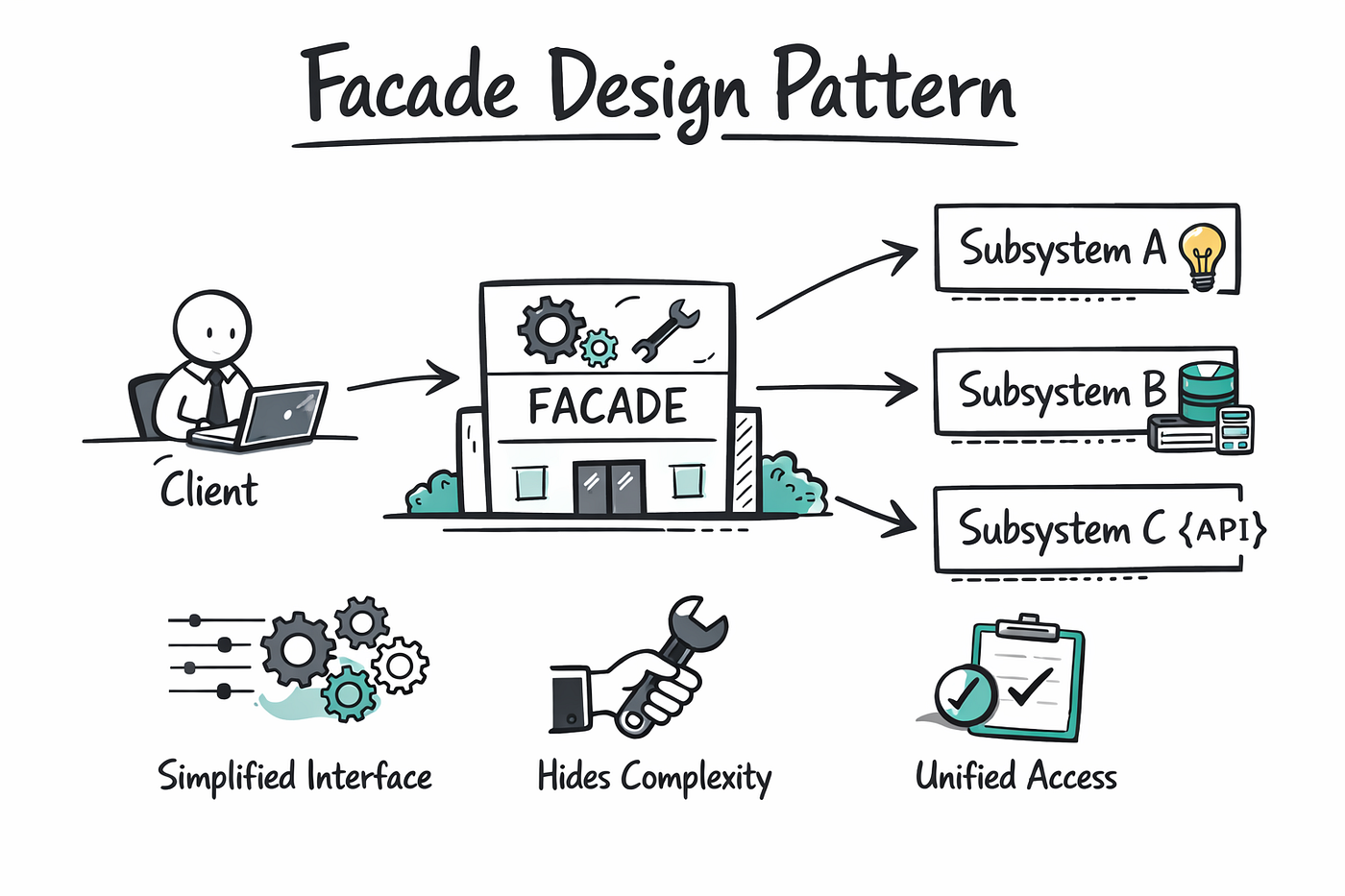
Facade design pattern provides a simplified, unified interface to a complex subsystem, acting as a single entry point to hide internal intricacies and reduce client-side dependencies, making the system easier to use and maintain, much like a remote control simplifies controlling a home theater system. It’s a structural pattern that wraps a complex set of classes or APIs with a single, cleaner class, offering only the most relevant functionality to clients.
How it works
- A Facade Class: A single class that provides simplified methods (e.g.,
playMovie(),setupHomeTheater()). - Subsystem Classes: The complex, underlying components (e.g.,
Television,SoundSystem,StreamingDevice). - Delegation:
- The Facade methods call multiple methods in the subsystem classes to perform a combined action, shielding the client from this complexity
Example: Home Automation System
- Without Facade: A client would need to interact with
Light.turnOn(),TV.setSource(HDMI1),SoundSystem.setVolume(30), etc.. - With Facade: A
HomeAutomationFacadeoffers awatchMovie()method that internally calls all the necessary subsystem methods in the correct order, requiring only one call from the client.
Key benefits
- Reduces Coupling: Clients depend on the single Facade, not many subsystem classes, making changes easier.
- Simplifies Usage: Provides an easy-to-understand interface for complex features.
- Improves Maintainability: Isolates complexity within the Facade.
- Handles Dependencies: Moves unwanted dependencies to one place.
Common use cases
- Wrapping complex libraries or frameworks (e.g., a video conversion library).
- Creating an API gateway for microservices.
- Simplifying database operations or network functions.
This video demonstrates how to use the facade pattern to reduce coupling:
// Inventory Service
class InventoryService {
    public boolean checkStock(String productId) {
        System.out.println("Checking stock for product: " + productId);
        return true; // assume available
    }
}

// Payment Service
class PaymentService {
    public boolean processPayment(String account, double amount) {
        System.out.println("Processing payment of Rs " + amount);
        return true; // assume success
    }
}

// Invoice Service
class InvoiceService {
    public void generateInvoice(String productId) {
        System.out.println("Generating invoice for product: " + productId);
    }
}

// Shipping Service
class ShippingService {
    public void shipProduct(String productId) {
        System.out.println("Shipping product: " + productId);
    }
}
// Facade Class
class OrderFacade {
private InventoryService inventoryService;
private PaymentService paymentService;
private InvoiceService invoiceService;
private ShippingService shippingService;
public OrderFacade() {
inventoryService = new InventoryService();
paymentService = new PaymentService();
invoiceService = new InvoiceService();
shippingService = new ShippingService();
}
public void placeOrder(String productId, String account, double amount) {
if (inventoryService.checkStock(productId)) {
if (paymentService.processPayment(account, amount)) {
invoiceService.generateInvoice(productId);
shippingService.shipProduct(productId);
System.out.println("Order placed successfully!");
} else {
System.out.println("Payment failed!");
}
} else {
System.out.println("Product out of stock!");
}
}
}메타데이터
- post_id
- 168d093a64d4
- slug
- facade-design-pattern-168d093a64d4
- url
- https://medium.com/@code.chandrashekhar/facade-design-pattern-168d093a64d4
- canonical_url
- https://medium.com/@code.chandrashekhar/facade-design-pattern-168d093a64d4
- author_url
- https://medium.com/@code.chandrashekhar
- status
- ok
- fetched_at
- 2026-07-15 15:45:51