The First AI Agent You Ship Should End in a Review Queue
Asia’s fastest no-code agent experiments now build in minutes. The durable ones add approvals, logs, and tiny scopes before they let an…
The First AI Agent You Ship Should End in a Review Queue
Asia’s fastest no-code agent experiments now build in minutes. The durable ones add approvals, logs, and tiny scopes before they let an agent click.
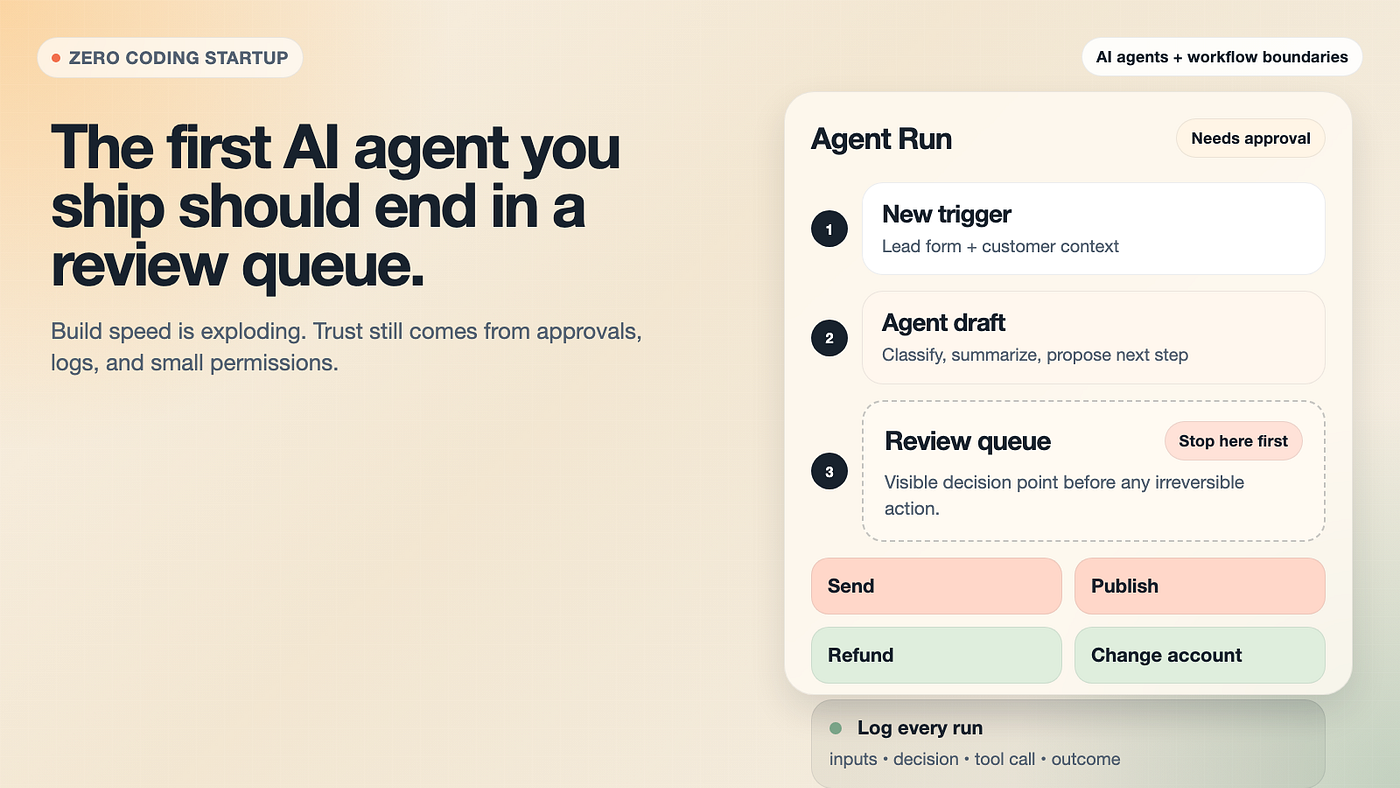
If your first AI agent can click “send,” “publish,” or “refund” before it can explain what it did, you are not shipping leverage. You are shipping blast radius.
That is the real lesson hiding under this month’s wave of no-code agent demos. A founder can now build and ship a working app in 25 minutes. Microsoft is making computer-using agents and workflow nodes mainstream. Cisco is turning natural-language prompts into apps and workflows inside enterprise operations. But the durable pattern is not “more autonomy.” It is tighter operating boundaries.
For a solo founder, creator, or side hustler, the highest-ROI agent is usually not the one that finishes the task. It is the one that gets 80% done, pauses at the point of consequence, and leaves a clean trail behind it.
TL;DR
- The build step is getting cheap fast; the trust step is still expensive.
- Recent Korea and Asia coverage shows the same pattern as official platform updates: teams are standardizing workflows, monitoring, and approval gates around agents.
- The right first agent for a solo business usually ends in a review queue, not a fully autonomous action.
- If an agent cannot show its inputs, scope, and last action, it should not touch money, publishing, customer messaging, or account changes.
- Your first durable automation stack is simple: model, workflow runner, system of record, approval checkpoint, and logs.
The seductive pitch in 2026 is speed.
A recent Korean founder essay pointed to a case where a startup founder built and deployed a production-style web app in roughly 25 minutes with no-code AI tools. That matters. It means the old bottleneck, “I need a developer before I can test this,” is collapsing for a huge class of workflow products and internal tools.
But another Korean operations essay made the more important point: many teams connect tools to an AI agent and still make work worse because they never design the workflow layer. They connect the model to the tool, then confuse technical integration with operational integration.
That gap is where solo operators get hurt.
If your agent drafts an email, you can review it. If it sends the email, issues a refund, publishes a post, or changes a record in a back-office system, the cost of being wrong jumps fast. The practical question is no longer, “Can the agent do the task?” It is, “Where should the agent stop?”
Speed is solved faster than trust
The market signal is now obvious: vendors are competing to make agents act inside real systems, not just chat about them.
Microsoft’s May 26, 2026 Copilot Studio update pushed computer-using agents into general availability and paired them with redesigned workflows and node-level testing. Cisco’s June 4, 2026 Cloud Control launch described a shared operating context where humans and AI agents can create apps and workflows in natural language, with telemetry and policy wrapped around the environment. A Korean enterprise platform vendor reported that its AI platform revenue mix rose from 0.57% in 2024 to 8.21% in 2025 and 9.52% in 2026 Q1 while emphasizing workflow-based development, model choice, monitoring, and infrastructure operations.
These are not “chatbot” signals. They are operating-system signals.
The build layer is getting easier. The governance layer is becoming the real product.
Why the first good agent ends in a queue
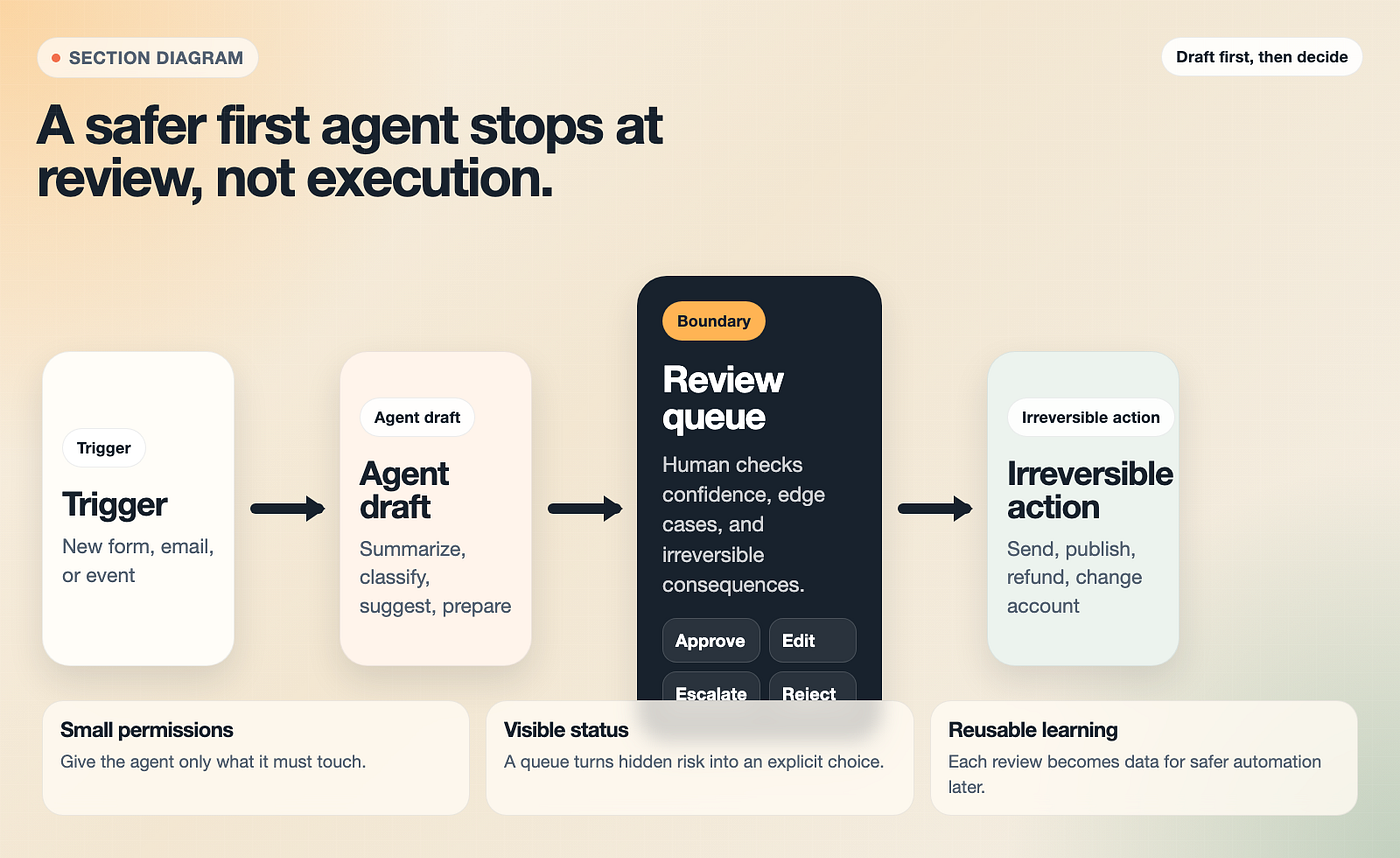
A review queue sounds boring. That is why it works.
For a solo operator, a queue does four things at once:
- It narrows scope.
- It turns risky actions into visible decisions.
- It creates training data for future automation.
- It limits the cost of a wrong model call.
Suppose you run a one-person services business. A useful first agent can read a new lead form, enrich it, classify urgency, draft a reply, suggest a price band, and create a follow-up task. That is already real leverage.
What it should not do on day one is send the message automatically for every edge case. Not because the model is useless, but because the workflow is immature. Until you know which inputs create bad drafts, which leads trigger false urgency, and which promises create support debt, the correct product is “draft plus review.”
The same rule applies to customer support, payouts, contracts, listings, and publishing. Automatic until the point of consequence is usually the right first architecture.
The minimum control stack for solo builders
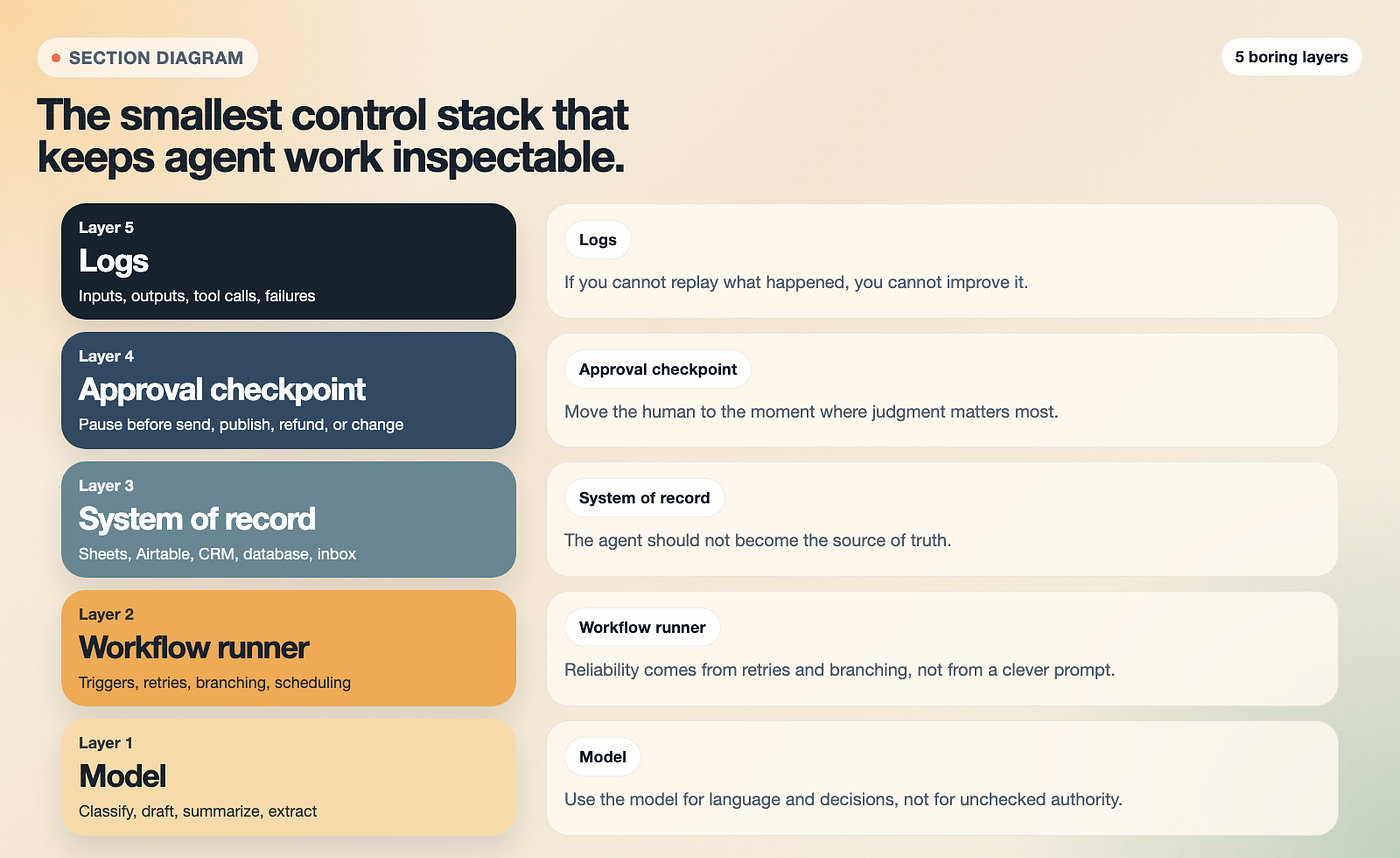
If you want an agent that survives real work, build five boring layers.
- A model that classifies, drafts, or extracts.
- A workflow runner that handles triggers, retries, and branching.
- A system of record that the agent reads from and writes back to.
- A human approval step for irreversible actions.
- A log that captures inputs, outputs, tool calls, and failures.
That last part matters more than most people think. Microsoft’s latest agent-governance guidance says every action should be traceable to a specific agent, context, and moment. For a solo builder, that does not require enterprise software. A spreadsheet row, a database table, or a Notion log is enough if it records what happened clearly.
Without that trace, you cannot answer the only questions that matter after a failure:
- What did the agent see?
- What did it decide?
- What did it change?
- What should happen differently next time?
A better build order for this week
Do not start with the most valuable process in your business. Start with the most repetitive process that is easy to inspect and easy to undo.
Good first candidates:
- lead qualification drafts
- meeting prep briefs
- customer support triage
- invoice reminder drafts
- research summarization
- daily metrics digests
Then write the workflow in plain English:
- Trigger
- Inputs
- Decision
- Tools
- Approval
- Output
- Log
If you cannot define those seven lines, you are not ready for autonomy. You are still naming the problem.
Key Takeaways
- The fastest agent demo is rarely the safest business system.
- Current Korea and Asia case studies point to the same destination as global platform releases: workflow standardization beats raw agent freedom.
- Review queues are not a temporary crutch. They are how you learn where autonomy is actually safe.
- The right first win for a solo business is not “agent runs everything.” It is “agent saves time every day without creating invisible risk.”
CTA
Pick one workflow this week and remove exactly one irreversible action from the agent’s permissions. Replace it with a review queue and a log. If performance drops, you learned your process was not ready. If quality improves, you found the real architecture.
If your first AI agent can click “send,” “publish,” or “refund” before it can explain what it did, you are not shipping leverage. You are shipping blast radius.
That is the real lesson hiding under this month’s wave of no-code agent demos. A founder can now build and ship a working app in 25 minutes. Microsoft is making computer-using agents and workflow nodes mainstream. Cisco is turning natural-language prompts into apps and workflows inside enterprise operations. But the durable pattern is not “more autonomy.” It is tighter operating boundaries.
For a solo founder, creator, or side hustler, the highest-ROI agent is usually not the one that finishes the task. It is the one that gets 80% done, pauses at the point of consequence, and leaves a clean trail behind it.
TL;DR
- The build step is getting cheap fast; the trust step is still expensive.
- Recent Korea and Asia coverage shows the same pattern as official platform updates: teams are standardizing workflows, monitoring, and approval gates around agents.
- The right first agent for a solo business usually ends in a review queue, not a fully autonomous action.
- If an agent cannot show its inputs, scope, and last action, it should not touch money, publishing, customer messaging, or account changes.
- Your first durable automation stack is simple: model, workflow runner, system of record, approval checkpoint, and logs.
The seductive pitch in 2026 is speed.
A recent Korean founder essay pointed to a case where a startup founder built and deployed a production-style web app in roughly 25 minutes with no-code AI tools. That matters. It means the old bottleneck, “I need a developer before I can test this,” is collapsing for a huge class of workflow products and internal tools.
But another Korean operations essay made the more important point: many teams connect tools to an AI agent and still make work worse because they never design the workflow layer. They connect the model to the tool, then confuse technical integration with operational integration.
That gap is where solo operators get hurt.
If your agent drafts an email, you can review it. If it sends the email, issues a refund, publishes a post, or changes a record in a back-office system, the cost of being wrong jumps fast. The practical question is no longer, “Can the agent do the task?” It is, “Where should the agent stop?”
Speed is solved faster than trust
The market signal is now obvious: vendors are competing to make agents act inside real systems, not just chat about them.
Microsoft’s May 26, 2026 Copilot Studio update pushed computer-using agents into general availability and paired them with redesigned workflows and node-level testing. Cisco’s June 4, 2026 Cloud Control launch described a shared operating context where humans and AI agents can create apps and workflows in natural language, with telemetry and policy wrapped around the environment. A Korean enterprise platform vendor reported that its AI platform revenue mix rose from 0.57% in 2024 to 8.21% in 2025 and 9.52% in 2026 Q1 while emphasizing workflow-based development, model choice, monitoring, and infrastructure operations.
These are not “chatbot” signals. They are operating-system signals.
The build layer is getting easier. The governance layer is becoming the real product.
Why the first good agent ends in a queue
A review queue sounds boring. That is why it works.
For a solo operator, a queue does four things at once:
- It narrows scope.
- It turns risky actions into visible decisions.
- It creates training data for future automation.
- It limits the cost of a wrong model call.
Suppose you run a one-person services business. A useful first agent can read a new lead form, enrich it, classify urgency, draft a reply, suggest a price band, and create a follow-up task. That is already real leverage.
What it should not do on day one is send the message automatically for every edge case. Not because the model is useless, but because the workflow is immature. Until you know which inputs create bad drafts, which leads trigger false urgency, and which promises create support debt, the correct product is “draft plus review.”
The same rule applies to customer support, payouts, contracts, listings, and publishing. Automatic until the point of consequence is usually the right first architecture.
The minimum control stack for solo builders
If you want an agent that survives real work, build five boring layers.
- A model that classifies, drafts, or extracts.
- A workflow runner that handles triggers, retries, and branching.
- A system of record that the agent reads from and writes back to.
- A human approval step for irreversible actions.
- A log that captures inputs, outputs, tool calls, and failures.
That last part matters more than most people think. Microsoft’s latest agent-governance guidance says every action should be traceable to a specific agent, context, and moment. For a solo builder, that does not require enterprise software. A spreadsheet row, a database table, or a Notion log is enough if it records what happened clearly.
Without that trace, you cannot answer the only questions that matter after a failure:
- What did the agent see?
- What did it decide?
- What did it change?
- What should happen differently next time?
A better build order for this week
Do not start with the most valuable process in your business. Start with the most repetitive process that is easy to inspect and easy to undo.
Good first candidates:
- lead qualification drafts
- meeting prep briefs
- customer support triage
- invoice reminder drafts
- research summarization
- daily metrics digests
Then write the workflow in plain English:
- Trigger
- Inputs
- Decision
- Tools
- Approval
- Output
- Log
If you cannot define those seven lines, you are not ready for autonomy. You are still naming the problem.
Key Takeaways
- The fastest agent demo is rarely the safest business system.
- Current Korea and Asia case studies point to the same destination as global platform releases: workflow standardization beats raw agent freedom.
- Review queues are not a temporary crutch. They are how you learn where autonomy is actually safe.
- The right first win for a solo business is not “agent runs everything.” It is “agent saves time every day without creating invisible risk.”
CTA
Pick one workflow this week and remove exactly one irreversible action from the agent’s permissions. Replace it with a review queue and a log. If performance drops, you learned your process was not ready. If quality improves, you found the real architecture.
메타데이터
- post_id
- 16a6d685bbb1
- slug
- the-first-ai-agent-you-ship-should-end-in-a-review-queue-16a6d685bbb1
- url
- https://blog.startupstash.com/the-first-ai-agent-you-ship-should-end-in-a-review-queue-16a6d685bbb1
- canonical_url
- https://blog.startupstash.com/the-first-ai-agent-you-ship-should-end-in-a-review-queue-16a6d685bbb1
- author_url
- https://medium.com/@zerocodingstartup
- status
- ok
- fetched_at
- 2026-06-12 10:20:10