Architecting Scalable Cannabis Hydroponic System
Architecting Scalable Commercial Cannabis Hydroponics
Architecting Scalable Cannabis Hydroponic System
Architecting Scalable Commercial Cannabis Hydroponics
Architecting Scalable Cannabis Hydroponic System
1. Introduction
Moving from a small grow room to a large farm takes careful planning. Success in California’s market is determined by steady THC levels, rich terpene profiles, and huge yields harvest after harvest. Reaching this level of success means moving past guesswork. You need a solid plan. A smart **cannabis hydroponic system** design unites fluid control, thermal loops, HVAC syncing, and smart automation into one strong facility layout.
2. Phase 1: Designing Fluid Networks
2.1 The Plumbing Backbone
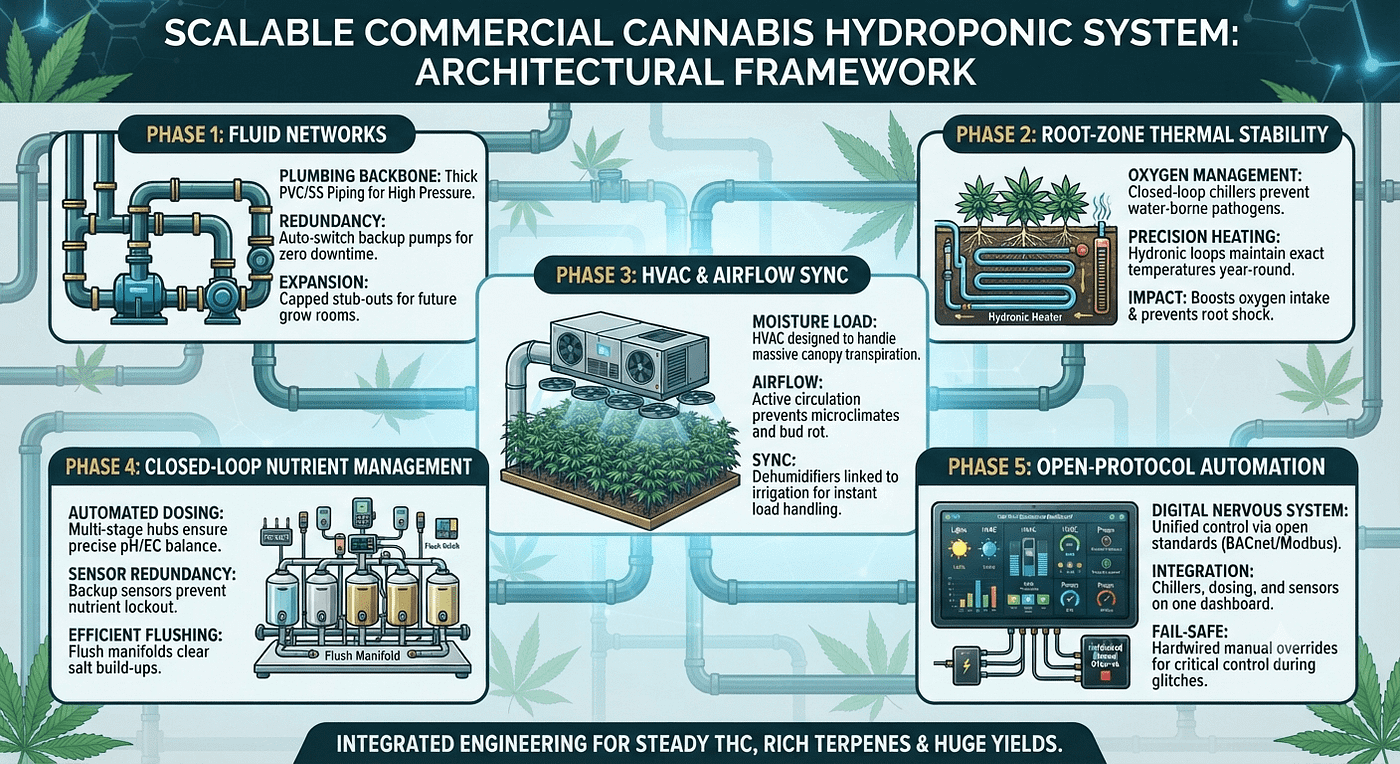
At the heart of any major farm is its fluid network. Moving thousands of gallons of water and food daily across large rooms takes careful pipe sizing and pressure care. If main lines are too small, distant plant rows get starved of water. This leads to uneven feed rates and weak plants.
Engineers must specify thick PVC or stainless-steel pipes. These materials handle high pressure and daily cleaning cycles. Adding cleanout ports and smooth elbows stops organic debris and mineral scale from clogging the lines.
2.2 Redundancy and Expansion
A commercial grow room cannot afford sudden downtime. Your plumbing setup must include backup pumps with auto-switch triggers. If a main pump fails, the backup starts right away.
Forward-thinking facility designs also include capped stub-outs along main lines. These extra ports let managers add new grow rooms later without draining the current water network.
3. Phase 2: Root-Zone Thermal Stability
3.1 Managing Dissolved Oxygen
Root-zone temperature dictates plant success. When nutrient solutions get too warm, the water holds less oxygen. Warm, stale water invites root rot and bad pathogens that can ruin a crop in days.
3.2 Closed-Loop Thermal Control
Keeping roots stable requires industrial chillers and precision hydronic heating loops. Unlike standard units, a closed-loop system uses a central mechanical room to send temperature-conditioned water right where it is needed.
By tying chillers and heaters into zone valves, growers keep exact root temperatures year-round. This thermal stability stops root shock, boosts oxygen intake, and keeps plants growing fast through every stage.
4. Phase 3: HVAC and Airflow Integration
4.1 Synchronizing Water and Air
Massive water volumes moving through an indoor room do not just vanish. They transpire right out of the canopy and into the air. Treating your water network and your air conditioning as separate things is a major design flaw.
During heavy bloom cycles, a dense cannabis hydroponic system releases massive amounts of moisture into the room. HVAC gear and commercial dehumidifiers must be designed right alongside the irrigation network to handle this water load instantly.
4.2 Stopping Mold Pockets
In large flowering rooms, stale air creates damp microclimates deep inside heavy colas. Trapped moisture invites powdery mildew and bud rot, which can destroy a harvest overnight.
Facility plans must include high-speed circulating fans and active canopy airflow loops. Syncing these fans with your dehumidifiers ensures that water pulled from the roots is pulled out of the air fast, keeping top-grade flower safe.
5. Phase 4: Closed-Loop Nutrient Management
5.1 Automated Dosing
Hand-mixing nutrients in a large farm brings human error, wild pH swings, and wasted cash. A modern cannabis hydroponic system relies on automated, multi-stage dosing hubs.
These central hubs pull water from primary tanks, inject precise doses of plant food based on real-time sensor data, and balance pH levels. This ensures every plant — whether at the front or back of the room — gets the exact chemical mix it needs.
5.2 Sensor Redundancy and Flushing
Digital sensors drift out of tune over time. Smart design requires backup sensors and auto-calibration triggers.
Architects should also add flush manifolds into the plumbing layout. These manifolds let workers push clean water through entire room zones instantly, clearing out salt build-ups without heavy manual labor.
6. Phase 5: Open-Protocol Automation
6.1 The Digital Nervous System
A multi-million-dollar commercial farm cannot run on separate software apps for lights, HVAC, and chillers. Running a high-tech cannabis hydroponic system requires a unified digital nervous system using open standards like BACnet and Modbus.
Open protocols stop software silos. They let chillers, dosing pumps, HVAC units, and sensors talk to each other. This integration gives head growers a single dashboard to monitor and adjust every variable in real time.
6.2 Manual Overrides
While automation drives efficiency, industrial design must account for digital glitches. Hardwired manual override switches and physical bypass valves must sit next to every automated relay. If a computer network fails, workers need instant, hands-on control over pumps and valves to save the crop.
7. Conclusion
Designing a top-tier cannabis hydroponic system means looking far beyond basic plumbing and lighting. It demands a holistic approach that links fluid dynamics, root thermal control, HVAC integration, and open automation.
메타데이터
- post_id
- 16c4ce84d8fe
- slug
- architecting-scalable-cannabis-hydroponic-system-16c4ce84d8fe
- url
- https://medium.com/@biotherm.solutions360/architecting-scalable-cannabis-hydroponic-system-16c4ce84d8fe
- canonical_url
- https://medium.com/@biotherm.solutions360/architecting-scalable-cannabis-hydroponic-system-16c4ce84d8fe
- author_url
- https://medium.com/@biotherm.solutions360
- status
- ok
- fetched_at
- 2026-08-18 09:13:47






