GCC Lifecycle Management: From Setup to Sustainable Scale
GCC lifecycle management is the structured approach organizations use to plan, launch, operate, and expand Global Capability Centers in a…
GCC Lifecycle Management: From Setup to Sustainable Scale
GCC lifecycle management is the structured approach organizations use to plan, launch, operate, and expand Global Capability Centers in a way that delivers long term business value. It goes beyond initial setup and focuses on how a GCC matures operationally, culturally, and strategically while remaining aligned with enterprise goals. For leaders responsible for technology, operations, or transformation initiatives, managing the GCC lifecycle effectively is often the difference between a cost focused offshore unit and a high impact global engine.
At its core, GCC lifecycle management connects strategy with execution across clearly defined GCC lifecycle stages. These stages guide decision making from early location planning and talent acquisition through capability expansion, governance maturity, and eventual ownership transfer. When approached deliberately, the GCC becomes a scalable extension of the core organization rather than a disconnected delivery arm.
Why GCC Lifecycle Management Matters
Many organizations underestimate the complexity of running a GCC beyond the first year. Initial success is often driven by enthusiasm, early hires, and visible cost benefits. Challenges typically surface as scale increases. Leadership bandwidth gets stretched, governance becomes inconsistent, and operational risks begin to rise.
A structured lifecycle approach brings clarity. It ensures that growth is intentional rather than reactive. GCC lifecycle management provides a framework to manage risk, maintain service quality, and steadily move the center up the value chain. This discipline also supports predictable outcomes, whether the goal is operational efficiency, innovation enablement, or enterprise wide integration.
Understanding the GCC Lifecycle Stages
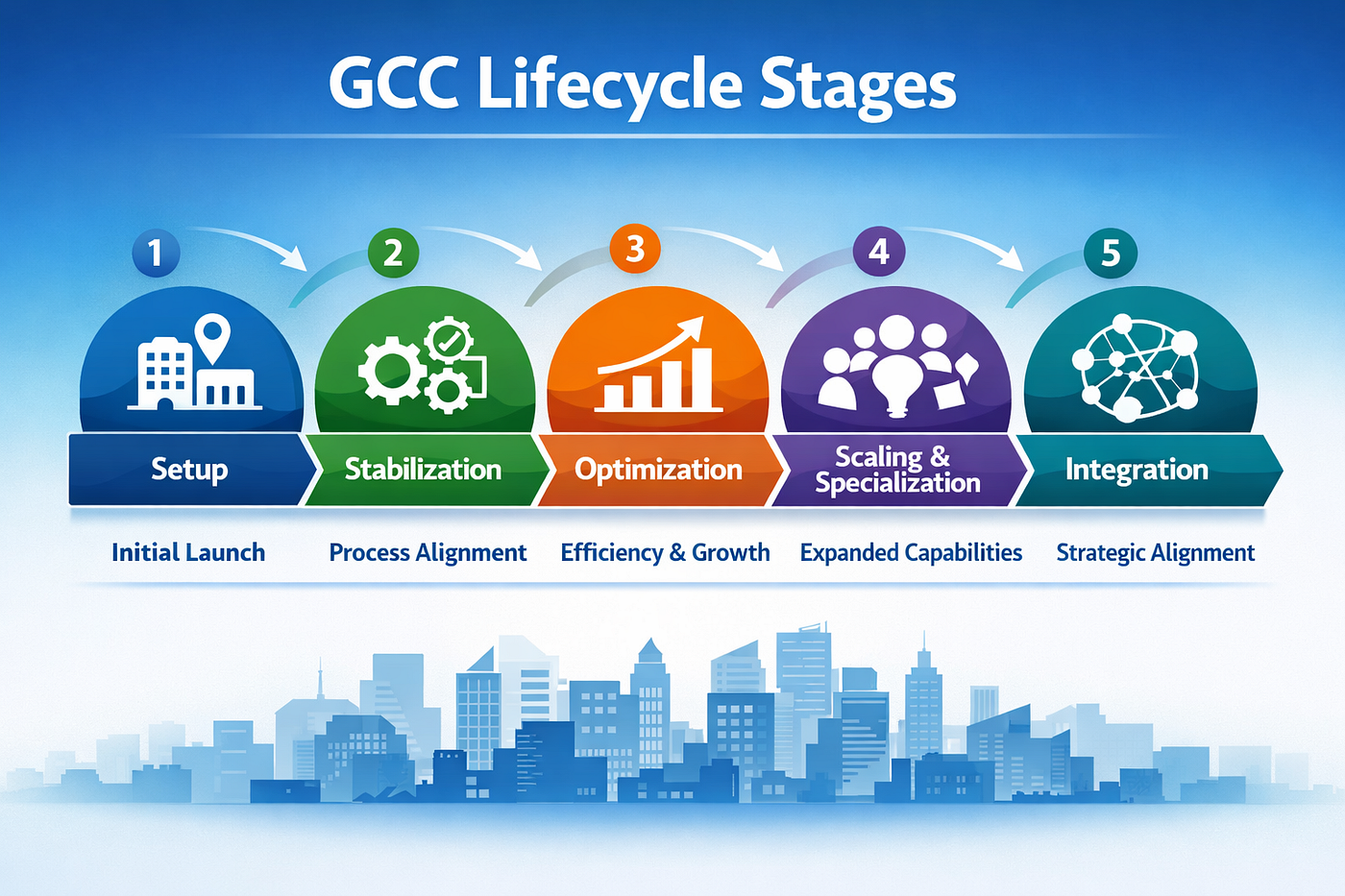
While each organization defines its own journey, most GCC lifecycle stages follow a similar progression.
The first stage focuses on setup. This includes location selection, legal entity formation, initial hiring, and infrastructure readiness. Decisions made here shape the long term cost structure and talent access of the center. A rushed setup often leads to downstream issues that are difficult to unwind.
The second stage is stabilization. Processes are documented, delivery metrics are established, and early teams begin operating consistently. Leadership attention is high, and operational oversight is often hands on. The goal is reliability and predictability.
The third stage centers on optimization. At this point, the GCC begins refining processes, improving productivity, and expanding functional coverage. Cross functional collaboration increases, and the center starts contributing ideas rather than simply executing tasks.
The fourth stage involves scale and specialization. Teams grow in size and complexity, advanced capabilities are introduced, and the GCC becomes embedded in core business workflows. Governance models mature, and accountability becomes distributed.
The final stage is strategic integration. The GCC operates as a trusted internal partner with end to end ownership of select capabilities. In many cases, this stage aligns with a transition toward full internal ownership under a Build Operate Transfer model.
Applying a GCC Maturity Model
A GCC maturity model helps organizations assess where their center stands and what capabilities must be strengthened to progress. Early maturity levels tend to emphasize delivery execution and compliance. Higher maturity levels focus on innovation, leadership development, and enterprise influence.
Using a maturity model prevents unrealistic expectations. It aligns leadership on what success looks like at each stage and avoids pushing advanced mandates onto an organization that is not structurally ready. It also provides a common language for performance discussions across regions.
Effective GCC lifecycle management integrates maturity assessments into regular planning cycles. This allows leaders to prioritize investments in talent, tooling, and governance based on where they will create the most impact.
The Role of the GCC Evolution Framework
A GCC evolution framework defines how the center transitions from one lifecycle stage to the next. It combines operating models, governance design, talent strategies, and performance management into a cohesive roadmap.
Without an evolution framework, growth tends to be uneven. Teams scale faster than leadership capacity. Processes remain manual while volumes increase. Decision rights stay centralized even as complexity rises.
A well designed evolution framework anticipates these challenges. It introduces structure gradually while preserving flexibility. It also ensures that the GCC evolves in line with business priorities rather than becoming a parallel organization with its own agenda.
Build Operate Transfer as a Lifecycle Enabler
Many organizations adopt a Build Operate Transfer approach to reduce risk during early GCC lifecycle stages. In this model, the center is built and run by an experienced partner during setup and stabilization. Over time, operational ownership is transferred to the organization once processes, teams, and governance are mature.
From a GCC lifecycle management perspective, this approach accelerates time to value. It brings proven operating practices into the environment while internal leaders build confidence and capability. Transfer is not treated as a one time event but as a gradual shift aligned with maturity milestones.
This structure is particularly effective for organizations entering new regions or building complex capability centers for the first time.
Governance Across the GCC Lifecycle
Governance requirements evolve significantly as the GCC grows. Early governance is often informal, relying on frequent touchpoints and direct oversight. As scale increases, this approach becomes unsustainable.
Mature GCC lifecycle management introduces role clarity, escalation paths, and performance dashboards that support autonomy without sacrificing control. Governance bodies shift from operational problem solving to strategic prioritization.
Importantly, governance should enable decision making rather than slow it down. Clear accountability and transparent metrics reduce friction and build trust between global and local teams.
Talent and Leadership Development
Talent strategy is a continuous thread across all GCC lifecycle stages. Early focus is on hiring capable generalists who can adapt. As maturity increases, specialization and leadership depth become priorities.
Leadership development is often overlooked in GCCs, leading to dependency on a small group of individuals. Sustainable lifecycle management invests in succession planning, coaching, and exposure to enterprise stakeholders.
This focus strengthens retention and ensures continuity as the GCC takes on higher value responsibilities.
Measuring Success Beyond Cost
Cost efficiency is an important driver, but it is not a sufficient measure of GCC success. As the center matures, performance indicators should expand to include quality, speed, innovation contribution, and stakeholder satisfaction.
Advanced GCC lifecycle management aligns metrics with business outcomes. This creates a shared sense of ownership and positions the GCC as a value creator rather than a cost center.
Common Pitfalls in GCC Lifecycle Management
Organizations often struggle when they attempt to skip lifecycle stages. Rapid scaling without stabilization leads to burnout and quality issues. Delaying governance formalization creates ambiguity. Treating the GCC as a static entity limits its relevance.
Another frequent issue is misalignment between expectations and maturity. When leadership expects strategic impact from a center that is still stabilizing operations, frustration builds on both sides.
Avoiding these pitfalls requires patience, structure, and a willingness to invest ahead of visible returns.
Sustaining Long Term Impact
GCC lifecycle management does not end once scale is achieved. Continuous review ensures that the center remains aligned with evolving business needs. Periodic maturity assessments, operating model refreshes, and leadership rotations keep the organization resilient.
The most successful GCCs are those treated as living systems. They adapt, learn, and grow alongside the enterprise while remaining grounded in disciplined lifecycle management practices.
메타데이터
- post_id
- 16ca4afcbc13
- slug
- gcc-lifecycle-management-from-setup-to-sustainable-scale-16ca4afcbc13
- url
- https://medium.com/@esha.khatri/gcc-lifecycle-management-from-setup-to-sustainable-scale-16ca4afcbc13
- canonical_url
- https://medium.com/@esha.khatri/gcc-lifecycle-management-from-setup-to-sustainable-scale-16ca4afcbc13
- author_url
- https://medium.com/@esha.khatri
- status
- ok
- fetched_at
- 2026-07-09 01:49:10