LLMs At the Edge: Compressed Language Models
Large Language Models (LLMs) are shifting from data centers to smaller devices, making advanced language processing more accessible on…
LLMs At the Edge: Compressed Language Models
Large Language Models (LLMs) are shifting from data centers to smaller devices, making advanced language processing more accessible on everyday tools like smartphones and IoT gadgets. This change is exciting because it allows real-time AI interactions without needing constant internet access, enhancing privacy and lowering delays. However, deploying these powerful models on limited devices requires significant downsizing and optimization.
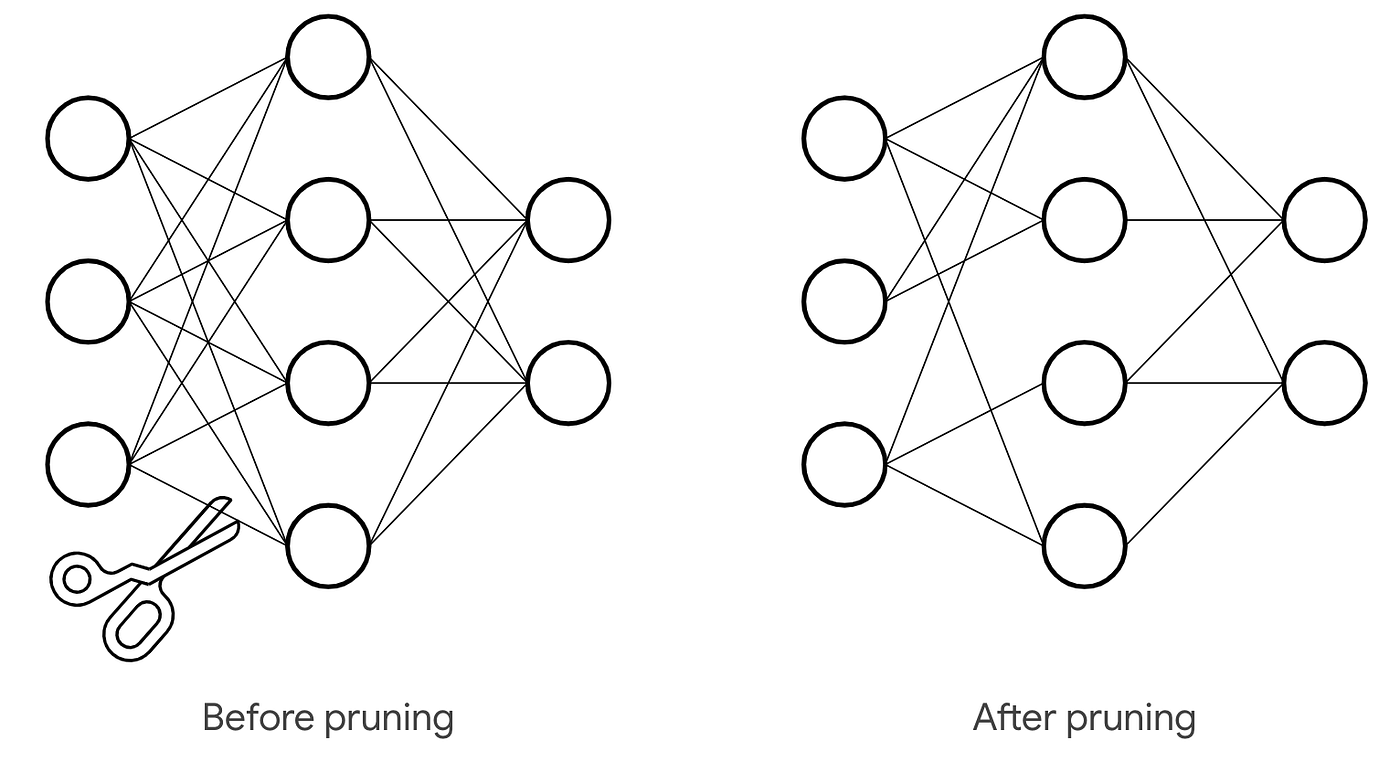
One of the most effective techniques for enabling LLMs on smaller devices is pruning, a method that strategically removes parts of the model that contribute the least to its overall function. By carefully selecting and “pruning” low-impact connections or parameters, LLMs can retain their abilities while shedding the burden of excessive size and computational demands. Early pruning methods, like Optimal Brain Damage (OBD) and Optimal Brain Surgeon (OBS), evaluated model weights and identified sections with minimal influence on performance, achieving substantial reductions without sacrificing quality. More recently, techniques like movement pruning introduced adaptability by dynamically evaluating which parts of the model are less essential during training. This nuanced pruning makes the model leaner, highly accurate, and well-suited for devices with limited resources.
Pruning has become critical to the viability of LLMs on edge devices because it tackles multiple challenges simultaneously. It minimizes the need for heavy computation, conserves memory, and reduces power consumption, all of which are critical for devices like phones and IoT sensors. Some pruning methods even address the unique structure of transformers — the architecture underpinning LLMs — by removing attention heads or entire layers that contribute little to performance. This targeted simplification enables models to operate effectively in constrained environments while still offering robust language processing capabilities.
While pruning is essential, the process of deploying LLMs on edge devices also relies on complementary strategies. For example, quantization reduces the precision of model calculations, conserving memory and power without compromising the model’s usability. Additionally, knowledge distillation transfers the “knowledge” of larger models to smaller ones, further optimizing their efficiency.
While pruning is essential, deploying LLMs on edge devices also relies on complementary strategies. Quantization, for instance, reduces the precision of model calculations to save memory and power, and knowledge distillation transfers the “knowledge” of larger models to smaller ones without compromising capability(EdgeLLMSURVEY (6)). Together with pruning, these methods create highly efficient LLMs capable of performing complex tasks on small devices.
By bringing advanced AI models to edge devices, these techniques enable language processing to happen securely and privately, directly on the user’s device. As the technology progresses, these optimized LLMs could transform industries and enhance daily life, making AI more personal, immediate, and widely available.
References
-
Han, S., Mao, H., & Dally, W. J. (2016). Deep compression: Compressing deep neural networks with pruning, trained quantization and Huffman coding. arXiv preprint arXiv:1510.00149.
-
Sanh, V., Wolf, T., & Rush, A. (2020). Movement pruning: Adaptive sparsity by fine-tuning. Advances in Neural Information Processing Systems, 33, 20378–20389.
-
Michel, P., Levy, O., & Neubig, G. (2019). Are sixteen heads really better than one? Advances in Neural Information Processing Systems, 32.
-
LeCun, Y., Denker, J. S., & Solla, S. A. (1990). Optimal brain damage. In Advances in Neural Information Processing Systems (pp. 598–605). Morgan Kaufmann.
-
Hassibi, B., Stork, D., & Wolff, G. (1993). Optimal brain surgeon and general network pruning. In IEEE International Conference on Neural Networks (Vol. 1, pp. 293–299).
-
Hinton, G., Vinyals, O., & Dean, J. (2015). Distilling the knowledge in a neural network. arXiv preprint arXiv:1503.02531.
메타데이터
- post_id
- 16d2bb2a84a2
- slug
- llms-at-the-edge-compressed-language-models-16d2bb2a84a2
- url
- https://medium.com/@siemghirmai2/llms-at-the-edge-compressed-language-models-16d2bb2a84a2
- canonical_url
- https://medium.com/@siemghirmai2/llms-at-the-edge-compressed-language-models-16d2bb2a84a2
- author_url
- https://medium.com/@siemghirmai2
- status
- ok
- fetched_at
- 2026-06-25 07:00:49