The Mathematics of Time, Consciousness, and Self-Improvement: My take on Quantum Jumping
Time is a concept that has fascinated philosophers, scientists, and mathematicians for centuries, yet our intuitive understanding of it…
The Mathematics of Time, Consciousness, and Self-Improvement: My take on Quantum Jumping
Time is a concept that has fascinated philosophers, scientists, and mathematicians for centuries, yet our intuitive understanding of it remains surprisingly limited. Most of us think of time as a river, with ourselves floating along its current in a physical body. But I propose a different perspective: it is not our bodies that move through time; it is our consciousness. The body you occupied five minutes ago remains exactly where it was, tethered to the past. What travels is your awareness your self observing, thinking, and choosing. Mathematics, particularly through sequences, functions, and the logic underlying temporal systems, provides us with a framework for understanding this more clearly. Moreover, it offers tools to intentionally navigate time, not passively exist within it, and in doing so, improve ourselves.
Our brains are structured to perceive continuity. Without sequential order, our minds would be unable to process events in a way that is coherent, likely leading to confusion or even mental instability. We construct timelines, logical sequences of events, to impose order on what would otherwise appear as chaos. In mathematical terms, a timeline can be thought of as a function mapping moments in the domain of time to states of reality in the codomain of experience. Each “input” a second, a minute, an hour corresponds to a particular “output,” a configuration of your body, surroundings, and mental state. This mapping allows for the predictability and rationality our minds require.
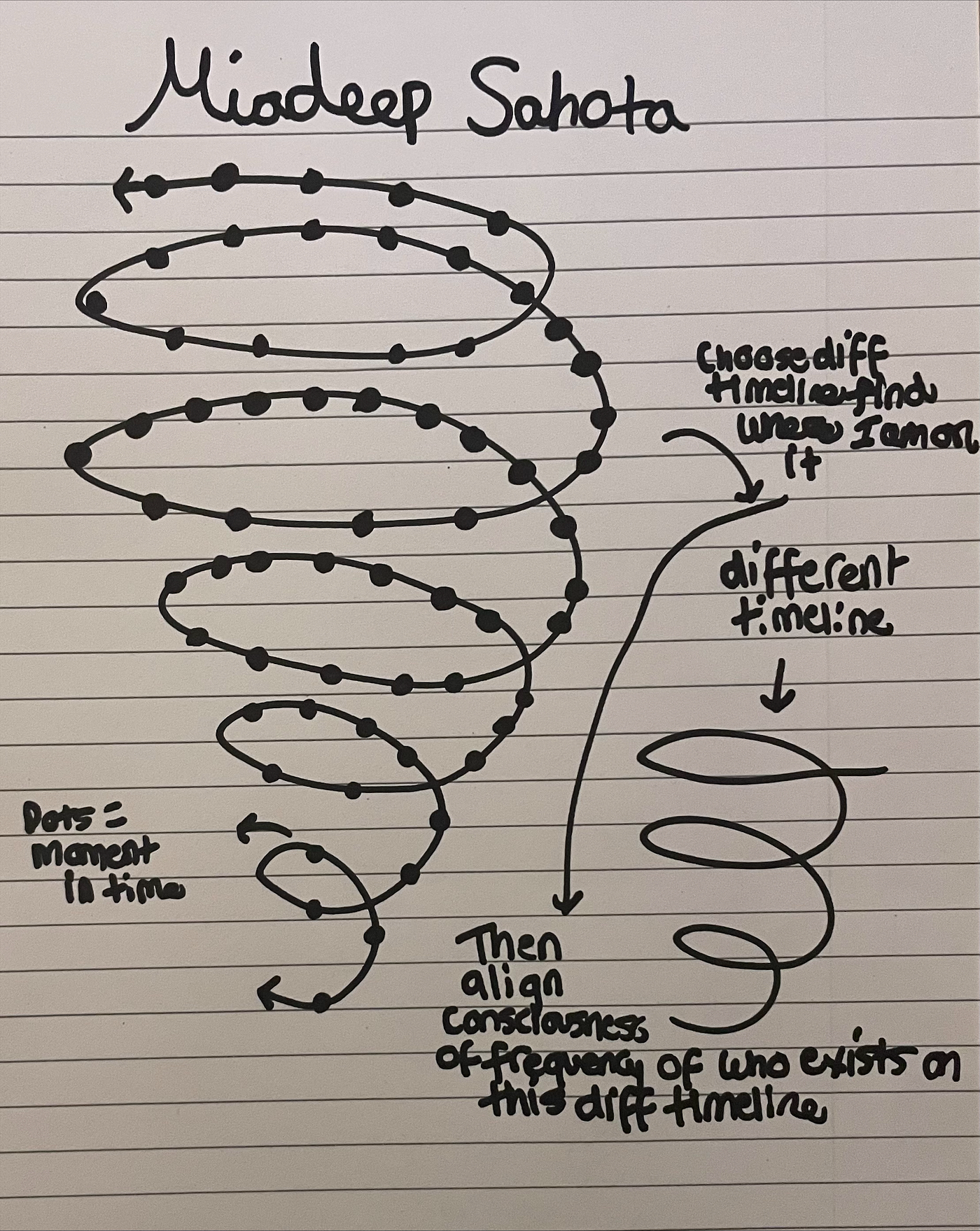
Crucially, this does not imply predestination. While a particular timeline provides a coherent sequence of events, our consciousness can choose to engage with alternate sequences parallel timelines, if you will. Each timeline represents a series of potential events that unfold logically. We can understand these potentialities mathematically, akin to branches in a probability tree or solutions to a differential equation with multiple initial conditions. Each branch is a different version of reality, each point along that branch a different state that could be occupied by our consciousness.
Consider a practical example. Imagine a student revising for an exam. In one timeline, they procrastinate and watch television; in another, they focus for an hour, solving complex problems, reinforcing neural pathways that strengthen memory. The body in both scenarios remains physically similar, but the awareness of the “you” that experiences and acts chooses which path to follow. By analysing the sequence of actions mathematically, one can calculate expected outcomes and adjust behaviour. This is the practical application of time theory: by quantifying probabilities, establishing logical sequences, and modelling potentialities, we can align our consciousness with the timeline that leads to improvement.
The mechanism of moving through time can also be conceptualised using set theory. Each “moment” of your existence is an element in a set of all possible states your consciousness could inhabit. Your awareness jumps from element to element, never occupying more than one simultaneously, much like a particle in quantum superposition collapsing into a particular state when observed. This perspective illuminates why meditation, visualisation, and focused intention work. When you imagine the version of yourself who has achieved a particular skill, whether solving a mathematical problem, running a marathon, or learning a musical instrument you are effectively identifying a point in a set of potential states. By repeatedly projecting your consciousness into that point, you increase the probability that your awareness will align with the necessary actions in the physical world to reach that state.
Mathematics can be applied directly to improve this process. For example, sequences, series, and exponential growth models help us understand habit formation. If mastering a piano piece requires 1000 hours of practice, you can model your daily practice as a series, summing each contribution to see cumulative progress. Graphing this on a time axis reveals that incremental daily improvements compound, producing exponential results over months. Similarly, probability theory allows us to assess the likelihood of success for different timelines. If one timeline involves studying in short bursts and another involves long, uninterrupted sessions, we can model the expected retention from each approach and make data-driven decisions.
Moreover, concepts from physics, such as relativity, reinforce this understanding. To an external observer, movement along different timelines may appear linear and slow, but subjectively, consciousness experiences these transitions as instantaneous when aligned correctly. This is analogous to the principle that time is relative to the observer; by calibrating awareness and focusing intention, one can accelerate perceived progress. In other words, our subjective experience of time can be “compressed” when attention is fully aligned with a chosen timeline.
An applied example: consider someone aiming to become more disciplined. Rather than focusing solely on external routines, they identify the “disciplined self” on another timeline. They examine every detail: how that person wakes, what they prioritise, how they respond to distractions. By modelling this mathematically, creating a flowchart of decisions, probabilities of various responses, and expected outcomes, they create a roadmap. Daily decisions then become functions with defined domains (choices) and codomains (results), and iteratively following these functions aligns consciousness with the target timeline. Over time, the student’s internal state and external actions converge with the projected disciplined self.
Mathematics also offers tools for self-reflection and self-improvement in areas less obviously linked to numbers. Game theory, for instance, illuminates social interactions. Each interaction is a “move” in a strategic matrix; understanding payoffs and probable responses allows one to navigate relationships optimally. Similarly, optimisation techniques can identify the best allocation of resources, time, energy, focus, across multiple competing demands. Even something as seemingly abstract as happiness can be approached analytically: by defining measurable inputs (sleep, exercise, creative engagement, social connection) and outputs (mood, productivity, satisfaction), one can construct a system of equations modelling well-being, and iteratively adjust variables to maximise outcomes.
Ultimately, this perspective reframes personal development as a mathematical and metaphysical endeavour. By recognising that our bodies are fixed points along a timeline and that only consciousness moves, we can leverage logic, probability, and sequences to intentionally navigate existence. By visualising alternate selves, modelling decisions mathematically, and consistently aligning awareness with optimal states, we improve not just skills or knowledge, but our very trajectory through life. Time ceases to be an abstract, uncontrollable force; it becomes a canvas upon which we can project desired realities, refine them with reason and calculation, and inhabit the resulting outcomes.
In conclusion, understanding the passage of time as the movement of consciousness, rather than the body, provides a profound framework for self-improvement. Mathematics, from sequences and probability to optimisation and game theory, offers tools to analyse, predict, and guide this movement. By locating the “desired self” within the vast expanse of possible timelines and systematically aligning our awareness, we can enact meaningful change, accelerate learning, and cultivate personal growth. The study of time, consciousness, and mathematics is not merely theoretical; it is deeply practical, providing a structured, logical, and evidence-based approach to becoming the person we aspire to be.
I have attached a diagram illustrating the predetermined series of events that allow for things to make sense and remain logical within a given timeline, showing how every individual can choose from the infinite expanse of timelines available to them; each dot represents a moment in time, with a version of oneself existing at each point for consciousness to inhabit, while the version at one point does not move forward, only consciousness jumps from dot to dot along the timeline. If one wishes to change the series of events in their life, the process begins with locating oneself within the space-time continuum. Conceptually, if we imagine a piece of paper as the framework of space and time, each timeline is a thread on that paper, and the goal is to choose a different thread, a different sequence of events, and align one’s consciousness with the frequency of the version of oneself existing on that timeline. This alignment is not mystical; it is a disciplined practice of observation, modelling, and embodiment. Here are six ways to achieve this:
- Create a precise profile of the person you aim to become. This includes habits, reactions, decision-making patterns, and even small preferences such as sleeping schedules or modes of transport. Mathematically, this is akin to constructing a state vector in a multidimensional space, where each component represents a behavioural or mental variable. The more accurately you define this vector, the more precisely your consciousness can “lock on” to the corresponding point in the desired timeline.
- Once the target state is identified, break it into discrete, measurable actions. Each action is a function, mapping a current state to a future state. By performing these actions consistently, one iteratively adjusts their real-world trajectory to match the chosen timeline. For example, if the goal is to become disciplined, begin with one consistent daily habit and gradually add others, each step building on the last in a sequence that mirrors the target state.
- To truly inhabit the target version of oneself, engage all senses in alignment with that state. If the ideal self exercises regularly, listens to certain types of music, or prepares specific meals, consciously replicate these conditions. This method utilises neuroplasticity: by simulating the sensory and cognitive environment of the chosen timeline, the brain begins to reinforce neural pathways corresponding to that version of reality.
- Practise mentally “jumping” to the desired timeline by visualising the sequence of events as a fully coherent, step-by-step process. Each decision point should be examined mathematically, considering possible outcomes and optimising choices according to logical probability. This transforms abstract intentions into structured sequences, effectively programming consciousness to follow the intended path. For example, if your goal is to be highly focused, visualise waking up, following a study routine, finishing tasks, and handling distractions exactly as your target version would. Imagine each decision point clearly: what you do, how you feel, and how each choice leads naturally to the next. This helps your consciousness “practice” moving along that timeline before it happens physically.
- Use quantifiable metrics to track progress and adjust actions. Just as iterative algorithms converge on solutions through repeated evaluation, regularly assess whether your current behaviour aligns with the target timeline. If discrepancies arise, analyse the deviation and recalibrate actions, effectively “steering” your consciousness along the chosen trajectory. Regularly check if your current actions match the behaviours and choices of the version you want to become. Keep a journal, track habits, or use measurable indicators like time spent productively or tasks completed. If something isn’t aligning, analyse why and make small corrections, like adjusting a morning routine, changing a study method, or modifying how you respond to distractions.
- Achieving the speed of consciousness necessary to shift timelines requires sustained focus. Momentum is built not through frantic effort, but through continuous, deliberate practice of behaviours, thoughts, and intentions aligned with the desired state. The longer one maintains this alignment, the more natural the transition becomes, until consciousness effectively inhabits the new timeline seamlessly, even if physical time appears to pass at the usual rate.
If discipline is a challenge, you can use your timeline analogy to make it more manageable. First, create “anchor points” in your day, specific, non-negotiable moments where your consciousness locks in to the version of yourself you want to become, like starting a study session, exercising, or planning your day. Treat these anchors as fixed dots on your timeline: each time you consistently occupy them, they generate a gravitational pull that makes it easier for your consciousness to follow the surrounding sequence of actions naturally, gradually building momentum so that the jumps between dots, your decisions and behaviours, become smoother and more automatic. Second, use the concept of “micro-jumps” for moments when discipline feels weak: break down challenging tasks into the tiniest possible steps, imagining each micro-action as a single jump to the next dot on the timeline. By focusing only on the immediate, manageable jump rather than the whole path, your consciousness stays aligned with the disciplined version of yourself without feeling overwhelmed, and over time, these micro-jumps accumulate into a full, seamless trajectory that aligns your daily actions with your long-term goals.A “micro-jump” is simply focusing on one very small, immediate action at a time rather than the entire task or goal. For example, if your goal is to write an essay, instead of thinking “I have to finish this whole essay today” (which can feel overwhelming), a micro-jump would be:
- Dot 1 is opening the document
- Dot 2 is writing a single paragraph
- Dot 3 revising that paragraph
Each tiny action is a jump from one dot to the next. By concentrating only on the next small jump, your consciousness stays aligned with your disciplined self, and momentum builds naturally. Over time, these tiny jumps add up, and you’ve moved across many dots on your timeline without forcing your consciousness to handle the whole path at once.
In conclusion, what I have been describing is a process known as quantum jumping, where consciousness moves between versions of ourselves across different points in time and potential realities, rather than the physical body moving through space. Much like in quantum physics, where particles can transition between states without traversing the space in between, our awareness can shift instantly to a different version of ourselves, provided we align with the frequency of that version. This is not merely a theoretical concept, it has practical applications in our daily lives. By clearly imagining the habits, behaviours, and thought patterns of the version of ourselves we wish to become, and by persistently embodying their energy through deliberate actions and sensory immersion, we create a bridge across time, allowing our consciousness to “jump” into that state. Techniques such as setting anchor points in our day, breaking tasks into micro-jumps, and maintaining continuous feedback loops make this process tangible and effective, turning abstract potential into real behavioural change. Quantum jumping teaches us that the limitations we perceive, lapses in discipline, indecision, or unproductive routines, are not fixed constraints but coordinates on a timeline that we can navigate with awareness and intention. By treating each decision as a point along a path, and each moment as an opportunity to align with a higher-frequency version of ourselves, we gain a framework for self-improvement that is simultaneously profound and practical. Ultimately, quantum jumping reframes our understanding of time, identity, and personal growth, showing that we are not passive observers of our lives but active participants, capable of intentionally shaping the trajectory of our existence through the power of consciousness.
메타데이터
- post_id
- 16d86c2c6e70
- slug
- the-mathematics-of-time-consciousness-and-self-improvement-my-take-on-quantum-jumping-16d86c2c6e70
- url
- https://medium.com/@MiadeepSahota/the-mathematics-of-time-consciousness-and-self-improvement-my-take-on-quantum-jumping-16d86c2c6e70
- canonical_url
- https://medium.com/@MiadeepSahota/the-mathematics-of-time-consciousness-and-self-improvement-my-take-on-quantum-jumping-16d86c2c6e70
- author_url
- https://medium.com/@MiadeepSahota
- status
- ok
- fetched_at
- 2026-07-23 13:31:45