Response to “Untangling the Web — A 2025 Update on COVID Origins”
Entropy Chase recently published an article on the origins of COVID-19. I read through it and it is my view that it presents itself as a…
Response to “Untangling the Web — A 2025 Update on COVID Origins”
Entropy Chase recently published an article on the origins of COVID-19. I read through it and it is my view that it presents itself as a meticulous dissection of evidence, but in reality, it rehashes a series of claims that have been thoroughly debunked, mischaracterized, or placed in misleading contexts by the scientific community and investigative journalists over the past four years. I am by no means a virologist, but I have a strong background in hard sciences and have spent a considerable amount of time on this topic the past 3.5 years.
Quick recap: Misleading Foundations
The article’s recap contains several foundational errors that poison the entire analysis. It states that “the city of Wuhan is home of the Wuhan Institute of Virology (WIV), which in 2019 had the largest repository of SARS-like bat coronaviruses in the world,” implying this makes a lab-leak probable. This is misleading on multiple fronts. First, Wuhan’s status as China’s seventh-largest city and a major transportation hub (for both people and wildlife trade) makes it a likely place for any outbreak to gain traction. Also, the “largest repository” claim is misleading; WIV had collected samples from about 20,000 bats over 15 years, but only about 2,000 of those contained any coronaviruses, and only ~200 were sarbecoviruses (Qiu, 2022). This is far from the impression of a facility swimming in dangerous viruses.
Top Chinese cities with virology labs. Wuhan is not unique in having high‑level virus labs.
The article also claims “Some of the first detected cases were distributed near the Huanan Market… which is on the same subway line (line 2) as the WIV.” This subway connection is statistical noise. As the map below shows, Wuhan has multiple labs and multiple subway lines. If you’re free to choose any lab and any transit route, you can link virtually any location in the city to a research facility. Hardly an honest or precise way to do science.

Maistre, Rodolphe & Demaneuf, Gilles & Bostickson, Billy. (2021). Appendix 1 — Wuhan Institute of Biological Products Co.
Missing infected animals
The article’s central claim, that the absence of infected animals proves a non‑natural origin, crumbles when you examine what sampling actually occurred. China’s headline figure of “80,000 wildlife samples” sounds exhaustive, but almost all of those were routine livestock and poultry collected all over the country, many of them in 2018–2019, long before anyone had heard of COVID‑19. Only about 1.3% of the tested animals had any connection at all to the Huanan market or its supply chain (WHO, 2021).

Only ~1.3% were from the Huanan market or its supply chain, and an even smaller fraction were relevant wild mammals
Within that tiny subset, just 457 samples came from the market itself, and those were taken three weeks after closure from frozen meat in refrigerators, warehouse stock, and a handful of stray cats, dogs, rats and the like (WHO, 2021, Liu et al., 2023). Another 616 animals were sampled from farms linked to the market, but only around 237 of all these samples were from potentially relevant wild mammals such as hedgehogs, bamboo rats, muntjac and weasels. Critically, zero raccoon dogs and zero civets from the market were ever tested, even though we know those species were sold there before the outbreak (Liu et al., 2023).

Species sold at Huanan vs species actually tested. Note the complete absence of raccoon dogs and civets from the tested set.
The market was shut down on December 31st, disinfected, and its live animals removed or destroyed before scientists were even allowed in (WHO, 2021, Liu et al., 2023).
The comparison to SARS‑1 is instructive, but not in the way the article intends. In 2003, civets were identified as intermediate hosts only because Chinese markets stayed open for months, giving investigators time to trace supply chains and test live animals (Guan et al., 2003). Even then, when researchers sampled 1,100 civets from farms supplying one infected Guangdong market, every single farmed civet tested negative (Kan et al., 2005). SARS animal tracing was messy and incomplete despite far better conditions for field work (Kan et al., 2005). With COVID‑19, authorities slammed the door much earlier. Huanan was closed immediately; within weeks, Hubei’s 600‑plus wildlife farms were shut and animals across China were killed or released with minimal testing (Standaert & Dou, 2021). The window to find infected animals was not just small, it was deliberately destroyed. In that context, the failure to isolate SARS‑CoV‑2 from a few hundred belated samples is exactly what you’d expect under a zoonotic origin, not a smoking gun against it (Liu et al., 2023).
If anything, what survived that destruction is striking. Years later, when the full environmental sequencing data from Huanan finally leaked out, several independent groups found that SARS‑CoV‑2 RNA co‑occurred with DNA from known SARS‑susceptible mammals in exactly the stalls we already knew sold those animals (Liu et al., 2023, Crits‑Christoph et al., 2024, Débarre, 2023). One sample from stall 6‑29, the same shop Eddie Holmes photographed selling live raccoon dogs in 2014, contains raccoon‑dog genetic material together with SARS‑CoV‑2 reads and no detectable human DNA (Crits‑Christoph et al., 2024).
It is a remarkable coincidence that, when searching for potential zoonotic spillover sites, the Wuhan CDC took Holmes to HSM, specifically to the very shop 6‑29 which had the greatest number of positive environmental samples (and whose owner was fined for selling illegal wildlife). This coincidence has no explanation under the lab-leak theory.

The western area of the seafood market, which sold the mammals as indicated, had the highest density of samples that contained SARS-CoV-2 (Liu et al., 2023).
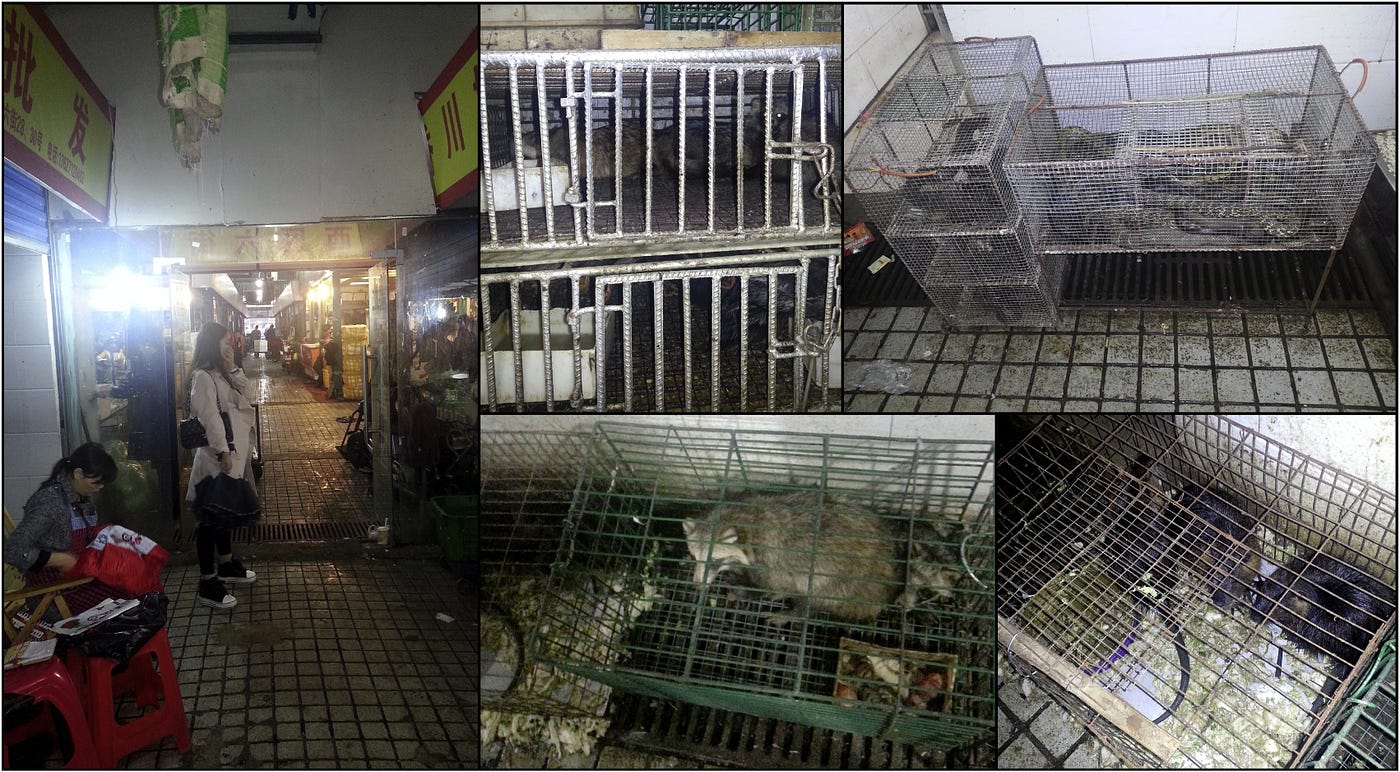
Photographs of shop 6-29 in HSM taken by Eddie Holmes in 2014
Across the market, the highest concentration and persistence of positive swabs came from two wildlife sellers, 6‑29 and 8‑25, and from the drains immediately in front of them (Liu et al., 2023).

Layout of the Huanan market. SARS‑CoV‑2–positive environmental swabs and drains cluster around two wildlife stalls (6‑29 and 8‑25), which sold raccoon dogs, civets, bamboo rats, hedgehogs and porcupines.
In other words, the only place in Wuhan where we see both the virus and the genetic traces of plausible intermediate hosts is a small cluster of stalls in the wildlife section of Huanan. The article brushes this aside by citing an early “negative correlation” analysis that lumped together hundreds of heterogeneous samples, but that broad‑brush statistic evaporates once you look at the raw swabs with modern methods and strand‑aware mapping. What matters is not whether raccoon‑dog reads rise and fall in lockstep with viral reads across the entire market, but whether the animals’ DNA is present in the virus‑positive hotspots. It is. That is exactly what you would expect if animals were the source of the outbreak and exactly what you would not expect if the virus arrived at the market solely in human lungs.
Unusual Outbreak Location
The article insists Wuhan is “inconsistent with a natural spillover” because the closest bat viruses are in Yunnan and Laos, over 1,000 km away. This is geographic determinism that ignores how zoonotic spillovers actually work. SARS‑1 emerged in Guangdong but its bat ancestors were from Yunnan, equally distant. The points where viruses are first recognized are far removed from their actual origin points. HIV and the Spanish Flu are well-known examples of this. SARS was also found on Hubei farms, so we know these viruses can naturally get to Hubei (Guan et al., 2003; Xu et al., 2004; Li et al., 2005).

Bats that can carry SARS viruses are found in many parts of China and Southeast Asia (Wacharapluesadee et al., 2021; Latinne et al., 2024). It’s only the density that’s highest in Yunnan and Laos (Latinne et al., 2024)
Viruses travel via trade routes, not bat flight paths (Latinne et al., 2024). Hubei province had 631 wildlife farms with 1.1 million animals at the time of the outbreak, and Wuhan was a major hub for the wildlife trade, receiving animals from across southern China (Standaert, 2020). The WHO‑China report itself lists animals from Yunnan farms being sold at the Huanan market (WHO, 2021). A 2005 study found SARS‑related antibodies in bats in Hubei (Li, W., et al, 2005), and serological surveys in Yunnan have detected prior infections with bat SARS‑related coronaviruses in people living near bat caves (Wang et al., 2018). In other words, there was already a proven bridge from Yunnan‑type bat viruses into Hubei wildlife and into farmed intermediate hosts long before SARS‑CoV‑2 appeared.
The article’s claim that “Wuhan’s wet markets did not sell many of these animals”, citing just 38 raccoon dogs and 11 palm civets per month city‑wide, ignores what actually matters. Huanan was one of only four markets in Wuhan selling live wild mammals and had the highest concentration of wildlife stalls; we have photos from December 2019 of raccoon dogs in exactly the stall that later tested positive for SARS‑CoV‑2 (Xiao et al., 2021). For a spillover you don’t need tens of thousands of animals, you need a small number of susceptible animals in the wrong place at the wrong time. Rare, high‑risk contact between humans and stressed, mixed‑species wildlife is the trigger, not mass commercial volumes. Once you condition on “a pandemic starts in a big, central or southern Chinese city”, a large transport hub that is also the city’s main wildlife market is not an implausible place for that to happen.
The Market; Origin or Superspreader?
The article argues the market couldn’t be the origin because molecular clock studies suggest emergence in August–October 2019, and because early cases weren’t all market‑linked. Both claims misrepresent the evidence. The first known case with a clear timeline is Wei Guixian, a shrimp vendor at Huanan who fell ill on December 10 (Worobey, 2021). Four of the first five known cases worked at the market, and the fifth was a repeat buyer for a hotel (Worobey, 2021).
Earliest recognised COVID‑19 cases and their workplaces in Wuhan. Four of the first five worked at Huanan market; the fifth was a regular customer.
The “accountant Chen” case, supposedly earlier and unlinked, was later shown to have had a dental problem on December 8 and true COVID onset on December 16, with the same lineage‑B virus seen in market cases (Worobey, 2021). More broadly, when Wuhan hospitals went back through their December records, the pattern was the opposite of what a non‑market origin would predict: before anyone had been told to “look for” a market connection, over half of the December pneumonia cases they found were market‑linked; only after January, when the case search widened, did the proportion of unlinked cases rise (Worobey, 2021). That is exactly what you expect if an outbreak starts in a single market and then spreads into the wider city.
On timing, molecular clock analyses from multiple groups converge on a late November/early December emergence when they focus on early genomes and simple models. The much earlier August–October estimates the article cites come from studies that let the evolutionary rate vary and lean heavily on later 2020 sequences; they have to be squared with the fact that Wuhan blood banks, influenza‑like illness samples, and hospital records show no sign of COVID circulating in September or October (Pekar et al., 2022, Chang et al., 2022, WHO, 2021). Pekar et al.’s 2022 simulations, using early genomes and realistic transmission dynamics, predict a median of zero COVID‑related hospitalizations by December 1 and make pre‑November spillovers extremely unlikely (Pekar et al., 2022). You can’t just quote a distant tail of one dating model and ignore the absence of any epidemiological signal in Wuhan for those months.
Framing the Huanan market as “an excellent location for a superspreading event” while denying it was the origin is also a false dichotomy. A zoonotic origin at the market almost inevitably produces a superspreading event there. What matters is where the first sustained cluster actually was and how the virus spread from there. December cases radiated outward from the market into the rest of Wuhan; even the early “unlinked” cases are geographically centered on it, and the earliest genetic diversity in both lineage A and lineage B is rooted in market‑associated genomes and in environmental samples from the market (Worobey, 2021; Worobey, 2022).

Spatial distribution of December 2019 cases in Wuhan. Both market‑linked and ‘unlinked’ early cases cluster around Huanan (Worobey, 2022).
Within the market, the highest concentration of positive environmental swabs and persistently positive drains was in two wildlife stalls, 6‑29 and 8‑25, that we independently know were selling raccoon dogs, civets, bamboo rats, hedgehogs, and porcupines and had been fined months earlier for illegal wildlife sales (Worobey et al., 2022). Metagenomic sequencing of those swabs shows DNA from exactly those animals co‑located with SARS‑CoV‑2 RNA, including at least one sample with raccoon dog DNA and no detectable human DNA (Crits‑Christoph et al., 2024). If you start from a lab-leak elsewhere in the city, you have to believe that the first big superspreading event just happened to be in the one wet market with the densest wildlife trade, that both early lineages A and B just happened to be rooted genetically in that market, and that the most heavily contaminated stalls just happened to be the ones selling the very animals we know can carry and transmit SARS‑like viruses (Pekar et al., 2022). The simpler reading is that the superspreading event at Huanan was not an incidental sideshow: it was the point at which a wildlife‑to‑human spillover in that market ignited the pandemic.
The Furin Cleavage Site
The article devotes enormous attention to the furin cleavage site (FCS), claiming it’s “consistent with a lab origin.” This is the most technically detailed section, but it collapses with only a small amount of critical thinking.
First, the article claims virologists have been “interested in creating FCSs for decades” and points to the DEFUSE proposal (EcoHealth Alliance, 2018). But DEFUSE was rejected (EcoHealth Alliance, 2023), and even if it had proceeded, the work was to be done at the University of North Carolina, not Wuhan. The proposal explicitly mentioned using the WIV1 and SHC014 backbones, viruses closely related to SARS‑1, not the novel backbone of SARS‑2. The article’s claim that WIV “co‑authored” DEFUSE is technically true but misleading: WIV was a sub‑contractor for field sampling, not the lead institution designing the experiments. Nothing in the proposal involves constructing a virus 80% similar to SARS‑1 with a brand‑new backbone; it envisages inserting cleavage sites into well‑characterised SARS‑like strains, mostly at UNC, and testing them in Vero and HAE cultures. That simply does not match what SARS‑CoV‑2 looks like genetically or how it behaves in those cell systems.
Second, the article calls the FCS “suboptimal” but treats this as a clever ruse. It’s genuinely suboptimal. The cleavage site PRRAR scores poorly in predictive models (0.626 vs. 0.884 for the optimal RRKR sequence) (Duckert et al., 2004). The proline is detrimental; it creates rigidity that reduces furin efficiency, which is why subsequent variants (Alpha, Delta, Omicron) mutated that position to improve cleavage (Johnson et al., 2021; Cai et al., 2021). Structural work has since shown that an upstream QTQTN motif is also important because it lengthens the loop and makes the site accessible, something nobody had predicted a priori (Vu et al., 2022). No rational engineer would choose an awkward, out‑of‑frame PRRAR with a proline at 681 and an odd QTQTN extension when cleaner, textbook motifs like RRKR or RRSRR were already in the literature. Entropy Chase argues that work on FIPV may have inspired the choice of SARS‑CoV‑2’s FCS, and he correctly notes that Baric has discussed FIPV’s cleavage site as part of the background that motivated interest in furin sites more generally. But turning that background interest into a claim that SARS‑CoV‑2’s particular, oddly encoded PRRAR motif was modeled on FIPV is still a large inferential leap: the feline site is not identical, there is no evidence that WIV or anyone else ever inserted an FIPV‑like site into a sarbecovirus, and WIV has never published any FCS‑insertion experiments in coronaviruses at all.
Third, once you look at both virology practice and viral evolution, the 12‑nucleotide insert looks less “lab‑like,” not more. In the coronavirus literature, when researchers have wanted to add or strengthen a furin‑like site in spike, they have done it with minimal, in‑frame point mutations at an existing cleavage loop, not by bolting on an extra four amino acids. Follis et al. (2006), Belouzard et al. (2009), Watanabe et al. (2008), Burkard et al. (2014) and Cheng et al. (2019) all converted native sequences to efficient motifs such as RRKR, RRSRR or RRRRR by changing a few codons. None of them created a new four-amino‑acid segment, and none used an out‑of‑frame 12‑nt insertion.

All were mutations not insertions. (Follis et al, 2016)

Mutations, not insertions. (Belouzard et al., 2009)

RRKR, by mutation, not insertion. (Watanabe et al., 2008)

RRRRR, by mutation, not insertion. (Burkard et al., 2014)

RRKR, by mutation, not insertion. (Cheng et al., 2019)
All of these pre‑2020 experiments were done in systems that were either inherently safe or only pathogenic in animals, not in humans. The SARS‑CoV work (Follis, Belouzard, Watanabe) used pseudotyped viruses: replication‑defective backbones bearing the SARS spike, useful for entry studies but incapable of autonomous spread in people. Other FCS insertions were introduced into mouse hepatitis virus, infectious bronchitis virus or porcine epidemic diarrhoea virus (Burkard 2014; Cheng 2019), coronaviruses that do not cause human epidemics. As Debarre & Hensel (2025) point out, there is no published precedent for inserting a furin site into a replication‑competent sarbecovirus with human‑pandemic potential, let alone doing so via the out‑of‑frame 12‑nt insertion we see in SARS‑CoV‑2.
By contrast, during the pandemic SARS‑CoV‑2 has repeatedly generated 12‑nucleotide insertions on its own, and systematic surveys of hundreds of thousands of genomes show that the spike gene, especially the S1/S2 junction, is a hotspot for exactly this kind of template‑switching event (Garushyants et al., 2021). Inserts are often copied from elsewhere in the viral genome or from host RNA. Long insertions occur naturally; what’s unusual is not their length, but that this one sits where it has a big phenotypic effect, and bat coronavirus RmYN02 has an independent natural insertion at the same S1/S2 junction, demonstrating that this kind of event occurs in wildlife sarbecoviruses (Zhou et al., 2020; Gallaher, 2020). And the claim that the insertion is “out of frame” and therefore suspicious is backwards: if you were engineering a new four‑amino‑acid motif, the simplest and safest route is to make a tidy, in‑frame change to an optimal sequence such as RRKR or RRSRR. The fact that SARS‑2’s insert is out of frame relative to close bat and pangolin viruses, and encodes a genuinely suboptimal PRRA, points to the messy mechanics of natural replication and recombination, not to design (Gallaher, 2020).
Fourth, the article’s focus on the CGG codon for arginine and the nearby FauI restriction site is a classic case of pattern‑seeking in noise. It claims CGG is “far more common in humans than in bats” and that its presence “creates a FauI restriction site” that acts like a tracking beacon. This is misleading on multiple levels. At the level of host genomes, humans and bats actually use CGG at similar frequencies; at the level of coronaviruses, CGG is rare across the board.
Arginine codon usage in SARS‑CoV‑2, RaTG13, human CoV OC43, and host genomes. CGG is rare across coronaviruses generally, not uniquely ‘human’ in SARS‑CoV‑2. (imotw2, n.d)
Debarre & Hensel (2025) take the local amino‑acid sequence around the FCS (QTQTNSPRRARSV), feed it into several standard gene‑design tools (Genscript, IDT, Twist, VectorBuilder), and ask them to optimise it for expression in Homo sapiens. Not one of these independent algorithms chooses CGG‑CGG for the RR pair. Likewise, if you look at the mRNA vaccine constructs from Moderna and Pfizer/BioNTech, spike genes that were explicitly codon‑optimised for human translation, neither uses CGG‑CGG at that position. In other words, when we look at what real‑world codon optimisation actually does, it does not reproduce the double‑CGG motif in SARS‑CoV‑2.

(A) Sequences obtained via various online codon-optimization tools for the shown amino-acid sequence. The URLs of the various tools are given in the Methods section. (B) Sequence fragments from mRNA vaccines, Moderna (top) and Pfizer-BioNTech (BNT; bottom). (Debarre & Hensel, 2025)
It’s used about 5% of the time in common human coronaviruses and 3.1% in SARS‑2, a negligible difference. In other words, SARS‑2’s CGG isn’t “human‑optimised,” it looks like any other mammalian coronavirus trying to minimise CpG (Simmonds, 2020). And there is a plausible functional reason for it: recent work shows the CGG codons in the FCS slow translation just enough to improve spike folding (Postnikova et al., 2021), which explains why they have barely mutated despite millions of infections. That’s exactly what you’d expect from natural selection, not from an engineer carelessly dropping in “human” codons.
The FauI site is even weaker as evidence. Viral genomes are littered with restriction sites; if you scan any coronavirus you will find dozens of them. Half of all possible 12‑base inserts will create at least one restriction site for some enzyme (Deigin & Segreto, 2021). Finding one that overlaps the FCS is statistically expected once you look for it. The article’s suggestion that WIV would need to build a FauI “tracking beacon” into the virus to monitor deletions assumes this site is unique and deliberate, when in fact it is one of many. It is also logically inconsistent: the same narrative tells us the lab was too lax and reckless to handle viruses safely, yet also endowed with the meticulous foresight to hide a custom tracking system in a way that leaves no other laboratory fingerprints anywhere in the genome. That is a lot of intention to hang on one restriction site in a region where restriction sites are commonplace.
Finally, the article never grapples with the broader coronavirus context: furin‑like cleavage sites are ubiquitous across the betacoronavirus family. Four of the seven known human coronaviruses have them; they are present in four of five betacoronavirus subgenera; and since 2020 we’ve discovered bat viruses that are one mutation away from an FCS at the same position, as well as other bat coronaviruses with bona fide furin sites (Zhou et al., 2020; Jaimes et al., 2020). In other words, the existence of an FCS in SARS‑2 is neither exotic nor uniquely “lab‑like.” The question is whether this particular, oddly encoded, structurally suboptimal site looks more like something derived from a well‑planned cloning experiment, or from the kind of messy insertions and selections we now routinely observe in coronavirus evolution. Once you look at the details, the lab‑design story stops being the simple explanation and starts to look like the contorted one.
Obfuscation: Contextualizing WIV’s Behavior
The article portrays WIV’s database removal and lack of transparency as proof of guilt. This ignores context. The database was taken offline in 2020 due to hacking attempts (Qiu, 2022), a real concern when your institution is being accused of causing a pandemic. Access to the database was spotty before that date and portions of it remained reachable into early 2020, which undercuts the idea of a clean switch flipped to hide a leak months in advance.

Monitoring of the WIV database site (Flo Débarre). Access was already unstable before September 2019 and remained possible into early 2020, inconsistent with a clean ‘September 12 blackout’ story.
The LeDuc emails, presented as a “gotcha,” actually show a colleague offering help, not a confession. The article never mentions that by January 2020, WIV scientists were working around the clock to isolate and culture the virus, sequence it, and share data internationally, all while their own city was locking down around them (Qiu, 2022). That early, rapid disclosure is exactly what you would not do if your overriding goal was to hide that the virus came from your lab.
It’s also important to notice that the opacity is not one‑sided. The same Chinese authorities who have restricted access to WIV materials have also systematically downplayed or erased evidence that supports a wildlife origin: they told the WHO mission there was “no illegal trade in wildlife” at Huanan (WHO, 2021), even though Chinese‑language papers and their own 2019 enforcement records show that multiple stalls at that market had been fined for illegal hedgehog sales (Xiao et al., 2021). They removed those fine notices from government websites after foreign journalists asked about them (Standaert, 2022). They shut down wildlife farms across Hubei and China in January–February 2020, releasing or culling tens of millions of animals with almost no targeted virological investigation, then pivoted to politically convenient stories about frozen‑food imports and US biolabs (Gu, 2020) . If you treat secrecy as a Bayesian datum, you have to apply it consistently: China’s pattern of concealment makes both a zoonotic origin at the wildlife market and any embarrassing lab practices harder to document. It is not specific evidence that the lab created the virus.
The claim that WIV “conveniently omitted” the FCS in early papers is demonstrably false. The first genome papers submitted on January 20, 2020 (Zhou et al., 2020) used standard graphics that truncated the spike protein comparison at a consistent location, six amino acids before the FCS, not “just before” it.

A comparison of spike genes for RATG13 and SARS-CoV-2, but stops a bit shy of the furin cleavage site (Zhou et al., 2020).
This was normal practice in the field, as shown by identical graphics in a 2017 paper from the same group (Hu et al., 2017), where it was cut off at the exact same spot.

Previous paper by the same group compared viruses and also cut them off at this exact spot (Hu et al., 2017).
Two other teams that independently published SARS‑CoV‑2 at the same time also failed to comment on the FCS (Wu et al., 2020, Wu & McGoogan, 2020), which is exactly what you’d expect if people were reusing legacy figure templates and not yet thinking in “furin‑site conspiracy” terms. Even the original researcher who pushed this claim admitted he was wrong back in 2022 (Deigin, 2022). Entropy Chase either doesn’t understand publication standards or is deliberately misrepresenting them. And if the FCS really were the tell‑tale signature of a secret engineering project at WIV, the most straightforward way to hide that fact would have been to avoid publishing RaTG13 at all, not to disclose a 96%‑similar virus and then crop a figure in a way that can be trivially checked against earlier papers.
Finally, the article treats any inconsistency from WIV as uniquely incriminating but never applies the same standard to its own side. Shi’s “fungal infection” explanation for the Mojiang miners was almost certainly misleading, but that is just as easily explained by a desire to avoid blame for a dangerous natural spillover on Chinese soil as by a desire to hide a man‑made virus. The US State Department’s 2021 fact sheet insinuated that WIV “conducted experiments on RaTG13” but never produced evidence (U.S. Department of State, 2021); subsequent FOIA’d manuscripts and data releases have found no such experiments and no close, unpublished precursor. Multiple US intelligence reviews, under two different administrations, have concluded that several agencies lean toward a natural origin and none has identified a specific engineered ancestor virus. In that light, WIV’s clumsy defensiveness looks like exactly what you’d expect from a politicized bureaucracy terrified of being blamed for any aspect of the catastrophe, not like the tight, coherent cover story you’d expect if they were hiding the deliberate construction and release of SARS‑CoV‑2.
Safety Issues
The article’s emphasis on BSL‑2 work is misleading. It notes that WIV created synthetic SARS clones in BSL‑2 conditions in 2016, and that visiting diplomats and collaborators like Baric worried this work should really have been done at BSL‑3. That is a legitimate biosafety concern, but it is not evidence of a COVID leak. BSL‑2 at WIV still meant work in negative‑pressure biosafety cabinets, not free‑handling unknown viruses in open air.

Typical BSL‑2 workflow: work is performed in a negative‑pressure biosafety cabinet, not on an open bench
Lab‑acquired infections do happen, including with SARS‑CoV‑2 itself at Academia Sinica and probably at UNC, but they are rare, on the order of ~1 in 500 lab‑years, and the vast majority never spread beyond the infected worker (Lipsitch & Inglesby, 2014). Even if we generously assume that WIV’s BSL‑2 coronavirus work made it ten times more dangerous than an average lab, that still only implies something like a 2% annual risk of any symptomatic accident, not a 2% annual risk of creating and releasing a brand‑new pandemic strain. Entropy Chase never do that second calculation. He never asks how likely it is that the one consequential accident in decades would involve a virus unlike anything WIV had ever reported, with a backbone only ~80% similar to SARS‑CoV‑1 and no known precursor in their published work. Instead, he stacks anecdotes: Sverdlovsk anthrax, SARS1 lab infections in 2003–04, smallpox escapes. But every one of those incidents involved a known agent that was already in the freezer. Labs leak what they are actively growing; they do not, by mistake, carry out years of unrecorded reverse‑genetics work, pick a novel backbone rather than the standard ones they are funded to study, engineer an oddly suboptimal furin site, and then leak that unique construct only once, across town in a wildlife market, without leaving any trace of infection among staff or their close contacts. The 1977 H1N1 pandemic, often cited as a possible lab origin, actually illustrates the point: it involved a 1950s‑like strain that had barely evolved, exactly what you would expect from a thawed or passaged laboratory virus (Rozo & Gronvall, 2015). SARS‑CoV‑2 bears no such simple relationship to known WIV viruses, and that difference matters when you are trying to decide whether the safety problems we can document are merely worrying, or specifically implicate this lab in this pandemic.
The “Three Sick Researchers”
The article repeatedly cites the Wall Street Journal report that three WIV researchers were hospitalized in November 2019. This claim has been thoroughly investigated and found baseless. The “intelligence” first appeared in a January 15, 2021 State Department “fact sheet” (U.S. Department of State, 2021), then in a May 2021 Wall Street Journal story by Michael Gordon (Gordon et al., 2021), the same reporter who fronted influential but incorrect Iraq WMD stories in 2002. It has never been released in full, and everything we know about it comes from anonymous Trump State Department sources during the final, chaotic days of that administration. The story has shifted repeatedly: Trump initially spoke of one sick researcher, then it became three; the dates moved from October to November; the symptoms alternated between “COVID‑like” and “seasonal illness.” David Asher, who says he “discovered” the intelligence, has variously claimed the source was “two foreign scientists in Wuhan” (Hudson Institute, 2021a), an Israeli newspaper (Hudson Institute, 2021b), and at one point embellished the tale to include a dead researcher’s wife (Owen, 2021) and a monkey bite starting the pandemic (Bostickson, 2023), details that vanish in other tellings. Australian virologist Danielle Anderson, who worked regularly at WIV through November 2019, has stated that nobody she knew at the institute was sick and that she herself was never infected (Kahn, 2021). When a 2023 Substack article (Shellenberger et al., 2023) and a follow‑up Wall Street Journal piece (Gordon et al., 2023) named three supposed patients, Ben Hu, Ping Yu and Yan Zhu, Hu and Yu told Science’s Jon Cohen that they had not fallen ill in late 2019 and had tested negative for SARS‑CoV‑2 antibodies in March 2020 (Cohen, 2023); Yu had in fact graduated and left the WIV by summer 2019 and did only computational work, not lab work (Crits-Christoph, 2023). The WHO investigation requested and reviewed staff serology from WIV and Wuhan CDC and reported no excess infections; it “could not confirm” that any researchers were hospitalized with COVID‑like disease (NBC News, 2021). The Senate GOP report on COVID origins does not rely on the claim at all (U.S. Senate Committee on Health, Education, Labor and Pensions, Minority Oversight Staff, 2022); the House GOP report merely cites the Wall Street Journal, not underlying intelligence (U.S. House Committee on Foreign Affairs, Republican Staff, 2021). The declassified 2023 DNI report (Office of the Director of National Intelligence, 2023), and the top Democrat on the House intelligence committee (NewsNation, 2023), both note that this reporting could not be corroborated and may simply reflect ordinary seasonal illness among staff. Given how transmissible SARS‑CoV‑2 is, a real cluster that put three researchers in hospital would almost certainly have produced a visible outbreak at the lab or in their households, which we do not see; instead, the first major cluster appears at the Huanan market across town.

Google search interest for ‘lab-leak’ spikes immediately following Michael Gordon’s Wall Street Journal articles in 2021 and 2023, underlining the media‑driven nature of this narrative.
At this point the “three sick researchers” story is best understood as an unverified rumour repeatedly laundered through sympathetic media, not as a factual data point — yet the article treats it as if it were established fact.
Proximal Origin
The article’s attack on “The Proximal Origin of SARS‑CoV‑2” is perhaps its most misleading section. It cherry‑picks private Slack messages to suggest the authors conspired to suppress the lab‑leak hypothesis. Read in full, those messages show something much more mundane and much more desirable: scientists arguing, changing their minds, and trying to falsify their own ideas in real time as new data arrived. Kristian Andersen’s early 50/50 assessment was entirely reasonable in late January 2020 when almost nothing was known about related viruses, the furin cleavage site, or the Wuhan outbreak. By March, after pangolin coronaviruses with highly similar receptor‑binding domains had been described, after closer inspection of the furin site, and after more background on sarbecovirus diversity, he concluded a natural origin was more likely (Xiao et al., 2020).
The Medium piece mocks Andersen’s explanation that he and his co‑authors were trying to “disprove any type of lab theory,” as if this line were a confession. In context it is exactly what you teach undergraduates the scientific method is supposed to look like. You pick the worrying hypothesis, you lean on it as hard as you can, and you see whether it breaks. The real irony is that Andersen put his reasoning on paper, subject to later scrutiny and criticism, while Entropy Chase hides behind anonymous “sources,” and retrospective certainty. If we are going to condemn people for mixing science and politics, we should at least hold both sides to the same standard.
Where Proximal Origin is vulnerable is not in its motives but in some of its early mechanistic arguments, and here the article quietly flips the facts. The O‑linked glycosylation argument did not age well: the authors speculated that certain predicted O‑glycans might imply in‑vivo evolution in an immune system, and later experiments showed O‑glycans appear quite happily on spike proteins expressed in standard cell lines. That is a strike against that part of the paper, not a vindication. The “existing backbone” argument, that an engineered virus would have obvious signs of coming from a known clone, was also too strong, as even Andersen and Garry admitted privately. It ignored the possibility of unpublished reverse‑genetics systems at WIV and, more importantly, the fact that you can now assemble a coronavirus genome from scratch and leave no “scar” that distinguishes it from a natural isolate.
But the article overcorrects in the opposite direction. It treats every admitted weakness in Proximal Origin as if it invalidated the conclusion, while never acknowledging that the most important evidence we have today for a natural origin, the Huanan market case clustering, the dual A/B lineages rooted in market cases, and the wildlife‑stall environmental sequencing, did not even exist when that correspondence was drafted. Proximal Origin is not why most virologists now lean toward zoonosis; Worobey’s early‑case analysis, Pekar’s phylogenetics, Crits‑Christoph’s metagenomics and later Chinese environmental data are. You can throw out Proximal Origin entirely and the market‑origin case is still very strong.
Entropy Chase piece’s discussion of receptor binding is a similar mixture of partial truths and rhetorical sleight of hand. It is perfectly correct that SARS‑CoV‑2’s spike binds human ACE2 substantially better than early SARS‑CoV‑1, and that early SARS‑CoV‑2 needed relatively little further adaptation to spread efficiently in humans. Where the article goes wrong is in pretending that Proximal Origin denied this. The authors’ actual point was narrower: computational models did not predict an “obviously engineered” RBD, and the binding interface looked like the sort of messy compromise you get from natural selection, not design. Later work has confirmed two things at once: SARS‑CoV‑2 was highly capable in humans from the outset, and bat viruses with RBDs as good or better already exist in nature (Cai et al., 2021; Temmam et al., 2022). Bat sarbecoviruses from Laos and Yunnan have near‑identical contact residues and bind human ACE2 at least as well as SARS‑CoV‑2 (Latinne et al., 2024). That is exactly what you would expect if SARS‑CoV‑2’s human competence reflects selection in some wild host.
If you want to criticise Proximal Origin, there are fair targets: it was overconfident for a short, rapidly written correspondence; it leaned on arguments (O‑glycans, backbones) that later work undercut; and it was naïve about how a politicised audience would weaponise every line. But the article uses those flaws to imply a kind of original sin for the entire natural‑origin case, while turning a blind eye to equally serious problems on the lab‑leak side, anonymous “intelligence” about three sick WIV workers that has never been substantiated, constantly shifting timelines and suspected labs, and a cottage industry of pundits who, unlike Andersen, never visibly update when their favourite talking points are disproven. Proximal Origin is not the linchpin of the zoonosis hypothesis, and knocking lumps out of it does not make the evidence from the Huanan market and from sarbecovirus ecology go away.
Fauci and Daszak
The article accuses Fauci of promoting Proximal Origin while posing as an “uninvolved outsider.” In reality, he was looped into the email discussions precisely because he was NIAID director and one of the people funding coronavirus work; being copied on drafts and asking “what do we actually know?” is normal scientific coordination, not a smoking gun. The fact that Andersen et al. sought his input early and then Fauci later cited their correspondence from the podium doesn’t show that he scripted their conclusions; if anything, the FOIA’d messages show the authors arguing among themselves, changing their minds as new data appeared, and making some poor arguments that subsequent work has corrected.
The claim that he “lied” about funding gain‑of‑function research in Wuhan also hinges largely on shifting definitions. In the broad, virologist sense, the 2015 Menachery/Baric/SHC014 chimera is clearly GoF; the authors themselves acknowledged the controversy and noted that the work had gone through NIH’s special review and exemption process during the 2014 funding pause. Under NIH’s narrower policy category “gain‑of‑function research of concern”, work reasonably expected to make a pathogen substantially more transmissible or lethal in humans, that UNC study was explicitly reviewed and allowed to proceed. When Fauci told Congress that NIH “does not now fund” such work at the Wuhan Institute, he was referring to that formal GOFROC category and to ongoing grants; the chimeric SARS‑1 work was done at UNC years earlier, and there is still no evidence that equivalent cleavage‑site or chimera experiments were carried out at WIV with SARS‑CoV‑2‑like backbones. You can criticise how he drew the semantic line, but that is conceptually distinct from the much stronger allegation, made by some commentators, though not in Entropy Chase’s article, that NIH covertly bankrolled the creation of SARS‑CoV‑2 in Wuhan.
The attack on Peter Daszak’s conflict of interest is the article’s only solid point, but it has little bearing on the actual origin question. EcoHealth did funnel US money to WIV and had a strong incentive to believe in, and publicly defend, a natural spillover; that is clearly a conflict of interest. It’s also true that the Lancet letter he organised in February 2020 blurred the line between denouncing bioweapon fantasies and casting doubt on any lab‑related scenario, and that he was not transparent about his role in orchestrating it. But the key evidence for a Huanan market origin does not come from Daszak or EcoHealth at all. It comes from Chinese hospital data collected before anyone was thinking about EcoHealth, from WHO and Chinese CDC field investigations, and from work by dozens of independent groups, Worobey’s early‑case mapping, Pekar’s dual‑lineage analysis, Liu et al.’s environmental sampling, Crits‑Christoph and Bloom’s metagenomics, Débarre and Koopmans’ serology and spatial work, many of whom are not collaborators of Daszak and some of whom are openly critical of him. By the time those studies were published, Daszak’s influence on the debate was already waning; he was dropped from later WHO advisory groups precisely because of perceived conflicts.
Seen in that context, the Lancet statement looks less like the keystone of a cover‑up and more like an over‑zealous attempt to push back against early “Chinese bioweapon” narratives at a moment when Trump was talking about the “China virus” and Steve Bannon and others were already spinning the outbreak into a deliberate attack. It was clumsy and politically tone‑deaf, and it did contribute to an atmosphere where lab‑related hypotheses were too quickly dismissed. But none of that changes the genetics, the epidemiology, or the environmental data that point to wildlife in the Huanan market. Those data would look the same if Fauci and Daszak had never opened their mouths.
The Worobey Paper
The article’s critique of Worobey et al.’s 2022 market epicenter paper reveals its methods. It claims the study’s statistical analysis is “invalid” because it used an inappropriate null hypothesis, as if that discredits the whole conclusion. But Worobey’s team didn’t hang their case on a single exotic test of a centroid; they used multiple, mutually reinforcing lines of evidence: social‑media check‑ins and traffic data that show how rarely people visit Huanan compared with other Wuhan venues, spatial clustering of both market‑linked and “unlinked” December cases around the market, genetic clustering with the earliest lineage‑B genomes rooted in Huanan patients, and environmental sampling that finds the densest and most persistent viral contamination in exactly the wildlife stalls already flagged as risky. Even the spatial statisticians who criticised one of Worobey’s Monte Carlo tests concede that you should not literally expect an epidemic’s origin to coincide with the geometric center of early cases. When their own preferred methods are applied correctly, the highest‑density point still falls at the Huanan market entrance, and the market sits well inside the plausible origin region. In other words, tweak the bandwidth and null hypothesis however you like, the qualitative picture does not change: early cases are abnormally concentrated around Huanan, not around the Wuhan Institute of Virology, the Wuhan CDC, or Hankou station.
Against that, the article offers a grab‑bag of alternative stories. Mahjong rooms, bathrooms, ventilation, that collapse as soon as you put numbers on them. There are 838 mahjong parlors in Wuhan and nearly 3,000 “leisure” venues in the study area (He et al., 2019). Many of them are smaller, more enclosed, and more poorly ventilated than an open‑sided wholesale market, and many sit closer to the WIV. If COVID had started with an infected researcher, the odds that the very first explosive cluster just happened to pick the one hidden mahjong room inside the one wildlife‑selling market are vanishingly small. The “bathroom theory” fares no better. It ignores that positive samples were not confined to toilets but were spread throughout the southwest wildlife section, and that the stalls with the highest concentration of positives, 6/29 and 8/25, are precisely the ones documented to have sold raccoon dogs, hedgehogs, bamboo rats, civets and other susceptible mammals, and to have been fined months earlier for illegal wildlife sales. Once you include the full pattern of human cases, viral genomes, and environmental swabs, Huanan is not just a vaguely plausible superspreading venue. It is exactly what you would expect to see if a wildlife‑to‑human spillover happened there, and extremely hard to reconcile with a virus that began life in a lab across town. (Worobey et al., 2022)
Putting Probabilities in Perspective
The article concludes with a Bayesian analysis claiming lab‑leak is “more parsimonious.” I’ll provide a detailed counter‑analysis based on Eric Stansifer’s calculations. Using generous assumptions at each stage, the paper finds that the posterior odds of a WIV lab leak producing the observed pattern are on the order of 3×10⁻⁴, i.e. about 1 in 3,000. The calculation combines a prior that favours lab‑leak over market spillover (~2:1 for a Wuhan GoF accident), a factor of ~1/5,000 from the first cluster arising at Huanan market, modest genetic Bayes factors for the furin cleavage site and ACE2 affinity (×4 and ×2 in favour of lab‑leak), and a conservative 1/10 penalty for the absence of a whistle‑blower. If you relax one or more of these terms by an order of magnitude, or even two, the plausibility of a lab origin remains low. And these inputs are not cherry‑picked “anti‑lab” numbers: they are deliberately tilted toward the lab‑leak hypothesis, erring on the side of overestimating the chance of a WIV accident (Stansifer, 2024).
More importantly, the analysis shows how the lab‑leak theory is unfalsifiable. The article claims BANAL‑52’s discovery in Laos (Temmam et al., 2022) supports their theory because WIV “must have” secretly sampled there. This is conspiracy logic: any new evidence, whether it points to nature or lab, gets assimilated into the narrative. The same pattern appears with pangolin viruses (Xiao et al., 2020), the UK bat sarbecovirus one mutation from a furin site, and now South American bat CoVs with furin sites: each time nature turns up a precedent that should make a natural origin more plausible, the hypothesis is modified to say “the WIV probably had that too.” At that point you are no longer testing a concrete hypothesis; you are protecting it from refutation.
Natural‑origin theories, by contrast, make testable predictions and have repeatedly stuck their necks out in advance. Scientists predicted lineage A would be found at the market; it was. They predicted environmental samples from wildlife stalls would contain DNA from susceptible species such as raccoon dogs and civets; they did. They predicted the genetic clock, combined with hospital and serology data, would align with a late‑November spillover in Wuhan rather than a long, cryptic summer epidemic; it does (Pekar et al., 2022). When those predictions failed, as with early claims about pangolins being the intermediate host or RmYN02 being the direct ancestor, the hypotheses were revised or discarded rather than retrofitted.
Finally, putting probabilities in perspective also means being honest about “parsimony.” The article treats “Wuhan + furin site” as a simple story, but once you spell out what a lab origin actually requires, an undisclosed near‑SARS‑CoV‑2 precursor, a bespoke reverse‑genetics system instead of the funded SARS1 backbones, an odd out‑of‑frame PRRAR insert that no one was using before 2020, cell‑culture conditions that preserve that insert rather than delete it, a leak that infects nobody visibly at the lab and instead seeds two independent lineages only at a wildlife market across town, plus a four‑year cover‑up that has left no documentary or whistleblower trail, that’s not a razor‑thin hypothesis. It’s a long chain of low‑probability events stacked on top of each other. The wildlife‑trade path, by contrast, needs only what we already know exists in abundance: infected bats, porous wildlife farming and transport networks, susceptible intermediate hosts sold alive at Huanan, and a crowded urban market where those animals and people mixed.
Conclusion
If you strip away the rhetoric and the selective emphasis, Entropy Chase’s article does not present a new, coherent case for a lab origin. It stitches together a familiar set of talking points, many of which have already been weakened or overturned by the empirical work of the last four years, and presents them as if nothing has changed since early 2020. It leans on gaps in Chinese transparency that he refuses to acknowledge cut both ways, on mischaracterisations of mainstream papers like Proximal Origin and Worobey et al., and on statistical or molecular “coincidences” that stop looking special as soon as you zoom out to the full coronavirus and epidemiological context.
When you look at the positive evidence rather than just the unanswered questions, a very different picture emerges. The earliest known cluster of atypical pneumonia cases in Wuhan is centered on the Huanan seafood market. Four of the first five recognised patients worked there; the fifth was a regular customer. Independent hospital record reviews, done before anyone had been told to “look for” a market link, found that over half of December’s unexplained cases were Huanan‑associated, and that early unlinked cases still clustered geographically around the market. Genetic data show two early SARS‑CoV‑2 lineages, A and B, both rooted in that same part of the city, with lineage B anchored in market patients and lineage A in a nearby resident, a hotel guest who stayed by the market, and an environmental swab from the market itself (Pekar et al., 2022). Environmental testing, imperfect and belated as it was, found the densest and most persistent SARS‑CoV‑2 contamination not in random aisles or distant toilets but in precisely two wildlife stalls that we independently know were selling raccoon dogs, civets, bamboo rats, hedgehogs and porcupines and that had been fined months earlier for illegal wildlife sales (Liu et al., 2023). Metagenomic sequencing of those swabs reveals DNA from those same species mixed with viral RNA, including at least one sample where raccoon‑dog genetic material appears alongside SARS‑CoV‑2 reads and no detectable human DNA. That is a concrete, specific pattern, and it points very strongly to infected animals in a particular corner of a particular market.
Against this, the lab‑leak story offers speculation and chain‑of‑possibility arguments. It points to WIV’s bat sampling and its collaborations with EcoHealth and Baric as if those alone could conjure SARS‑CoV‑2. It presents the furin cleavage site as an indelible laboratory watermark while skating past the growing catalogue of coronaviruses with natural FCSs or near‑miss motifs, and past the awkward details of SARS‑CoV‑2’s own PRRAR sequence: suboptimal, out‑of‑frame relative to close bat and pangolin viruses, and already being “fixed” by natural selection in humans. It infers undisclosed precursors and secret reverse‑genetics systems where years of FOIA’d drafts, forgotten GenBank embargoes and independent sequence comparisons have so far turned up nothing closer than the 96%‑identity RaTG13/Ra4991 cluster and the BANAL viruses in Laos. It leans on an uncorroborated rumour about “three sick researchers” which has never been backed by public intelligence or hospitalisation data and which runs headlong into the fact that SARS‑CoV‑2, once it starts causing enough severe disease to put three young scientists in hospital, does not politely stop there. At each step, whenever new evidence appears that ought to clarify things, pangolin viruses, Laotian bat sarbecoviruses, UK bat viruses one mutation from an FCS, the Huanan wildlife stalls’ metagenomics, the hypothesis is not narrowed or tested, it is rewritten to accommodate the new facts: the lab “must have” had those sequences too, must have gone to those caves earlier, must have possessed those backbones in secret. That is not how you converge on a reliable explanation. It is how you keep a suspicion alive.
None of this means we should be complacent about lab safety, or about the role of high‑risk virology. WIV’s decision to perform some coronavirus work under BSL‑2, EcoHealth’s opaque handling of data, Fauci’s lawyerly parsing of “gain‑of‑function,” Daszak’s undisclosed conflicts, Proximal Origin’s overconfident early arguments, all of these are legitimate targets for criticism. The documented escapes of SARS‑1, smallpox and now SARS‑CoV‑2 itself from laboratories should make us nervous about experiments that can create novel, more transmissible variants of dangerous viruses. But it does not follow that every pandemic is the fault of a lab any more than every plane crash is the fault of a mechanic. History is clear: natural spillovers have caused every unambiguous respiratory pandemic we know, 1918, 1957, 1968, 2009, and probably the vast majority of emerging viral diseases. The best guess for 1977 H1N1 is indeed a lab or vaccine‑trial release; that still leaves us with a ratio of perhaps one research‑associated pandemic to many natural ones (Rozo & Gronvall, 2015). Given those base rates, you need very strong, direct evidence to overturn the default. In SARS‑CoV‑2’s case, after four years of intense scrutiny by journalists, activists, whistleblowers, intelligence agencies and scientists, no such direct evidence has materialised.
If we are serious about “learning from tragedy,” the most useful lesson is not that we should shut down virology or let ourselves be paralysed by endlessly malleable suspicions. It is that we must act on the risks that our best evidence actually identifies. On one side, that means stricter global regimes for work on potential pandemic pathogens: clearer definitions, genuinely independent review panels, fewer live‑virus experiments when pseudoviruses will do, more transparency about what is being done and where (Lipsitch & Inglesby, 2014). On the other side, it means confronting the uncomfortable fact that the wildlife trade and intensive farming of wild mammals, especially in and around large cities, are proven engines for novel coronaviruses (Latinne et al., 2024). China’s decision to close wildlife farms and slaughter or release animals in early 2020 was an implicit admission of that; its later decision to relax those rules is an implicit bet that the world has a short memory.
We may never get the one piece of dispositive evidence that satisfies everyone. A frozen raccoon‑dog carcass from stall 6‑29, a whistleblower from WIV with a flash drive of unpublished genomes. Science almost never gets that kind of courtroom closure. What it can do, and what it has done here, is reduce uncertainty to the point where policy‑makers and citizens can act responsibly. Taken in full, the genetic, epidemiological, and environmental data make a zoonotic origin, very likely involving wildlife sold at the Huanan market, the overwhelmingly more probable explanation for the start of COVID‑19. Lab‑leak scenarios remain logically possible in the abstract, but as concrete explanations of this particular pandemic they require a baroque cascade of assumptions that the evidence we actually have does not support. If we want fewer pandemics, our focus should follow the weight of that evidence: away from endlessly litigating a single institute in Wuhan, and toward fixing the much broader systems, wildlife trade, agricultural practices, global biosurveillance, and yes, high‑risk lab work, that made a catastrophe like SARS‑CoV‑2 not just possible, but predictable.
Sources
- Qiu, J. (2022, February 9). Meet the scientist at the center of the covid lab leak controversy. MIT Technology Review.
- Kan, B., Wang, M., Jing, H., Xu, H., Jiang, X., Yan, M., Liang, W., Zheng, H., Wan, K., Liu, Q., Cui, B., Xu, Y., Zhang, E., Wang, H., Ye, J., Li, G., Li, M., Cui, Z., Qi, X., … Xu, J. (2005). Molecular evolution analysis and geographic investigation of severe acute respiratory syndrome coronavirus-like virus in palm civets at an animal market and on farms.
- Worobey, M. (2021). Dissecting the early COVID-19 cases in Wuhan: Elucidating the origin of the pandemic requires understanding of the Wuhan outbreak.
- Pekar, J. E., Magee, A., Parker, E., Moshiri, N., Izhikevich, K., Havens, J. L., … Worobey, M. (2022). The molecular epidemiology of multiple zoonotic origins of SARS-CoV-2.
- Latinne, A., Hu, B., Olival, K. J., Zhu, G., Zhang, L.-B., Li, H., Chmura, A. A., Field, H. E., Zambrana-Torrelio, C., Epstein, J. H., Li, B., Zhang, W., Wang, L.-F., Shi, Z.-L., & Daszak, P. (2024). Origin and cross-species transmission of bat coronaviruses in China.
- Wang, N., Li, S.-Y., Yang, X.-L., Huang, H.-M., Zhang, Y.-J., Guo, H., Luo, C.-M., Miller, M., Zhu, G., Chmura, A. A., Hagan, E., Zhou, J.-H., Zhang, Y.-Z., Wang, L.-F., Daszak, P., & Shi, Z.-L. (2018). Serological evidence of bat SARS-related coronavirus infection in humans, China.
- Liu, W. J., Liu, P., Lei, W., Jia, Z., He, X., Shi, W., Tan, Y., Zou, S., Wong, G., Wang, J., Wang, F., Wang, G., Qin, K., Gao, R., Zhang, J., Li, M., Xiao, W., Guo, Y., Xu, Z., Zhao, Y., Song, J., Zhang, J., Zhen, W., Zhou, W., … Wu, G. (2023). Surveillance of SARS-CoV-2 at the Huanan Seafood Market.
- Worobey, M., Levy, J. I., Malpica Serrano, L., Crits-Christoph, A., Pekar, J. E., Goldstein, S. A., Rasmussen, A. L., Kraemer, M. U. G., Newman, C., Koelle, K., Lemey, P., Suchard, M. A., Wertheim, J. O., Garry, R. F., Holmes, E. C., Rambaut, A., & Andersen, K. G. (2022). The Huanan Seafood Wholesale Market in Wuhan was the early epicenter of the COVID-19 pandemic.
- World Health Organization. (2021). WHO-convened global study of origins of SARS-CoV-2: China part. Joint WHO-China study, 14 January–10 February 2021 (120 pp.). World Health Organization.
- Guan, Y., Zheng, B. J., He, Y. Q., Liu, X. L., Zhuang, Z. X., Cheung, C. L., Luo, S. W., Li, P. H., Zhang, L. J., Guan, Y. J., Butt, K. M., Wong, K. L., Chan, K. W., Lim, W., Shortridge, K. F., Yuen, K. Y., Peiris, J. S. M., & Poon, L. L. M. (2003). Isolation and characterization of viruses related to the SARS coronavirus from animals in southern China.
- Xiao, X., Newman, C., Buesching, C. D., Macdonald, D. W., & Zhou, Z.-M. (2021). Animal sales from Wuhan wet markets immediately prior to the COVID-19 pandemic.
- Crits-Christoph, A., Levy, J. I., Pekar, J. E., Goldstein, S. A., Singh, R., Hensel, Z., Gangavarapu, K., Rogers, M. B., Moshiri, N., Garry, R. F., Holmes, E. C., Koopmans, M. P. G., Lemey, P., Peacock, T. P., Popescu, S., Rambaut, A., Robertson, D. L., Suchard, M. A., Wertheim, J. O., Rasmussen, A. L., … Débarre, F. (2024). Genetic tracing of market wildlife and viruses at the epicenter of the COVID-19 pandemic.
- Xu, R.-H., He, J.-F., Evans, M. R., Peng, G.-W., Field, H. E., Yu, D.-W., Lee, C.-K., Luo, H.-M., Lin, W.-S., Lin, P., Li, L.-H., Liang, W.-J., Lin, J.-Y., & Schnur, A. (2004). Epidemiologic clues to SARS origin in China.
- Débarre, F. (2023). What we can and cannot learn from SARS-CoV-2 and animals in metagenomic samples from the Huanan market.
- Li, W., Shi, Z., Yu, M., Ren, W., Smith, C., Epstein, J. H., Wang, H., Crameri, G., Hu, Z., Zhang, H., Zhang, J., McEachern, J., Field, H., Daszak, P., Eaton, B. T., Zhang, S., & Wang, L.-F. (2005). Bats are natural reservoirs of SARS-like coronaviruses.
- Andersen, K. G., Rambaut, A., Lipkin, W. I., Holmes, E. C., & Garry, R. F. (2020). The proximal origin of SARS-CoV-2.
- Johnson, B. A., Xie, X., Bailey, A. L., Kalveram, B., Lokugamage, K. G., Muruato, A., Zou, J., Zhang, X., Juelich, T., Smith, J. K., Zhang, L., Bopp, N., Schindewolf, C., Vu, M., Vanderheiden, A., Winkler, E. S., Swetnam, D., Plante, J. A., Aguilar, P., Plante, K. S., Popov, V., Lee, B., Weaver, S. C., Suthar, M. S., … Menachery, V. D. (2021). Loss of furin cleavage site attenuates SARS-CoV-2 pathogenesis.
- Simmonds, P. (2020). Rampant C→U hypermutation in the genomes of SARS-CoV-2 and other coronaviruses: Causes and consequences for their short- and long-term evolutionary trajectories.
- Jaimes, J. A., Millet, J. K., & Whittaker, G. R. (2020). Proteolytic cleavage of the SARS-CoV-2 spike protein and the role of the novel S1/S2 site.
- Cai, Y., Zhang, J., Xiao, T., Lavine, C. L., Rawson, S., Peng, H., Zhu, H., Anand, K., Tong, P., Gautam, A., Lu, S, Sterling, S. M., Walsh, R. M., Jr., Rits-Volloch, S., Lu, J., Wesemann, D. R., Yang, W., Seaman, M. S., & Chen, B. (2021). Structural basis for enhanced infectivity and immune evasion of SARS-CoV-2 variants.
- Zhou, H., Chen, X., Hu, T., Li, J., Song, H., Liu, Y., Wang, P., Liu, D., Yang, J., Holmes, E. C., Hughes, A. C., Bi, Y., & Shi, W. (2020). A novel bat coronavirus closely related to SARS-CoV-2 contains natural insertions at the S1/S2 cleavage site of the spike protein.
- Gallaher, W. R. (2020). A palindromic RNA sequence as a common breakpoint contributor to copy-choice recombination in SARS-CoV-2.
- EcoHealth Alliance. (2018). Project DEFUSE: DEFusing the emerging threat of bat‑borne coronaviruses [DARPA PREEMPT proposal, PDF].
- Rozo, M., & Gronvall, G. K. (2015). The reemergent 1977 H1N1 strain and the gain-of-function debate.
- Lipsitch, M., & Inglesby, T. V. (2014). Moratorium on research intended to create novel potential pandemic pathogens.
- U.S. Department of State, Office of the Spokesperson. (2021, January 15). Fact sheet: Activity at the Wuhan Institute of Virology. U.S. Department of State.
- Gordon, M. R., Strobel, W. P., & Hinshaw, D. (2021, May 23). Intelligence on sick staff at Wuhan lab fuels debate on Covid-19 origin: Report says researchers went to hospital in November 2019, shortly before confirmed outbreak; adds to calls for probe of whether virus escaped lab. The Wall Street Journal.
- Kahn, J. (2021, June 27). Did covid come from a lab? Scientist at Wuhan Institute speaks out. Bloomberg News.
- Xiao, K., Zhai, J., Feng, Y., Zhou, N., Zhang, X., Zou, J.-J., Li, N., Guo, Y., Li, X., Shen, X., Zhang, Z., Shu, F., Huang, W., Li, Y, Zhang, Z., Chen, R.-A., Wu, Y.-J., Peng, S.-M., Huang, M., Xie, W.-J., Cai, Q.-H., Hou, F.-H., Chen, W., Xiao, L., & Shen, Y. (2020). Isolation of SARS-CoV-2-related coronavirus from Malayan pangolins.
- Temmam, S., Vongphayloth, K., Baquero, E., Munier, S., Bonomi, M., Regnault, B., Douangboubpha, B., Karami, Y., Chrétien, D., Sanamxay, D., Xayaphet, V., Paphaphanh, P., Lacoste, V., Somlor, S., Lakeomany, K., Phommavanh, N., Pérot, P., Dehan, O., Amara, F., Donati, F., Bigot, T., Nilges, M., Rey, F. A., van der Werf, S., … Eloit, M. (2022). Bat coronaviruses related to SARS-CoV-2 and infectious for human cells.
- Wacharapluesadee, S., Tan, C. W., Maneeorn, P., Duengkae, P., Zhu, F, Joyjinda, Y., Kaewpom, T., Chia, W. N., Ampoot, W., Lim, B. L., Worachotsueptrakun, K., Chen, V. C.-W., Sirichan, N., Ruchisrisarod, C., Rodpan, A., Noradechanon, K., Phaichana, T., Jantarat, N., Thongnumchaima, B., Tu, C., Crameri, G., Stokes, M. M., Hemachudha, T., & Wang, L.-F. (2021). Evidence for SARS-CoV-2 related coronaviruses circulating in bats and pangolins in Southeast Asia.
- Rodolphe de Maistre, Bostickson, B., & Demaneuf, G. (2021, March). Wuhan Institute of Biological Products Co [Preprint]. ResearchGate.
- Standaert, M. [@mstandaert]. (2020). Before that, just to note: Hubei had 631 total wildlife farms… [Tweet]. Twitter. https://lyj.hubei.gov.cn/jhyjzx/xwzx/gzdt/202007/t20200731_2723655.shtml
- Standaert, M. [@mstandaert]. (2022). E’dong Red Star Game Store; Eighth Street, №25, West District, South China Seafood Market, Jianghan District … [Tweet]. Twitter.
- Standaert, M., & Dou, E. (2021). In search for covid origins, Hubei caves and wildlife farms draw new scrutiny. The Washington Post.
- Gu, X. (2020). 1800万只竹鼠被判死缓:10万养殖户的生计和20亿元生意. 中国新闻周刊.
- Chang, L., Zhao, L., Xiao, Y., Xu, T., Chen, L., Cai, Y., Dong, X., Wang, C., Xiao, X., Ren, L., & Wang, L. (2023). Serosurvey for SARS-CoV-2 among blood donors in Wuhan, China from September to December 2019.
- EcoHealth Alliance. (2023, December 21). EcoHealth Alliance response to false statements about an unfunded grant proposal. https://www.ecohealthalliance.org/2023/12/ecohealth-alliance-response-to-false-statements-about-an-unfunded-grant-proposal
- Duckert, P., Brunak, S., & Blom, N. (2004). ProP 1.0 (Version 1.0) [Software]. Department of Health Technology, Technical University of Denmark. https://services.healthtech.dtu.dk/services/ProP-1.0/
- Vu, M. N., Lokugamage, K. G., Plante, J. A., Scharton, D., Johnson, B. A., Sotcheff, S., Swetnam, D. M., Schindewolf, C., Alvarado, R. E., Crocquet-Valdes, P. A., Debbink, K., Weaver, S. C., Walker, D. H., Routh, A. L., Plante, K. S., & Menachery, V. D. (2022). QTQTN motif upstream of the furin-cleavage site plays a key role in SARS-CoV-2 infection and pathogenesis.
- Garushyants, S. K., Rogozin, I. B., & Koonin, E. V. (2021). Template switching and duplications in SARS-CoV-2 genomes give rise to insertion variants that merit monitoring.
- Postnikova, O. A., Uppal, S., Huang, W., Kane, M. A., Villasmil, R., Rogozin, I. B., Poliakov, E., & Redmond, T. M. (2021). The functional consequences of the novel ribosomal pausing site in SARS-CoV-2 spike glycoprotein RNA.
- Deigin, Y., & Segreto, R. (2021). The genetic structure of SARS-CoV-2 is consistent with both natural or laboratory origin: Response to Tyshkovskiy and Panchin.
- Zhou, P., Yang, X.-L., Wang, X.-G., Hu, B., Zhang, L., Zhang, W., Si, H.-R., Zhu, Y., Li, B., Huang, C.-L., Chen, H.-D., Chen, J., Luo, Y., Guo, H., Jiang, R.-D., Liu, M.-Q., Chen, Y., Shen, X.-R., Wang, X., … Shi, Z.-L. (2020). A pneumonia outbreak associated with a new coronavirus of probable bat origin
- Hu, B., Zeng, L.-P., Yang, X.-L., Ge, X.-Y., Zhang, W., Li, B., Xie, J.-Z., Shen, X.-R., Zhang, Y.-Z., Wang, N., Luo, D.-S., Zheng, X.-S., Wang, M.-N., Daszak, P., Wang, L.-F., Cui, J., & Shi, Z.-L. (2017). Discovery of a rich gene pool of bat SARS-related coronaviruses provides new insights into the origin of SARS coronavirus.
- Wu, F., Zhao, S., Yu, B., Chen, Y.-M., Wang, W., Song, Z.-G., Hu, Y., Tao, Z.-W., Tian, J.-H., Pei, Y.-Y., Yuan, M.-L., Zhang, Y.-L., Dai, F.-H., Liu, Y., Wang, Q.-M., Zheng, J.-J., Xu, L., Holmes, E. C., & Zhang, Y.-Z. (2020). A new coronavirus associated with human respiratory disease in China.
- Yuri Deigin. [@ydeigin]. (2022). Ok, I was wrong about them cropping off the image by hand, it was cut off just before the FCS algorithmically … [Tweet]. Twitter.
- Hudson Institute. (2021b, March 12). The origins of COVID-19: Policy implications and lessons for the future [Video]. YouTube.
- Hudson Institute. (2021a, June 17). Counterbalance Ep. 16: David Asher on the true origins of COVID-19 [Video]. YouTube.
- Owen, G. (2021, March 27). ‘A lab leak isn’t 100% certain but it seems to be the only logical source of Covid’: Washington expert who led inquiry into the cause of the virus reveals three Wuhan lab scientists fell ill in November 2019. Daily Mail. https://www.dailymail.co.uk/news/article-9410163/US-State-Department-expert-David-Asher-says-lab-leak-logical-explanation-Covid-source.html
- Billy Bostickson [@BillyBostickson]. 2023. October Monkey Bite, October Surprise! … [Tweet]. Twitter
- Shellenberger, M., Taibbi, M., & Gutentag, A. (2023, June 13). First people sickened by COVID-19 were Chinese scientists at Wuhan Institute of Virology, say US government sources. Public. https://public.substack.com/p/first-people-sickened-by-covid-19
- Gordon, M. R., Strobel, W. P., & Hinshaw, D. (2023, June 20). U.S.-funded scientist among three Chinese researchers who fell ill amid early Covid-19 outbreak. The Wall Street Journal. https://www.wsj.com/world/u-s-funded-scientist-among-three-chinese-researchers-who-fell-ill-amid-early-covid-19-outbreak-3f919567
- Cohen, J. (2023, June 23). ‘Ridiculous,’ says Chinese scientist accused of being pandemic’s patient zero. Science. https://www.science.org/content/article/ridiculous-says-chinese-scientist-accused-being-pandemic-s-patient-zero
- Crits-Christoph, A. [@acritschristoph]. (2023, June 25). There has been much recent misinformation about COVID-19 origins that we can now debunk with the new declassified intel report [Twitter thread]. ThreadReaderApp. https://threadreaderapp.com/thread/1673034164973764608.html
- NBC News. (2021, March 11). WHO team scientist: Wuhan lab workers fell sick in 2019 [Video]. https://www.nbcnews.com/nightly-news/video/who-team-scientist-wuhan-lab-workers-fell-sick-in-2019-104497733806
- U.S. Senate Committee on Health, Education, Labor and Pensions, Minority Oversight Staff. (2022, October). An analysis of the origins of the COVID-19 pandemic: Interim report. https://www.help.senate.gov/imo/media/doc/report_an_analysis_of_the_origins_of_covid-19_102722.pdf
- U.S. House Committee on Foreign Affairs, Republican Staff. (2021, August). The origins of COVID-19: An investigation of the Wuhan Institute of Virology. https://web.archive.org/web/20210802132454/https://gop-foreignaffairs.house.gov/wp-content/uploads/2021/08/ORIGINS-OF-COVID-19-REPORT.pdf
- Office of the Director of National Intelligence. (2023, June 23). Report on potential links between the Wuhan Institute of Virology and the origins of COVID-19. https://www.odni.gov/files/ODNI/documents/assessments/Report-on-Potential-Links-Between-the-Wuhan-Institute-of-Virology-and-the-Origins-of-COVID-19-20230623.pdf
- NewsNation. (2023, June 15). Rep. Himes: Despite declassification of COVID leak docs, “we may never know” | The Hill [Video]. YouTube. https://www.youtube.com/watch?v=DjEJPu7q8Rc
- He, C., Xiao, H., Wang, R., & Liu, Y. (2019). A spatial design network analysis of street networks and the locations of leisure entertainment activities: A case study of Wuhan, China. Sustainable Cities and Society, 44(C), 880–887. https://doi.org/10.1016/j.scs.2018.11.007
- Stansifer, E. (2024, June 3). Rootclaim covid-19 origins debate: Final decision. Retrieved November 16, 2025, from https://ermsta.com/covid_debate/
- Follis, K. E., York, J., & Nunberg, J. H. (2006). Furin cleavage of the SARS coronavirus spike glycoprotein enhances cell–cell fusion but does not affect virion entry.
- Belouzard, S., Chu, V. C., & Whittaker, G. R. (2009). Activation of the SARS coronavirus spike protein via sequential proteolytic cleavage at two distinct sites.
- Watanabe, R., Matsuyama, S., Shirato, K., Maejima, M., Fukushi, S., Morikawa, S., & Taguchi, F. (2008). Entry from the cell surface of severe acute respiratory syndrome coronavirus with cleaved S protein as revealed by pseudotype virus bearing cleaved S protein.
- Burkard, C., Verheije, M. H., Wicht, O., van Kasteren, S. I., van Kuppeveld, F. J., Haagmans, B. L., Pelkmans, L., Rottier, P. J. M., Bosch, B. J., & de Haan, C. A. M. (2014). Coronavirus cell entry occurs through the endo-/lysosomal pathway in a proteolysis-dependent manner.
- Cheng, J., Zhao, Y., Xu, G., Zhang, K., Jia, W., Sun, Y., Zhao, J., Xue, J., Hu, Y., & Zhang, G. (2019). The S2 subunit of QX-type infectious bronchitis coronavirus spike protein is an essential determinant of neurotropism.
- Wu, Z., & McGoogan, J. M. (2020). Characteristics of and important lessons from the coronavirus disease 2019 (COVID-19) outbreak in China.
- Débarre, F., & Hensel, Z. (2025). Theories of the origin of SARS-CoV-2 in the light of its continuing evolution.
- imotw2. (n.d.). Codon-usage-analysis [Computer software]. GitHub. https://github.com/imotw2/codon-usage-analysis
메타데이터
- post_id
- 16f533f7d2ec
- slug
- response-to-untangling-the-web-a-2025-update-on-covid-origins-16f533f7d2ec
- url
- https://medium.com/@otw3contact/response-to-untangling-the-web-a-2025-update-on-covid-origins-16f533f7d2ec
- canonical_url
- https://medium.com/@otw3contact/response-to-untangling-the-web-a-2025-update-on-covid-origins-16f533f7d2ec
- author_url
- https://medium.com/@otw3contact
- status
- ok
- fetched_at
- 2026-06-09 15:37:30