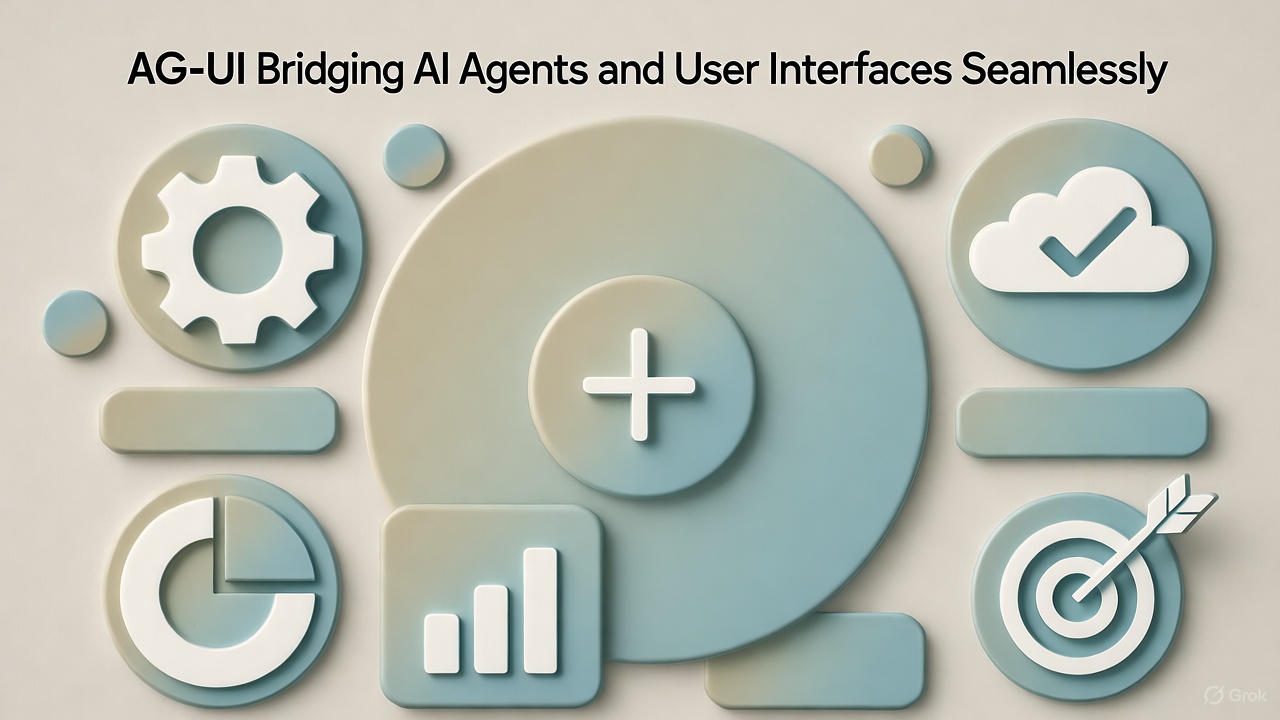
AG-UI: Bridging AI Agents and User Interfaces Seamlessly
The Open Protocol Empowering Real-Time, Human-in-the-Loop AI Experiences in Modern Frontend Apps
AG-UI: Bridging AI Agents and User Interfaces Seamlessly
The Open Protocol Empowering Real-Time, Human-in-the-Loop AI Experiences in Modern Frontend Apps
Introduction
In the rapidly evolving landscape of artificial intelligence, AI agents are no longer confined to backend silos — they’re stepping into the spotlight of user-facing applications. As of September 2025, developers are grappling with the challenge of integrating these intelligent systems into dynamic frontends without sacrificing performance or simplicity. Enter AG-UI (Agent-User Interaction Protocol), a lightweight, event-based standard that’s quickly becoming the go-to solution for embedding AI agents directly into user interfaces.
Born from hands-on experience in building in-app agent interactions, AG-UI standardizes communication between agents and UIs, supporting real-time streaming, generative elements, and collaborative workflows. Hosted on GitHub at ag-ui-protocol/ag-ui, this open-source project has garnered attention for its flexibility across frameworks and transports. In this article, we’ll explore what makes AG-UI tick, why it’s essential for today’s agentic apps, and how you can get started today.
What is AG-UI? A Closer Look at the Specification
At its core, AG-UI is an open protocol designed for effortless agent-human interaction. It operates on a simple premise: during agent executions, backends emit events aligned with one of about 16 standard event types, while accepting straightforward inputs as arguments. This event-driven architecture ensures low overhead and high interoperability.
Key to its appeal is the built-in middleware layer, which adapts to any event transport — be it Server-Sent Events (SSE), WebSockets, or webhooks. It even permits “loose” event format matching, allowing diverse agents and apps to play nice without rigid schemas. The protocol ships with a reference HTTP implementation and a default connector, making it plug-and-play for most setups.
As detailed in the project’s introduction docs, AG-UI isn’t just theoretical — it’s battle-tested for scenarios like real-time chat, state syncing, and context-aware enhancements.
Why AG-UI? Solving Real-World Integration Pains
Traditional agent frameworks excel at orchestration (e.g., tool usage or inter-agent chats), but they often falter when it comes to frontend harmony. AG-UI fills this gap by focusing exclusively on user-facing integrations, drawing from practical lessons in deploying agents within apps.
In the broader “agentic protocol stack,” it complements powerhouses like MCP (which equips agents with tools) and A2A (for agent-to-agent dialogue). While those handle the “behind-the-scenes” logic, AG-UI ensures agents feel native in your UI — think instant feedback loops or adaptive interfaces that evolve with user input. For teams tired of custom bridges or brittle APIs, AG-UI’s simplicity translates to faster iterations and fewer headaches.
Core Features: Powering Next-Gen Interactions
AG-UI packs a punch in a compact package. Here’s what sets it apart:
- Real-Time Agentic Chat with Streaming: Deliver fluid, interruption-free conversations that feel truly conversational.
- Bi-Directional State Synchronization: Keep agent memory and UI state in perfect sync, no matter the latency.
- Generative UI and Structured Messages: Dynamically render components or format responses for clarity and engagement.
- Real-Time Context Enrichment: Pull in live user data (e.g., session history) to make agents smarter on the fly.
- Frontend Tool Integration: Seamlessly invoke UI-native actions, like modals or drag-and-drops, from agent logic.
- Human-in-the-Loop Collaboration: Enable pauses for user approval or edits, fostering trust and control.
These features aren’t gimmicks — they’re engineered for scalability, supporting everything from simple bots to complex multi-agent systems.
Framework and Language Support: Broad Ecosystem Compatibility
One of AG-UI’s strengths is its growing ecosystem. As of late 2025, it boasts robust support for popular agent frameworks, with ongoing expansions via partnerships and community contributions. Below is a snapshot of current integrations:
| Framework            | Status          | Resources                  | Integration Type |
|----------------------|-----------------|----------------------------|------------------|
| No-framework         | ✅ Supported    | ➡️ Docs coming soon        | -                |
| LangGraph            | ✅ Supported    | ➡️ Docs ➡️ Demos           | Partnership      |
| CrewAI               | ✅ Supported    | ➡️ Docs ➡️ Demos           | Partnership      |
| Mastra               | ✅ Supported    | ➡️ Docs ➡️ Demos           | 1st Party        |
| AG2                  | ✅ Supported    | ➡️ Docs ➡️ Demos           | 1st Party        |
| Agno                 | ✅ Supported    | ➡️ Docs ➡️ Demos           | 1st Party        |
| LlamaIndex           | ✅ Supported    | ➡️ Docs ➡️ Demos           | 1st Party        |
| Pydantic AI          | ✅ Supported    | ➡️ Docs ➡️ Demos           | 1st Party        |
| Google ADK           | 🛠️ PR          | –                          | 1st Party        |
| AWS Bedrock Agents   | 🛠️ In Progress | –                          | 1st Party        |
| AWS Strands Agents   | 🛠️ In Progress | –                          | 1st Party        |
| Vercel AI SDK        | 🛠️ In Progress | –                          | Community        |
| OpenAI Agent SDK     | 🛠️ In Progress | –                          | Community        |
| Cloudflare Agents    | 💡 Open to Contributions | –                  | Community        |
Language SDKs are also advancing, with full support for Kotlin and progress on .NET, Nim, Golang, Rust, and Java. This matrix highlights AG-UI’s commitment to accessibility, whether you’re in Python-heavy ecosystems or branching into JVM worlds.
Getting Started: From Zero to AG-UI App in Minutes
Jumping in is straightforward — AG-UI is built for velocity. To scaffold a new app:
- Run the CLI command:
npx create-ag-ui-app my-agent-app-
This generates a ready-to-run project with dependencies wired up.
-
Navigate and install:
-
text
cd my-agent-app npm install-
Launch it:
-
text
npm startFor deeper dives, head to the documentation or explore the AG-UI Dojo — a live showcase of modular building blocks (50–200 lines each) demonstrating features like shared state across frameworks. If you’re extending support, check the Quickstart for integrations or join the Discord for collab calls.
Note: As of September 2025, no formal releases are published yet, but the repo sees active commits, including recent PRs for language SDKs.
Showcases and Community: Seeing AG-UI in Action
The proof is in the demos. Videos like the “AG-UI Hello World” (a quick Chrome extension build) and Dojo walkthroughs illustrate everything from basic chats to advanced state syncing. A June 2025 Discord workshop kicked off community momentum, and since then, partnerships with LangGraph and CrewAI have accelerated adoption.
Contributors are welcome — fork the repo, tackle an open issue (e.g., Rust SDK), and submit via the Contributing guide. Under the MIT License, it’s free to fork, modify, and deploy commercially.
Conclusion: The Future of Agentic Frontends
AG-UI isn’t just a protocol; it’s a catalyst for more intuitive, agent-powered apps. By abstracting away integration complexities, it lets developers focus on innovation — whether that’s crafting empathetic chatbots or context-aware dashboards. As AI agents proliferate in 2025 and beyond, protocols like AG-UI will define how we interact with intelligence at scale.
Ready to build? Clone the repo, spin up a demo, and join the conversation on Discord. The agent-user era is here — AG-UI is your entry point.
메타데이터
- post_id
- 16fbcb74933a
- slug
- ag-ui-bridging-ai-agents-and-user-interfaces-seamlessly-16fbcb74933a
- url
- https://medium.com/@shouke.wei/ag-ui-bridging-ai-agents-and-user-interfaces-seamlessly-16fbcb74933a
- canonical_url
- https://medium.com/@shouke.wei/ag-ui-bridging-ai-agents-and-user-interfaces-seamlessly-16fbcb74933a
- author_url
- https://medium.com/@shouke.wei
- status
- ok
- fetched_at
- 2026-08-18 10:55:16