Math In Music: The Sound Of Numbers
Introduction
Math In Music: The Sound Of Numbers
Introduction
One would think that mathematics and music are worlds apart, one being logical and based on mathematical formulas, while the other is based on emotion and imagination. However, underlying all music and harmony is a mathematical code waiting to be unlocked. The sounds we hear, the harmonies we find beautiful, and even the rhythm we find infectious are all based on mathematical patterns, ratios, and frequencies. For many years now, mathematicians and music lovers have been studying this phenomenon, showing that music is not only an art but also a language based on mathematics.
Harmony of Ratios:
Music and mathematics have been intertwined since ancient times. Long before modern science explained sound waves and frequencies, thinkers realized that the beauty of music could be described through numbers and proportions. From vibrating strings to cosmic theories about the universe, mathematical ratios have helped humans understand why certain combinations of notes feel harmonious and pleasing.
- Pythagoras’s Monochord: One of the earliest discoveries linking math and music came from experiments with a single vibrating string called a monochord. When the string was divided into simple whole-number ratios such as 1:2, 2:3, and 3:4, the resulting notes sounded naturally harmonious. This observation became the first mathematical model explaining musical intervals.
- Ratios in Ragas: In Indian classical music, ragas are built upon carefully structured relationships between notes. These relationships often correspond to precise frequency ratios, giving each raga its distinct emotional and melodic identity.
- The “Music of the Spheres”: Philosophers later extended this idea beyond music itself. The concept suggested that the motions of celestial bodies follow harmonious mathematical proportions, as if the universe itself were producing a silent cosmic symphony.
- Euler’s Theory of Consonance: Centuries later, mathematicians attempted to quantify musical beauty. One such effort involved measuring how “pleasant” combinations of notes are using equations that analyze the numerical relationships between frequencies.
The Mathematics of Sound and Scales
Every note we hear is a number, a vibration per second.
● Pitch and Frequency: Frequency (Hz) determines pitch.
● Octaves as Powers of Two: Doubling frequency produces the same note an octave higher, showing exponential relationships.
●Logarithmic Hearing: Humans perceive pitch differences multiplicatively, not linearly, hence why music uses logarithmic scales.
● Harmonic Series
● Equal Temperament vs. Just Intonation: The trade-off between mathematical purity and musical practicality.
Patterns, Symmetry, and Structure in Music
Music is mathematics in motion: rhythm, harmony, and melody all reflect symmetry and pattern.
● Fractals in Music: Recursive motifs in Bach, Debussy, or modern ambient music.
● Group Theory: Musical transformations (inversion, retrograde, transposition) as algebraic operations.
● Rhythm and Modular Arithmetic: The Mathematics of Time in Music
● Algorithmic Composition: Computers generate music through Markov chains, probability, and recursion.
Chaos and Dissonance: Order at the Edge
Between harmony and noise lies the mathematics of unpredictability.
● Chaos Theory Basics: Logistic map and Lorenz attractor, deterministic yet unpredictable systems.
● Chaos in Composition: Composers use chaotic equations to map pitch, rhythm, or timbre.
● Aesthetic Meaning: Dissonance and chaos mirror life’s complex structure emerging from randomness.
Mathematics in Acoustics and Architecture
Math doesn’t just shape notes — it shapes the spaces they live in.
● Wave Equations: Predicting how sound reflects and resonates.
● Architectural Geometry: Using ellipses, parabolas, and irregular forms to optimize acoustics.
● Modern Concert Halls: Computer simulations based on partial differential equations model how audiences will actually “hear” a room.
Digital Revolution: Math in Modern Music Technology
Every modern sound owes its life to mathematics.
● Fourier Transform: The math that breaks complex sounds into pure tones, the foundation of all digital audio.
● Sampling and Compression: Nyquist theorem, MP3 encoding, and mathematical signal representation.
● Auto-Tune and Pitch Correction: Real-time frequency mapping using advanced algorithms.
Mathematical Perception: Why We Feel Music Mathematically
Math doesn’t just shape music’s structure; it shapes our experience of it.
● Consonance and Dissonance: The ear prefers simple ratios; irrational ratios create tension. The human ear naturally prefers simple frequency ratios, which are perceived as harmonious and pleasing. In contrast, more complex or irrational ratios tend to generate tension, giving rise to dissonance.
● Neuroscience of Patterns: The brain predicts beats and symmetry, mathematical pattern recognition as pleasure. It also creates a sense of satisfaction. The brain is self reflectory that reflect its neurochemicals for a particular frequency; hence, it is advised to rectify and modify its stems for upgrading.
● Emotion and Expectation: Our joy in rhythm, balance, and surprise follows mathematical laws of probability and proportion.
Music is in the air; literally.
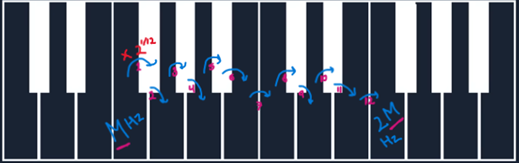
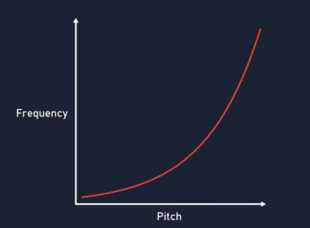
Every note you hear is nothing but tiny particles dancing in the air, creating different notes as they vibrate at different frequencies. When these vibrations get faster , i.e.,the frequency increases, the pitch of a note rises too. The relationship between frequency and pitch, though, is an exponential one, meaning that the difference in pitch we perceive from say 200Hz to 400Hz is not the same as that from 400Hz to 600Hz, rather, for that to happen, our two sets of frequencies would need to have the same ratio.
The interesting thing here is that when the frequency of a particular note is doubled, we get the same note but an octave higher. For example, the note A4 (440 Hz) becomes A₅ (880 Hz) when its frequency doubles. In fact, all the other notes are derived from this relation, and thus the ratio between two consecutive notes becomes 21/1 .
This is also exactly why a musical scale is logarithmic and not linear; we humans perceive pitch on a logarithmic/exponential scale. We hear an octave when the frequency is doubled or halved, not when a certain amount is added or subtracted from it.
What’s even more fascinating is that consonant intervals, notes that sound pleasant when played together, are usually those whose frequencies have a simple whole number ratio! Pythagoras discovered that certain frequency ratios sound especially consonant.
● Octave → 2 : 1
● Perfect Fifth → 3 : 2
● Perfect Fourth → 4 : 3
When two notes vibrate in small whole-number ratios, their sound waves align periodically, creating smooth resonance. Harmony is essentially mathematics we can hear.
Patterns, Symmetry, and Structure in Music
Music revels in the qualities that define math- patterns, symmetry, structure, all of which are beautifully present in the music around us. Concepts like Fractals- self-similar structures that repeat themselves ad infinitum- don’t just exist in geometry and nature but also in music.
From the 17th-century composer Bach, whose music contained smaller motifs repeated in larger forms, to modern-day composers who may use fractal mapping to create music, fractals are everywhere.
Music even uses similar operations as mathematics, to transform a piece while still preserving the relationship between the notes
● Transposition shifts every note by the same interval, analogous to translation in geometry.
● Inversion flips intervals around a central pitch, a kind of reflection symmetry.
● Retrograde plays the melody backward, a reversal in time.
These operations are the musical equivalent of the algebraic groups mathematicians study.
In fact, composers like Schoenberg built entire musical systems (twelve-tone serialism) on these principles, treating melodies as objects to be transformed by mathematical rules.
The Monochords and The Consonances
The Pythagorean Monochord:
You must know about Pythagoras the old man who was born between 570BC-495BC and who, well, discovered the pythagorean formula and many other result in the field, now no one’s gonna say that the results were already discovered and he just wanted blow up his name, but it’s not like we’re here to talk about that part of the Bean-Hating old man’s stuff but some part that is not well talked about…..
So, as the story goes, once Pythagoras was taking a walk around, he heard the clanking sound of the hammers at a toolsmith. He saw that the length of the hammers used made a different sound when striking the anvil, and from that it led to the discovery of monochords.
Simply put monochords can be defined as tunings in which the frequency ratios of all intervals are determined by choosing a sequence of fifths: which are “pure” or perfect, with ratio 3:2 .This is chosen because it is the next harmonic of a vibrating string, after the octave (which is the ratio 2:1) . Using these we can create multiple notes and create our own harmonic.
Let us now look in the detailed step by step method:
-
We take 2:1 as the starting point. Let’s call it the BASE
-
Now we multiply our bass by 3:2 to go up an octave and create our first perfect fifth.
-
Again, we do the same, hence creating a new note(9/4), and here we notice that our harmonic is greater than 2, thus making it out of the octave range. To prevent this, we multiply the note by ½.
Why did we multiply by ½?
We multiplied by ½ because by doing so, we can reduce our frequency by a factor of ½
-
Going forward, we will keep creating new fifths by repeating the method, and thus we have a continuous series of pleasant-sounding notes till we have a total of 11 fifths or 12 notes.
-
Using these, we can go an octave above it by multiplying our base octave by 2 or below by dividing it by 2.
Well, this is how Pythagoras made music, nothing less expected from a philosopher and mathematician.
The Major Flaw: The Wolf Interval
Remember, we went up to 11 fifths before stopping our quest into a particular octave. What would happen if we moved just one more fifth up? Well, if you remember that our Music system revolves around the fact that our fifths revolve around the octave that are into. Let’s look mathematically at this
12 Fifths= (3/2)12≅129.74
7 Octaves=(2)7=128
Now we can see that the complete cycle of fifths actually is never able to be equal to or return to a pure octave, as our 12th fifth came too close to the 7th octave but never equal to it.
Coming to this point, let me introduce you to a new term, ‘The Pythagorean Comma’, which can be said to be the ratio of the fifths to octaves. For the tuning to work, our ratio needs to be 1, which is not possible, and because the system assumes these values are equal to create a closed loop, the final interval in the chain — the 12th fifth — must be severely narrowed to fit. This grating, dissonant interval was known as the Wolf Interval.
The Fix: Equal Temperament
Developed in the 17th century, this system abandons the goal of having mathematically pure ratios for any interval (except the octave). Instead, it makes the ratio between any two successive notes the same, creating 12 equally spaced notes in the octave, and well, this made the lives of musicians a lot easier.
The Ratio: The frequency ratio between any half-step is the twelfth root of two ≈ 1. 059
Every interval (fifths, thirds, etc.) is now slightly mathematically imperfect (irrational), but they are all consistently and equally imperfect across the entire range, eliminating the Wolf Interval
Euler’s Theory of Consonance
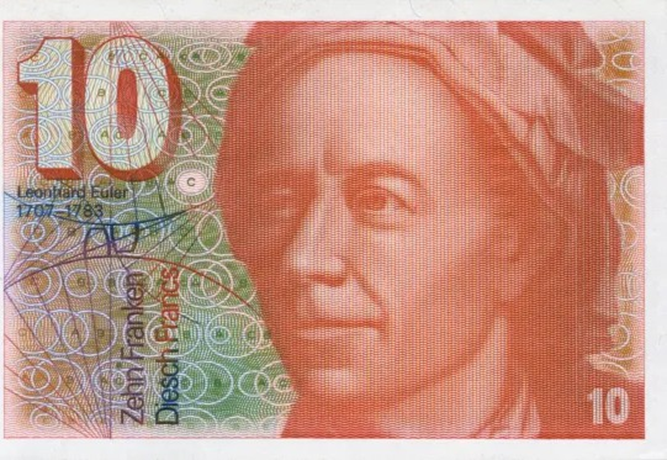
Continuing our way forward in this journey, we come across arguably the most respected Mathematician: Leonhard Euler. This man was a ‘universal genius’, publishing 1 paper every week, even after losing his eyesight, and boy, oh boy, it’s to no surprise how much the modern mathematics has due to his contribution and let alone math, he also wrote a whole book on modern music theory Tentamen novae theoriae musicae (An Attempt at a New Theory of Music).
Let us now dive deeper into this book, and let’s see how a genius can redefine music….
Leonhard Euler’s Gradus Suavitatis or Order of Softness
Euler’s goal was to move beyond the simple binary of consonance (good) vs. dissonance (bad) that dominated Baroque-era musical rules, creating a system that could assign a precise, numerical value to the “pleasantness” of any interval or chord.
The fundamental principle is that the consonance of an interval is directly related to the simplicity of the ratio between the frequencies of the two notes.
Let's go step by step and learn how Euler’s Formula works:
1. Initial Rules and Observations
● 1:1 (Unison): Assigned the 1st Order.
● 1:2 (Octave): Assigned the 2nd Order.
● Powers of Two: For ratios that are powers of 2 (1:2^n), the order is the exponent plus one (n+1). For example, two octaves (1:4 or 1:2²) is the 3rd Order (2+1=3).
● Prime Numbers: For ratios that are prime numbers (1:p), the order is the prime number itself. For example, 1:3 is 3rd Order, and 1:5 is 5th Order
2. The General Formula (Prime Factorization)
The general formula uses prime factorization to break down any ratio’s number into its smallest components.
For a number N with prime factors p1, p2, p3,…and exponents e1, e2, e3,…, the formula is calculated by:
-
Subtracting 1 from each prime factor: pn -1
-
Multiplying the result by its exponent: (pn — 1)times en.
-
Summing these results for all prime factors.
-
Adding a final 1.
Example: For the ratio 1:20 (20 = 22x51):
● 2→(2–1)x2=2
● 5→(5–1)x1=4
● Sum: 2 + 4 = 6
● Final Order: 6 + 1 = 7.
3. Application to Intervals and Chords
● Intervals (not starting with 1): For ratios like the perfect fifth (2:3) or major third (4:5), the numbers are first simplified, multiplied together (2 x 3 = 6 or 4 x 5 = 20), and this product is plugged into the prime factorization formula.
● Chords: For a triad, Euler used the Least Common Multiple (LCM) of the ratios’ numbers. For the major triad (4:5:6), the LCM is 60, which, when run through the formula, yields an Order of Softness of 9.
Now that we have a clear understanding of how the formula works we also need to see the strengths and challenges that it faces….
Strengths and Limitations of the System
Strength
The formula’s success in creating a coherent ranking that largely matches musical intuition, placing the octave and perfect fifth on top and the minor second and tritone at the bottom, offering far greater nuance than the old binary system.
Limitations
● Precision Issues: The formula struggles with large, complex ratios. For example, the video shows a highly dissonant $200:299$ ratio that, in practice, sounds like a slightly flat perfect fifth — meaning human perception can override the formula’s harsh score.
● Modern Tuning: The formula is based on Just Intonation ratios. Modern music uses Equal Temperament, where intervals are slightly “off” from these pure ratios. Despite the mathematical difference (e.g., the modern major third being closer to a 50:63 ratio), the ear still perceives it as the “pure” 4:5 ratio, rendering Euler’s precise calculation less relevant to modern performance.
Chaos and Dissonance — Order at the Edge
A lot of music always seems to live between order and noise. A melody feels like it follows rules, while a violent cluster of notes feels like it’s breaking them. But what if the most unpredictable music isn’t actually random at all? At the edge where harmony dissolves into dissonance, we find a strange type of order: patterns that almost make sense, textures that evolve like weather, and music that feels alive because it’s never the same twice. To understand why this zone feels so powerful, let’s take a quick look at Chaos Theory.
Chaos Theory
Chaos Theory is a field of mathematics that studies systems that follow strict rules but still behave in ways that we can’t fully predict. These systems are very sensitive to initial conditions, where small changes in the starting point can cause large effects in the system, sometimes known as the “butterfly effect”.
The Logistic Map
A classic example of this is the logistic map, a recurrence relation described by the equation:
As the logistic map’s control parameter r increases, the system transitions from stable repetition
-> doubling patterns -> and eventually chaotic motion. The structure is still there, but now it evolves in ways that no longer feel predictable.
Swans
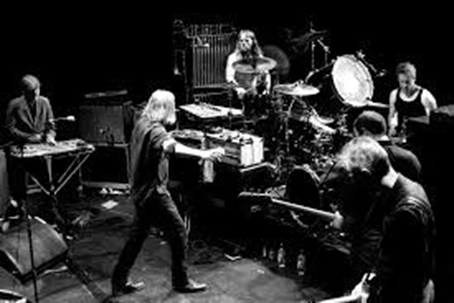
Swans are a rock band known for long, repetitive structures that slowly build into overwhelming walls of sound. Their music often sits between order and noise, patterns that seem stable at first, but intensify until they twist into something turbulent and unpredictable.
As they repeat a riff and subtly increase distortion, volume, or rhythmic tension, the piece undergoes a kind of sonic phase transition. It’s not random, but it feels like it could rupture at any moment. Tracks like
Blood Promise (from Swans Are Dead: Live ‘95-’97) and The Glowing Man are perfect examples of structure evolving into chaos. The fine edge between chaos and order makes these songs some of the most mind-bending experiences in music.
The Lorenz Attractor
In the 1960s, Edward Lorenz was trying to model the weather using a few simple rules about how heat moves through the atmosphere. He plugged numbers into a computer, changed one tiny value… and the entire pattern of wind he predicted changed wildly. Even though the motion looked chaotic, it wasn’t random. It kept swirling inside the same overall shape, called the Lorenz attractor.
This is the essence of chaos theory:
Chaos is the unpredictability inside a well-defined deterministic system.
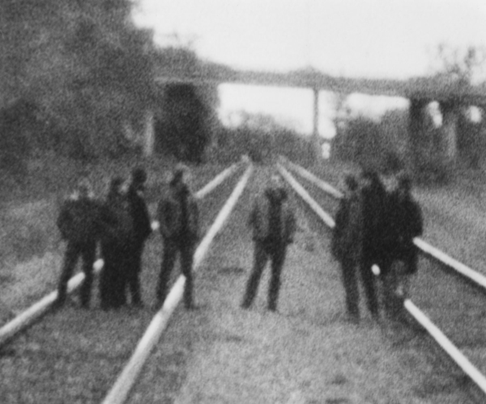
Godspeed You! Black Emperor
Godspeed writes long-form compositions where layers of guitars, strings, and drones evolve gradually over time. The direction is always clear, the piece is always moving somewhere, but the way it gets there is filled with subtle, unpredictable changes. Distortion increases, rhythms loosen, new textures enter or fade, and the entire piece shifts shape without ever collapsing into noise. continuous change inside a structure that never fully repeats and never breaks apart. Tracks like Mladic, Storm show how complexity can escalate while the foundation still holds. unpredictable locally, consistent globally.
Digital Revolution: Math in Modern Music Technology
Think about how you listen to music today. Not on CDs or cassettes, but on Spotify, YouTube, or Gaana. One click, and the world’s music plays instantly. But behind that effortless experience lies a world of mathematics, signals, and algorithms quietly reshaping how music is created and shared. From Pythagoras measuring harmony on a single string to Spotify predicting your next favorite song, music and math have come full circle. What began as the study of perfect ratios has transformed into algorithms that compose, correct, and recommend. This is the digital revolution, where sound is no longer bound by instruments or space. Instead, it travels through waves of data and code. The same math that once tuned a lyre now powers Auto-Tune, sound filters, and even your favorite Bollywood remixes. In this new era, music isn’t just heard; it’s calculated, coded, and personalized for every ear.
Fourier Transform :
Have you ever paused to watch the sound bars on your screen move perfectly to your favorite song? Those waves, colorful, alive, and rhythmic, aren’t just visuals. They are mathematics in motion. They show what happens when math starts to listen. I still remember opening a music editing app for the first time. The screen was full of moving patterns: sharp spikes, gentle humps, fading echoes. Every rise and fall was a heartbeat of sound. Yet beneath that beauty was a simple but powerful idea: even the most complex sound can be broken down into pure, simple waves. That is the magic of the Fourier Transform.
“The whole is nothing more than the sum of its parts.” — Aristotle
That quote by Aristotle captures its essence perfectly. The Fourier Transform is like a bridge that takes messy, layered sounds and reveals their hidden ingredients. A violin’s warmth, a singer’s tremble, a drum’s deep pulse, each is made up of tiny sine waves vibrating at different frequencies
Mathematically, this beautiful process is expressed as:
At first glance, this equation might seem intimidating. But think of it like a translator. It takes sound from the time domain, where we hear changes over time, and converts it into the frequency domain, where we can see the notes, tones, and harmonies that shape it. It’s like turning a song into a color palette where each frequency is a shade, each note is a brushstroke.
We experience Fourier’s work every single day, often without realizing it. When you hum into Shazam, and it instantly recognizes the song playing in a café, it’s the Fourier Transform at work, breaking your recording into frequency patterns and matching them against millions of others.
When your noise-canceling headphones silence the roar of an airplane, they’re using the same math to detect unwanted frequencies and cancel them by generating the opposite wave. Even voice assistants like Siri or Alexa rely on Fourier analysis to understand what you’re saying, converting speech into frequency data before turning it into meaning.
“Fourier didn’t just find equations — he found harmony hidden inside chaos.”
That’s what fascinates us most. It’s not just math; it’s philosophy. It’s the realization that even the most unpredictable sounds, a crowded street, a crashing wave, a chaotic melody, can be expressed as a pattern of perfect sine waves. Beneath the surface of every sound, structure, and order is waiting to be uncovered.
The Fourier Transform gave sound a way to be seen, numbers a way to be heard, and music a language that science could finally understand. From studio recordings to AI-driven mixing tools, from the way Spotify cleans your playlists to how film composers sculpt emotion, Fourier’s mathematics hum quietly beneath it all.
In the end, it feels poetic to think that behind every beat and every note lies an equation not cold or mechanical, but alive, listening, and resonating with the rhythm of the world. Fourier didn’t just give us a formula; he taught us that math itself can sing.
Sampling and Compression :
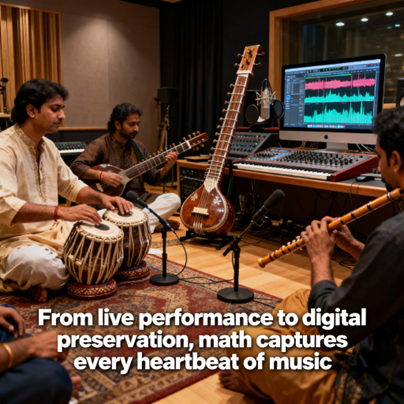
Imagine sitting in a quiet room, listening to a sitar gently weaving a raga at dawn. The pluck of each string, the subtle vibrato, the tiny pauses between notes, all these delicate waves of sound are flowing continuously through the air.
But how does a computer capture that soul, that richness, and turn it into something you can play on your phone or stream online?
The secret begins with sampling. Think of it like taking rapid snapshots of the sound wave, thousands of tiny measurements every second, which captures a moment of the vibration. The higher the sampling rate, the more faithfully the wave is recreated. But how high is high enough?
This is answered by the Nyquist Theorem, a simple yet powerful rule: the sampling rate must be at least twice the highest frequency in the sound.
fs ≥ 2 × fmax
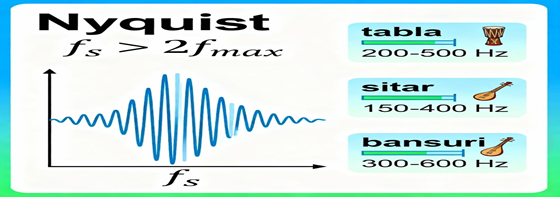
For humans, that means recording at 44.1 kHz preserves everything we can hear from the soft flutter of a flute to the crisp, rapid strokes of a tabla. Sample too slowly, and the sound bends, distorts, and loses its clarity, mathematically folding high notes into low ones, creating ghostly echoes that were never played.
Once the wave is captured, another challenge appears. Raw digital recordings of an entire raga or orchestral piece are enormous. How can it be stored, streamed, or shared easily? This is where compression works its quiet magic. Using mathematics, compression algorithms like MP3 or AAC remove frequencies that the human ear barely perceives. The music loses none of its soul, yet the file becomes small enough to travel across the internet instantly.
Imagine a long alaap in a raga, with every microtone intact, yet stored in a fraction of the original size, mathematics has preserved the emotion, the subtle vibrato, the space between notes, while removing the inaudible excess. It’s like trimming a masterpiece painting without losing a single brushstroke.
“Mathematics doesn’t just measure music; it listens, preserves, and lets it travel through time.”
From a tabla’s rhythmic pulse in a Mumbai studio to a bansuri’s airy melody streamed to headphones across the globe, every note passes through this invisible mathematical filter. Sampling captures the wave; compression sculpts it. Together, they turn ephemeral vibrations into lasting experiences, proving that math and music are not separate worlds, but deeply intertwined.
Auto-Tune and Pitch Correction:
Have you ever listened to a pop song and wondered how every note sounds so perfectly in tune, even when sung live? Or noticed the subtle glide of a voice in modern Indian pop or Bollywood tracks, where every pitch bends flawlessly? Behind this magic is Auto-Tune, a mathematical wizard turning raw human vocals into perfectly tuned music.
A
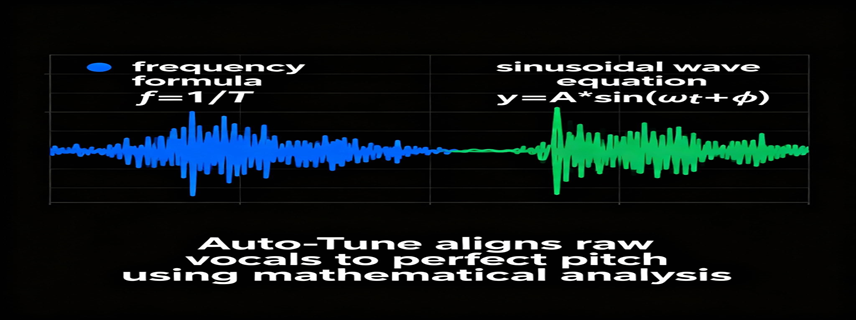
At its core, Auto-Tune relies on real-time frequency analysis. Every vocal note is converted into digital data, and its frequency is measured with extreme precision. If a singer sings slightly flat or sharp, algorithms calculate the difference between the actual frequency and the desired pitch. Then, almost instantly, the note is adjusted mathematically to match the target.
This process uses concepts from Fourier analysis and signal processing. The sound is first decomposed into its frequency components, which are much like the Fourier Transform reveals the hidden sine waves in complex music. Then, using advanced algorithms, the pitch of each component is shifted just enough to correct the tone without distorting the timbre of the voice.
Imagine a classical Indian singer attempting a delicate glide between notes in a raga. Auto-Tune can preserve the expressive slide while subtly aligning the pitch to the intended note, maintaining emotion and musicality while ensuring precision. This isn’t just digital magic; it’s math applied in real-time to enhance human expression.
“Auto-Tune is where mathematics meets art — transforming human imperfection into musical perfection.”
From Bollywood playback singing to modern fusion tracks and live performances, Auto-Tune and pitch correction have become essential tools. They allow artists to explore creativity without being constrained by tiny pitch errors, while listeners enjoy flawless, immersive music. In essence, this is the final step in the digital journey of sound: after Fourier analysis and sampling, math ensures that even the human voice aligns with harmony itself.
References
● Whipple Museum: The Monochord
● Stanford Encyclopedia of Philosophy — Music and Mathematics
● Tymoczko, “The Geometry of Musical Chords” (Science, 2006)
● MIT OCW: The Physics of Music and Sound
● Numberphile: Fractal Music
● “Gödel, Escher, Bach” by Douglas Hofstadter
● “Chaos and Music: From Lorenz to Ligeti” by Eduardo Reck Miranda
● WolframTones — chaos-based music generator
● “Chaos and Music: From Lorenz to Ligeti” by Eduardo Reck Miranda
● WolframTones — chaos-based music generator
메타데이터
- post_id
- 16fff3396fbb
- slug
- math-in-music-the-sound-of-numbers-16fff3396fbb
- url
- https://medium.com/@nakshatransit/math-in-music-the-sound-of-numbers-16fff3396fbb
- canonical_url
- https://medium.com/@nakshatransit/math-in-music-the-sound-of-numbers-16fff3396fbb
- author_url
- https://medium.com/@nakshatransit
- status
- ok
- fetched_at
- 2026-06-21 19:25:17




