Securing the Checkout: A Threat Modeling Case Study
Context: We performed a security analysis on our e-commerce platform (React, Node.js, PostgreSQL, Stripe) to identify and mitigate critical…
Securing the Checkout: A Threat Modeling Case Study
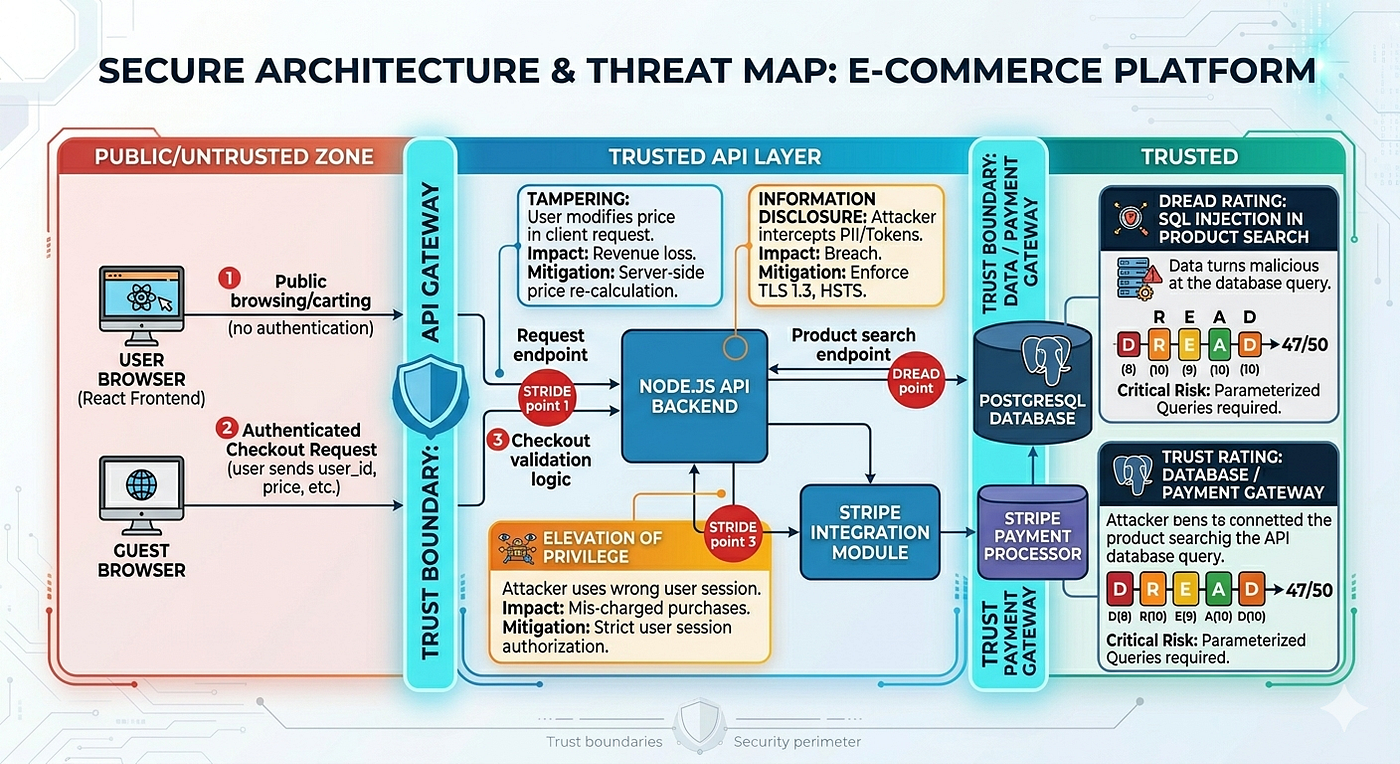
Context: We performed a security analysis on our e-commerce platform (React, Node.js, PostgreSQL, Stripe) to identify and mitigate critical risks in the checkout flow and search functionality.
To analyze this e-commerce platform, we will apply the methodologies of STRIDE, DREAD, and architectural decomposition to secure the checkout flow and the search function.

1.2 Identifying Trust Boundaries
Trust boundaries delineate where security controls must be enforced because the level of trust changes.
- Frontend/Backend Boundary: The boundary between the user’s React browser and the Node.js API. Everything on the client side is untrusted, while the server is trusted. All API endpoints must treat incoming data as malicious until validated.
- API/Stripe Gateway Boundary: The boundary between your Node.js backend and the Stripe payment infrastructure. While both are “trusted” systems, your system must treat the connection as a boundary where secrets (API keys) are used to authenticate requests.
- Backend/Database Boundary: The boundary between the Node.js application and the PostgreSQL database. The application must treat the database as a highly sensitive zone, using parameterized queries to ensure the database layer is not directly exposed to user input.
1.3. DREAD Scoring: SQL Injection in Product Search

Conclusion: With a score of 47, this is a critical risk. You must immediately implement parameterized queries (prepared statements) to ensure user input is treated as data, not as executable SQL code.
2. Healthcare Mobile App

This healthcare mobile app environment involves highly sensitive Protected Health Information (PHI), making security and privacy the top architectural priorities. Here is the threat analysis and security prioritization.
2.1 Critical Asset Analysis
The most critical asset is the Patient Medical Record (PHI). medical records carry the highest combined CIA weight. They are the asset HIPAA’s Security Rule is specifically built around, and they’re the one whose compromise causes irreversible harm — you can rotate a password, but you cannot un-expose someone’s diagnosis history.
Applying the CIA Triad:
- Confidentiality — highest stakes: Medical records reveal diagnoses, mental health history, substance use, reproductive health, and genetic data — categories with social, employment, and insurance consequences if disclosed. HIPAA classifies this as PHI requiring the strictest access controls of any data type in the system.
- Integrity: If altered (e.g., incorrect medication dosages or diagnosis records are injected), the result can be direct physical harm or death to the patient.
- Availability: If the records are inaccessible during an emergency (e.g., ransomware), the healthcare provider cannot deliver necessary care, potentially leading to critical health outcomes
2.2 STRIDE Analysis: “Message Healthcare Providers” Feature

2.3 Prioritized Security Controls
When protecting PHI, we focus on Defense in Depth. Here are the five prioritized controls:
. Identity & Access Management (MFA): Highest priority. Standard passwords are insufficient for healthcare. Multi-Factor Authentication ensures that even if credentials are stolen, the patient account remains secure.
. End-to-End Encryption (Encryption in Transit/At Rest): Data must be unreadable to anyone without the decryption key. This ensures that even if a database is breached or a network is intercepted, the PHI remains protected.
. Role-Based Access Control (RBAC): Ensures “Principle of Least Privilege.” Only authorized staff can view specific parts of a record, limiting the “blast radius” of an internal compromise.
. Immutable Audit Logging: Every time a record is accessed, edited, or messaged, an unchangeable log entry must be created. This is vital for accountability, forensic investigation, and HIPAA compliance.
. Data Masking and Anonymization: For development and analytics, PII/PHI should be masked. This reduces the risk of accidental exposure during internal system processes.
3. IoT-Specific Threats
The security of an IoT ecosystem requires moving beyond software-level threats to include hardware and physical interface vectors. Below is the threat analysis for the Smart Thermostat.

Unlike web apps, IoT devices have unique vectors due to their proximity to hardware and local network reliance:
- Physical Interface Exposure: Unauthorized access via JTAG, UART, or USB debug ports left active on the PCB.
- Lack of Hardware-Based Root of Trust: Without secure boot or a Trusted Platform Module (TPM), attackers can replace the firmware with malicious versions.
- Insecure Default Credentials: Devices often ship with hardcoded, shared manufacturer credentials that are easily brute-forced.
- Side-Channel Attacks: Measuring power consumption or electromagnetic emissions to extract cryptographic keys stored in volatile memory.
- Firmware Extraction & Analysis: Using SPI Flash dumps to reverse-engineer the binary, discovering hidden APIs or hardcoded API keys for cloud services.
3.2 Physical Access Attack Chain
If an attacker gains physical possession of the device, the following chain of compromise is likely:
- Step 1: Reconnaissance. The attacker inspects the PCB for hidden headers (e.g., serial console pins).
- Step 2: Access. Using a logic analyzer or UART-to-USB bridge, they tap into the boot process to gain a root shell.
- Step 3: Extraction. They dump the flash memory content, which contains configuration files, Wi-Fi credentials, and cloud API tokens.
- Step 4: Manipulation. They modify the firmware binary to create a “backdoored” version that pings a malicious server, then re-flash the modified image.
- Potential Impact: Total device control, lateral movement into the home network via stored Wi-Fi credentials, and botnet enrollment (e.g., Mirai-style attacks).
3.3 Securing the OTA Update Process
The Over-The-Air (OTA) update mechanism is the most sensitive feature. To ensure integrity, the following controls are essential:
- Code Signing (Asymmetric Encryption): The device must verify the firmware signature using a public key burned into hardware. If the signature doesn’t match the private key held by the manufacturer, the device rejects the update.
- Secure Boot: The device performs a cryptographic chain-of-trust check upon power-on, ensuring only verified, authenticated firmware can execute.
- Encrypted Channels (TLS): All firmware downloads must occur over a mutual-TLS (mTLS) connection to prevent Man-in-the-Middle (MITM) interception.
- Rollback/Anti-Rollback Protection: The device must store version numbers in secure storage to prevent an attacker from downgrading the firmware to an older, vulnerable version.
- Staged Rollouts & Hash Verification: Verify the SHA-256 hash of the entire image before the update is committed to the active partition.
4. Financial Trading Platform

In financial systems, where every millisecond counts and regulatory scrutiny is constant, security must be integrated into the architecture rather than added as a layer on top.
4.1 The Critical CIA Component: Integrity
While Availability and Confidentiality are important, Integrity is the most critical component for a trading platform.
- Why: In financial markets, the “truth” of a trade — the price, the quantity, and the identity of the buyer/seller — is the foundation of the entire system.
- Impact of Failure: If data integrity is compromised (e.g., unauthorized alteration of trade orders or balance sheets), the platform faces immediate financial loss and legal repercussions from regulatory bodies like the SEC and FINRA.
- Performance Conflict: Strict security controls, such as deep packet inspection or complex MFA handshakes, can increase latency. Developers resolve this by using asynchronous security validation and hardware-accelerated encryption to keep trade execution below the 100ms threshold.
2. Threat Modeling: Automated Trading Rules
Automated trading rules are high-value targets because they execute transactions on behalf of the user.
- Logic Manipulation: Attackers may modify rule parameters to execute disadvantageous trades (e.g., buying high and selling low).
Mitigation: Store rules as cryptographically signed objects so that any unauthorized modification invalidates them.
- Unauthorized Execution: An attacker gains access to a user account and triggers rules to drain funds.
Mitigation: Implement “Step-up Authentication,” requiring a time-sensitive MFA token for any rule modification or mass execution.
- Race Conditions: Exploiting network latency to feed the engine stale market data.
Mitigation: Utilize deterministic execution with server-side atomic timestamps; any data packet older than the current market tick is rejected.
4.3 Defense-in-Depth: Limiting Account Compromise
If an attacker successfully bypasses initial login, the system must limit the “blast radius” via multiple defensive layers:
- Context-Aware Authentication: Automatically trigger additional identity verification if the login attempt deviates from the user’s “normal” (e.g., new device, new IP, or unusual geo-location).
- Velocity and Limit Controls: Enforce hard-coded thresholds on the total volume and frequency of trades/transfers that can be performed within a specific timeframe.
- Service Segregation: Decouple the trading engine from the fund withdrawal service. A compromised trading account should not have direct, automated permission to move funds to an external bank without a separate, high-privilege verification step.
- Behavioral Analytics (UEBA): Implement machine learning to monitor for trading patterns that deviate from the user’s historical behavior (e.g., suddenly trading obscure, high-volatility assets), triggering an immediate account freeze.
- Immutable Audit Logs: Maintain a tamper-proof, write-only log of every state change in the user’s account. This ensures forensic traceability for FINRA/SEC compliance.
메타데이터
- post_id
- 17830bc7f7e4
- slug
- securing-the-checkout-a-threat-modeling-case-study-17830bc7f7e4
- url
- https://medium.com/@hafidhbakar504/securing-the-checkout-a-threat-modeling-case-study-17830bc7f7e4
- canonical_url
- https://medium.com/@hafidhbakar504/securing-the-checkout-a-threat-modeling-case-study-17830bc7f7e4
- author_url
- https://medium.com/@hafidhbakar504
- status
- ok
- fetched_at
- 2026-07-09 21:48:21