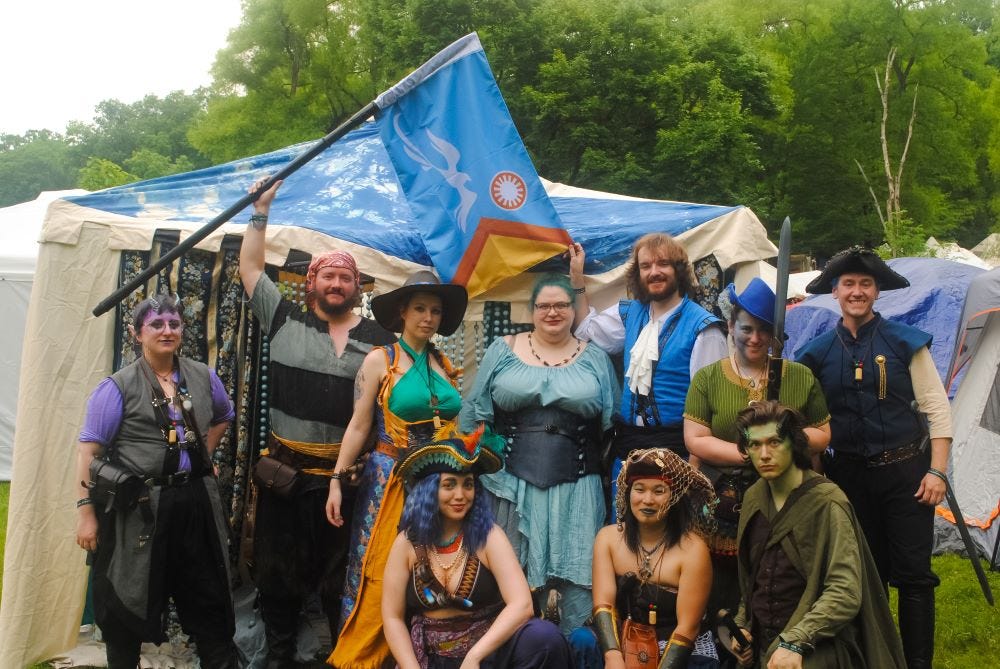
Re: “Fantasy, Not History “— DFUS Blog Thoughts
On Friday April 4th, the Drachenfest team released a blog post on their website titled “Fantasy, Not History”, detailing DFUS’s policy on…
Re: “Fantasy, Not History “— DFUS Blog Thoughts
Wherein we reckon with the implications of the latest DFUS policy change — nothing is from Earth, only “Earth-inspired”.
On Friday April 4th, the Drachenfest team released a blog post on their website titled “Fantasy, Not History”, detailing DFUS’s policy on real-world places, symbols, ethnicities and cultures — do not play them.
As a social justice writer and prospective DFUS 2025 attendee, I feel compelled to write some commentary on this updated policy. I’m not aware of whether this has been a hot button issue or a fierce topic of conversation for attendees — nevertheless, it’s worth doing some critical analysis as a frame of reference for new and veteran players alike.
TL;DR I support the policy, but the article stands on some shaky semantic footing and doesn’t contain a whole lot of discussion on race and gender inequity in the LARP scene, which I would have liked to see.
Despite my misgivings with the article (or perhaps because of them), I think there’s value in continuing the discussion they began. So allow me to dive right in.
The Policy is a Series of Concessions
For the record, this is not a condemnation or disapproval of the announcement, but an observation of the statement at face-value. DFUS is interested in opening its sandbox up to as many people and their myriad perspectives together. Given this, the choice to confine a lot of this discussion in concrete terms is not unreasonable from a business or policy perspective.

The official policy, in brief.
It might be better to frame this blogpost as such: with regard to costuming and roleplay, what responsibility does the DFUS team have to the emotional safety of its diverse player base and staff? So far the answer has been to establish a clinical position: do not make explicit references to the real world. Make minor modifications to costumes and language to fall in line with this policy. Avoid caricature, and be open to critique from staff if they voice concerns.
On the whole, this seems reasonable enough. This dovetails nicely with the other policies on the website — there are plenty of sections declaring that DFUS is a no “isms” space. Seems legit so far.
There’s a broader discussion on the challenges of “fairness” in LARP expression; in there they discuss “permission” for explicitly cultural wear. While I don’t disagree that there are many nuances and pitfalls to navigating this topic, the conclusion it draws does not exactly follow. “Removing Earth from all of this will help” is a bit of a non-answer. After all, we’ve discussed previously how plenty of fantasy LARPs still manage to be racist without referencing the real world in name.
The blog acknowledges this somewhat, saying that the policy to change proper nouns is a “band-aid”, implying the beginning of a much longer conversation. I agree, but given that DFUS is billing itself as the premier US LARP, I do feel slightly underwhelmed by hedging a policy in this way. I suppose it’s up to the rest of us to triage the wound.
Beyond some reasonable notes on avoiding real-like religious symbols and costumes, a large section of the blog covers how one can substitute a real-world proper noun with a fictional one: The “Tokugawa Clan” for the “Jade Crane Court”, China and Japan with the Earth and Fire Kingdoms from AtlA, and — “Kill the Jews” with “Kill the Deves.” Hmm.
Finally, the article concludes that DFUS is “not asking you to be less creative. We’re asking you to be more.” Hopefully by being expansive on fantasy, it reads, you can have more fun with less harm.
Generally, I appreciate this article for what it is: outlining some standards for the game for better inclusion. It’s in the meat where I start to find some points for critique, and I’ll go over these next.
First: “Open Source” Cultures — Greece, Rome and the Vikings

the Open Source mindset, probably
Sorry for being a pedant, but I wanted to address this first.
The DFUS team opens their elaboration by arguing that even though some people have declared that certain cultures are “open-source”, using proper nouns and imagery directly could open a can of worms that DFUS would like to avoid. I don’t mean to be this person, but — why are we using the term “open source” in the first place? I’m not very “hip” to the world of fantasy/TTRPG literature, but apparently this is accepted as a colloquialism, and I’m not fond of it.
Considering that their examples for “open source” include Greek and Viking cultures, I have to assume that open source stands for white cultures (or ones frequently used as inspiration for Western fantasy canon, like pirates), and closed source stands for non-white or marginalized cultures, with some caveats in there for both. I’m going to eschew this terminology and cut to the chase — why is the DFUS team banning the usage of cultural names and costumes with no real risk of appropriation?
Update: On 4/9/25, the DFUS team released the 2025 rulebook, and page 5 makes mention of “open source” and “closed source” aesthetics, yet again. In my opinion, culture “source” debates preclude a certain thoughtfulness that I believe is necessary for navigating a diverse world earnestly. I wish the DFUS team was able to address the nuances of costuming with more precision. “Open source” is not a substitute for “safe” , just as “closed source” doesn’t equate to “controversial.”
It may be worth starting with classical studies, aka one of the intellectual inspirations of “Western” society. Classicism historically was a kind of educational bedrock for European gentlemen; Greco-Roman systems of governance, law and warfare were studied and deployed as nation-building blueprints. The USA’s current mode of governance (as of 2025, so far) takes massive inspiration from Athenean and Roman democracies.
Philhellenism, an intellectual movement focused on Ancient Greece in particular, left a major impression on art, archaeology, and philosophy in the Western world. Kate Alexandra’s video essay has a primer on the impact of Antiquity period cultures on both recent history and the present day, and I highly encourage watching.
Part of the issue with Classicism is the cultural soft power it holds in the West — the Greco-Roman world has frequently been invoked, reinterpreted and weaponized to malicious ends. The most egregious instance is, of course, the Nazis: the Third Reich was named explicitly in reference to the Holy Roman Empire. Much of the mythos of the Aryan race was bolstered by claims that the success of Greek and Roman societies was due to their “Germanic blood”. Hitler was an open laconophile, and race scientists rushed to connect the mythos of Spartan military superiority with their own imperial ambitions.
For the record, “Viking” iconography was not spared from this pointed usage either. Nordic mythology was regularly appropriated for use in Nazi propaganda and imagery. Nordic runes like the sigel/sowilō (ᛋ) famously were used by the Schutzstaffel. They also frequently utilized Norse imagery and myths in material manufactured for their Scandinavian allies and occupied territories.
Unfortunately fascists have not abandoned their selective treatment of culture — far from it. The rebounding neo-nazi movement continues to persist in their efforts to shape ancient cultures and histories to nationalist, racist political movements. The Neo-Nazi organization Golden Dawn justified Swastika tattoos by insisting they were “Trojan”. The alt-right “trad” internet movement which invokes “RETVRN” makes calls to embrace the Roman empire as a blueprint for contemporary politics. With phrenology gaining a surge of interest in social media spaces like Tiktok, Vikings have once again started trending alongside race science. This is not an isolated phenomenon.
The distinction between “closed” and “open source” cultures are in the power dynamics of Western hegemony — a fetish for marginalized cultures is extractive and appropriative, whereas a fetish for the classics is manipulative and prescriptive. In the US, American native cultures are frequently depicted as primitive, their clothing and artifacts used to represent a primordial power, traditional wisdom, and connection to nature. The Spartan “red and bronze” (as depicted in 300), on the other hand, evokes authority: power, martial prowess, and discipline. These attributes don’t arise out of a vacuum, but are derived from a biased sociopolitical lens. This lens is the issue here: a tendency to detach a culture’s aesthetic from their peoples and histories, and wield it as a cudgel. One of the many reasons DFUS is pursuing a “Fantasy, Not History” policy is to try softening the blows — by divesting Drachenfest’s costumes of specific iconography, the hope is that these power dynamics will no longer be in play.
To be clear, carrying an aspis and spear into battle at DFUS doesn’t make you a fascist. You aren’t a Nazi for carrying nordic runes around your neck or on your body as a tattoo. However, in a shared playspace, these icons can suddenly take on new meaning if your character is a xenophobe, or shouting nationalist slogans. For these reasons and more, we should be responsible for the storytelling choices we make while in costume. If you are a player hoping to costume up in either Greco-Roman, Viking, or European medieval wear, I recommend you remain curious about the cultures that inspire you, and the ways that they continue to influence contemporary politics.
Let’s set this aside for now and move on to Drachenfest’s proposed substitution solution.
The Pitfalls of Substitution

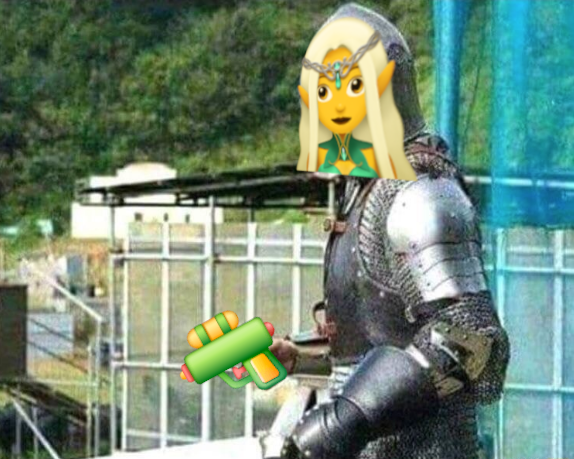
One of the many examples the blog uses for its plan to rid DFUS of the “real world.”
“Kill the Deves”, perhaps a bad comparison in print, is exemplary for a variety of reasons.
One of the primary issues with this example is that, crucially, prejudice and discrimination do not need to name a particular identity in order for their harms to be real. Anti-Semitism is the archetypal endpoint for conspiracy theories for a reason: the common thread between “lizard people”, “the bankers”, “the new world order” is the invocation of a conspiring secret society with an outsized amount of financial/social control — these are Nazi dog whistles, full stop. The history of the internet as we know it is shaped by Nazis and their relentless efforts to dodge censorship through the invention of anti-Jewish codewords.
Dog whistles, racialized language, and euphemisms are weaponized against every minority with degrees of offensiveness. “Gang violence” as disparaging shorthand for black/brown urban conflict, “locusts/pests” as a descriptor wielded against immigrants, “savages” to put down indigenous and First Nations peoples — and of course, filters for “The Real World” likely will not address any of these pejoratives if used in-game. If a player in samurai gear told me they were on a mission to uplift the inferior “Earth Kingdom” people, I would very quickly “Oh Mother” and walk as far away from them as possible. That is not subtext so much as it’s naked racism under a thin veneer of fantasy — but does that qualify as fair game for DFUS? I should hope not!
DFUS 2024 certainly included themes of “war, religion, betrayal, and big emotional moments” — in abstract. I do not know if Drachenfest has the right scaffolding for specific investigations into these topics, especially as it relates to race, ethnicity, and culture. My experience last year certainly didn’t come with any explicit religious rifts. Any conflicts of spirituality were based on the arguably polytheistic nature of the dragon avatars. The worst factionalism was just between camps, and did not involve players utilizing fictional lands or ethnicities in any context, so I’m surprised by the focus on those exact things in this article.
I find myself wondering why the writing doubles down on insisting that minor cosmetic changes can ameliorate the systemic issues at play. It does not confront the possibility of coded language and sentiment, which feels dishonest to the actual struggles and concerns of many minority LARPers. I’m sure the example of the Deves was picked somewhat arbitrary; nonetheless it makes me uncertain of the staff’s ability to adequately respond to veiled bigotry and prejudice.
Permission: Who is Allowed to Wear/Say It?

Trivially easy, it turns out, to find and buy outfits of your choice online.
As it turns out, the rules change to avoid specific symbols and names does not magically strip clothes and names of their connotations. A katana is still an undeniably Japanese weapon. A toga is obviously a Roman costuming choice. Because clothing and behavior carry cultural meaning, costumes and names can never be fully disconnected from the context from which they came. Those choices impact how other players will see you — that’s the point of all of this. Because a rhetorical language shift doesn’t resolve this problem, I expect the conversation to inevitably drift back to whether players have the right to wear ethnically-coded clothing. I am going to preempt this by saying: what rights?
A continual gripe that I will have until the end of my LARP career is discussion on permission. It is the Catch-22 of every LARPer of Color — whenever the topic of ethnic costumes comes up, we are seen by our identities first and our personhood second. We find ourselves asking whether we should or should not advise white people on their portrayals of our cultures. When we don’t, we are often subject to insulting or derogatory performances. When we do ask to participate in the making of the world, however, it can easily become an unrewarding, uphill battle for proper representation. The struggle becomes endless; “damned if you do, damned if you don’t.”
Key to understanding the “permission” problem is the absence of any structural accountability*. Who granted those LARP prop and costume manufacturers permission to produce ethnically coded gear for the wider public? Has anyone experienced any measure of recourse for the continual racial prejudice and discrimination, the constant hindrance to our participation in nerd spaces? What organizations, advisory boards, community spaces or interest groups exist to ensure the well-being of minority LARPers, the “equitable consumption” of culture, if such a thing exists? “Cancel culture” only goes as far as you have the social capital to spend; in a rapidly growing subculture like ours, there’s very few who hold large amounts of that currency, and fewer who wish to expend it on this problem.
( there are a few pieces of legal defense for some Indigenous Americans through laws such as the Indian Arts and Crafts Act of 1990, made to protect against counterfeit and falsely advertised Indian cultural exports. Those laws have run into frustrations around the light and inconsistent enforcement of the law; efforts are being made to strengthen these legal protections. This effort does not prevent non-natives from wearing Native American clothes and styles in situations such as LARP — I certainly am not endorsing any legal action to restrict cultural wear in this way either.)*
To be clear, I am not advocating for the creation of a national LARP oversight committee, nor do I wish to introduce the conditions or frameworks for policing cultural expression. Rather, I disagree with the stated premise entirely.
The framework of “permission” for costuming is a flawed one. LARPers are already empowered to buy (or for the crafty ones, make) ethnically-coded clothing from virtually any place at the press of a button. No one can physically prevent someone from acquiring 汉服 from an online retailer. “Permission” from who? This may be a utilitarian way of putting this, but the only question an aspiring player wrangles with is one of risk: do I risk causing discomfort or distress to others by buying and wearing ethnically-coded costumes? Do I risk feeling “cringe” by wearing clothes loaded with cultural context? With DFUS: what are the odds this costume will be filtered by staff? For the thoughtful consumer: are there ways I can reduce the potential discomfort/ethical concerns associated with my purchase and wear?
Even at their most candid, considering these questions requires more thought than simply reading a “open/closed source” aesthetic list. It is telling that people (perhaps well-intentioned) feel inclined to label cultures in this manner — as though one should stop critically evaluating their choices the moment that they feel no individual or extant group is going to be harmed.
The secret is that discussions about appropriation aren’t about clothing, or culture, or language, or even any of those in their myriad pieces. It’s about people and communities, and their ability (or lack thereof) to help each other feel welcome in a space. If the intent of “Fantasy, Not History”, then, was to ease the concerns of marginalized players, DFUS’s guidance does feel lacking. There are some explicit warnings to stay away from “race painting, accents and caricatured behavior,” but leave the rest up to players to decide for themselves how much care to put into their costumes and performance. And try as I might, I’m not sure I can immediately trust people to be normal about all of this.
My faith in DFUS attendees can only go so far when we’re approaching 1000+ players this season. Add to this my particular brand of vigilance towards orientalism, and I will always have a little bit of cringe, as a treat. White folks in samurai gear will make me uncomfortable, no matter who signs off on it; these misgivings arrive from the wholesale fetishization of the “Orient”, not something that can be easily smoothed out by giving specific names and cultural artifacts the landlord special.
If anything, a thin veneer of fantasy might make it feel worse. Real talk: if I knew that someone rolled a character by ctl+f replacing “China” with “Earth Kingdom” I would probably be more insulted than if that same person’s original idea was to play a Ming Dynasty embroidered uniform guard. I’d rather that someone be honest about their interests than hide behind a thin shield of deniability.
Dialogue: When and Where?

Are you sure the conversation is happening in good faith? Screenshot from ProZD clip.
The blog addresses the possibility that attendees might make mistakes in good faith, in cases of unintentional stereotype and/or discomfort. Staff could get involved as a part of this intervention, rooting the exchange in growth, dialogue, and community care. I think it is absolutely worth aspiring to the highest potential of how these conversations could go.
However, as with any fantasy game, the baseline for enjoyment will always be a smooth, fun experience. Let’s be pragmatic about the upcoming season’s massive player base. Will everyone be acting in good faith? How many of these conversations are likely to be productive or result in substantive change?
In the abstract I agree that rhetoric often requires subtlety to effect change in others. Realistically speaking, I imagine the average DFUS player will be bothered by being pulled out-of-scene, even for serious out-of-game conversations. For this reason alone, I have doubts that many people will reach for productive conflict, myself included. As wonderful as the ref team is, I don’t know to what extent that DFUS trains staff to moderate these conversations. There’s also logistical challenges — if someone is wearing an offensive costume, how would they resolve that issue if that was addressed? Would they be forced to remake their character at-game, costume and all? These layers of inconveniences increase the odds that conversation will be unproductive.
In writing this article, I’ve considered how I would react personally to seeing/hearing something offensive at Drachenfest. Alone, I might walk away rather than start dialogue with a player and risk interrupting play. With friends or a committed team, it could be a different story. I think I would evaluate the decision to Dialogue based on the intensity of my discomfort, my belief that it would cause anything to change for the better, and my own ability to host those kinds of conversations.
For prospective attendees, my advice would be to gauge your comfort level. Identify what your capacity is for out-of-game conflict, and be aware of the possibility of bad faith actors. I would hate for you to be put in a situation where your concerns are falling on deaf ears. Use your time wisely — consider how best you can improve both your own and the gameplay experience of others around you. Walking away is a valid answer.
In Summary
The article states that DFUS is supposed to be a vacation. My question is this — whose vacation is being valued here, and at whose expense?
Despite my critiques, I believe the article is ultimately a helpful one. At its best, it is trying to encourage people to be more thoughtful with their costuming choices. Even its missteps provide a useful piece of information for minority LARPers, to help us decide our comfort level in participating in the premier US LARP. Reading this article helps us answer the question we ask whenever we consider attending a game — how much trust do we place in the boundary between fiction and reality? Does the strength of a LARP’s policy protect minorities from the racialized, gendered fantasy space of 2025?
At my most pessimistic, I would say no, it does not protect us, and that in fact this is not the intended purpose of “Fantasy, Not History.” The purpose of this article is to try to reduce sticky and convoluted work on behalf of the staff. Scrubbing proper nouns certainly adds a band-aid, but it also adds a layer of deniability. Any costuming concerns from there on out can then be resolved with a shrug. Even if the intent of a player’s costume is as fetish (which it almost certainly is — no judgement), it won’t be worth an actual investigation if you can’t know “for sure.” And… touché, right? So long as we can agree that one or two layers of abstraction lets us turn our brains off, everyone can go home happy.
At my most charitable, I would say “your mileage may vary.” “Fantasy, Not History” is useful in that it sets the tone for DFUS 2025 — people trying their best to share a fantasy world for a weekend and a half. It tries to address systemic violence with a needed safety feature, to focus on community care and joy that appeals to our shared humanity. It shows that the DFUS team wants to start these conversations in earnest. Hopefully my contribution advances this in a useful direction.
Personally, I will do my best to have fun, but that is going to be the case whether or not racism, sexism or prejudice rear their ugly heads. Over the course of LARPing as long as I have, I’ve learned to set boundaries, extricate myself from harmful situations, and seek support from friends and staff. And based on my experience with DFUS 2024, I expect that I will be able to continue to do so.
Closing Thoughts
It’s no secret that minority LARPers in the US are going to feel on edge this season. Trans folks, immigrants, people of color, women: we all have been targeted for our identities. The federal administration has explicitly rolled back protections, rights and representation in as many layers of attack as possible in their crusade against “DEI,” and plenty of businesses and state governments have followed suit. This political climate is rancid, if not actively hostile to people like me. In a time like this, having a safe space for expression is more important than ever. I’m glad that DFUS hasn’t made any changes to their policy to fall in line with this ideological violence — but that’s the bare minimum I expect out of any place I tender business with.
Meanwhile, fantasy LARPs are about fun, and often fun at the expense of the Other. How much the Other is harmed may be adjusted to sensibility and taste, but fundamental to fantasy is the idea of being transported to a “separate world,” attempting to shake off all the baggage of the real one. But it’s not possible to truly separate oneself from the context of colonialism, fetishization, segregation, and nationalist violence — some of which is ongoing. The artifacts we play with are steeped in history; we probably would enjoy them less if they weren’t. One of the responsibilities of being a roleplayer is coming to terms with the breadth of this history, in both the positives and negatives.
Minority LARPers often have little recourse when prejudiced or discriminatory behavior occurs either in or out-of-game. When microaggressions occur, it’s often not worth the effort to seek restitution. When larger incidents of racism or sexism occur, we’re often at the mercy of systems that fail to meaningfully address these harms. Unless there’s a major reckoning of the many inequalities that persist in the US, I doubt these incidents will fully go away. What we can do is to push for collective agency and action when the moment demands it, to ask for our part in the larger conversation, and to remain thoughtful and curious as these conversations continue.
I believe that the only thing that can allow LARPers like us to be at ease is communal trust and solidarity — real solidarity, a sense of shared humanity that remains resilient between games, an unspoken pact to defend and care for the marginalized. Action groups and networks have proven effective in the past, and I hope that such strategies can see similar successes in other places. That is what matters to me, far more than any arbitrary changes someone makes to their costume. In an ideal world, playing with the aesthetics of a culture comes with a grounded reckoning of the people who share a deep connection with it. In reality, I just hope we’ll be there for one another when it really matters.
Fantasy is not the point, I say. Humanity is.
메타데이터
- post_id
- 17992eccdcb9
- slug
- re-fantasy-not-history-dfus-blog-thoughts-17992eccdcb9
- url
- https://medium.com/@rockpapersiren/re-fantasy-not-history-dfus-blog-thoughts-17992eccdcb9
- canonical_url
- https://medium.com/@rockpapersiren/re-fantasy-not-history-dfus-blog-thoughts-17992eccdcb9
- author_url
- https://medium.com/@rockpapersiren
- status
- ok
- fetched_at
- 2026-07-20 01:46:52