They Said They Would Pay. They Lied. And I Saw It Coming.
By Omar El Adli | TariffGuru.com | June 1, 2026
FILE BEFORE IT’S TOO LATE
They Said They Would Pay. They Lied. And I Saw It Coming.

The Tariff Refund portal was open just long enough for the Billionaires to file.
By Omar El Adli | TariffGuru.com | June 1, 2026
On January 8, 2026, five weeks before the Supreme Court ruled, the Department of Justice filed a formal legal stipulation with the Court of International Trade. In it, the government committed to refunding all IEEPA tariffs for all current and future similarly situated importers.
They put it in writing. Filed it with a federal court. Then they built a refund system, opened a portal, and started paying people.
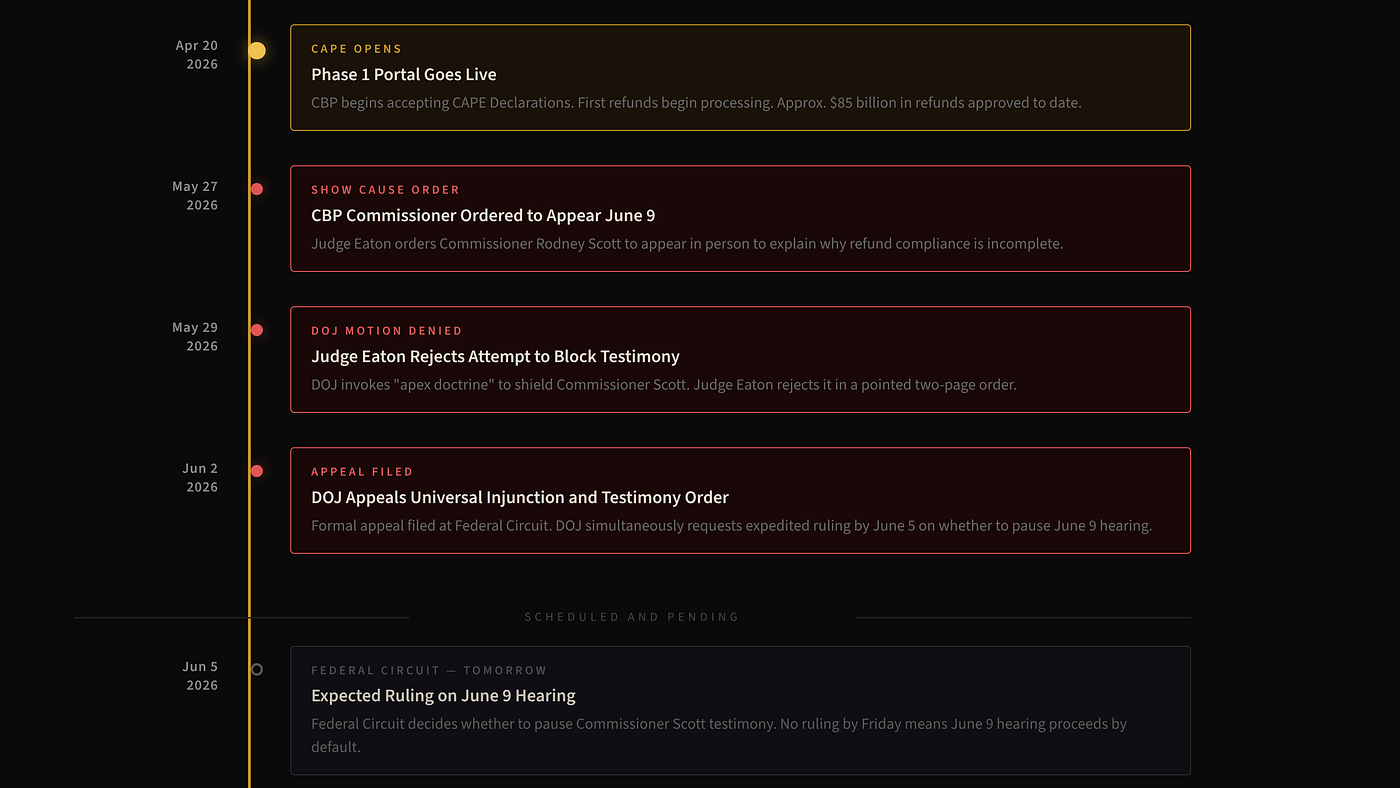
On May 29, 2026, they filed a notice of intent to appeal the order requiring those refunds.
I saw this coming. I wrote about it in April. Let me explain exactly what happened, what they are actually doing, and what every small business importer needs to know right now.
The Deal They Made
Before the Supreme Court ruled, the government was facing thousands of individual importers filing their own lawsuits at the CIT. To prevent that flood they made a deal.
On January 8, 2026 the DOJ filed a formal stipulation committing to refund all IEEPA tariffs for all current and future similarly situated plaintiffs following a “final and unappealable decision” ordering the government to issue refunds. They separately stated they did not intend to challenge the Supreme Court’s ruling on the underlying legality of the tariffs.
They kept that second promise. The tariffs remain illegal. Nobody is disputing that.
But notice the language in the first promise. “Final and unappealable.” That phrase was doing a lot of work. It meant the government reserved the right to appeal any court order requiring them to pay. Once all appeals were exhausted and no further legal options remained, then they would pay.
Now read what they filed on May 29.
What They Are Actually Appealing
The government is not appealing the Supreme Court’s ruling. The tariffs are illegal. That is settled law.
What they are appealing is whether the Court of International Trade had authority to issue a universal injunction ordering refunds for all 330,000 importers, not just the companies that filed their own lawsuits. They are arguing the CIT exceeded its jurisdiction.
If they win that argument the practical effect is this: the large corporations that filed individual lawsuits at the CIT keep their refunds. They are protected by importer-specific relief regardless of what happens on appeal. The 300,000 small businesses that never filed their own cases and relied on the universal injunction to protect them lose their pathway entirely.
They made a deal that protected the people who could afford lawyers. They are now appealing the order that protected everyone else.
Consider the timeline carefully.
The CAPE portal opened April 20. The large corporations and institutional importers with legal teams filed immediately. By the time the government filed its notice of intent to appeal on May 29, CBP was already processing approximately $85 billion in refunds, the vast majority going to the largest importers who moved first.
The universal injunction stayed in place just long enough for the people with resources and counsel to get their money in the pipeline. Then the government moved to appeal the mechanism that would have ensured everyone else got theirs.
Whether that timing was coincidental or deliberate is a question worth asking. What is not a question is who benefits from the appeal and who gets left behind.
What I Wrote in April
On April 25 and May 10, 2026, President Trump posted on Truth Social calling American businesses that claim their court-ordered refunds “enemies, and people, companies, and Countries, that have been ripping us off for years.”
The day after CBP opened the CAPE portal on April 20, Trump told CNBC he would remember companies that choose not to file for refunds. He called it brilliant to give up what the Supreme Court ruled you are owed.
I wrote about those posts in May. Here is what I said:
“The government has until approximately June 7, 2026 to appeal the Court of International Trade’s nationwide refund order to the Federal Circuit. If an appeal is filed and an emergency stay is granted, the entire CAPE refund process could be suspended while the case works through the appellate court, a process that could take months.”
The Truth Social posts told me everything I needed to know about where this was heading. A president who publicly called refund claimants enemies and suggested companies should voluntarily walk away from money the Supreme Court ruled they were owed was not a president who was going to let that money flow quietly to 330,000 small businesses.
The Small Businesses Being Left Behind
While this legal maneuvering plays out in Washington, 330,000 businesses are trying to file a customs declaration most of them have never heard of, without lawyers, without trade counsel, without a compliance department.
According to data reported by Talking Points Memo, the first 26,664 importers registered in CAPE account for $120 billion in refunds. That is roughly 8% of importers claiming 72% of the total pool. Those are the large corporations with legal teams and customs brokers on staff. They filed first. They are protected.
That leaves more than 300,000 smaller importers dividing approximately $46 billion. Around $140,000 per firm on average. Life-changing money for a small business. And most of them still have not filed.
Federal litigator Matthew Seligman told Fortune he was deeply worried that small and medium-sized importers would lose their refund rights without access to trade counsel. He said that before the appeal was announced. It is more true today.
What Importers Need to Do Right Now
The situation has two possible outcomes and you need to prepare for both simultaneously.
If CAPE processing continues: File now. The portal is open. First refunds are being paid. Every day you wait is another day of entries aging. The 60 to 90 day payment clock starts at acceptance not submission. A declaration accepted before any stay is already in the pipeline.
If a stay is granted: The protest pathway under 19 U.S.C. 1514 gives importers 180 days from liquidation to file a protest with CBP. That window is running right now on entries that liquidated months ago. If the universal injunction is overturned, protests may become the only vehicle for small business refunds. Those windows are closing entry by entry every single day.
Filing your CAPE Declaration now is the only hedge against both scenarios. A declaration already accepted by CBP is in the pipeline regardless of what happens on appeal. One filed after a stay is granted may wait months or longer or may never be processed at all.
What This Is Really About
The Supreme Court ruled those tariffs were illegal. The government filed a formal commitment to pay. CBP built the system. Money started moving.
Now they are appealing the order that required them to pay the people who never had the resources to sue.
The corporations did not wait. They filed their own lawsuits. They protected themselves. Their money is coming regardless of what the Federal Circuit decides.
The small businesses waited. They trusted the system. They trusted the universal injunction. They trusted that the government’s written commitment meant what it said.
That trust may cost them everything they are owed.
The information gap between large institutional importers and small business owners is exactly why I built TariffGuru.com. Free AI agent trained on CBP source documents. Free eligibility diagnostic. Free refund calculator. $97 self-filing toolkit. Everything a small business needs to file correctly without paying $400 an hour for a customs attorney.
File it right the first time. Before the window closes entirely.
tariffguru.com
Omar El Adli is the founder of TariffGuru.com, a federal trade recovery consultancy based in Los Angeles. He has been tracking IEEPA tariff litigation since 2025, prior to the Supreme Court ruling.
Sources: DOJ stipulation January 8, 2026. Learning Resources, Inc. v. Trump (Supreme Court, February 20, 2026). National Law Review, May 29, 2026. Talking Points Memo, April 2026. Fortune, April 20, 2026. NPR, May 3, 2026. CBP Trade User Information Notice Pub# 1009–1119. Volokh Conspiracy, May 30, 2026.
메타데이터
- post_id
- 17a656a43a9a
- slug
- they-said-they-would-pay-they-lied-and-i-saw-it-coming-17a656a43a9a
- url
- https://medium.com/@omar.digitalassets/they-said-they-would-pay-they-lied-and-i-saw-it-coming-17a656a43a9a
- canonical_url
- https://medium.com/@omar.digitalassets/they-said-they-would-pay-they-lied-and-i-saw-it-coming-17a656a43a9a
- author_url
- https://medium.com/@omar.digitalassets
- status
- ok
- fetched_at
- 2026-06-09 15:37:30